

Brief

Multinational IT companies doing business in China face formidable challenges. Once dominant players in this vast market, they've seen their positions erode dramatically in just the past few years. In 2012, for example, four non-Chinese multinational companies (MNCs)—Dell, EMC, Hewlett-Packard and IBM—ruled the $2.8 billion Chinese data-storage market, with a collective share of 69%. Since then, the storage market has grown, to $4.5 billion in 2016, but the total share held by foreign MNCs has plummeted to about 17%. At the same time, Chinese companies have been ascendant, led by Huawei, New H3C, Inspur and Sugon (see Figure 1).
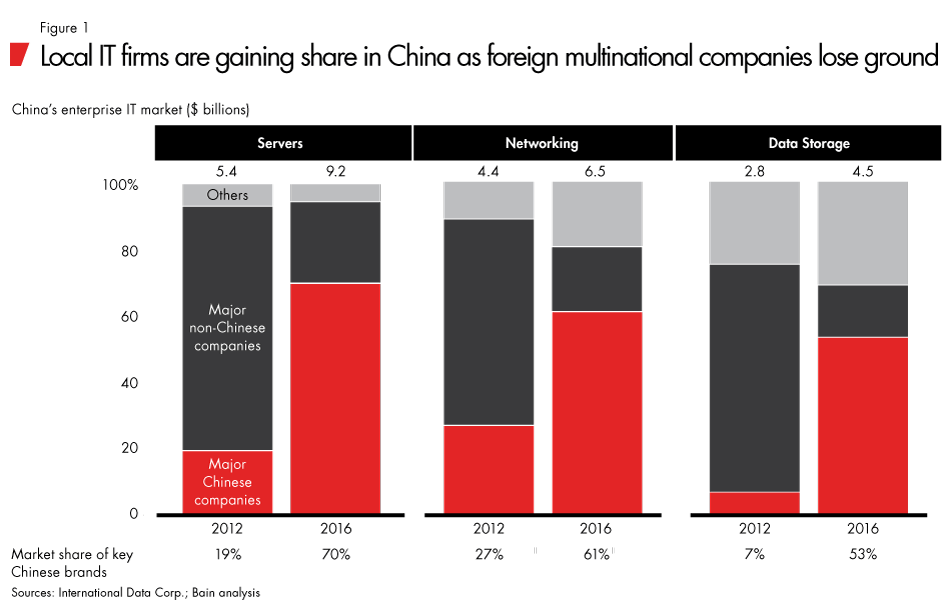
Across IT markets in China, foreign multinational and local tech companies have effectively traded places. Some of these changes reflect acquisitions and divestitures. For example, IBM sold its global x86 server business to Lenovo in 2014, which contributed to an uptick in Lenovo's share of the Chinese server market and a downward shift in IBM's share of that market.
Beyond divestitures, there are many reasons behind the eroding positions of foreign IT companies in China. For starters, Chinese firms have upped their game in terms of the products they sell, the prices they charge and the services they provide. And, along the way, they've been helped by government procurement regulations.
In recent years, Beijing has introduced a series of progressively more restrictive regulations that encourage, and sometimes require, government agencies and companies in major sectors of the economy to purchase Chinese-made IT.
These rules can pose considerable challenges to foreign companies—often leaving them no viable option except to enter a joint venture with a Chinese company. When Dell acquired EMC in 2015, for example, it inherited a joint venture that EMC had forged with Lenovo in 2012 to provide storage systems to small and mid-sized Chinese companies. In 2016, Hewlett Packard Enterprise (HPE) sold H3C Technologies, its Chinese data-storage and technology-services subsidiary, to New H3C, a new venture controlled by Unisplendour, a subsidiary of Tsinghua Holding, which is affiliated with Tsinghua University.
This buy-local movement, which began informally a decade ago, is widely known as De-IOE, an acronym that stands for a campaign to dethrone three once-dominant multinationals: IBM in servers, Oracle in database management and EMC (which is now part of Dell) in storage. The government has gradually codified these practices, most recently with the national Cybersecurity Law that took effect June 1.
Under the cybersecurity act, officials will monitor hardware procurement practices in seven sectors deemed essential to national security: government agencies, public service, financial services, telecommunications, energy, water and transportation. The law requires many government agencies and state-owned enterprises to use an independent reporting company to track and publish the names of the winning vendors for all contracts, along with the prices they've agreed to charge. The government can cancel projects not found to comply with the new law and fine the companies involved.
The government isn't the only party changing the rules of the game. Chinese tech customers also have a new playbook. They're fundamentally altering the way they research, purchase and use IT. Many are eschewing high-end, brand-name hardware in favor of "white-label" or "good enough" servers, storage devices and communications equipment that they can then quickly overlay with customized software.
Even Chinese tech customers that still see value in name-brand equipment want something more from their suppliers than a bunch of discrete and disconnected products. They expect integrated and customized solutions, often comprised of hardware and software from multiple vendors.
Navigating the channel
Foreign companies have a tough time reaching these customers directly. Most IT in China is bought and sold by intermediaries. MNCs scrambling to regain market share know that most roads to Chinese IT customers lead through the channel.
MNCs are used to doing business directly with their customers in their home markets. In China, by contrast, direct sales predominate in only a few sectors, such as telecommunications. In most sectors, the channel rules. In Asia-Pacific, some 60% of hardware purchases are made through intermediaries, compared with about 20% in North America.
The channel in China is highly fragmented, narrowly focused, structurally inefficient—and very powerful. There are multiple categories of intermediaries—including general distributors, resellers, systems integrators, independent software vendors and managed service providers—and multiple players in each sector and each geography.
In a cloud-based, software-dominated era, these intermediaries have become even more influential. They, not the original equipment manufacturer (OEM), often play the critical role in designing, customizing and assembling the multicomponent, multivendor systems that customers now demand. Intermediaries, not OEMs, are responsible for devising tailored solutions that fit the needs of end users.
The cybersecurity act that took effect in June has lent new urgency to the need for MNCs to form strong partnerships with systems integrators and other channel intermediaries. The new law applies primarily to technology sold directly to customers by foreign OEMs, not to products sold directly by Chinese OEMs or to integrated solutions created and sold by Chinese intermediaries.
MNCs know that the key to reigniting growth in China is developing a go-to-market (GTM) strategy that acknowledges the centrality of the channel. To do that, companies must first understand what the channel expects from them.
Channel partners want to be wooed, wowed, supported and rewarded. When Bain & Company asked 50 systems integrators in China to name the top criteria they used in making a purchasing decision, the most popular answers were brand (80%), the vendor's ability to provide technical support and total solutions (72%), price (42%) and financial incentives (also 42%). Interestingly, the breadth of the product portfolio was mentioned only 18% of the time—a sign that systems integrators care more about a vendor's reputation, the service it provides, the prices it charges and the rebates it offers than they do about the size of its product line (see Figure 2).
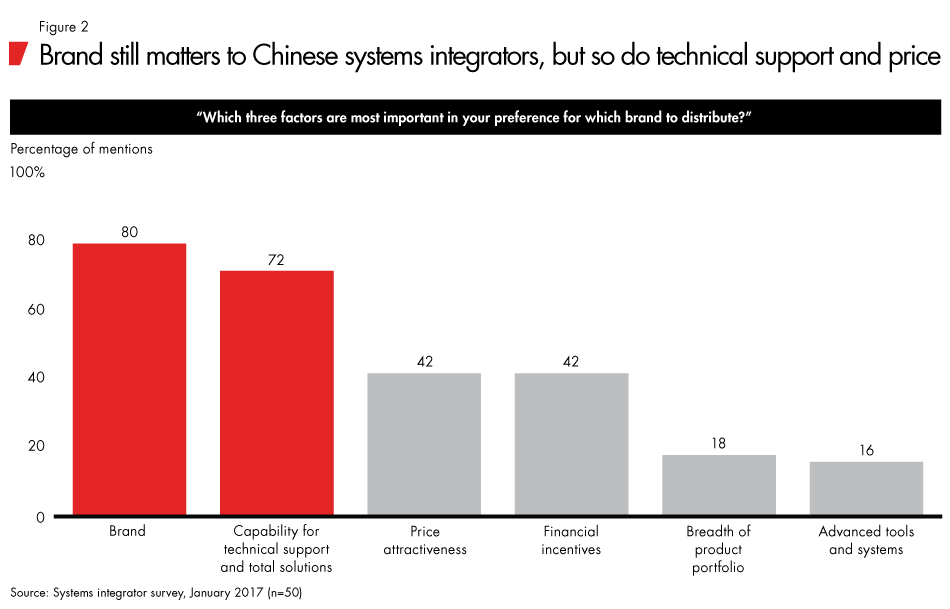
From the perspective of systems integrators, how a vendor sells matters more than what it sells. But who the vendor is matters most of all. For MNCs doing business in China, having an internationally known and respected brand still carries great weight—even after a decade of De-IOE pressure and increased use of white-label hardware. Their biggest challenge is figuring out how to convert that name recognition into a viable GTM strategy, especially when Chinese technology brands such as Huawei and Lenovo are catching up fast in the reputation sweepstakes.
Picking partners
In a market awash with integrators, resellers and other intermediaries, vendors that build a successful channel strategy pick their partners with care. They focus on resellers and integrators that sell into highly regulated sectors, such as energy and telecommunications, areas where specialized knowledge and connections are essential. MNCs know that partnering with a Chinese intermediary is critical to navigating the De-IOE movement in all its manifestations, including the new cybersecurity act.
Foreign companies in China can learn from the way local IT giant Huawei recruits and manages its channel partners. Huawei focuses on eight major verticals, including finance, transport, energy, media and telecom. For each sector, it enlists partners with specific industry knowledge, and it trains them to provide solutions, not just sell products.
Huawei Partner University offers more than 400 online courses and more than 350 in-person training sessions in such areas as presales, postsales and distributor development. Huawei also shares its R&D resources with its channel partners to help them hone their technical skills. While systems integrators surveyed by Bain don't yet value the Huawei brand as highly as the brands of foreign MNCs, they give Huawei high marks for education, solution building, attractive pricing, technical support and marketing referrals.
Huawei has also seen results in the marketplace. Its share of the Chinese server market surged from about 1.5% in 2012 to about 16% in 2016.
One MNC that has recognized the growing importance of the channel in China is Dell. As part of its Partner-Direct program, Dell has created a comprehensive online channel portal that provides partners with resources for business development, sales, marketing, training and certification. The portal, which received high ratings from systems integrators surveyed by Bain, offers digital tools that help channel partners develop bids, create demos, build marketing platforms and configure solutions. Like Huawei, Dell also provides a wide range of online and in-person training.
Dell has prioritized its channel partners, dividing them into three main tiers: registered, preferred and premier. As partners meet certain revenue, headcount and certification requirements, Dell can upgrade their status, for example, from preferred to premier. As partners rise in status, they become eligible for new benefits, including access to specialized support and resources, more generous sales rebates, more development funds, and more favorable return and payment policies. At all levels, Dell builds in extra incentives for partners who bring in new customers and/or sell new products in designated business lines.
Dell's channel efforts are part of a series of steps the US-based company has taken in recent years to strengthen its position in China. From 2015 to 2016, Dell's growth in sales of both personal computers and monitors outpaced the market in China. In the same period, Dell was able to maintain a 14% share in cloud infrastructure equipment, even as other foreign multinationals lost ground.
Another leading US company, Hewlett Packard Enterprise, has learned from experience that the key to building and sustaining good partner relationships is having clear rules of engagement. The company, which was created when Hewlett-Packard split into two entities in November 2015, garners a majority of its revenues in China from channel sales. Even when HPE sells directly to customers, it mainly uses the channel to fulfill the orders.
HPE has a rigorous screening process for potential channel partners: They must meet certain sales thresholds and certification requirements, but even then they may not make the cut. HPE limits the number of industry-specific value-added resellers (VARs) it does business with. The company doesn't want nationally oriented VARs encroaching on the sales territories of local, geographically oriented HPE partners.
Through its Partner Ready program, HPE reaches out to specific groups, including resellers, service providers and system integrators, with targeted support and training, including access to an exclusive sales and management database. As partners ascend the four ranks of the Partner Ready program—business, silver, gold and platinum—they become eligible for additional benefits.
System integrators give HPE top marks both for its standard sales rebates and for the extra incentives it provides to channel partners that sell key products and help develop specific markets. HPE customizes its sales targets by market size, so channel partners operating in smaller cities may have lower thresholds for winning rebates than partners who do business in larger cities. The company also offers variable rebates based on monthly historical sales figures, which are designed to encourage partners to do additional business in traditionally low seasons.
HPE has seen tangible results in the marketplace from its channel management efforts, and is regarded as one the most well-managed brands by local distributors in our latest survey.
Five steps for successful channel management
Bain’s experience in China shows that multinational companies develop a successful channel strategy by simultaneously doing several things well (see Figure 3).
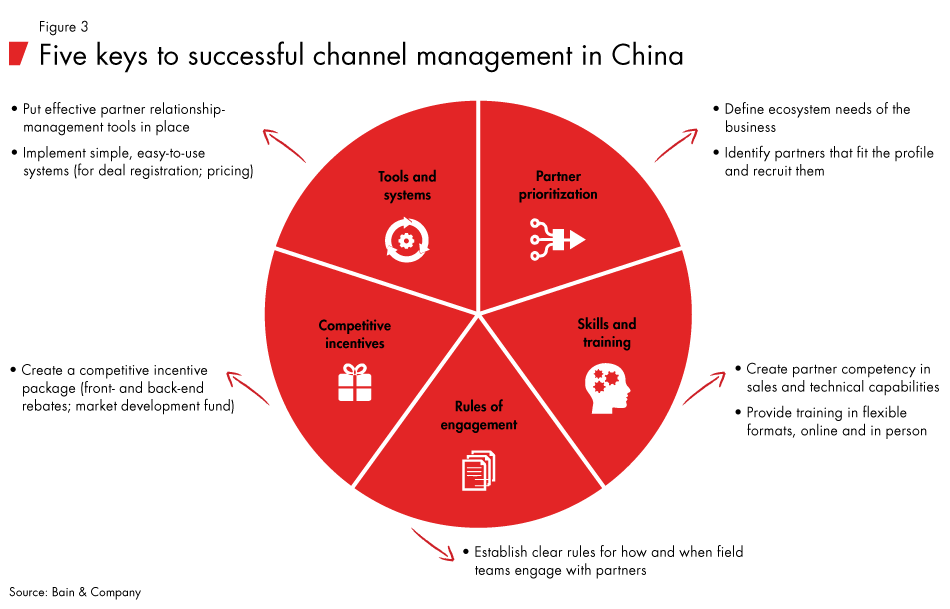
Prioritize partners. They identify which partners are best positioned to serve which markets and which products. They then categorize and prioritize those partners based on the strength of their relationships with target customers; their potential to bring in sales and affect margins; and their capabilities to provide solutions, service, branding and marketing.
How an MNC manages its partners depends largely on what it's selling. When a company has a high-value product, one that's clearly differentiated from the offerings of its competitors and is likely to command premium prices, it should be ready to invest heavily in recruiting, training, supporting and rewarding suitable channel partners. By contrast, MNCs selling a high-volume, low-cost product may choose to focus less on training and more on price incentives.
Once a company has developed focused approaches for particular products and markets, it can set sales targets relevant to the type of product and build in customized incentives for channel partners that reach or exceed those goals. As channel partners attain their targets, they can become eligible for promotion to the next status level; for example, from silver to gold.
Train, train, train. There may have been a time when big, internationally branded hardware products basically sold themselves in China, but those days are long gone. When customers want integrated solutions, often composed of hardware and software from various companies, the expertise of channel sales and support people becomes critical. Leading MNCs tailor their training to the subject matter and the individuals, with, for example, web-based courses for product details and selling techniques, and in-person classes for technical skills.
Channel partners can become the face of a foreign company in China. More often than not, it's the partner, not the company itself, that connects with the customer. That's why MNC representatives spend a great deal of time in the field training channel partners, joining them on sales calls and helping to build excitement around products.
Establish clear rules of engagement. When going to market involves multiple partners, potential conflicts are bound to arise. It's essential to set up clear rules of engagement, delineating which customers will be served directly by the vendor; which will be completely owned by the channel partner; and which will be a hybrid, where the partner leads the relationship and the vendor provides support. Once the rules are established, they must be enforced. If channel partners don’t follow the rules, they can face penalties that include the cancellation of rebates, lack of access to new products for a certain period and demotion to a lower partnership tier.
Offer competitive incentives. Leading MNCs know they need to adjust their incentives to the exigencies of an evolving marketplace. They offer channel partners rebates on both the front and back ends of a transaction, and provide ample funds for market development. And they avoid overpaying. They calibrate the size of rebates so they can overcome any potential erosion to margins, either by increasing sales volume or charging the end user a premium price—one that's justified by strong brand appeal and high levels of service. Smart MNCs craft incentives that are aligned with the overall goals of the business, including rewards for partners that sell value-added services and bundled offerings.
Create simple systems. Channel partners that are in the business of selling IT naturally expect to have access to easy-to-use technology that will enable them to do their jobs more effectively. For MNCs, that means investing in systems that help partners configure and price the multiproduct offerings that customers now demand.
Foreign IT companies could once sell in China largely on the strength of their brand and the quality of their products. In the current environment, these are merely the minimum requirements. As multinational companies confront rising regulatory pressures, strengthening local competitors and changing customer expectations, they recognize the need to develop and sustain a robust go-to-market strategy. The key to that is mastering the channel, and that means picking partners with care, then training, managing, supporting and rewarding them. The potential payoff is huge: an opportunity to rebuild share in one of the world's biggest, most important—and most challenging—markets for information technology.
Kevin Meehan leads Bain & Company's Telecommunications, Media and Technology (TMT) practice in the Asia-Pacific region, and is based in the firm's Singapore office. Raymond Tsang leads Bain's Performance Improvement practice in Asia-Pacific, and is based in Shanghai. Velu Sinha is a partner with Bain’s TMT practice, based in Silicon Valley. The authors would like to acknowledge the contributions of Steven Lu, a partner, and Mingfeng Bao, a manager, both based in Bain's Shanghai office.
First published in enero 2018