


Expert Commentary

|
|
When the use of the Internet to support qualitative group research was still something of a novelty, almost two decades ago, scholars and professionals debated whether “the online environment” was “a legitimate addition to qualitative methodologies”i. Today, the question has become moot. Chat-style, webcam-based, and bulletin board-type focus groups have proliferated. Some market research professionals might still dispute the merits (speed, reach) and shortcomings (superficial, impersonal) of online group research. For most, however, these digital formats serve as viable options, and the primary consideration is how best to use them. 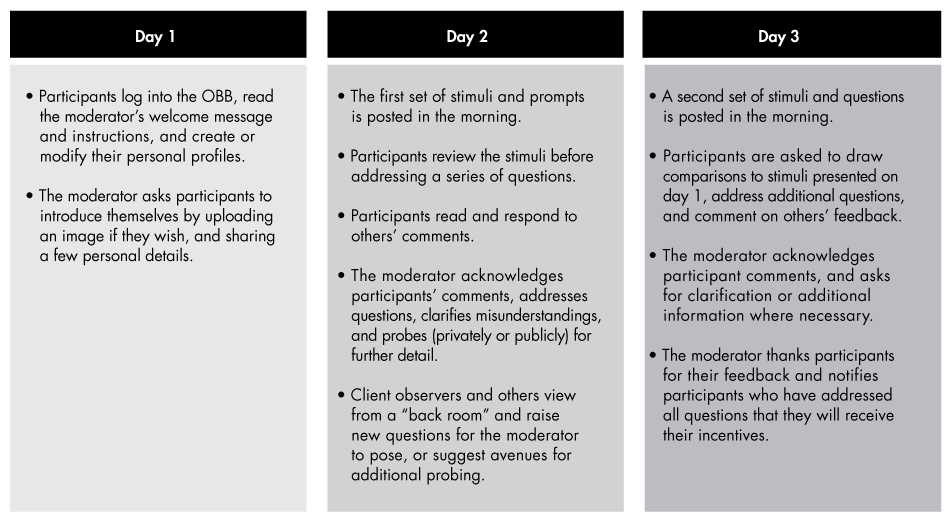 Online versus face to faceOBBs offer several advantages over face-to-face groups:
As with any text-based qualitative research format, however, the biggest drawback of OBB groups is the loss of non-verbal cues that enliven discussion and enrich verbal data in in-person and, to a limited extent, webcam focus groups. 
Advanced Analytics Expert CommentarySuccess with advanced analytics requires both technical know-how and a thoughtful approach. In this series, Bain's experts offer practical advice on some of the most common data issues. When to use OBBsSpecific project goals and constraints determine whether a researcher chooses an OBB over the in-person format. OBBs lend themselves to the following situations:
With the goal of generating rich qualitative data from OBBs, several principles are worth keeping in mind. First, the kind of interpersonal dynamism that generally characterizes in-person focus groups can also characterize OBBs, but you must more actively engineer participant interactions. You can require or give incentives to participants to read and respond to others’ comments and moderator probes. And you should factor in time for participants to build rapport with one another through general introductions and an icebreaker exercise. Second, building trust between participants, even in an impersonal space, is essential to generating honest feedback. It helps to offer a more detailed and perhaps personal introduction than is necessary, and to model ideal behavior. For example, you can respond with more verbal (here, textual) feedback, and possibly use emoticons. Third, avoid being an overly intrusive presence, which risks biasing feedback. In contrast to the minimal interference that moderators practice in face-to-face groups, OBB participants may interpret the absence of regular moderator responses as indifference. Strike a balance between facilitation and allowing participants to establish meaningful dialogue among themselves. Finally, as with any research method, “garbage in, garbage out” holds true. Design neutral, open-ended questions that invite relevant and elaborated responses. By adhering to these principles, researchers will harvest rich insights from their online groups. i Mann, Chris, and Fiona Steward. 2000. Internet Communication and Qualitative Research: A Handbook for Researching Online. London: Sage. Aimée Douglas is a senior specialist in Bain & Company’s Advanced Analytics practice. She is based in Boston. |