

Founder's Mentality Blog

|
|
I’m in Kuala Lumpur, writing this blog by the light of the daily afternoon thunderstorms. We just finished our inaugural Developing Market 100 meeting, which brought together an exclusive group of founder-led companies from emerging markets. These companies have each gone through a period of 10x growth and aspire to another period of 10x growth—always a formidable challenge. As one member put it: “We don’t have a growth issue, we have a sustainable-growth issue.” All of these companies are facing directly into what we call the westward winds—the forces of complexity that work against fast-growing companies as they approach scale. One of the stiffest: Their revenue is growing far faster than their talent. One key to scaling with a limited supply of talent is to unburden crucial frontline people so they can remain focused on customers as the company’s footprint expands. But as we debated strategies to address this core issue, one dilemma emerged clearly: How do you simplify these core customer-facing roles without dumbing them down or “destroying” them? The leaders of these companies are extremely frontline oriented. They understand that their job is to:
There are several ways to free up the kings so they can focus most intently on the customer. These include:

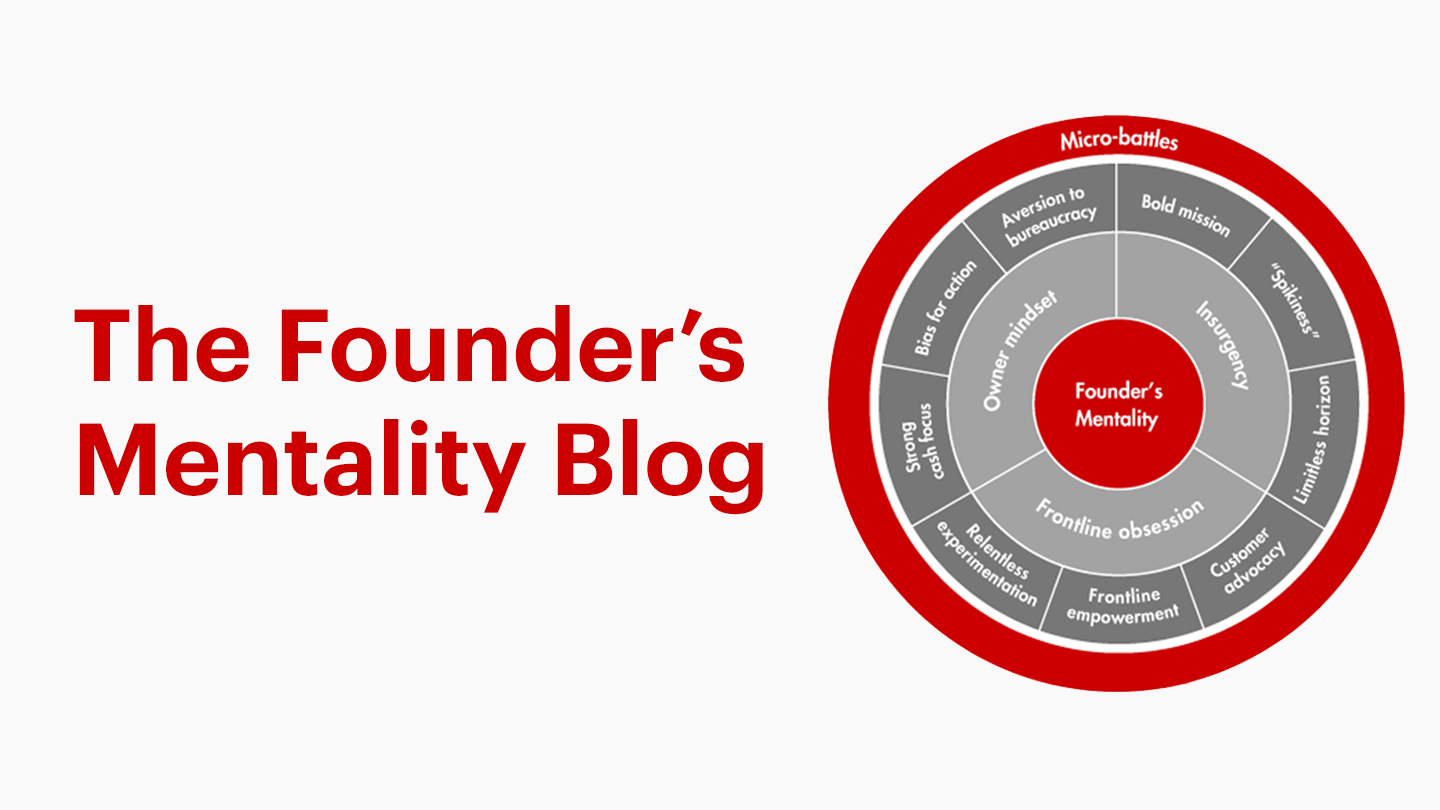
About the Founder's MentalityThe three elements of the Founder's Mentality help companies sustain performance while avoiding the inevitable crises of growth. The key debate among the meeting's participants focused on which non-back-office responsibilities can be pulled back from frontline leaders without disempowering them or hobbling their ability to serve customers. During the meeting, participants created four useful rules of thumb. 1. Free the kings of these responsibilities:
2. Ensure that kings remain responsible for activities that:
3. Carefully consider the risks and benefits of centralizing certain scalable jobs.
4. Understand that the development of trusted kings almost always trumps the benefits of centralization. This is the key insight. During the fast-growth period of these companies, it is critical to empower the kings of the business and give them all the tools they need to do their job locally. It is also important to simplify the job by peeling away administrative and transactional activities. Equally, these jobs must be where future leaders are developed—the kings must keep control of decisions involving customers and must keep decisions that help them develop their business judgment. After rethinking the role of the kings in his organization, one CEO concluded he had to reconfigure his HR strategy. “We can only scale through adding kings,” he explained. “But kings are so hard to recruit. Before this meeting, I felt the only way to add more kings was to dumb down their job—make it easier so I could hire more junior, less-experienced people. Now I realize that would be a disaster. My new task is to work with the kings of my business to agree [on] how we can simplify their jobs—taking away all transactional, administrative activities.” He added: “I will let them decide, because if they are having fun at the job, they will help me find more people to join them on their adventures.” What’s clear is that helping existing kings grow and reach their full potential involves some calculated risks. To some degree, it means “overempowering” the kings by increasing their responsibilities for working with customers and developing the next generation of leaders. But it also requires freeing them up to focus on these crucial responsibilities. The combination simplifies the job—but it also enhances it. |