

Founder's Mentality Blog

|
|
Any discussion of how companies can “maintain the insurgency” as they grow toward scale will eventually run into a fundamental tension. On the one hand, maintaining an insurgent mindset requires expansiveness—stretching beyond a company’s existing revenue streams and narrow market definition to imagine how the original insurgent mission can be applied in new, disruptive ways. On the other, sustaining profitable growth requires intense focus—a companywide commitment to continuously improve the company’s core business and exploit its full potential. The solution to this seeming contradiction is for leaders to strike a balance between core focus and an insurgent mission as they debate growth strategies. But it’s important to understand why the tension is a necessary one. 
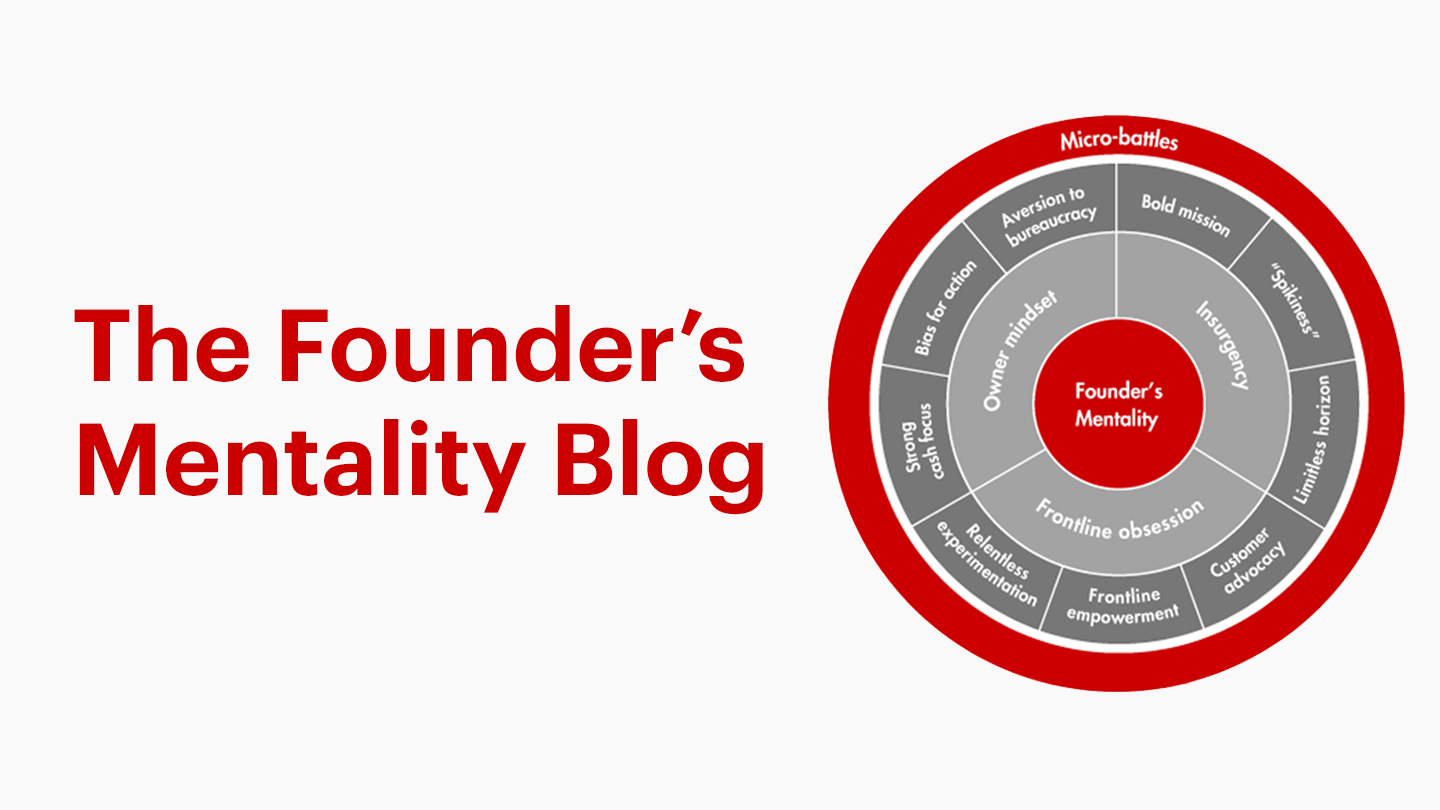
About the Founder's MentalityThe three elements of the Founder's Mentality help companies sustain performance while avoiding the inevitable crises of growth. First of all, the evidence shows that sustaining profitable growth is one of the hardest acts in business. After running the numbers for two decades, we’ve found that, on average, only 10% of companies can maintain a modest 5.5% growth rate in revenues and profits over 10 years. By studying what that 10% share in common, we’ve identified what we call the five pillars of sustainable growth, and they all emphasize the core:
These pillars are clear and robust and management teams have found them a useful foundation for strategy discussions. But they also rub up against important notions about how to maintain the kind of freewheeling insurgency mindset that helps promote and preserve a company’s essential Founder’s MentalitySM. What we’ve learned is that leadership teams need to return to the initial “insurgent mission” to revive the energy and purpose that guided their early growth. This mission should not be limited to the core markets in which you compete today, but rather should be focused on the initial “revolution” the company was founded to pursue. Consider the example of India’s CavinKare. It famously disrupted the Indian market as a hair-care company. But its extraordinary insurgent mission—”whatever a rich man enjoys, the common man should be able to afford”—has more recently led it to take on the juice business. Using an insurgent mission to frame a debate about growth strategy focuses leadership on innovation and redefining markets. Without that, growth strategies are destined to be rooted in incumbency thinking. You are forever constrained by the rules of the game as defined by your industry, which inevitably caps ambition (see our discussion of Google’s Larry Page and his rationale for “moon shots”). But an important question to ask is whether insurgency also threatens chaos. As the five pillars suggest, everything we’ve learned about sustainable growth strategy screams and shouts “Focus!” Growth requires a well-defined core business, competing in well-defined markets and a narrowly focused mission to achieve full potential. If defined too broadly, won’t the insurgent mission lead to a “peanut buttering” of resources across a broad set of unrelated growth initiatives? Debating these points always reminds me of famed astronomer Carl Sagan’s call for balance in pursuit of scientific discoveries. In his book, The Demon-Haunted World: Science as a Candle in the Dark, he writes: “At the heart of science is an essential balance between two seemingly contradictory attitudes —an openness to new ideas, no matter how bizarre or counterintuitive they may be, and the most ruthless, skeptical scrutiny of all ideas, old and new. This is how deep truths are winnowed from deep nonsense.” In the same way, we would argue that balance is crucial in corporate strategy, and we’ve come up with a nice way of framing it: “The insurgent mission demands we widen the conversation to ensure we start strategic debates as the innovator, as the disrupter of industries. The five pillars of sustainable growth define the funnel through which any ‘insurgent’ initiative must pass.” As the late, great comedian George Carlin liked to say, “Those who dance are considered insane by those who can’t hear the music.” Returning to the insurgent mission is an opportunity to rediscover the unique music that served as a soundtrack for your early, innovative years. It also gives you the opportunity to dance in ways the incumbents will consider insane. But for every insanely innovative growth option identified through a discussion of the insurgent mission, you need to ask four “balance questions.”
With the growing companies of the Developing Market 100 we are working to strike the proper balance between the five pillars and a return to the insurgent mission. Getting it right will allow a company to maintain the insurgency and use it to sustain profitable growth. That’s a place most industry incumbents will never reach. 
RepeatabilityLearn more about how executives use Repeatable Models® to build enduring businesses. |