

Founder's Mentality Blog

|
|
I spent this past week in Mumbai, Delhi and Bangalore talking to founders—or as Indians tend to call them, “promoters.” A recurrent theme was the role of the second generation—the sons and daughters of the founder. It’s an issue that also came up during recent trips to China and South America. Here’s a typical situation I’ve encountered five times in three countries over the last three weeks:
In my conversations, we talked about this as a classic triad—the Chairman-Founder, the Professional CEO and the Child of the Founder—and discussed the following questions:
The common instinct of the Child of the Founder, as discussed by a son of the founder of a Chinese luxury business: “Managing the triad is difficult, and my instinct is to play to my strengths, helping the CEO professionalize the company. I have a good education and good work experience and this seems like the right first step. I’m currently helping my father and the CEO on M&A work.” The Child of the Founder, understandably, wants to help the CEO and their parent, the Chairman-Founder, to continue to professionalize the company. When it comes to the benefits of scale/scope versus the benefits of Founder’s MentalitySM, as shown on the Founder’s Mentality 2X2 graphic, the common instinct of the Child of the Founder is to help the company gain further benefits of scale and scope (see Figure 1). 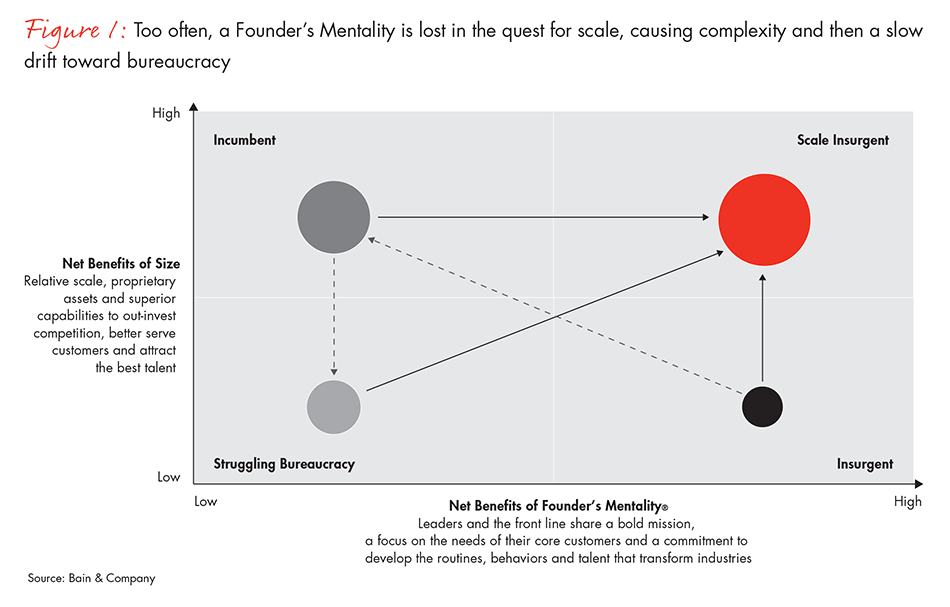
While this instinct is understandable, it also is wrong in most cases if their goal (and the Founder’s goal) is for the Child of the Founder to take over the company. In this sort of a generational transfer of company leadership from Founder to Child, the most threatened aspect of the company is its Founder’s Mentality—the sense of insurgency, the owner mindset, and the obsession with customers and front line. The Professional CEO will handle the “Benefits of scale and scope” axis and bring in additional professional managers as needed to help with this mission. But who, if not the Child of the Founder, will take over the Founder’s Mentality? With newly minted professional education and experience, the children of founders instinctively want to bring that professionalism to their family business. But in most cases, what the company actually needs is for them to carry on their parents’ mission. Rather than become the group professional, this suggests strongly that they should become the voice of the front line and voice of the customer. It suggests that the best career path for them is to start at the front line of the business, not its center—to work with the “kings” of the organization (those responsible for delivering the company’s products and services every day), not the “court” (those responsible for supporting the kings with professional services). The Child of the Founder should be mission-driven—to continue the insurgency—and obsessed with culture—to maintain the owner mindset. 
About the Founder's MentalityThe three elements of the Founder's Mentality help companies sustain performance while avoiding the inevitable crises of growth. This is often not a conclusion that the Child of the Founder or the Founder wants to hear, and these conversations aren’t always easy ones to have. The typical objections, from highly emotional to more dispassionate, are:
The answer to these questions, quite simply, is that Founder’s Mentality is magic dust. Growing to leadership in your industry and maintaining the sense of Founder’s Mentality is rare. Companies that do both, like AB InBev or Ikea, become industry leaders. What the Child of the Founder can do to truly differentiate the company is to provide insights on both scale and scope and Founder’s Mentality. Education and experience in blue-chip firms can help with the first dimension. But the Child of the Founder needs to round out that experience if they are to be the voice of the front line and customers, to be the culture carrier. Spending time on the front line is not a bad idea if you will someday be the champion of that front line. Of course, if the founder hasn’t brought in professional management and the Triad doesn’t exist, then the role of the Child of the Founder can be different. In that case, the company needs his or her newly acquired skills to support the transition to more professional management. Of course, in that case the Child of the Founder also has to work on maintaining the company’s Founder’s Mentality. This is a very tall order. In most cases, the correct action of the parent is to complete the TRIAD. Bringing in a Professional CEO will give the Child of the Founder the time and space they need to take over—not just from the Professional CEO but from the Founder-Chairman as well. Maintaining the magic dust of the Founder’s Mentality is often the most important mission of the Child of the Founder. They’ll need their education and blue-chip experience too. But let’s start on the shop floor. |