

Brief

Executive Summary
- To understand what it takes to thrive as an Engine 2 bank—a neobank separate from the parent—we spoke to the leaders of seven successful institutions.
- They have thrived by penetrating new customer segments and designing the business around those segments’ unique needs. They deliver a differentiated proposition with a lower cost to serve and a better experience.
- Leading Engine 2 banks quickly respond to customer feedback and market evolution by pivoting the original strategy when necessary.
- New market realities and tighter funding have caused a shift from rapid growth to a focus to monetization and average revenue per user (ARPU).
As banks continue to digitize more of their processes, products, and services, many are finding the journey slow and painful. Meanwhile, digital native fintechs are moving quickly and gaining share in many markets.
In response, executives at some traditional banks have sought to compete by building entirely new, digital businesses to capture new customer segments or meet new needs of their existing customers. They’ve encouraged these ventures even at the expense of potential competition with the core business. Some have failed, and others have closed or been folded back into the parent bank, but there have been notable successes over the past decade. What have we learned from those that are thriving?
To understand what it takes with an Engine 2 strategy, we spoke to the leaders of seven successful institutions: ubank in Australia (launched by NAB), Next in Brazil (Bradesco), Mettle in the UK (NatWest), Tangerine (Scotiabank) and Simplii (CIBC) in Canada, Weyay (NBK) in Kuwait, and Mox (Standard Chartered) in Hong Kong. Their experiences hold lessons for other banks that have taken or are contemplating the Engine 2 route.
Bain & Company has extensive experience working with established firms in many industries to develop Engine 2 businesses that can ignite new waves of growth. Backed by extensive cross-industry research, we’ve found that successful Engine 2 businesses in any industry share four characteristics: They compete in a large growing profit pool (even if they start in a market niche); they build on a proprietary source of competitive advantage of the parent company; they adopt an entrepreneurial mindset; and they continue to access the core business and assets of the parent company in order to help them win.
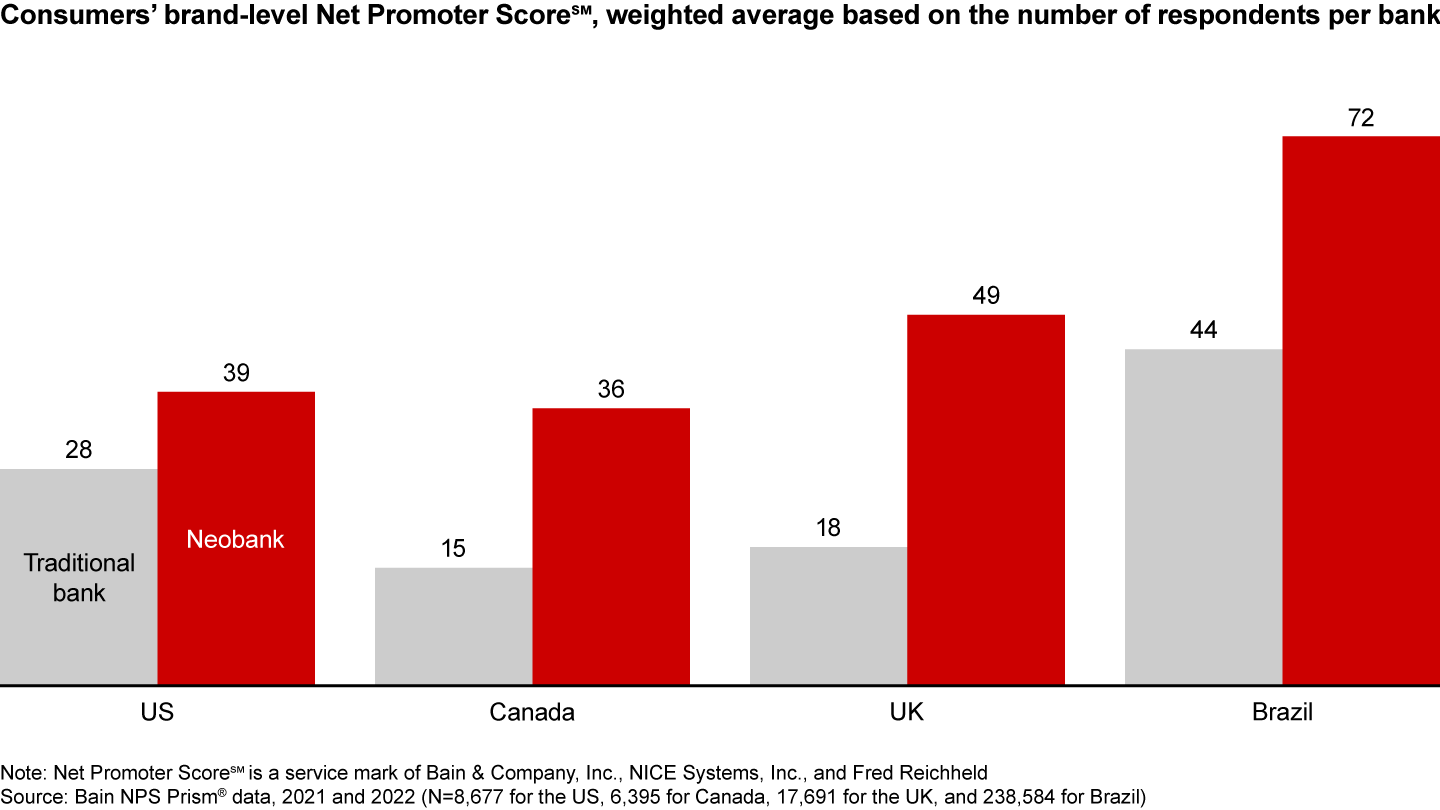
This plays out in banking, where all of the Engine 2 companies we spoke to are managed as separate subsidiaries yet depend to some extent on the core business or joint venture partners for capital, talent, capabilities, or technology. They have all built large-scale businesses, and some thrive despite overlaps with the core business that they acknowledge and even prize. Moreover, these banks outperform their parents when it comes to customer advocacy, as measured by Net Promoter Score℠ (see Figure 1).
Figure 1

The economics of the Engine 2 model remain a work in progress for most of these banks, with the particular challenges of moving from a rapid growth phase to delivering sustainable returns, and from small to large scale. As previously ample funding has tightened, these businesses now face more pressure to demonstrate a path to profits and grow their average revenue per user (ARPU). This has prompted a sharper focus on becoming the primary bank for more of their customers, cross-selling more products, and establishing new sources of revenue. The Engine 2 approach makes strategic sense in many cases, but pursuing it requires determination to navigate a bumpy ride over the medium term.
With that context in mind, our conversations with the leaders of seven Engine 2 banks uncovered seven factors that have proven central to their success. Let’s examine each of these factors in turn.
1. A focus on new or underserved customer segments
Each of the Engine 2 banks we spoke with has built the business to penetrate new customer segments where the parent has been less focused or struggled to gain market share.
Weyay, for example, wooed younger customers who had been less attracted to parent bank NBK. Tangerine targeted do-it-yourselfers who have less complex needs and don’t value extensive branch-based support. And Mettle focused on small businesses that were less economically attractive for the parent bank.
These target segments have unique needs that were not well or profitably met by the parent bank and often require a simpler, lower-priced direct model than full-service, higher-cost banks can offer.
One benefit to such segmentation has been the limited overlap with the incumbent’s core business, and thus limited cannibalization of customers. At Tangerine, for example, only a tiny fraction of customers overlap with parent Scotiabank.
In each instance, the choice of target segments was made deliberately to help defend against digital attackers that are innovating, often at the bottom of the customer pyramid—large, growing segments that represent attractive profit pools for lower-cost digital models. The parents, in turn, anticipated the value of a lower-cost, digital defensive play as a hedge against attack. As Barbaros Uygun, CEO at Mox, told us, “The approach from Standard Chartered was to make an offensive play to deepen the market share in the mainstream mass and mass affluent segments and address the long-term challenge from digital nonbank players.”
Having chosen their target segments, most have invested heavily in customer acquisition to build local market scale, sometimes at a much faster pace compared with incumbent banks. Next, for example, has achieved 12 million customers in the large Brazilian market, up from 3 million in late 2020. Mox in Hong Kong has rapidly grown to about 400,000 customers by end of 2022, roughly double what it had a year prior. The longer-tenured Engine 2s we spoke to have also achieved substantial local market scale: ubank, launched in 2008 by its parent, NAB, has become a sizable competitor in the Australian market. Tangerine has 2.5 million customers in Canada, with Simplii close behind at more than 2 million—together serving more than 10% of the Canadian consumer market.
2. Customer-experience-led models
Digital attackers behave like fintechs and put the customer’s priorities at the center of their business design, and the Engine 2 leaders we spoke with have all built simple and convenient propositions for customers. This mindset led them to radically simplify the proposition and make processes such as account opening faster and easier than those with the parent. AAmir Fadel, lead founder of Weyay, said, “From the communication about the proposition to the user interface, we have worked to limit [data] fields. For example, when onboarding students we use their national allowance data to do light KYC [know your customer] in real time, and do the full account opening in under five minutes.”
They also all have adopted a separate brand with unique positioning, a different tone of voice in communications, and a much stronger emphasis on digital marketing, with limited (if any) endorsement from the parent brand—all to create the impression of a new experience for their customers.
More aggressive pricing and different credit and risk parameters also feature in some of the new bank propositions. So do innovative designs. At Mox, Uygun reported that the bank engaged 2,000 Hong Kong residents in initial ethnographic studies, which informed the design of products that would resonate with the target demographic. “We developed a spending and savings solution where anything you spend on our all-in-one bank card will earn you cash back directly in your savings account, which in turn will grow with the application of a daily rate of interest. The same integrated vision applied to affordability solutions. Our customers can secure any loan product, from a simple split purchase option to a tax loan, with only three clicks under one umbrella limit.”
Putting customers at the heart of the business has helped these Engine 2s earn customer advocacy (as measured by Net Promoter Score) comparable to the digital attackers in their markets, and significantly higher than their parents.
3. Simplicity and low cost at scale
These Engine 2 banks not only seek to deliver banking services in a better, more differentiated way, they all also aim for simplicity and lower cost. Their offerings rely on more automation and lower marginal cost relative to the established business (after the cost of customer acquisition). Les Matheson, Group COO of National Australia Bank, which launched ubank, told us, “If you are taking advantage of the latest digital technology, you can price competitively while offering functionality that will appeal to customers.”
However, the scale of the parent also brings benefits, particularly early on. Curt Zimmermann, CEO of Next, said, “We benefit from the expertise and the products offered by Bradesco ... we have the chance to adapt and customize the ones that are more suitable to be successful in a digital platform.”
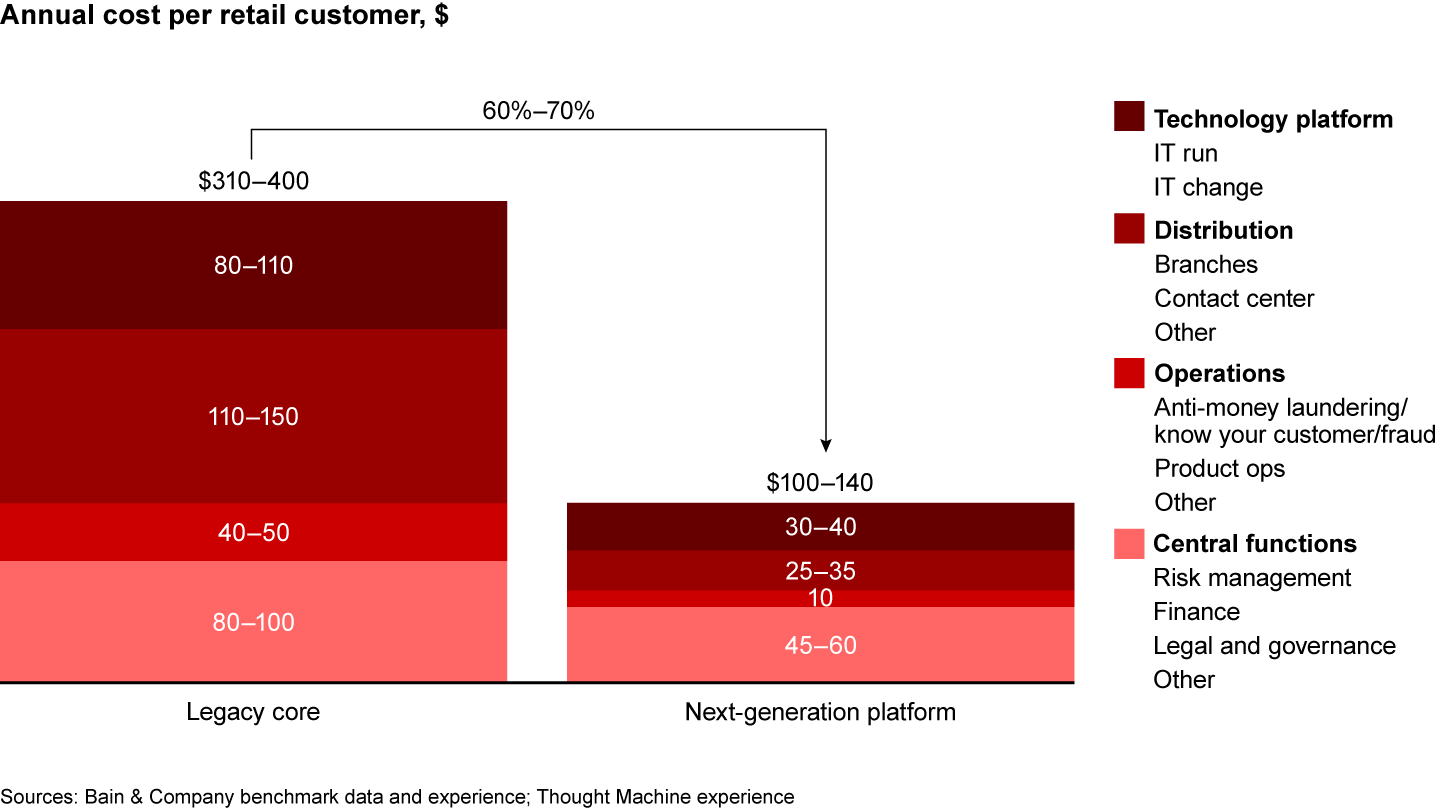
Some Engine 2 banks use their parent’s core banking system, while others have built entirely separate systems for greater speed and flexibility. Indeed, the new banks may serve as proving grounds for the parent on lower-cost technology. Their modern, cloud-native architectures can offer a 60%–70% cost advantage relative to legacy infrastructures (see Figure 2).
Figure 2

4. Top-of-the-house sponsorship
Getting governance right has been critical for the Engine 2 banks we analyzed. They all report directly to the executive committee level of the parent and have a level of senior sponsorship that is critical to providing “air cover” as they grow. Vineet Malhotra, head of Simplii, pointed out, “Success is about structure, entrepreneurial mindset and talent associated with that, an execution-oriented team rethinking the way banking has been done.”
Senior sponsorship is critical for obtaining parental support at important stage gates, preventing the parent business functions from squashing the fledgling business, or helping to bring regulatory expertise.
Many also have their own board that mixes senior executives from the parent with external advisers and expert partners to maintain focus and provide inspiration from outside. They also often operate with tailored policies and policy governance to ensure speed to market for procurement, hiring, and other activities, albeit closely coordinated with the parent. Some have their own license, but most operate under the parent’s license for now. This creates some governance constraints, but their independent advisory boards help to keep the staff focused and moving quickly.
5. Set up for speed
Engine 2 banks have all embraced Agile ways of working, testing and learning as they go. Agile methods and supporting capabilities serve as a petri dish on behalf of the parent.
Gillian Riley, president and CEO of Tangerine, said, “Our Agile operating model, with its well-integrated product and tech capabilities, where everyone knows each other, allows us to deliver with far more agility and speed than Scotiabank.” Andrew Ellis, CEO of Mettle, cited designers sitting next to engineers and the release of code about 1,000 times monthly enabled by a modern cloud-driven architecture. Mettle’s practices have served as a model for the parent bank to learn from in many instances.
They and other such banks are physically separate from the parent, with their own unique environment and with campuses, sometimes in a different city.
While not all have an independent front-to-back IT stack, they do directly manage the digital front-end architecture and development and marketing, and usually have CIOs reporting to the Engine 2 CEO, rather than to the enterprise CIO. And they work through separate distribution channels and brands for reasons of speed and independence in the eyes of their customers. Further, despite aligning to the parent’s controls and risk management in most instances, they have found ways to innovate and create a competitive edge in elements like credit.
6. The ability to pivot at a fast pace
Customer feedback and market realities may cause a reassessment of the original strategy. In those circumstances, many successful Engine 2 businesses learned from the market and substantially pivoted their strategy.
Weyay, for instance, began as a strategic entry to an adjacent country, but the onset of the Covid pandemic soon torpedoed that plan. The bank changed priorities to protect its home market in Kuwait. Similarly, Next originally targeted millennials in Brazil, but quickly realized that a substantial share of customers over age 40 were also interested in digital banking, so adapted to serve them as well.
These and other Engine 2 businesses have proved adaptable in the face of real-world experience. They’ve benefited from senior executive and board sponsorship as well as flexibility in their business architecture and systems to help them make and execute quick decisions.
In common with other neobanks, many of the Engine 2 institutions have not yet turned a profit, in part because of the continual investment in customer acquisition. As market conditions recently turned, they have sharpened efforts around ARPU (a term borrowed from telecommunications). There is often a greater focus on becoming the primary bank of their customers, with a focus on cross-selling additional services and sources of revenue such as credit and wealth management. For some, this extends to nonbank revenue from services such as consumer product marketplaces. Customers buying, say, a travel product through the bank might want to finance it at the same time, and that financing could be seamlessly embedded in the commerce platform.
Zimmermann at Next acknowledged, “We continue to grow, but now in a smarter way. Scale is important, but not only scale. We now focus on delivering and capturing value. We launched several new features to increase engagement as well as to improve profitability, such as our marketplace and secured loans, among others.” Similarly, Mox is creating an ecosystem to address various customer needs, such as partnering with telecom providers.
Despite the push to deliver higher ARPU, the fact remains that Engine 2 businesses require considerable up-front investment and patience to reach profitability. They may also need to make multiple strategic shifts in the search for returns in their chosen segments and beyond.
7. An entrepreneurial culture and talent pool
It goes without saying that Engine 2 companies must build a distinct, entrepreneurial culture—different from the parent and characterized by speed, customer-first thinking, transparency, and inter-team collaboration.
The talent required for success tends to be a fusion of internal and external talent, because at least some of the technical and innovative talent required to compete with fintechs does not exist within the parent company. That means recruiting outside experts in design, digital marketing, architecture, and engineering—including people from other industries. However, all of the Engine 2 banks derive some of their talent from the parent; these intrapreneurs relish a start-up environment and want to make a mark in a high-growth area.

Deliver an unparalleled banking experience
Use NPS Prism® as your window into how your customers want to be served.
Questions to inform the Engine 2 decision
Many incumbent banks have realized significant benefits from their Engine 2 experiments, from tapping new credit segments to greater use of cloud-based technologies, new ways of working, and faster experimentation. These units also create optionality for the bank, in some cases allowing the new bank to test systems and processes that would ultimately be rolled out in the parent.
Yet benefits back to the core business rarely figure as the primary rationale nor the primary intended benefit. Rather, incumbents see an opportunity to build a new, high-growth business that leverages the parent’s capabilities—a form of portfolio diversification. It’s a viable way to penetrate new customer segments, at a dramatically lower cost over time, and to deliver a different experience at a faster pace.
The Engine 2 approach makes sense when a bank:
- encounters disruption from fintech competitors that threaten the core business;
- has an adjacent or low-focus segment where these models could be used as a tool for market entry and growth;
- sees growth in core slowing and lacks other options;
- has senior leaders willing to sponsor the new business over time;
- can find capital to invest in over the medium term and can mobilize core functions and technology to support Engine 2; and
- believes in the business model and economic returns of low-cost, digital banking.
It’s very hard for a bank to deliver a compelling proposition to every customer segment in every product line. An Engine 2 approach allows incumbents to build a faster, more digital, lower-cost model. For incumbents with sufficient conviction and long-term investment, an Engine 2 may be an effective route to growth in new segments or regions where the core bank cannot credibly compete.

The Engine 2 Imperative: New Business Innovation and Profitable Growth under Turbulence
Amid new forms of competitive differentiation and shifting business boundaries, the potential to build innovative, next-generation businesses at scale has never been greater.
First published in febrero 2023