
Skip to Content
  • Offices

    Offices

    North & Latin America
    • Atlanta
    • Austin
    • Bogota
    • Boston
    • Buenos Aires
    • Chicago
    • Dallas
    • Denver
    • Houston
    • Los Angeles
    • Mexico City
    • Minneapolis
    • Monterrey
    • Montreal
    • New York
    • Rio de Janeiro
    • San Francisco
    • Santiago
    • São Paulo
    • Seattle
    • Silicon Valley
    • Toronto
    • Washington, DC
    Europe & Africa
    • Amsterdam
    • Athens
    • Berlin
    • Brussels
    • Copenhagen
    • Dusseldorf
    • Frankfurt
    • Helsinki
    • Istanbul
    • Johannesburg
    • Kyiv
    • Lisbon
    • London
    • Madrid
    • Milan
    • Munich
    • Oslo
    • Paris
    • Rome
    • Stockholm
    • Vienna
    • Warsaw
    • Zurich
    Middle East
    • Doha
    • Dubai
    • Riyadh
    Asia & Australia
    • Bangkok
    • Beijing
    • Bengaluru
    • Brisbane
    • Ho Chi Minh City
    • Hong Kong
    • Jakarta
    • Kuala Lumpur
    • Manila
    • Melbourne
    • Mumbai
    • New Delhi
    • Perth
    • Seoul
    • Shanghai
    • Singapore
    • Sydney
    • Tokyo
    See all offices
  • Alumni
  • Media Center
  • Subscribe
  • Contact
  • Chile | Español

    Select your region and language

    Global
    • Global (English)
    North & Latin America
    • Brazil (Português)
    • Argentina (Español)
    • Canada (Français)
    • Chile (Español)
    • Colombia (Español)
    Europe, Middle East, & Africa
    • France (Français)
    • DACH Region (Deutsch)
    • Italy (Italiano)
    • Spain (Español)
    • Greece (Elliniká)
    Asia & Australia
    • China (中文版)
    • Korea (한국어)
    • Japan (日本語)
  • Saved items (0)
    Saved items (0)

    You have no saved items.

    Bookmark content that interests you and it will be saved here for you to read or share later.

    Explore Bain Insights
  • Industries
    Main menu

    Industries

    • Aeroespacial y Defensa
    • Agroindustria
    • Químicos
    • Construcción e Infraestructura
    • Productos de Consumo
    • Servicios Financieros
    • Salud y Ciencias de la Vida
    • Maquinaria y Equipo Industrial
    • Medios y Entretenimiento
      Industries
      Medios y Entretenimiento
      • Media Lab
    • Metales
    • Minería
    • Petróleo y Gas
    • Papel y Empaque
    • Private Equity
      Industries
      Private Equity
      • Due Diligence
      • Exit Planning
      • Firm Strategy & Operations
      • Portfolio Value Creation
    • Sector Público y Social
    • Retail
    • Tecnología
    • Telecomunicaciones
      Industries
      Telecomunicaciones
      • Capital Expenditure
      • Telco Digital Transformation
    • Transporte
    • Viajes y Turismo
    • Servicios Públicos y Energías Renovables
  • Consulting Services
    Main menu

    Consulting Services

    • Customer Experience
    • Sustainability
    • Innovation
    • M&A
    • Operations
    • People & Organization
    • Private Equity
    • Sales & Marketing
    • Strategy
    • AI, Insights, and Solutions
    • Technology
    • Transformation
  • Digital
  • Insights
    Main menu

    Insights

    • Industry Insights
    • Services Insights
    • Bain Books
    • Webinars
    • Bain Futures
    View all Insights
    Featured topics
    • Tariff Response
    • Artificial Intelligence
    • Thriving in Uncertainty
    • Executive Conversations
    • Macro Trends
    • M&A Report
    • Healthcare Private Equity Report
    • Paper & Packaging Report
    • Technology Report
    • CEO's Guide to Sustainability
    • CEO Insights
    • CFO Insights
    • COO Insights
    • CIO Insights
    • CMO Insights
    View all featured topics
  • About
    Main menu

    About

    • What We Do
    • What We Believe
    • Our People & Leadership
    • Client Results
    • Awards & Recognition
    • Global Affiliations
    Further: Our global responsibility
    • Sustainability
    • Social Impact
    • World Economic Forum
    Learn more about Further
  • Carreras
    Main menu

    Carreras

    • Trabaja con Nosotros
      Carreras
      Trabaja con Nosotros
      • Find Your Place
      • Nuestras Áreas de Trabajo
      • Equipos Integrados
      • Estudiantes
      • Internships & Programs
      • Eventos de Reclutamiento
    • La Vida en Bain
      Carreras
      La Vida en Bain
      • Blog: Inside Bain
      • Historias Profesionales
      • Nuestra Gente
      • Dónde Trabajamos
      • Apoyando tu Crecimiento
      • Grupos de Afinidad
      • Beneficios
    • Impact Stories
    • Nuestro Proceso
      Carreras
      Nuestro Proceso
      • Qué Esperar
      • Entrevistas
    FIND JOBS
  • Offices
    Main menu

    Offices

    • North & Latin America
      Offices
      North & Latin America
      • Atlanta
      • Austin
      • Bogota
      • Boston
      • Buenos Aires
      • Chicago
      • Dallas
      • Denver
      • Houston
      • Los Angeles
      • Mexico City
      • Minneapolis
      • Monterrey
      • Montreal
      • New York
      • Rio de Janeiro
      • San Francisco
      • Santiago
      • São Paulo
      • Seattle
      • Silicon Valley
      • Toronto
      • Washington, DC
    • Europe & Africa
      Offices
      Europe & Africa
      • Amsterdam
      • Athens
      • Berlin
      • Brussels
      • Copenhagen
      • Dusseldorf
      • Frankfurt
      • Helsinki
      • Istanbul
      • Johannesburg
      • Kyiv
      • Lisbon
      • London
      • Madrid
      • Milan
      • Munich
      • Oslo
      • Paris
      • Rome
      • Stockholm
      • Vienna
      • Warsaw
      • Zurich
    • Middle East
      Offices
      Middle East
      • Doha
      • Dubai
      • Riyadh
    • Asia & Australia
      Offices
      Asia & Australia
      • Bangkok
      • Beijing
      • Bengaluru
      • Brisbane
      • Ho Chi Minh City
      • Hong Kong
      • Jakarta
      • Kuala Lumpur
      • Manila
      • Melbourne
      • Mumbai
      • New Delhi
      • Perth
      • Seoul
      • Shanghai
      • Singapore
      • Sydney
      • Tokyo
    See all offices
  • Alumni
  • Media Center
  • Subscribe
  • Contact
  • Chile | Español
    Main menu

    Select your region and language

    • Global
      Select your region and language
      Global
      • Global (English)
    • North & Latin America
      Select your region and language
      North & Latin America
      • Brazil (Português)
      • Argentina (Español)
      • Canada (Français)
      • Chile (Español)
      • Colombia (Español)
    • Europe, Middle East, & Africa
      Select your region and language
      Europe, Middle East, & Africa
      • France (Français)
      • DACH Region (Deutsch)
      • Italy (Italiano)
      • Spain (Español)
      • Greece (Elliniká)
    • Asia & Australia
      Select your region and language
      Asia & Australia
      • China (中文版)
      • Korea (한국어)
      • Japan (日本語)
  • Saved items  (0)
    Main menu
    Saved items (0)

    You have no saved items.

    Bookmark content that interests you and it will be saved here for you to read or share later.

    Explore Bain Insights
  • Industries
    • Industries

      • Aeroespacial y Defensa
      • Agroindustria
      • Químicos
      • Construcción e Infraestructura
      • Productos de Consumo
      • Servicios Financieros
      • Salud y Ciencias de la Vida
      • Maquinaria y Equipo Industrial
      • Medios y Entretenimiento
      • Metales
      • Minería
      • Petróleo y Gas
      • Papel y Empaque
      • Private Equity
      • Sector Público y Social
      • Retail
      • Tecnología
      • Telecomunicaciones
      • Transporte
      • Viajes y Turismo
      • Servicios Públicos y Energías Renovables
  • Consulting Services
    • Consulting Services

      • Customer Experience
      • Sustainability
      • Innovation
      • M&A
      • Operations
      • People & Organization
      • Private Equity
      • Sales & Marketing
      • Strategy
      • AI, Insights, and Solutions
      • Technology
      • Transformation
  • Digital
  • Insights
    • Insights

      • Industry Insights
      • Services Insights
      • Bain Books
      • Webinars
      • Bain Futures
      View all Insights
      Featured topics
      • Tariff Response
      • Artificial Intelligence
      • Thriving in Uncertainty
      • Executive Conversations
      • Macro Trends
      • M&A Report
      • Healthcare Private Equity Report
      • Paper & Packaging Report
      • Technology Report
      • CEO's Guide to Sustainability
      • CEO Insights
      • CFO Insights
      • COO Insights
      • CIO Insights
      • CMO Insights
      View all featured topics
  • About
    • About

      • What We Do
      • What We Believe
      • Our People & Leadership
      • Client Results
      • Awards & Recognition
      • Global Affiliations
      Further: Our global responsibility
      • Sustainability
      • Social Impact
      • World Economic Forum
      Learn more about Further
  • Carreras
    Popular Searches
    • Agile
    • Digital
    • Strategy
    Your Previous Searches
      Recently Visited Pages

      Content added to saved items

      Saved items (0)

      Removed from saved items

      Saved items (0)

      Brief

      How Top Chemical Companies Navigate Portfolio Decisions

      How Top Chemical Companies Navigate Portfolio Decisions

      Delivering both cohesion and resilience.

      By Jason McLinn, Mark Porter and David Schottland

      • min read
      }

      Brief

      How Top Chemical Companies Navigate Portfolio Decisions
      en

      Large chemical companies are often the result of a series of mergers and acquisitions that occur over time. Each deal may have made sense when it was completed. But since the sector changes rapidly, the resulting collection might not form an ideal suite of businesses.

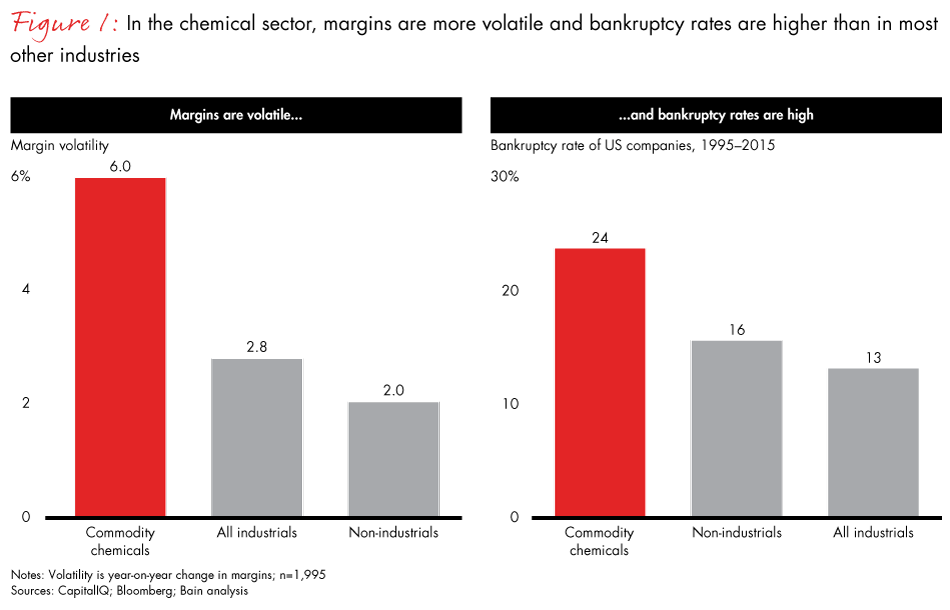
      To manage these assembled businesses, leading companies regularly assess their portfolio coherence—defined as the level of sharing between business units—and the magnitude of volatility they introduce. Active portfolio management is even more critical in chemicals than other sectors. The reasons—all too familiar to executives—are unique to the industry. Large changes in feedstock prices can alter the competitive position of plants. Profit pools shift up and down the value chain over time, changing the landscape of winners and losers. High capital requirements create long-term financial and strategic commitments. All these dynamics create higher levels of margin volatility, bankruptcy and financial stress in chemicals than in other industries (see Figure 1). To navigate successfully, executives review their portfolios, assessing these risks and managing their exposure to them.

      Leading chemical companies are also sharply focused when setting their strategic goals and defining sources of advantage, and they use periodic reviews to validate each business unit’s alignment (or lack of alignment) with these goals. Bain research suggests this diligence pays off financially: Greater portfolio coherence at top chemical companies leads to lower margin volatility, stronger alignment of their businesses to a strategy and more effective sharing between businesses—all of which contribute to higher financial returns. For example, we found that commodity chemical companies that balanced volatility with coherence were able to grow earnings at twice the rate of the rest of the industry. Companies in this group delivered 2.5 to 4.5 times the total shareholder returns while seeing 30% lower margin volatility.

      portfolio-strategy-in-chemicals-fig01_embed

      Align businesses around a common strategy


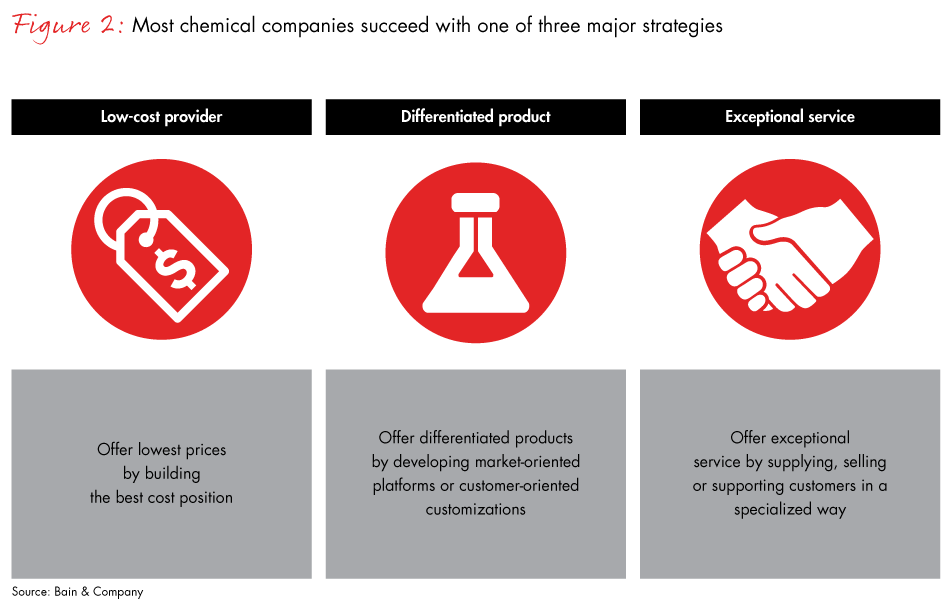
      The first step in assessing the coherence of business units is to understand the broader organization’s central strategy. Chemical companies typically follow one of three well-known paths to success: low cost, differentiated products or exceptional service (see Figure 2). However, when a portfolio pulls in multiple directions, it can be challenging to meet the requirements of conflicting strategies. By designing their businesses around a common strategy, high performers send a strong message to investors, partners and employees about how they intend to compete in their markets. A common strategy across businesses also allows executives to develop a focused set of capabilities to enable success. They can build their operating model and cost structure around one strategy and share those skills to create value throughout the organization.

      portfolio-strategy-in-chemicals-fig02_embed

      Alternatively, companies made up of businesses with divergent strategic approaches—for example, a low-cost producer in one segment combined with another business unit that invests heavily in innovation and R&D—may struggle to develop the capabilities necessary to thrive with multiple strategies. It will be harder to take the strengths that worked in one business and extend them to help their other businesses succeed. Worse, they may spread their focus too thin—so they find themselves performing adequately at many activities, but great at none.

      As executives rationalize their portfolio, they should develop an understanding of the capabilities necessary to win in each business. In some cases, they may need to divest business units with outlying strategies that detract from success. Where divestitures are not realistic, companies may need to manage multiple strategies simultaneously, which can pose significant challenges to their operating model and cost structure.

      Determine what gets shared


      When determining which capabilities and resources to share among business units, chemicals executives know that not all sharing is equally valuable. It is most important to share the things that make you uniquely successful. Sharing the sources of advantage across business units—whether they are costs, capabilities or other resources—allows companies to extend their lead.

      For example, in businesses pursuing a low-cost strategy, it is more valuable to share costs or common feedstock than to share customers. Westlake Chemical, for example, taps scale benefits through shared raw materials and highly integrated operations across its business units to achieve a low-cost position in multiple segments. The polyethylene and PVC businesses have common feedstocks, and the PVC business is highly integrated vertically. As a result, the company is able to extend its low-cost business structure into its acquisitions, keeping a sharp focus on costs as the top priority.

      On the other hand, businesses pursuing innovation strategies to earn high value for their products will get far more out of sharing R&D capabilities, technology and go-to-market strategies than from sharing costs. One of the rationales for the Dow-DuPont merger is to realize benefits from shared customers to enhance relationships with decision makers and gain a deeper understanding of customer requirements. The improved R&D breadth also encourages the development of unique products to meet these customer needs.

      Of course, it’s always possible to turn a virtue into a sin. Sharing makes sense when it helps achieve strategic goals. But companies that aggressively share costs, capabilities or resources across businesses with different support needs can sometimes create burdensome and unnecessary bureaucracy. Having identified the common sources of value, organizations should remain selective about sharing those features that make the company better, not just bigger.

      Acquiring chemical companies requires strategic planning when it comes to organizing the portfolio. Mark Porter, who leads Bain’s Global Chemicals practice, shares two factors that influence the way portfolios are often organized and how they can influence the success of the acquisition.

      Manage volatility


      A key complication is that common strategies and the pursuit of overlap and synergies can expose businesses to greater volatility. Two business units that rely on similar raw materials can share costs to create better economy on inputs, but both are exposed to the same cycles and volatility in that material market.

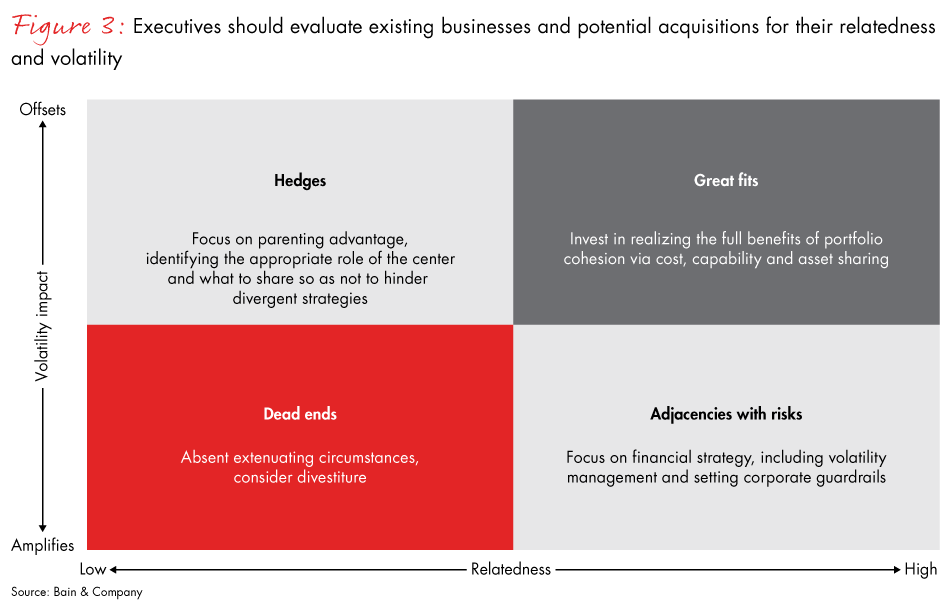
      A well-balanced portfolio reduces volatility for the company as a whole. Businesses that decrease volatility may be valuable to retain, even if their strategic approach is different. Businesses that amplify risk must create enough value to justify their inclusion. Depending on the deal, acquisitions can introduce organizational complexity at one extreme or financial volatility at the other. Wise executives keep an eye on both risks (see Figure 3).

      portfolio-strategy-in-chemicals-fig03_embed

      For businesses that are not closely related to the core strategy but that reduce volatility (upper left), executives manage organizational complexity risks by deciding which capabilities should reside at the corporate versus business unit level and which practices should be standardized across businesses.

      For businesses that are highly related to the core strategy but increase volatility (lower right), executives turn their focus to managing volatility.

      • They can mitigate risk through actions within business units: building flexibility into supply contracts, diversifying geographic footprints or accessing different end markets.
      • They can also address volatility through portfolio actions: expanding into a variety of derivatives from a common intermediate product, vertically integrating to capture profit pools as they move across the value chain or divesting businesses that create disproportionate risk.
      • Finally, they can manage volatility through financial strategy: conserving cash in a “rainy day fund” for down markets, smartly managing debt covenants or share buybacks, or spreading capital expenditures across multiple periods.

      Through regular, ongoing assessments of their portfolios, executives in the chemical sector can reduce their organization’s exposure to volatility while discovering opportunities to create synergies across business units. These assessments shed light on where to invest or divest, and can help executives shape a comprehensive acquisition strategy. Beyond M&A, insights from these assessments can also help executive teams determine the proper structure and interaction between the corporate center and business units, and thereby capture the benefits of the range of businesses.

      One way to get started is by asking a few questions that can help shape portfolio analysis:

      • How do each of our businesses generate value? Are their means of generating value similar or quite different?
      • Which business units are most coherent in terms of their alignment with our strategy and the amount of volatility they introduce? Which do not fit as well?
      • Where are the greatest opportunities to share capabilities and skills across our business units to extend our advantages?
      • Are we creating financial risk through volatility? Are there any mitigating actions we could pursue?

      The answers to these questions can establish the starting point for an in-depth assessment of portfolio coherence and a strategic approach to manage volatility.

      Jason McLinn is a partner with Bain & Company in Chicago and leads Bain’s Chemicals practice in the Americas. Mark Porter is a partner in London and leads Bain’s Global Chemicals practice. David Schottland is a Bain principal in New York.


      portfolio-strategy-in-chemicals-fig01_full

      portfolio-strategy-in-chemicals-fig02_full

      portfolio-strategy-in-chemicals-fig03_full
      Authors
      • Headshot of Jason McLinn
        Jason McLinn
        Partner, Chicago
      • Headshot of Mark Porter
        Mark Porter
        Partner, London
      • Headshot of David Schottland
        David Schottland
        Partner, New York
      Related Industries
      • Advanced Manufacturing & Services
      • Chemicals
      Chemicals
      Study of the Potential for Diversification of the Brazilian Chemical Industry

      Opportunities abound for diversification in the Brazilian chemical industry if the right policies are implemented.

      Read more
      Chemicals
      Profitable Growth in Chemicals Through Commercial Excellence

      Commercial transformations often falter when customers fail to react as expected. Successful executives anticipate customers’ reactions and plan for round two.

      Read more
      Advanced Manufacturing & Services
      How Sustainability Is Creating B2B Growth

      Our survey of B2B buyers and sellers finds growth leaders using sustainability to create commercial value while laggards focus on compliance.

      Read more
      Advanced Manufacturing & Services
      Business Breakthrough Barometer 2025

      The annual pulse check from leading businesses on the pace of the net-zero transition.

      Read more
      Advanced Manufacturing & Services
      Southeast Asia's Green Economy 2025 Report

      Unlocking systems for growth and impact

      Read more
      First published in febrero 2017
      Tags
      • Advanced Manufacturing & Services
      • Chemicals

      How We've Helped Clients

      A Conglomerate Charts a New Global Strategy

      See more related case studies

      An Auto Parts Company Revs Up Its Competitive Position

      See more related case studies

      Don't give customers options they don't want

      See more related case studies

      Want to continue the conversation

      We help global leaders with their organization's most critical issues and opportunities. Together, we create enduring change and results

      Bain Insights. Our perspectives on critical issues global businesses face in today's challenging environment, delivered monthly.

      *I have read and understand Bain’s Privacy Notice.

      Please read and agree to the Privacy Policy.
      Bain & Company
      Contact us Sustainability Accessibility Terms of use Privacy Modern Slavery Act Statement Cookie Policy Sitemap Log In

      © 1996-2026 Bain & Company, Inc.

      Contact Bain

      How can we help you?

      • Business inquiry
      • Career information
      • Press relations
      • Partnership request
      • Speaker request
      See all offices