

Brief

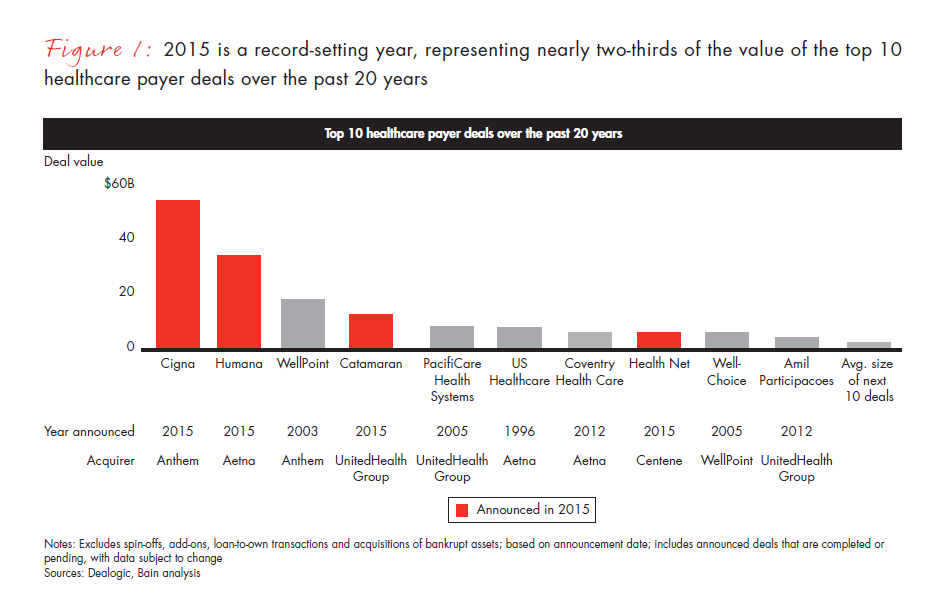
When Aetna announced its deal to acquire Humana and Anthem followed with its plan to buy Cigna, the moves ushered in a new era of mergers in the US health insurance industry. The combined deals totaled around $90 billion in value, dwarfing anything the industry had seen and significantly raising the stakes for performance expectations.
Similar to most industries, healthcare insurance merger activity has gone through multiple distinct waves. A spate of acquisitions in the 1990s through the early 2000s sought to grow regional scale and lower administrative costs or to double down on more attractive (at that time) segments such as the individual market. In another wave of acquisitions in the late 2000s and early 2010s, the aim was to diversify insurance companies in the face of looming health reform. In yet another wave, national insurers acquired the largest Medicare Advantage and managed Medicaid platforms, once the essential elements of health reform came into focus.
The most recent wave of deals, including Aetna-Humana and Anthem-Cigna, is far different, not only because of the sheer size of the companies involved (see Figure 1) but because it comes at a time when health insurers are fully immersed in reshaping themselves to deal with the Affordable Care Act, the shift to value-based care and unprecedented consumerism in healthcare. As such, the companies face the daunting challenge of merger integration on a huge scale—and eliminating literally billions of dollars in selling, general and administrative costs—while in the process of reevaluating and redefining their business models.
As in other industries, healthcare insurers can fall short of their goals (or far worse) by stumbling in three broad areas of post-merger integration.
- Missed targets. Ambitious cost synergy targets, executed while insurers are fundamentally reshaping their business models, result in massive complexity that could thwart even the best integration model. Instead of simultaneously trying to tackle every project, the most successful companies zero in on the few most critical areas to address—ones that will deliver the biggest and immediate value—and put their resources behind these initiatives. The trouble is, too many companies fail to define clearly and agree internally on a deal’s primary sources of value and key risks, so they don’t set priorities for the integration.
- Loss of key people. There’s always the risk of losing important talent in a merger. For example, in the current wave of large-scale insurance mergers, lengthy close periods mean months of ambiguity. Often, the most talented executives and middle managers use the time to pursue other options. Many companies stumble by waiting too long to put new organizational structures and leadership in place. Companies also may fail to address cultural issues that often determine how people feel about the new environment. Talented people may view the cultural differences between the merging companies as being too radical for comfort and drift away.
- Poor performance in the base business. Integration soaks up energy and attention, distracting managers from the core business. The situation can be even more troublesome for large-scale deals in the healthcare insurance industry, where companies risk diverting focus and resources from performance improvement initiatives in their base business, such as tackling tricky pricing challenges in the public exchange business.
There is no cookie-cutter approach to avoiding these pitfalls. In fact, no two deals should be integrated in the same way, with the same priorities and same timetable. However, 10 essential guidelines can make the task far more manageable and lead to the right outcome.
1. Follow the money
Every merger or acquisition needs a well-thought-out deal thesis, an objective explanation of how the deal enhances the company’s core strategy—for example, giving the company privileged access to attractive new customers and channels. A deal thesis clarifies the 5 to 10 most important sources of value (and danger) and the actions you must take to be successful. It should be the focus of both the due diligence and the subsequent integration.
Integration task forces are then structured around the key sources of value. It is also necessary to translate the deal thesis into tangible nonfinancial results that everyone in the organization can rally around—for example, one public exchange brand or one claims adjudication platform. The teams need to understand the value for which they are accountable, and should be challenged to produce their own bottom-up estimates of value right from the start.
2. Tailor your actions to the nature of the deal
Anyone undertaking a merger or acquisition must be certain whether it is a scale deal (an expansion in the same or highly overlapping business) or a scope deal (an expansion into a new market, product, geography, or channel)—many deals, of course, are a mix of the two types. The answer affects a host of subsequent decisions, including what you choose to integrate and what you will keep separate, what the organizational structure will be, how you will go to market when combined, and how you manage the cultural integration process.
Consider the recent acquisitions of Medicare Advantage and managed Medicaid platforms. Many of these are scope deals as these companies search for ways to move into more attractive market segments and acquire new capabilities for serving those segments. If those acquirers had treated the acquisitions like scale deals and aggressively taken out people and costs, they would have compromised the value of the new assets they bought.
3. Resolve the power and people issues quickly
The new organization should be designed around the deal thesis and the new vision for the combined company. You’ll want to select people from both organizations who are enthusiastic about this vision and can contribute the most to it. Set an ambitious deadline for filling the top levels. The sooner you select the new leaders, the sooner you can fill in the levels below them. And after you stem the flight of talent and customers, you can get on with the integration. Leaders need to quickly hammer out a specific plan for who will lead the new organization, under what conditions and for what predetermined tenure, and a model for how they should resolve the hundreds of similar people-related decisions that lie on the other side of a mega-deal’s regulatory approval.
4. Start the integration planning when you announce the deal
Ideally, the acquiring company should begin planning the integration process even before the deal is announced. Once it is announced, several priorities need to be addressed immediately. Identify everything that must be done prior to close. Make as many of the major decisions as you can so that you can move quickly once the deal has closed. Again, get the top-level organization and people in place fast. But don’t do it so fast that you lose objectivity or that you shortcut the necessary processes.
One useful tool is a clean team—that is, a group of individuals operating under confidentiality agreements and other legal protocols who can review competitive data that would otherwise be off limits to the acquirer’s employees. Their work can help get things up to speed faster once the deal closes. For example, a clean team might analyze procurement contracts to determine cost-savings opportunities with common suppliers so that negotiations with those suppliers can begin at the close.
5. Manage the integration through a “decision drumbeat”
Companies can create endless templates and processes to manage an integration. But too much bureaucracy distracts from the critical issues and sucks the energy out of the integration team. The most effective integrations instead employ a decision management office (DMO), and integration leaders, by contrast, focus the steering group and task forces on the critical decisions that deliver value. They lay out a decision roadmap and manage the organization to a “decision drumbeat” to ensure that each decision is made by the right people at the right time with the best available information.
To get started, ask the integration task force leaders to play back the financial and nonfinancial results for which they are accountable as well as the time frame. That will help identify the key decisions they must make to achieve these results, by when and in what order.
6. Handpick the leaders of the integration team
An acquisition or merger needs a strong leader for the DMO. He or she must have the authority to triage, make decisions, coordinate task forces and set the pace. The leader should be strong on strategy and content as well as process—in other words, one of your rising stars. Ideally, this individual and other task force leaders will spend about 90% of their time on the integration.
7. Commit to one culture
Culture represents one of the biggest M&A challenges. Usually, the acquirer wants to maintain its own culture. Occasionally, it makes an acquisition in hopes of infusing the target company’s culture into its own. Whatever the situation, commit to the culture you want to see emerge from the integration, talk about it, and put it into practice. A diagnostic can help reveal the gaps between the two cultures. Design compensation and benefits systems to reward the behaviors you are trying to encourage. Create an organizational structure and decision-making principles that are consistent with the desired culture.
Customer service is one area in which cultural integration represents a real potential business risk for large insurance mergers. A company with a strong service capability needs to transfer that advantage to its merging partner. Otherwise, it risks eroding its well-earned service levels and customer loyalty.
8. Win hearts and minds
Mergers and acquisitions make people nervous. That means you have to “sell” the deal internally as well as to shareholders and customers. Employees need to understand how the deal will affect them, and it’s vital that your messages be consistent. To energize employees, leaders should be clear about what the deal will mean for customers and the company’s place in the industry. For example, will the company return cost savings to customers in lower prices? Will the company reinvest savings in new capabilities or technology to make the deal worthwhile?
9. Maintain momentum in the base businesses of both companies and monitor their performance closely
If management allows itself and the organization to get distracted by the integration, the base business of both companies will suffer. It’s up to the CEO to set the tone. He or she should allocate the majority of time to the base business and maintain a focus on existing customers. Below the CEO, at least 90 percent of the organization should be focused on the base business, and these people should have clear targets and incentives to keep those businesses humming. Take particular care to make customer needs a priority and to bundle customer and stakeholder communications, especially when system changes risk confusing customers. To make sure things stay on track, monitor the base businesses closely throughout the integration process. Emphasize leading indicators such as sales pipeline, employee retention and call-center volume.
10. Invest to build a repeatable integration model
Finally, after (and potentially during) big merger integrations, M&A will continue to be a critical tool for insurers to build capabilities. Take the time to review the process. Evaluate how well it worked and what you would do differently next time, using your lessons and discipline from the mega-merger integration to make future M&A activity more successful.
Bain has conducted extensive research on what contributes to success in acquisitions, including two different 10-year studies. The data is compelling. Frequent acquirers consistently outperform infrequent acquirers as well as companies that do no deals at all. If you had invested $1 in the group of frequent acquirers, the returns would be 25% greater than a similar investment in the infrequent acquirers over a 20-year period. You can substantially beat the odds if you get the integration process right and make it a core competency.
Dale Stafford is a partner in Bain’s Washington, DC, office and leads Bain’s Mergers & Acquisitions practice in the Americas. Ted Rouse is a partner with Bain & Company in Chicago and coleader of Bain’s Global Mergers & Acquisitions practice. Josh Weisbrod is a partner in New York and a leader with the firm’s Healthcare practice.
First published in septiembre 2015