

Brief
Consumer goods executives who look at Western Europe may feel like holding up their hands in resignation. While some developed markets like the US stimulate their way to growth and most emerging markets continue to thrive, Western Europe’s well-documented challenges drag on. Gross domestic product (GDP) growth is virtually nonexistent in most Western European countries, populations are stagnant or declining, consumer confidence still sags and shoppers’ loyalty to their preferred brands is low. Shelf space for branded goods is dwindling as retailers turn to smaller store formats and private labels steal share. Top talent is either rapidly being deployed to faster-growth markets or discouraged by their inability to make a difference, let alone advance their careers, in this environment.
Thus the growth gap compared with other regions continues to widen in most product categories. Growth for personal care was more than seven times greater in Asia and growth for soft drinks nearly six times greater in Eastern Europe than in Western Europe from 2001 to 2011, according to Euromonitor. As a consequence, between 2003 and 2012 the region’s share of global sales dropped significantly for many consumer goods companies: 17 points for L’Oreal and 21 points for Nestlé (excluding water, nutrition and other businesses).
It’s no surprise, then, that consumer goods players are tempted to de-prioritize Western Europe in their corporate agendas in favor of more dynamic regions. That, however, only compounds the problem: Companies that choose to manage for cost and retain their Western European presence with minimal investment set a downward spiral in motion.
Here’s how: Reduced investments, starting with innovation and marketing, lead to an erosion of product sales. That, in turn, causes retailers to delist poor-performing products, which hurts financial results, spurring high turnover in the regional executive suite. In fact, an astounding 70% of current leaders of consumer products companies in Western Europe have been in their current jobs for no more than two years. Feeling the pressure of not having turned Europe around, it’s easier for them to move on and blame the market. These leaders, however, leave behind a frustrated organization, which causes a talent drain, decreased confidence in the company’s long-term perspective and further declines.
To return to growth, leading consumer products companies are focusing resources on their key brands, reducing complexity and perfecting their in-store strategies, says Matthew Meacham, practice leader of the Consumer Products practice in Europe, the Middle East and Africa.
Why Western Europe (still) matters
For many companies, however, Western Europe remains unavoidable. That’s because it is one of the largest and wealthiest markets in terms of consumer spending globally and continues to represent a significant share of sales and profits.
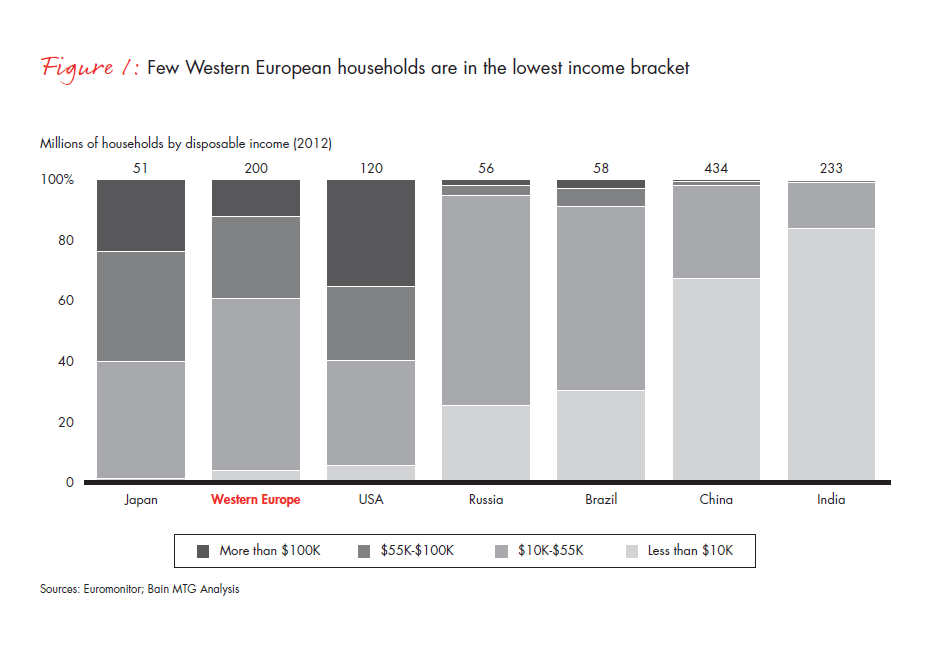
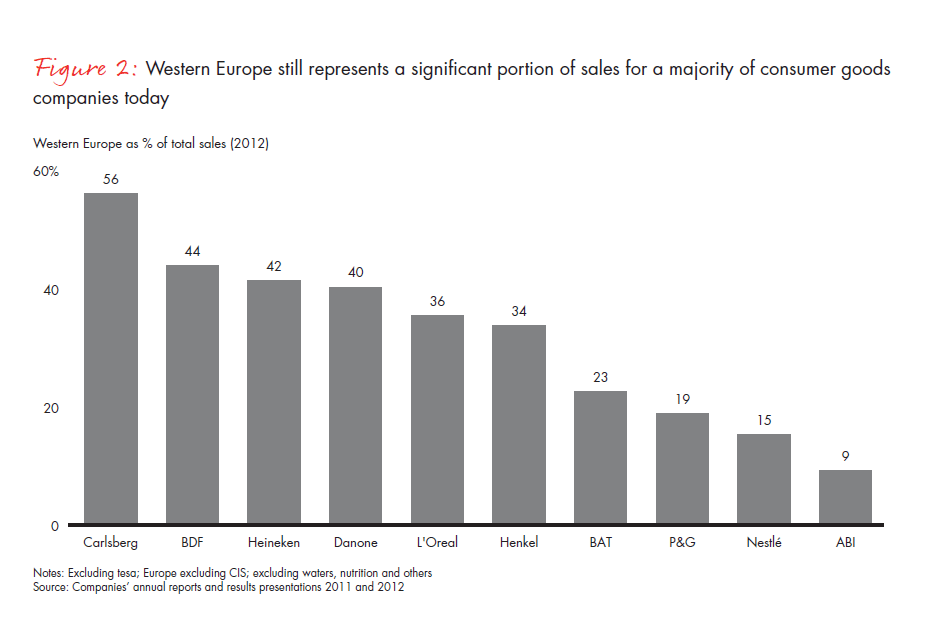
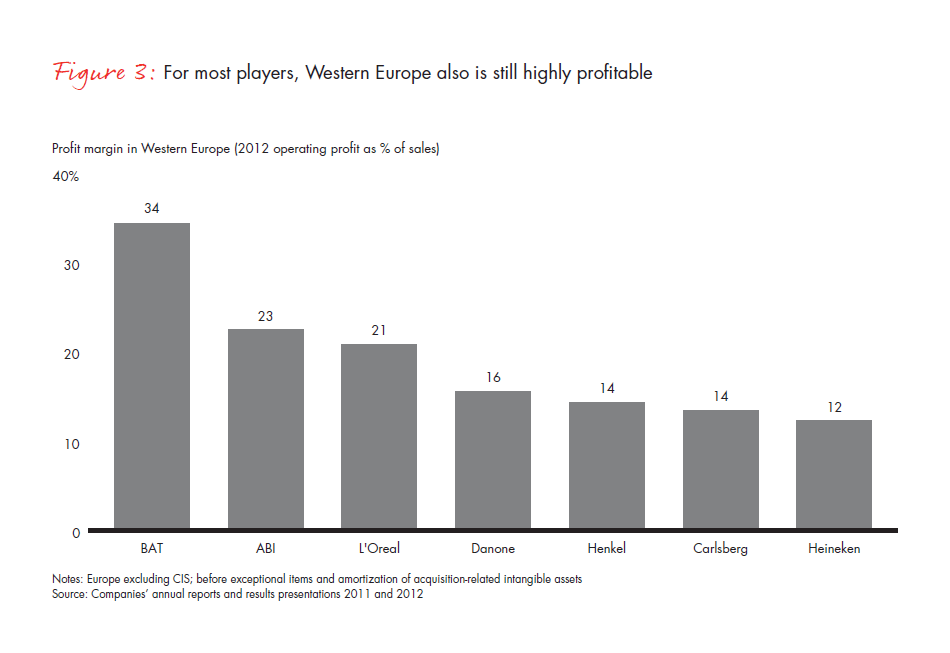
Although the greatest growth for consumer goods companies may be taking place in the BRIC and other developing markets, Western Europe is still home to a significant portion of the world’s wealth. Its complexity as a multi-market region—with differences in shopper needs and trade structures—may put off some companies, but it has an important characteristic that makes it worthy of consideration and continued investment: Unlike consumers in other, faster-growing parts of the world, relatively few Western Europeans are in the lowest-income groups (see Figure 1). Almost every shopper there can afford mainstream consumer goods, making it possible for fast-moving consumer goods (FMCG) companies to achieve high rates of penetration. While GDP per capita growth rates may be higher in developing economies, absolute growth is greater in Western Europe. As a result, even as multinationals redeploy talent to the developing world, Western Europe still represents a significant portion of sales for a majority of global consumer goods companies—and remains highly profitable for many of them. For example, last year British American Tobacco achieved profit margins of 34% in Western Europe. L’Oréal reached 21% in 2012 (see Figures 2 and 3).
Finally, there’s ample evidence that profitable growth in Western Europe is still possible, with some brands strongly outperforming their peers and achieving high levels of growth. From 2007 to 2012, brands such as Nescafé in France, Aperol spirits in Germany, Ecover laundry detergent in the UK and the Giorgi line of hair-care products in Spain well exceeded the branded category average in annual growth.
Redeploying Western Europe
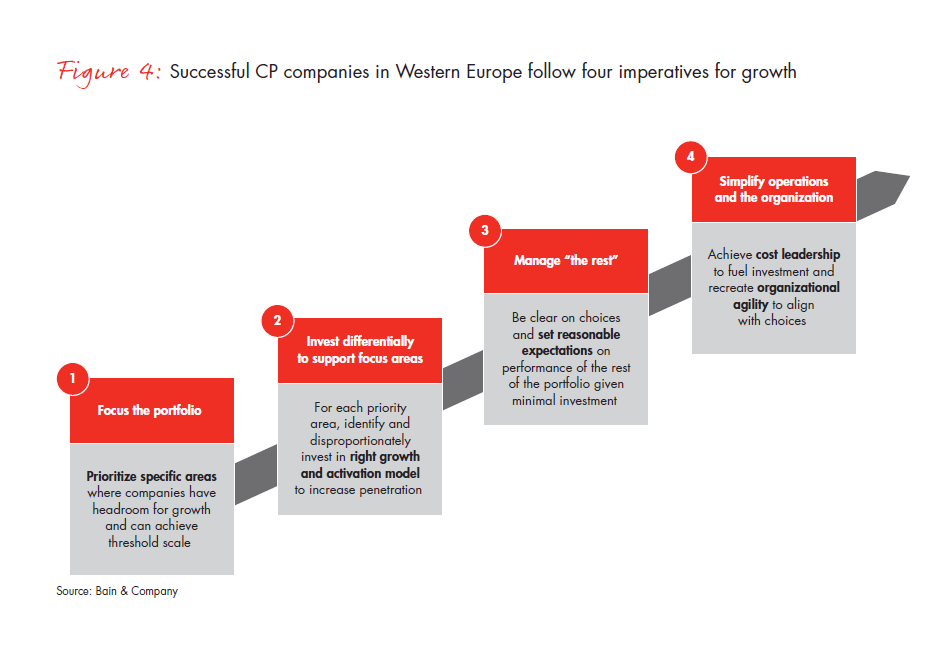
In this environment of high disposable income and growth potential, the key for any player is to boost penetration—getting more shoppers to choose to spend on its products. That’s why leading consumer goods companies are rethinking their approach to Western Europe. They’ve analyzed the trade data and shopper behavior and have realized that, by streamlining and honing their product portfolios, they can increase penetration with a few right products, rejuvenating growth while simplifying operations. Welcome to Western Europe, the world’s new test market for focused growth strategies (see Figure 4).
Focus the portfolio
The starting point is to understand that many companies have tried to generate growth in the last decade by multiplying the number of products in their portfolio to tap into a highly sub-segmented market. In a low- growth environment, however, this strategy quickly becomes unsustainable. To push all of these products, companies must invest in advertising, trade terms, salesforce support and a host of other activities. The trouble is that when you have too many products to support and your top and bottom lines are not growing as fast as you want, you are doomed to invest less and less in each individual product. It reaches a point where your investment levels become too low to make a meaningful impact.
If they hope to grow and outperform, consumer goods companies must first redefine what it means to win in Western Europe. For many, it will require rejecting across-the-board growth and making tough choices: finding, prioritizing and doubling-down on fewer key areas where they can achieve threshold scale and leadership. Call this “quality” growth.
Take Orangina Schweppes. The company reversed a 10-year market- share and volume decline in France, outperforming the market from 2006 to 2009, by reprioritizing its fruit beverages portfolio and substantially reinvesting in its priority brands. Similarly, Red Bull has risen above the pack because of its focused-portfolio approach and single-brand platform. It grew by an annual 8% in Western Europe during the slow growth years of 2009 to 2012. Such outperformance is not unusual. Bain & Company research has shown that focused-portfolio companies—those with the lowest levels of product complexity—grow at faster rates in periods of stable or slow growth. High-complexity companies begin to shrink in a recession.
A focused portfolio offers multiple benefits. Not only does it align resources in priority areas, allowing a company to invest enough to have a material impact, but it also keeps senior management focused and helps brands win in the store. Dedicating shelf space, promotion slots and other critical store assets to priority products increases influence with retailers and reduces shopper-choice paralysis. It lowers supply-chain and back-office costs. It also allows companies to build scale across markets for targeted products and to benefit from the experience curve.
Invest more to support targeted areas
Achieving growth in a stagnating environment means having to do better with less. Instead of spreading resources too thin, focusing on a few select areas allows companies to invest disproportionately where and how it matters based on a deep understanding of the rules in their categories.
Once a company has identified key focus areas within its portfolio, it must fully redirect resources to achieve full-potential penetration. In consumer products, penetration is the leading indicator of success: The largest and most enduring brands are the ones that systematically reach the largest number of consumers. This is a key insight from the research of the Ehrenberg-Bass Institute for Marketing Science, summarized by Professor Byron Sharp, director of the Institute, in his book How Brands Grow, based on decades of observations of buying behavior. That further reinforces why, instead of selling a widely diversified product range to a select few, companies should focus on selling only the right few products to as many shoppers as possible.
Among the most important investments to rethink: media spending. In today’s world of cluttered media messaging, brands need minimum scale of voice to be noticed. Many smaller brands simply cannot afford these threshold levels, but companies continue to invest at a sub-scale level based on what these brands can sustain. They’d likely get better results by redirecting their media spending to support their priority brands, ensuring sufficient, continuous and consistent messaging for those brands.
Promotions are another area where companies can gain by investing more in carefully chosen priorities. Various Bain studies have shown the greater benefit of promoting the so-called hero brands over smaller brands. When companies promote hero brands instead of small brands, they are more successful in expanding the category in the short term. In one category, for example, promotions for a hero brand generated three times the volume as those for a small brand; 43% of the hero brand’s incremental volume came from category expansion compared with 27% for the small brand. Nearly half of the incremental volume from the small-brand promotion came from competitive switching, i.e., in-category cannibalization, compared with 17% for the hero brand. Concentrating well-executed promotions on core SKUs, as opposed to offering deep promotions intended to push peripheral SKUs, will deliver higher returns on investment.
Finally, the same single-minded focus on selected products needs to extend to in-store sales execution. By investing disproportionately in priority areas, companies can increase their ability to win at the moment shoppers make their decision by having a highly targeted offering that is perfectly executed on the shelf with sufficient availability and visibility—at the right price.
Manage “the rest”
While companies pump up their investment in targeted areas, they need to be mindful of how they manage the rest of their portfolio.
What’s the best approach for non-priorities? Winning companies establish strict guidelines for non-core areas. For example, a company may specifically limit advertising for a “B” brand to only a four- to eight-week period. In situations where it won’t achieve the visibility and voice scale required to have an impact, it may decide to advertise in a lower-cost media channel where it can generate sufficient reach and scale. It also could choose to eliminate the investment entirely and redirect the budget to its “A” brands.
When making these trade-offs, companies must also recognize the need to recalibrate performance targets and overall expectations for these de-prioritized areas. A food company chose to invest heavily for in-store activation of its top three brands, a decision that reversed a negative growth trend and generated 8% annual growth in Western Europe for those brands for 2009 to 2011. At the same time, it reduced investments in all other brands. The strong performance in the chosen brands, however, far outweighed declines in the non-priorities. Overall, growth improved by 7 percentage points.
Costs for managing non-core brands should also be heavily controlled. Opportunities should be identified to build scale for these brands across markets or regions with similar needs. If the cost of maintaining them is too high, the best option is to divest or delist.
Simplify operations and the organization
There’s another benefit to focusing only on those few products with high growth potential: It gives companies the opportunity to simplify operations and redesign a more agile and flexible organization.
Companies with fewer products can reduce overall costs and improve productivity by streamlining the supply chain or other processes to reflect their simplified portfolio. For example, a protein company lowered its costs by 15% when it modified or delisted 85% of its SKUs and reduced the number of different product sizes by 70%. The drastically refocused portfolio simplified its supply-chain operations, decreased time lost in man-ufacturing changeovers and achieved other efficiencies, all while increasing production capacity (see Bain Brief “Growth through simplicity: How the best consumer goods players are getting bigger by getting smaller”).
More focused companies can also more easily create clear, repeatable routines for critical activities while eliminating activities that create complexity. To achieve these benefits, companies must identify the few capability areas where they want to truly excel. For some, this will be sales execution; for others, it will be marketing. For all, a simpler portfolio will make it easier to excel in those areas. For instance, a food company in Western Europe with a highly focused product line was able to grow despite the declining market by establishing a best-in-class, highly repeatable sales-execution process at each point of sale that focused on its core products. Clearly defined and streamlined salesforce activities helped end years of strong variance in store performance. The company attributes 50% of its growth to those point-of-sale improvements. Likewise, the company was able to outperform the market in most of its categories between 2007 and 2012 by applying strict, nonnegotiable principles to innovation—a move that helped it maintain simplicity in its product line. Another food company saved 20% in overhead costs and boosted profits as a result of refocusing on three core brands. By prioritizing where it would focus, the company was able to remove work associated with non-priority brands, redirect marketing resources and bring most activities to scale.
Finally, winning players in Western Europe also reorganize themselves to use pan-regional scale where it makes economic sense while still maintaining local capabilities where it matters. This typically involves regionalizing some brand management, commercial, supply, procurement and support functions, while keeping most sales activities local to ensure the appropriate activation is implemented at the local stores.
Companies enjoying success in Western Europe have learned an invaluable lesson: A focused company is always a winning company. Results, however, don’t happen overnight. Place big bets, stay undistracted, be committed. The results will pay off.
Matthew Meacham is a Bain partner based in Madrid and the leader of the firm’s Consumer Products practice in the EMEA region. Nicolas Bloch, Guy Brusselmans and Christophe De Vusser are Bain partners based in Brussels and are leading members of the EMEA Consumer Products practice.
Betting big on fewer brands
A multinational company we’ll call “FoodCo” faced bleak prospects in France. Sales had fallen by an average of 3% annually over the past five years, the market was in decline and two clear leaders dominated the product category. Management needed to make a quick decision about one of its least profitable business units in Western Europe.
The company had two options: Continue on the current path but try harder, or take a bold, albeit well-reasoned, bet and retrench to focus on only two brands where it believed it could win. It chose the latter: to transform itself from a losing full-portfolio player into a lean and focused competitor. It was not an easy choice to make. Walking away from the majority of its business required determination. The focused brands made up far less than half of the existing business, but the company knew it needed to trust its analysis or else watch its much bigger non-core businesses steadily decline. With the right investment plan, growth in the targeted areas would more than compensate for those losses. Many other players would have seen the decision as being too risky and would have stayed the course, simply hoping to improve marginally each year.
FoodCo, however, was not interested in easy decisions. It was ready for action. It reallocated investments to support the two key brands. It aimed packaging renovations, product extensions, in-store execution and brand adver tising at boosting penetration through clear, occasion-based messaging. Meanwhile, it halted innovations beyond these two brands, sold non-core businesses and aligned the overhead structure with the much simpler focus, making better use of its pan-regional capabilities.
The result? The company endured six years of radical decline in the areas it had de-prioritized. In fact, revenues went down faster than anticipated. From the start, however, FoodCo’s top two brands grew beyond expectations, even outperforming the market and more than compensating for the company’s leaner portfolio. Volume for these brands increased two- and three-fold while sales more than doubled and tripled over an eight-year period. The two targeted brands also doubled in penetration, gaining market share and closing the gap with category leaders. After years of decline, the shift away from non-core brands lifted the overall business and completely transformed the shape of the company’s profit and loss. Margins rose 20% annually in the first four years and 30% in the two subsequent years. The company learned that less can be more when you operate in stable or declining categories and that it takes a strong stomach to resist the urge to prop up non-core brands in order to concentrate on the few that have great potential. For FoodCo, the successful refocusing of one of its least profitable European businesses was not achieved overnight. Only by stripping itself down could the company build itself back up in France.
Germany: Where simplicity rules
The German market is renowned as one of the most challenging in Western Europe. The dominating presence of discounters, proliferation of private labels and importance of price as a shopping criterion have made this a daunting market for most consumer goods companies around the world. By looking deeper into its distinct retail landscape and understanding the unique German shopper behavior, however, it’s possible to see how this market, more than any other in Western Europe, is tailor-made for a simplified portfolio approach. Germany offers a massive opportunity for consumer goods companies that can focus on fewer but better-selling products.
Few other countries in Western Europe match Germany for its abundance of discounters: As much as 40% of reported grocery sales take place in Germany’s discount channel, and there is a discounter in almost every town. To win in Germany, you need to win with discounters. That means offering a simple range focused on the leading, best-rotating SKUs, which discount retailers prioritize. For discounters, fewer but higher-rotating items will not only increase shopper traffic but will also simplify store operations and reduce out-of-stocks, the very essence of their business model.
This same model of simplicity allows you to win with the other major group of players in German trade: decentralized and franchised retailers. In these outlets, store managers usually have the authority to make many of the listing and shelving decisions, and stores are typically smaller with less shelf space. By offering a simple assortment, you’re able to minimize the number of decisions store managers are forced to make and return the decision of which products will be most successful to your own hands. Fewer products reduce in-store execution errors and streamline shelf management. Offering fewer products optimizes choices for everyone in the value chain.
Identifying and prioritizing the few core products allows companies to better differentially support them with above-the-line advertising, with the goal of achieving a share of voice that is sufficient to really make a difference. The German market is advertising-intensive and expensive. That means it requires higher investments to reach an audible share of voice. To be able to spend more on a given product, however, you need to spend across fewer of them. In addition, in a country with high levels of private-label penetration, category leaders must be able to defend their positions by investing the adequate advertising budget to support brand equity. That also makes the case for increased focus.
While many consumer goods companies have been tempted to reconsider their presence in Germany altogether, those who decided instead to invest heavily in their top brands have been successful. One food company’s focused approach enabled its top brands to grow by more than 7%, far out pacing the sector’s growth of 0.5%. Among other moves, it boosted advertising spending by more than 40% and focused innovations on these top brands. It optimized shelf and checkout placements and invested in 50,000 more displays to support promotional activities for secondary placements.
For its part, Procter & Gamble succeeded in Germany by applying a similar focused model on fewer but stronger brands. By investing in these brands through significant marketing, selective innovation and strategically tiered pricing structures to win with discounters, it outpaced other players in the market. For example, its top three laundry care brands grew by an average 4%, year over year, from 2007 to 2012, according to Euromonitor, while the category only grew 0.2%.
The lesson for consumer goods players: If you can figure out how to grow in Germany, you can grow anywhere in Western Europe. Simplicity is the key to unlocking that growth.
First published in junio 2013