
Skip to Content
  • Offices

    Offices

    North & Latin America
    • Atlanta
    • Austin
    • Bogota
    • Boston
    • Buenos Aires
    • Chicago
    • Dallas
    • Denver
    • Houston
    • Los Angeles
    • Mexico City
    • Minneapolis
    • Monterrey
    • Montreal
    • New York
    • Rio de Janeiro
    • San Francisco
    • Santiago
    • São Paulo
    • Seattle
    • Silicon Valley
    • Toronto
    • Washington, DC
    Europe & Africa
    • Amsterdam
    • Athens
    • Berlin
    • Brussels
    • Copenhagen
    • Dusseldorf
    • Frankfurt
    • Helsinki
    • Istanbul
    • Johannesburg
    • Kyiv
    • Lisbon
    • London
    • Madrid
    • Milan
    • Munich
    • Oslo
    • Paris
    • Rome
    • Stockholm
    • Vienna
    • Warsaw
    • Zurich
    Middle East
    • Doha
    • Dubai
    • Riyadh
    Asia & Australia
    • Bangkok
    • Beijing
    • Bengaluru
    • Brisbane
    • Ho Chi Minh City
    • Hong Kong
    • Jakarta
    • Kuala Lumpur
    • Manila
    • Melbourne
    • Mumbai
    • New Delhi
    • Perth
    • Shanghai
    • Singapore
    • Sydney
    • Tokyo
    See all offices
  • Alumni
  • Media Center
  • Subscribe
  • Contact
  • Colombia | Español

    Select your region and language

    Global
    • Global (English)
    North & Latin America
    • Brazil (Português)
    • Argentina (Español)
    • Canada (Français)
    • Chile (Español)
    • Colombia (Español)
    Europe, Middle East, & Africa
    • France (Français)
    • DACH Region (Deutsch)
    • Italy (Italiano)
    • Spain (Español)
    • Greece (Elliniká)
    Asia & Australia
    • China (中文版)
    • Korea (한국어)
    • Japan (日本語)
  • Saved items (0)
    Saved items (0)

    You have no saved items.

    Bookmark content that interests you and it will be saved here for you to read or share later.

    Explore Bain Insights
  • Industries
    Main menu

    Industries

    • Aeroespacial y Defensa
    • Agroindustria
    • Químicos
    • Construcción e Infraestructura
    • Productos de Consumo
    • Servicios Financieros
    • Salud y Ciencias de la Vida
    • Maquinaria y Equipo Industrial
    • Medios y Entretenimiento
      Industries
      Medios y Entretenimiento
      • Media Lab
    • Metales
    • Minería
    • Petróleo y Gas
    • Papel y Empaque
    • Private Equity
      Industries
      Private Equity
      • Due Diligence
      • Exit Planning
      • Firm Strategy & Operations
      • Portfolio Value Creation
    • Sector Público y Social
    • Retail
    • Tecnología
    • Telecomunicaciones
      Industries
      Telecomunicaciones
      • Capital Expenditure
      • Telco Digital Transformation
    • Transporte
    • Viajes y Turismo
    • Servicios Públicos y Energías Renovables
  • Consulting Services
    Main menu

    Consulting Services

    • Customer Experience
    • Sustainability
    • Innovation
    • M&A
    • Operations
    • People & Organization
    • Private Equity
    • Sales & Marketing
    • Strategy
    • AI, Insights, and Solutions
    • Technology
    • Transformation
  • Digital
  • Insights
    Main menu

    Insights

    • Industry Insights
    • Services Insights
    • Bain Books
    • Webinars
    • Bain Futures
    View all Insights
    Featured topics
    • Tariff Response
    • Artificial Intelligence
    • Thriving in Uncertainty
    • Executive Conversations
    • Macro Trends
    • M&A Report
    • Healthcare Private Equity Report
    • Paper & Packaging Report
    • Technology Report
    • CEO's Guide to Sustainability
    • CEO Insights
    • CFO Insights
    • COO Insights
    • CIO Insights
    • CMO Insights
    View all featured topics
  • About
    Main menu

    About

    • What We Do
    • What We Believe
    • Our People & Leadership
    • Client Results
    • Awards & Recognition
    • Global Affiliations
    Further: Our global responsibility
    • Sustainability
    • Social Impact
    • World Economic Forum
    Learn more about Further
  • Carreras
    Main menu

    Carreras

    • Trabaja con Nosotros
      Carreras
      Trabaja con Nosotros
      • Find Your Place
      • Nuestras Áreas de Trabajo
      • Equipos Integrados
      • Estudiantes
      • Internships & Programs
      • Eventos de Reclutamiento
    • La Vida en Bain
      Carreras
      La Vida en Bain
      • Blog: Inside Bain
      • Historias Profesionales
      • Nuestra Gente
      • Dónde Trabajamos
      • Apoyando tu Crecimiento
      • Grupos de Afinidad
      • Beneficios
    • Impact Stories
    • Nuestro Proceso
      Carreras
      Nuestro Proceso
      • Qué Esperar
      • Entrevistas
    FIND JOBS
  • Offices
    Main menu

    Offices

    • North & Latin America
      Offices
      North & Latin America
      • Atlanta
      • Austin
      • Bogota
      • Boston
      • Buenos Aires
      • Chicago
      • Dallas
      • Denver
      • Houston
      • Los Angeles
      • Mexico City
      • Minneapolis
      • Monterrey
      • Montreal
      • New York
      • Rio de Janeiro
      • San Francisco
      • Santiago
      • São Paulo
      • Seattle
      • Silicon Valley
      • Toronto
      • Washington, DC
    • Europe & Africa
      Offices
      Europe & Africa
      • Amsterdam
      • Athens
      • Berlin
      • Brussels
      • Copenhagen
      • Dusseldorf
      • Frankfurt
      • Helsinki
      • Istanbul
      • Johannesburg
      • Kyiv
      • Lisbon
      • London
      • Madrid
      • Milan
      • Munich
      • Oslo
      • Paris
      • Rome
      • Stockholm
      • Vienna
      • Warsaw
      • Zurich
    • Middle East
      Offices
      Middle East
      • Doha
      • Dubai
      • Riyadh
    • Asia & Australia
      Offices
      Asia & Australia
      • Bangkok
      • Beijing
      • Bengaluru
      • Brisbane
      • Ho Chi Minh City
      • Hong Kong
      • Jakarta
      • Kuala Lumpur
      • Manila
      • Melbourne
      • Mumbai
      • New Delhi
      • Perth
      • Shanghai
      • Singapore
      • Sydney
      • Tokyo
    See all offices
  • Alumni
  • Media Center
  • Subscribe
  • Contact
  • Colombia | Español
    Main menu

    Select your region and language

    • Global
      Select your region and language
      Global
      • Global (English)
    • North & Latin America
      Select your region and language
      North & Latin America
      • Brazil (Português)
      • Argentina (Español)
      • Canada (Français)
      • Chile (Español)
      • Colombia (Español)
    • Europe, Middle East, & Africa
      Select your region and language
      Europe, Middle East, & Africa
      • France (Français)
      • DACH Region (Deutsch)
      • Italy (Italiano)
      • Spain (Español)
      • Greece (Elliniká)
    • Asia & Australia
      Select your region and language
      Asia & Australia
      • China (中文版)
      • Korea (한국어)
      • Japan (日本語)
  • Saved items  (0)
    Main menu
    Saved items (0)

    You have no saved items.

    Bookmark content that interests you and it will be saved here for you to read or share later.

    Explore Bain Insights
  • Industries
    • Industries

      • Aeroespacial y Defensa
      • Agroindustria
      • Químicos
      • Construcción e Infraestructura
      • Productos de Consumo
      • Servicios Financieros
      • Salud y Ciencias de la Vida
      • Maquinaria y Equipo Industrial
      • Medios y Entretenimiento
      • Metales
      • Minería
      • Petróleo y Gas
      • Papel y Empaque
      • Private Equity
      • Sector Público y Social
      • Retail
      • Tecnología
      • Telecomunicaciones
      • Transporte
      • Viajes y Turismo
      • Servicios Públicos y Energías Renovables
  • Consulting Services
    • Consulting Services

      • Customer Experience
      • Sustainability
      • Innovation
      • M&A
      • Operations
      • People & Organization
      • Private Equity
      • Sales & Marketing
      • Strategy
      • AI, Insights, and Solutions
      • Technology
      • Transformation
  • Digital
  • Insights
    • Insights

      • Industry Insights
      • Services Insights
      • Bain Books
      • Webinars
      • Bain Futures
      View all Insights
      Featured topics
      • Tariff Response
      • Artificial Intelligence
      • Thriving in Uncertainty
      • Executive Conversations
      • Macro Trends
      • M&A Report
      • Healthcare Private Equity Report
      • Paper & Packaging Report
      • Technology Report
      • CEO's Guide to Sustainability
      • CEO Insights
      • CFO Insights
      • COO Insights
      • CIO Insights
      • CMO Insights
      View all featured topics
  • About
    • About

      • What We Do
      • What We Believe
      • Our People & Leadership
      • Client Results
      • Awards & Recognition
      • Global Affiliations
      Further: Our global responsibility
      • Sustainability
      • Social Impact
      • World Economic Forum
      Learn more about Further
  • Carreras
    Popular Searches
    • Agile
    • Digital
    • Strategy
    Your Previous Searches
      Recently Visited Pages

      Content added to saved items

      Saved items (0)

      Removed from saved items

      Saved items (0)

      Brief

      A Chip Shortage Recovery Guide

      A Chip Shortage Recovery Guide

      There is light at the end of the tunnel, but for some it’s a very long tunnel. Take steps now to emerge stronger.

      By Peter Hanbury, Anne Hoecker, and Michael Schallehn

      • min read
      }

      Brief

      A Chip Shortage Recovery Guide
      en
      Executive Summary
      • Chip shortages in some sectors will begin to ease later this year, including among automotive and industrial companies.
      • Other industries, including gaming consoles and computer servers, won’t recover until 2024.
      • Leading companies are making investments to address short-term supply disruptions and set themselves up for long-term resilience.

      The computing chip shortage has wreaked havoc on global supply chains for more than two years. Now, its end is finally in sight. But the recovery will be uneven: We project some industries will start to see improvement by the end of this year, while others might not turn the page until 2024 or later.

      The automotive and industrial sectors, among the hardest hit by the chip shortage, will be the fastest to recover, according to Bain & Company analysis. We anticipate that supply bottlenecks in these sectors will begin to improve in late 2022 and early 2023 (see Figure 1). Their products rely most heavily on semiconductors in two categories—“leading-edge” 12-inch wafers and “lagging-edge” 6-inch and 8-inch wafers—that will see manufacturing capacity meaningfully increase over the next 9 to 12 months, thanks to new fabs coming online. These types of chips make up more than 90% of the semiconductors used by automotive and industrial companies.

      Figure 1
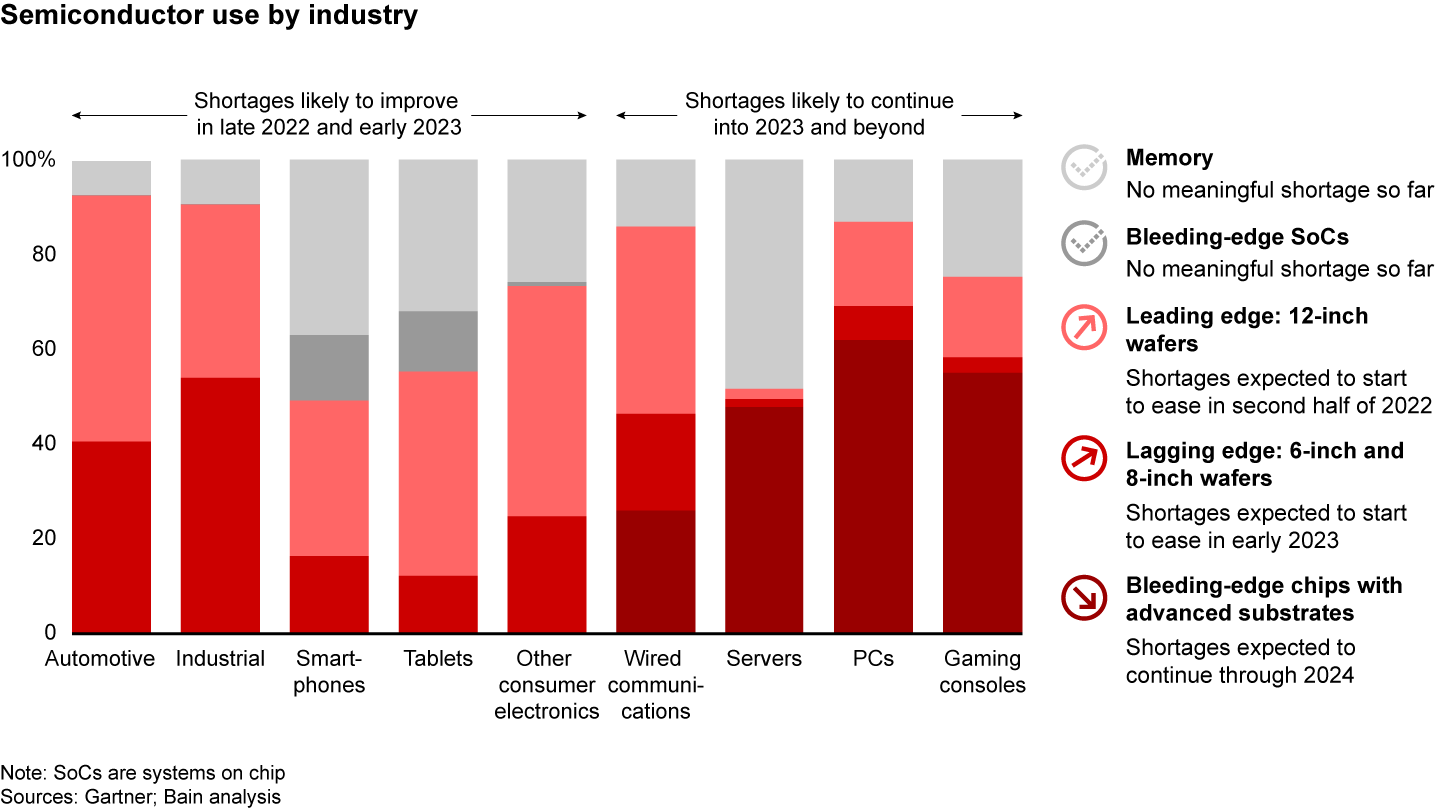
      Automotive and industrials will start to see chip shortage relief this year, but gaming consoles and servers face a challenging period
      Automotive and industrials will start to see chip shortage relief this year, but gaming consoles and servers face a challenging period
      Automotive and industrials will start to see chip shortage relief this year, but gaming consoles and servers face a challenging period

      Consumer electronics, including smartphones and tablets, will also rebound from the chip shortage over the next year or so. These products depend on the 6-inch, 8-inch, and 12-inch wafers whose supply is increasing, and they also use other types of semiconductors that have been more widely available.

      On the other end of the spectrum, we expect shortages to hamper several sectors through 2024, including gaming consoles and computer servers. Why? As demand for these products has jumped during the Covid-19 pandemic, the supply of “bleeding-edge” wafers has kept up, but production of the accompanying advanced substrate components has not. These suppliers lack the financial resources to build their substrate factories fast enough to meet rising demand. The bleeding-edge chips reliant on these substrates make up nearly 50% of the semiconductors used in servers and more than half those used in gaming consoles.

      Given that the chip shortage will linger for the foreseeable future—and the devastating war in Ukraine and Covid-19 surges could cause further uncertainty and supply disruptions—many companies are moving beyond table-stakes response tactics and building a flexible, forward-looking semiconductor supply strategy. The leading companies are taking a two-pronged approach that makes bold investments to address short-term supply disruptions and set themselves up for long-term resilience. Here are some of the emerging best practices.

      Short-term solutions

      Design for availability. When losing sales due to a supply chain shock, leading companies rapidly redesign existing products to minimize or eliminate their exposure to the component shortage. With the chip shortage, this might entail removing nonessential features underpinned by unavailable chips, minimizing product customization, qualifying parts from multiple suppliers, or creating new products that rely on available chips and serve untapped market niches.

      The most successful companies start by deploying an agile, cross-functional team with the right skills to quickly and effectively achieve the redesign, and give it a set of clear goals and incentives to deliver on the project. They continue using the agile team in other strategic ways even after the supply shock has passed. That way, these teams continue adding value while remaining ready to spring into action when the next disruption hits.

      Shape demand to accommodate supply. Sales and marketing can play a critical role in responding to supply crunches. One of the most effective tactics is actively steering customers toward the company’s more widely available products, either by raising the price of products hit by the shortage or more heavily promoting the widely available ones. One technology company is working to develop a machine learning algorithm for its online store that recognizes when a shopper demonstrates interest in a low-supply product and instead recommends a related product with more inventory. 

      Component shortages can also push companies to retire legacy products that rely on components in short supply, thereby accelerating the shift toward a company’s newer, more advanced products.

      Long-term solutions

      Design for flexible resilience. Leading companies constantly refine their products to increase resilience, ideally beginning early in product development and before a supply disruption hits. In our work with clients and analysis of the global landscape, we’ve found that several specific attributes tend to improve a resilience strategy’s odds of success. These include reducing a product’s number of parts, reusing components, using standard design approaches and flexible product architecture wherever possible, and decoupling software from hardware. In a chip shortage, for example, the fewer “hooks” the product has into silicon, the better.

      Build capabilities to see deeper into the supply chain. Traceability has risen near the top of many companies’ supply chain agendas. It not only supports their sustainability goals but also can play a critical role in increasing efficiency and resilience. Enabled by digital tools, traceability allows companies to follow products as they move along the value chain and quickly glean exact information about the provenance of inputs and supplier sourcing practices. That data enables companies to make better predictions, run scenarios, and dynamically optimize operations. Companies are also getting in front of potential shortages by establishing supply chain visibility systems to consistently gather real-time market intelligence on key pinch points across their components.

      Invest in value chain innovations. In this era of increasingly frequent and intense supply disruptions, leading companies recognize that traditional supply chain approaches won’t cut it. One type of partnership growing in popularity involves the company paying its supplier to subsidize its production capacity and guarantee an agreed-upon volume of product for the buyer. Others are getting more hands on; some automakers, for example, have formed joint ventures with silicon manufacturers to codesign the chips they need. Meanwhile, other companies are taking on more semiconductor design in-house, which requires developing new capabilities.

      To pull all of this off, leading companies are revamping their operating model to improve collaboration between engineering, sales and marketing, and procurement, the teams that are most critical to managing through supply disruptions and preparing for the next one. For example, these companies embed procurement staff within the engineering department during product design, to catch potential supply chain issues earlier in the product development process. They also create rapid feedback mechanisms to help the three departments better communicate and more efficiently prioritize the most important customer requests and highest-value product redesign opportunities. Lastly, leading companies emphasize cross-functional collaboration in their training programs to strengthen these operational muscles.

      One global industrial company’s supply chain vulnerabilities came to a head over the past two years, as it got hit by pandemic disruptions and the chip shortage. These headwinds made clear the growing importance of risk management and a well-defined supply chain resilience strategy, and the company’s leadership team quickly responded with significant investments to bolster those capabilities.

      First, the company created a new tool that uses a scoring system to triage risks. As part of this, the company developed and codified hundreds of risk assessments, while identifying thousands of metrics that would enable it to better predict risk and quickly react. Lastly, it designed a comprehensive operating model to support the new supply chain resilience strategy and cement it throughout the company. Although it’s difficult to project the impact of these investments since every supply chain disruption is different, they could easily save the company hundreds of millions of dollars when the next major supply shock hits.

      The eventual end of the chip shortage will undoubtedly bring a sigh of relief, but executives recognize that the supply chain shocks won’t stop coming. Companies that move quickly to bolster their resilience will put themselves in the best position to respond to whatever comes next.

      Authors
      • Headshot of Peter Hanbury
        Peter Hanbury
        Partner, San Francisco
      • Headshot of Anne Hoecker
        Anne Hoecker
        Partner, Silicon Valley
      • Headshot of Michael Schallehn
        Michael Schallehn
        Partner, Silicon Valley
      Related Industries
      • Technology
      Related Consulting Services
      • AI, Insights, and Solutions
      How We Can Help
      • Agile Teams
      Advanced Manufacturing & Services
      How Long Will the Chip Shortage Last?

      Semiconductor companies have few quick-fix options at their disposal, making it increasingly likely that the shortage will extend into 2022.

      Read more
      Technology
      Two Lessons the Chip Shortage Taught Us about Supply Chains

      Navigating future disruptions calls for a more holistic and proactive strategy involving closer collaboration between suppliers and customers.

      Read more
      Technology
      How Your Engineering Team Can Help Solve the Chip Shortage

      Companies are rethinking product design to ease the current supply chain disruption, and the ones sure to follow.

      Read more
      Technology
      Exploring AI for Packaging Circularity

      AI is already creating value across the packaging lifecycle, from optimising design and reducing material use to improving sorting and traceability.

      Read more
      Technology
      Software M&A

      The good news: Most deal best practices still apply to AI acquisitions.

      Read more
      First published in marzo 2022
      Tags
      • Agile Teams
      • AI, Insights, and Solutions
      • Technology

      How We've Helped Clients

      Can Microchips Turbocharge Sustainability Improvement?

      See more related case studies

      An Energy and Chemical Company Rebuilds Its Technology Foundation

      See more related case studies

      Increased sales productivity frees selling time and saves millions

      See more related case studies

      Want to continue the conversation

      We help global leaders with their organization's most critical issues and opportunities. Together, we create enduring change and results

      Bain Insights. Our perspectives on critical issues global businesses face in today's challenging environment, delivered monthly.

      *I have read and understand Bain’s Privacy Notice.

      Please read and agree to the Privacy Policy.
      Bain & Company
      Contact us Sustainability Accessibility Terms of use Privacy Modern Slavery Act Statement Cookie Policy Sitemap Log In

      © 1996-2026 Bain & Company, Inc.

      Contact Bain

      How can we help you?

      • Business inquiry
      • Career information
      • Press relations
      • Partnership request
      • Speaker request
      See all offices