
Skip to Content
  • Offices

    Offices

    North & Latin America
    • Atlanta
    • Austin
    • Bogota
    • Boston
    • Buenos Aires
    • Chicago
    • Dallas
    • Denver
    • Houston
    • Los Angeles
    • Mexico City
    • Minneapolis
    • Monterrey
    • Montreal
    • New York
    • Rio de Janeiro
    • San Francisco
    • Santiago
    • São Paulo
    • Seattle
    • Silicon Valley
    • Toronto
    • Washington, DC
    Europe & Africa
    • Amsterdam
    • Athens
    • Berlin
    • Brussels
    • Copenhagen
    • Dusseldorf
    • Frankfurt
    • Helsinki
    • Istanbul
    • Johannesburg
    • Kyiv
    • Lisbon
    • London
    • Madrid
    • Milan
    • Munich
    • Oslo
    • Paris
    • Rome
    • Stockholm
    • Vienna
    • Warsaw
    • Zurich
    Middle East
    • Doha
    • Dubai
    • Riyadh
    Asia & Australia
    • Bangkok
    • Beijing
    • Bengaluru
    • Brisbane
    • Ho Chi Minh City
    • Hong Kong
    • Jakarta
    • Kuala Lumpur
    • Manila
    • Melbourne
    • Mumbai
    • New Delhi
    • Perth
    • Shanghai
    • Singapore
    • Sydney
    • Tokyo
    See all offices
  • Alumni
  • Media Center
  • Subscribe
  • Contact
  • Colombia | Español

    Select your region and language

    Global
    • Global (English)
    North & Latin America
    • Brazil (Português)
    • Argentina (Español)
    • Canada (Français)
    • Chile (Español)
    • Colombia (Español)
    Europe, Middle East, & Africa
    • France (Français)
    • DACH Region (Deutsch)
    • Italy (Italiano)
    • Spain (Español)
    • Greece (Elliniká)
    Asia & Australia
    • China (中文版)
    • Korea (한국어)
    • Japan (日本語)
  • Saved items (0)
    Saved items (0)

    You have no saved items.

    Bookmark content that interests you and it will be saved here for you to read or share later.

    Explore Bain Insights
  • Industries
    Main menu

    Industries

    • Aeroespacial y Defensa
    • Agroindustria
    • Químicos
    • Construcción e Infraestructura
    • Productos de Consumo
    • Servicios Financieros
    • Salud y Ciencias de la Vida
    • Maquinaria y Equipo Industrial
    • Medios y Entretenimiento
      Industries
      Medios y Entretenimiento
      • Media Lab
    • Metales
    • Minería
    • Petróleo y Gas
    • Papel y Empaque
    • Private Equity
      Industries
      Private Equity
      • Due Diligence
      • Exit Planning
      • Firm Strategy & Operations
      • Portfolio Value Creation
    • Sector Público y Social
    • Retail
    • Tecnología
    • Telecomunicaciones
      Industries
      Telecomunicaciones
      • Capital Expenditure
      • Telco Digital Transformation
    • Transporte
    • Viajes y Turismo
    • Servicios Públicos y Energías Renovables
  • Consulting Services
    Main menu

    Consulting Services

    • Customer Experience
    • Sustainability
    • Innovation
    • M&A
    • Operations
    • People & Organization
    • Private Equity
    • Sales & Marketing
    • Strategy
    • AI, Insights, and Solutions
    • Technology
    • Transformation
  • Digital
  • Insights
    Main menu

    Insights

    • Industry Insights
    • Services Insights
    • Bain Books
    • Webinars
    • Bain Futures
    View all Insights
    Featured topics
    • Tariff Response
    • Artificial Intelligence
    • Thriving in Uncertainty
    • Executive Conversations
    • Macro Trends
    • M&A Report
    • Healthcare Private Equity Report
    • Paper & Packaging Report
    • Technology Report
    • CEO's Guide to Sustainability
    • CEO Insights
    • CFO Insights
    • COO Insights
    • CIO Insights
    • CMO Insights
    View all featured topics
  • About
    Main menu

    About

    • What We Do
    • What We Believe
    • Our People & Leadership
    • Client Results
    • Awards & Recognition
    • Global Affiliations
    Further: Our global responsibility
    • Sustainability
    • Social Impact
    • World Economic Forum
    Learn more about Further
  • Carreras
    Main menu

    Carreras

    • Trabaja con Nosotros
      Carreras
      Trabaja con Nosotros
      • Find Your Place
      • Nuestras Áreas de Trabajo
      • Equipos Integrados
      • Estudiantes
      • Internships & Programs
      • Eventos de Reclutamiento
    • La Vida en Bain
      Carreras
      La Vida en Bain
      • Blog: Inside Bain
      • Historias Profesionales
      • Nuestra Gente
      • Dónde Trabajamos
      • Apoyando tu Crecimiento
      • Grupos de Afinidad
      • Beneficios
    • Impact Stories
    • Nuestro Proceso
      Carreras
      Nuestro Proceso
      • Qué Esperar
      • Entrevistas
    FIND JOBS
  • Offices
    Main menu

    Offices

    • North & Latin America
      Offices
      North & Latin America
      • Atlanta
      • Austin
      • Bogota
      • Boston
      • Buenos Aires
      • Chicago
      • Dallas
      • Denver
      • Houston
      • Los Angeles
      • Mexico City
      • Minneapolis
      • Monterrey
      • Montreal
      • New York
      • Rio de Janeiro
      • San Francisco
      • Santiago
      • São Paulo
      • Seattle
      • Silicon Valley
      • Toronto
      • Washington, DC
    • Europe & Africa
      Offices
      Europe & Africa
      • Amsterdam
      • Athens
      • Berlin
      • Brussels
      • Copenhagen
      • Dusseldorf
      • Frankfurt
      • Helsinki
      • Istanbul
      • Johannesburg
      • Kyiv
      • Lisbon
      • London
      • Madrid
      • Milan
      • Munich
      • Oslo
      • Paris
      • Rome
      • Stockholm
      • Vienna
      • Warsaw
      • Zurich
    • Middle East
      Offices
      Middle East
      • Doha
      • Dubai
      • Riyadh
    • Asia & Australia
      Offices
      Asia & Australia
      • Bangkok
      • Beijing
      • Bengaluru
      • Brisbane
      • Ho Chi Minh City
      • Hong Kong
      • Jakarta
      • Kuala Lumpur
      • Manila
      • Melbourne
      • Mumbai
      • New Delhi
      • Perth
      • Shanghai
      • Singapore
      • Sydney
      • Tokyo
    See all offices
  • Alumni
  • Media Center
  • Subscribe
  • Contact
  • Colombia | Español
    Main menu

    Select your region and language

    • Global
      Select your region and language
      Global
      • Global (English)
    • North & Latin America
      Select your region and language
      North & Latin America
      • Brazil (Português)
      • Argentina (Español)
      • Canada (Français)
      • Chile (Español)
      • Colombia (Español)
    • Europe, Middle East, & Africa
      Select your region and language
      Europe, Middle East, & Africa
      • France (Français)
      • DACH Region (Deutsch)
      • Italy (Italiano)
      • Spain (Español)
      • Greece (Elliniká)
    • Asia & Australia
      Select your region and language
      Asia & Australia
      • China (中文版)
      • Korea (한국어)
      • Japan (日本語)
  • Saved items  (0)
    Main menu
    Saved items (0)

    You have no saved items.

    Bookmark content that interests you and it will be saved here for you to read or share later.

    Explore Bain Insights
  • Industries
    • Industries

      • Aeroespacial y Defensa
      • Agroindustria
      • Químicos
      • Construcción e Infraestructura
      • Productos de Consumo
      • Servicios Financieros
      • Salud y Ciencias de la Vida
      • Maquinaria y Equipo Industrial
      • Medios y Entretenimiento
      • Metales
      • Minería
      • Petróleo y Gas
      • Papel y Empaque
      • Private Equity
      • Sector Público y Social
      • Retail
      • Tecnología
      • Telecomunicaciones
      • Transporte
      • Viajes y Turismo
      • Servicios Públicos y Energías Renovables
  • Consulting Services
    • Consulting Services

      • Customer Experience
      • Sustainability
      • Innovation
      • M&A
      • Operations
      • People & Organization
      • Private Equity
      • Sales & Marketing
      • Strategy
      • AI, Insights, and Solutions
      • Technology
      • Transformation
  • Digital
  • Insights
    • Insights

      • Industry Insights
      • Services Insights
      • Bain Books
      • Webinars
      • Bain Futures
      View all Insights
      Featured topics
      • Tariff Response
      • Artificial Intelligence
      • Thriving in Uncertainty
      • Executive Conversations
      • Macro Trends
      • M&A Report
      • Healthcare Private Equity Report
      • Paper & Packaging Report
      • Technology Report
      • CEO's Guide to Sustainability
      • CEO Insights
      • CFO Insights
      • COO Insights
      • CIO Insights
      • CMO Insights
      View all featured topics
  • About
    • About

      • What We Do
      • What We Believe
      • Our People & Leadership
      • Client Results
      • Awards & Recognition
      • Global Affiliations
      Further: Our global responsibility
      • Sustainability
      • Social Impact
      • World Economic Forum
      Learn more about Further
  • Carreras
    Popular Searches
    • Agile
    • Digital
    • Strategy
    Your Previous Searches
      Recently Visited Pages

      Content added to saved items

      Saved items (0)

      Removed from saved items

      Saved items (0)

      Brief

      Finding the Silver Lining in China's Cloud Market

      Finding the Silver Lining in China's Cloud Market

      Many of China’s businesses prefer their own private cloud rather than subscribing to public cloud services.

      By Kevin Meehan, Mark Brinda, Steven Lu and Christian Hut

      • min read
      }

      Brief

      Finding the Silver Lining in China's Cloud Market
      en

      Cloud computing, e-commerce and software as a service (SaaS) are hot topics and the focus of technology companies in mature and developing markets. Perhaps no market is more dynamic and complex than China, where Alibaba, Baidu and Tencent parallel global giants like eBay, Google and Facebook; where WeChat trumps WhatsApp; and where a shift away from Western suppliers has accelerated opportunities for local firms like Huawei, Inspur and ZTE.

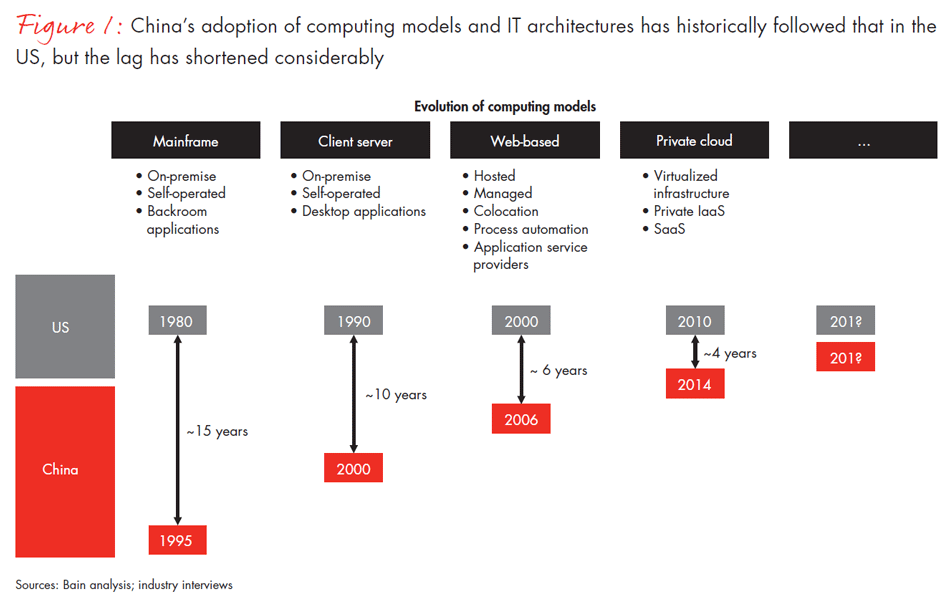
      China’s adoption of computing models and IT architectures has historically trailed that in the US, but this time lag has shortened over the past 20 years (see Figure 1). The cloud computing market is still nascent in China—it was $1.5 billion in 2013, about 3% of China’s enterprise IT market—but we expect it to grow faster than overall IT spending. By 2020, cloud spending could reach $20 billion, representing, at the high end, a compound annual growth rate of 40% to 45% that will lift it to 20% of China’s IT market (see below). Rapid growth, however, depends on overcoming several hurdles.

      First and foremost is broadband infrastructure. Speeds are slower than elsewhere: an average 3.4 Mbps in the fourth quarter of 2014 compared with 11.1 Mbps in the US. Penetration rates also lag: 14% for fixed and 21% for mobile broadband subscribers per capita in China compared with 29% and 98%, respectively, in the US. Urban areas do better, but companies in the interior regions have difficulty accessing remote applications and data at speeds comparable to those in developed markets.

      Beyond infrastructure, cultural and business norms hinder cloud adoption. Heightened awareness of the vulnerabilities of information security has created a preference among Chinese businesses to maintain close control of their workloads and data. A bias for Capex over Opex—a desire to own hardware and software rather than rent them as a service—reinforces a reluctance to put workloads on the public cloud or otherwise outsource IT. 

      Multinational corporations (MNCs) face other unique challenges. China’s government, citing national security concerns, encourages buyers to adopt technology based on locally developed standards and IP, which in practice often translates to using Chinese vendors’ solutions. Some government bodies and state-owned enterprises are beginning to wean themselves off IT gear from IBM, Oracle, EMC and other Western technology companies— a trend known as “de-IOE.” Chinese tech companies like Lenovo, Huawei and Inspur are increasingly competitive and successful in industries with strong security concerns, such as telecommunications. For MNCs aiming to deliver public cloud services, the regulatory requirement to work with a domestic partner creates additional challenges, and that has contributed to the relatively slow development of public cloud to date.

      finding-the-silver-lining-in-chinas-cloud-fig01_embed

      At the same time, tailwinds are accelerating cloud adoption. China’s state-owned telcos plan to invest about $180 billion from 2015 through 2017 in fixed-line and wireless connectivity. The government views cloud as a strategic priority and included it in the nation’s 12th Five-Year Plan. The Ministry of Industry and Information Technology (MIIT) and the National Development and Reform Commission (NDRC) subsequently launched pilot cloud schemes in five cities: Beijing, Shanghai, Shenzhen, Hangzhou and Wuxi. The 13th Five-Year Plan will likely reaffirm the strategic priority of cloud, with the NDRC planning continued investment through 2020. China’s market also comprises many rapidly growing businesses that are less encumbered by legacy IT systems than is typical in more developed markets, which means they can more easily adopt new IT models.

      Now is the time to shape the market, as businesses in China decide which cloud solutions to adopt. Bain research identified a silver lining for most vendors of cloud hardware and software: Many large IT buyers, such as financial institutions, telcos, big Internet companies and well-funded government bodies, favor building their own private clouds over adopting public cloud services (see Figure 2). This creates a window of opportunity for IT hardware and solution vendors to help build out their customers’ private clouds—which is generally more lucrative than selling to one or two large public cloud service providers that might dominate if public cloud adoption accelerates. MNCs could still capture much of the private cloud opportunity, since many of the customers looking to adopt private cloud value tried-and-tested solutions and remain open to sourcing from international sellers, especially where local alternatives are less competitive. Multinational and domestic suppliers alike should move quickly on this front to cement the trend toward private cloud solutions. A broad shift toward public cloud services would create a tougher environment overall and for MNCs in particular, since the companies that deliver public cloud services increasingly rely on hardware from less expensive vendors, potentially including white box solutions.

      China’s private and public cloud

      In China, most cloud adopters choose private or public cloud, with very few embracing hybrid cloud. Private cloud customers spend up to 13% of their IT budgets on their private clouds; public cloud adopters spend less, generally below 10%.

      We expect private cloud to remain the platform of choice for most enterprise customers that can afford it. As we noted earlier, the biggest spenders—financial institutions, telcos, large Internet companies and well-funded government bodies—favor private cloud due to concerns about data security and their preference for investing in things they can own over spending on services. Smaller Internet companies sometimes start out on the public cloud and then go private when success enables them to. Most private cloud users prefer branded hardware, and MNCs still have a strong position here, as well as in infrastructure software. Local vendors, especially Huawei, have done well with telecom operators that have been among the first to “shift local” for these solutions.

      Public cloud is gaining traction in some segments, with local leaders like Aliyun out in front and global competitors such as Amazon Web Services (AWS) entering the market. Customers for public cloud comprise mostly small and medium-sized enterprises, especially in the Internet industry. Some large enterprises in traditional industries use public cloud for customer-facing applications like webpages, e-commerce platforms and mobile apps. Local government bodies with funding constraints and less stringent data security requirements—for example, weather and education bureaus—also tend to use public cloud, in line with the government’s push.

      Kevin Meehan, who leads Bain's Telecommunications, Media and Technology practice in Asia, offers an overview of both the technology market and the opportunities in cloud computing in China.

      Implications for international and local providers

      China’s cloud market is unique, but the basics remain essential. Cloud infrastructure and service providers still need to go to market with the right products and prices, through the right channels and often with the right local partners. As always, strategy begins with assessing your competitive position and opportunities, understanding the competition and determining where your business can best compete—which, in this case, includes deciding whether your company is localized enough in terms of its offering, operating model and partnerships.

      Multinational hardware providers already in China’s enterprise IT market should encourage their customers’ migration to private cloud and help forestall a broader move to public cloud. They should identify the industries least sensitive to the shift away from Western tech providers—generally those that place a premium on reliability, quality and performance. These companies should also carefully weigh the benefits of expanding their focus beyond private cloud to include public cloud server providers, given the latter may favor lower-cost solutions. Finally, multinational equipment vendors and cloud service providers should consider whether the cloud will eventually become more global. Recent moves by some Chinese companies, such as Aliyun’s opening of its first US data center in Silicon Valley and its recently announced deal with Equinix, indicate that they may be looking at the market with globalization in mind.

      Conversely, local cloud equipment vendors should identify the industries that are most sensitive to de-IOE and possibly double down in those verticals. While MNCs currently hold sway at the top of the market, local companies must continue building up their capabilities and product portfolios so they can deliver reliability, quality and performance levels that will allow them to compete effectively. Local players may want to partner with international cloud technology leaders on an exclusive basis if they can. Local IT hardware and solutions providers might be better positioned to serve China’s public cloud service providers and, in some cases, may want to explore becoming public cloud service providers themselves.

      Software companies face a different set of questions. A significant shift toward domestic hardware providers could force multinational software vendors to reconsider which platforms they support as their customer base moves to a mix of international and local player platforms. Makers of application software will need to build the capabilities to sell and deliver SaaS solutions, which, for MNCs, will require partnerships with local firms and the additional layer of complexity that entails.

      Despite the uncertainties and challenges, global cloud providers cannot afford to ignore China’s large and growing market. Increasingly competitive domestic players are finding their niche, but MNCs still have an opportunity to shape the market. Now is the time to identify target segments and invest in solutions for this customer base, as China’s IT buyers decide how they will take advantage of what the cloud has to offer.

      Kevin Meehan and Mark Brinda are partners with Bain & Company in Singapore and New York, respectively. Steven Lu is a partner with Bain in Shanghai, and Christian Hut is a manager with Bain in Hong Kong. All four work with the firm’s Technology practice, and Kevin leads the practice in the Asia-Pacific region.


      China’s enterprise IT market

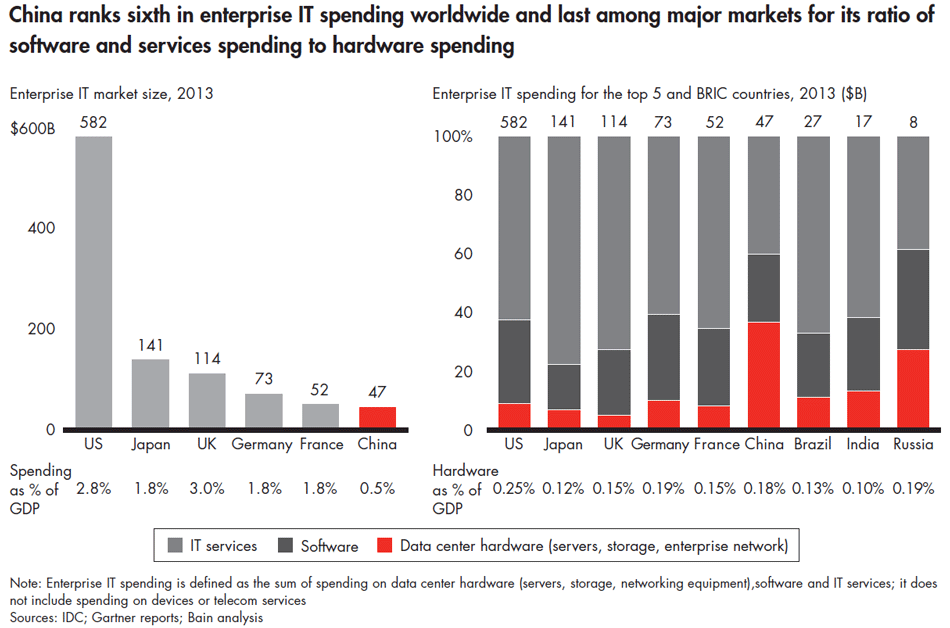
      In 2013, China was the world’s sixth-largest market for total enterprise IT spending and the second-largest in IT hardware spending, on par with other leading nations for hardware spending as a percentage of GDP. But overall, China’s enterprise IT spending as a percentage of GDP is comparatively less, because it spends significantly less on software and services. Among major markets, China ranks last in the ratio of software and services spending to hardware spending. Given this ratio and the still relatively strong growth in IT spending in China, its hardware market remains disproportionately important for leading vendors.

      finding-the-silver-lining-in-chinas-cloud-sidebar_embed

      Local leaders are emerging in China’s IT hardware market, with notable gains across servers, storage and enterprise networking. Enterprise software remains largely the domain of MNCs, with some local players, such as Yonyou, Kingdee and Neusoft, gaining traction. In IT services, local leaders focus primarily on hardware and software support and implementation services. MNCs still lead in higher-complexity services such as consulting and IT outsourcing.


      finding-the-silver-lining-in-chinas-cloud-fig01_full

      finding-the-silver-lining-in-chinas-cloud-sidebar_full
      Authors
      • Headshot of Kevin Meehan
        Kevin Meehan
        Partner, Austin
      • Headshot of Mark Brinda
        Mark Brinda
        Partner, New York
      Related Industries
      • Technology
      Technology
      Steven Lu: China's Evolving Cloud Ecosystem

      China's cloud computing market is growing at a healthy rate, spurred by government support.

      Read more
      Technology
      Software M&A

      The good news: Most deal best practices still apply to AI acquisitions.

      Read more
      Technology
      Exploring AI for Packaging Circularity

      AI is already creating value across the packaging lifecycle, from optimising design and reducing material use to improving sorting and traceability.

      Read more
      Technology
      How Businesses Can Prepare for Post-Quantum Cybersecurity Threats

      Your company will soon face attackers armed with quantum technology. Will you be ready?

      Read more
      Technology
      Where Have All the Sales Reps Gone?

      The math has changed: Future growth won’t reflect the size of the sales staff, but how much value you add.

      Read more
      First published in julio 2015
      Tags
      • Technology

      How We've Helped Clients

      Can Microchips Turbocharge Sustainability Improvement?

      See more related case studies

      Increased sales productivity frees selling time and saves millions

      See more related case studies

      Aggressively growing an IT service provider with a high-performance culture

      See more related case studies

      Want to continue the conversation

      We help global leaders with their organization's most critical issues and opportunities. Together, we create enduring change and results

      Bain Insights. Our perspectives on critical issues global businesses face in today's challenging environment, delivered monthly.

      *I have read and understand Bain’s Privacy Notice.

      Please read and agree to the Privacy Policy.
      Bain & Company
      Contact us Sustainability Accessibility Terms of use Privacy Modern Slavery Act Statement Cookie Policy Sitemap Log In

      © 1996-2026 Bain & Company, Inc.

      Contact Bain

      How can we help you?

      • Business inquiry
      • Career information
      • Press relations
      • Partnership request
      • Speaker request
      See all offices