

Brief

Executive Summary
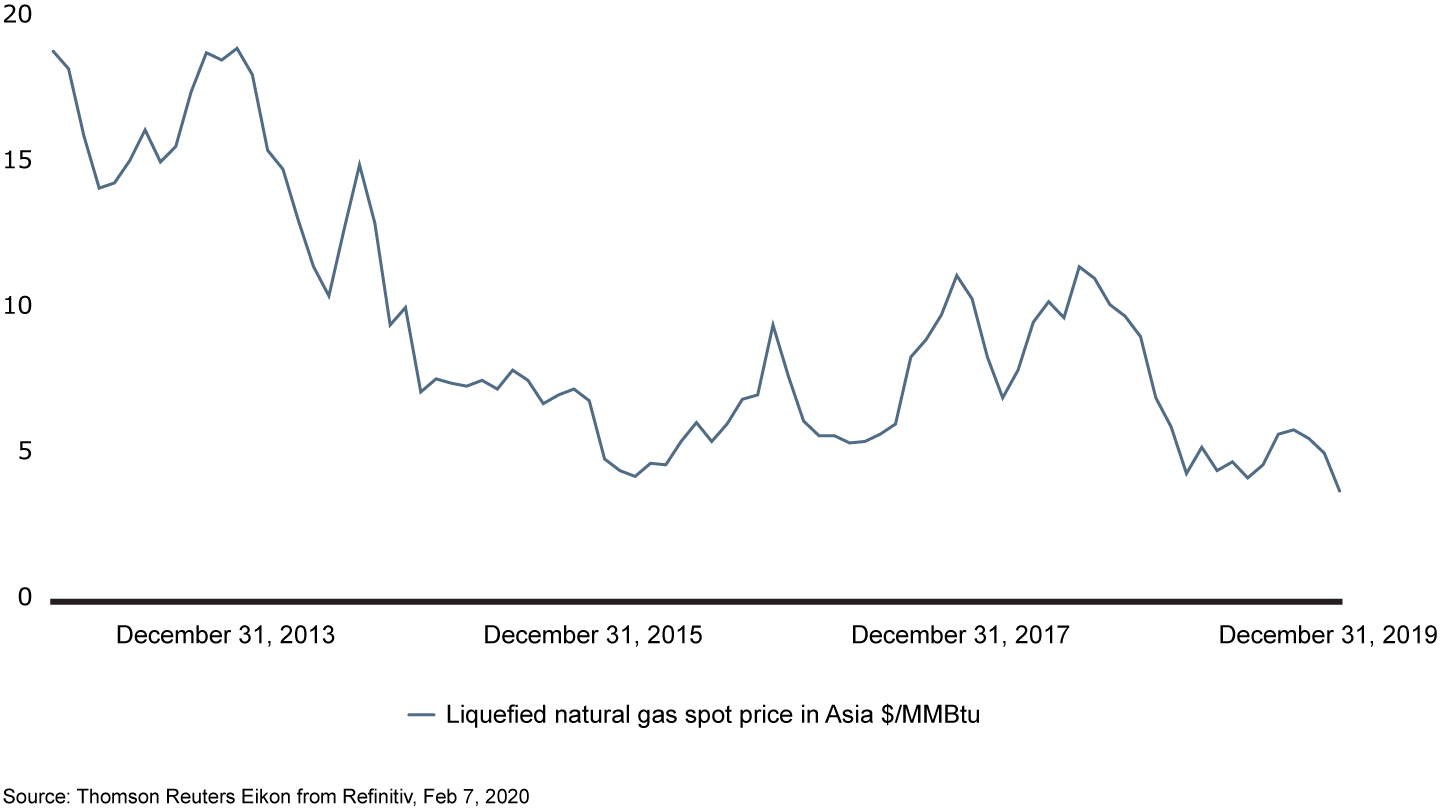
- Prices for liquefied natural gas (LNG) have fallen over the past year because of an oversupply of available natural gas. Fears of a global slowdown due to the coronavirus are likely to depress prices further.
- The price decline adds to the uncertainty over new capital investments. Over the longer term, three trends are shaping the economics of the LNG market: greater flexibility in supply, gas’s expanding role in the energy transition, and greater and more diverse demand.
- The rise in demand creates new opportunities for a range of companies, including large oil and gas companies, independent upstream producers, service companies, infrastructure providers and traders.
- Most players will need to expand their reach along the value chain, making agreements to secure their access to supply and their ability to move it.
The global market for LNG, which was once bound by long-term purchase agreements and dominated by a few key producers, looks very different today than it did a few years ago. Global flows are growing quickly, fueled by rising demand among more customers in more places. Driving that demand is the emerging role of gas as an essential fuel for the energy transition. Because it emits less carbon dioxide than coal when burned, it has become a popular option for electricity generation (although its total impact of greenhouse gases emitted is more of a mixed bag). It’s also seen as a potential fuel for transportation, particularly as a bunker fuel to help maritime fleets meet stricter emission regulations.
Naturally, as with any market that experiences a sudden surge in demand, bottlenecks have arisen, particularly at the points where gas needs to be liquefied to be transported overseas, or where LNG is converted back to gas for consumption. Around the world, investments are being planned to build up necessary LNG infrastructure. But the same flexibility that has helped grow the market can also reduce the certainty of long-term revenue, making these projects more difficult to fund. Many of them will never be built. One reason is that the financial markets that support LNG trading and could facilitate greater funding remain small compared with equivalent markets that facilitate oil and gas trading.
Every player along the natural gas value chain—from upstream producers through infrastructure players, exporters and traders—recognizes the new opportunities and the risks. Many are expanding their position along the value chain, making deals to secure assets, supply or utilization, to avoid being caught on the wrong side of a bottleneck or left with stranded assets. Three major trends guide their considerations.
- Greater supply flexibility. The shale revolution in North America has lifted the US to become a top producer of LNG, along with Qatar and Australia. As more low-cost LNG enters the market, large buyers that once had to accept long-term purchase agreements can secure short-term contracts and remove destination clauses that prevented them from reselling. But this also makes it harder for producers to lock in the long-term, fixed-price agreements that were important sources of financial stability.
- Fuel of choice. Natural gas will play an important role in the energy transition, serving as a bridge fuel for power generation between coal and renewables. It burns cleaner than coal, although when methane emissions at the production source are included, along with the carbon impact of liquefaction, transport and regasification, LNG’s footprint is similar to that of oil.
- More demand from more customers. New markets often lack infrastructure to receive LNG and turn it back into gas. By financing import facilities in these markets, LNG suppliers and traders open new outlets for their products. Some depend on floating storage regasification units (FSRUs), which are cheaper and faster to deploy than traditional infrastructure, such as pipelines and large regasification terminals.
Since late 2018, an oversupply of LNG has pushed down prices, raising uncertainty about the feasibility of many proposed infrastructure projects (see Figure 1). To navigate this volatile market, players across the value chain will need to understand the effect of these trends on their business and identify new participation models that allow them to make sure they have access to supplies and markets and are not edged out by shifting dynamics.
Figure 1

Opportunities across the value chain
The opportunities in a larger and more liquid global market will be great, but those opportunities look different for each player, depending on the starting point.
- IOCs and NOCs. To make sure they don’t find themselves on the wrong side of a bottleneck, the international majors and the national oil companies are acquiring or developing upstream assets while also investing in liquefaction and regasification terminals essential to imports and exports in Europe and Asia. For example, ExxonMobil has signed a preliminary deal to secure much of the capacity of Germany’s first LNG terminal, an FSRU scheduled to begin operating in Wilhelmshaven in 2022.
- Upstream producers. Large independent gas producers are making deals to ensure they have a market for their supply. Apache’s 15-year agreement with leading US LNG exporter Cheniere Energy is an example. The terms of the deal are a sign of the increasingly fluid market: Rather than guaranteeing Apache a set price, Cheniere will market the LNG overseas, giving Apache exposure to both the risk and reward of moving further downstream in the value chain.
- Infrastructure providers. In North America, the buildup of midstream and liquefaction capacity moves the bottleneck for gas offshore. For pipeline companies and other infrastructure players, the game is less about connecting two domestic points, and more about working with offshore logistics providers to make sure LNG can reach its end market. The ambition extends beyond their traditional purview, but it is designed to ensure gas keeps flowing through their pipelines.
- Service companies. Engineering, construction and maintenance firms all stand to benefit from more capital investment in LNG projects, but they should prepare for cyclical waves of development. Private equity companies that have their eyes on thriving service companies need to consider the cyclical nature of the oil and gas industry and take a realistic approach to growth projections, one that considers various scenarios based on many factors (see the Bain Brief “Managing the Energy Transition: Three Scenarios for Planning”).
- Traders. Greater supply and liquidity of LNG are creating new opportunities for arbitrage and substantial growth in LNG trading. The top three commodity trading firms (Gunvor, Trafigura and Vitol) more than doubled their trade volumes over two years, going from trading 13.5 million tons in 2016 to 28.8 million tons in 2018. IOCs, NOCs and other LNG producers have taken note and are building up their trading capabilities to capture additional value.
A developing global market
The role of traders is likely to become increasingly important as the global market for gas evolves and as more players adjust their plans to reflect these new realities. The historical limitations on LNG trading have kept the market relatively illiquid and far below the scope of trading seen in the global oil market. For example, only two years ago, the total annually traded volume of the Japan-Korea Marker LNG futures contracts stood at 2% of global LNG production. In comparison, crude oil financial markets have dwarfed the physical market for many years, with exchange-traded contracts representing more than 10 times the value of total annual global production.
Long-term contracts still dominate the LNG market, but the share of spot and short-term sales—deals outside the bounds of the larger, fixed-price contracts—is rising, up from about 12% in 2009 to about 32% in 2018. Even large LNG consumers such as Japan and the European Union see the benefits of greater flexibility in purchase agreements, and they are pushing for short-term contracts without the destination clauses that have restricted their ability to manage domestic energy demand swings.
For example, Japan’s Strategy for LNG Market Development shows the government’s commitment to remove destination clauses, make public financing available for LNG projects (including price hub developments) and increase third-party access to existing LNG infrastructure (such as access to regasification terminal capacity). The EU’s Strategy for LNG and Gas Storage is another effort aimed at reducing pipeline gas dependence.
Beyond these large markets, governments around the world will continue to promote projects that increase demand for LNG because it emits less carbon when burned than coal or oil. (Although, as indicated above, leakage of methane at the production point and in transit can undermine the case for LNG being an ideal carbon solution, reinforcing the need for modernized operations.) For example, China’s Blue Sky initiative for reducing air pollution includes measures that would increase the use of LNG. Sinopec plans to build new infrastructure that will double its receiving capacity of LNG over six years, and the state has created a national oil and gas pipeline company to help ensure supply isn’t hindered by bottlenecks. Domestic market reforms will encourage state-owned companies to provide greater access to regasification facilities and nurture a trading hub in Shanghai.
As the larger markets have matured, LNG producers and traders saw the potential to open new markets by financing LNG-receiving facilities in developing countries. Trading houses such as Gunvor and Vitol have helped to open new markets in developing countries such as Pakistan and Bangladesh, where buyers may not have the credit rating and financial reliability demanded by large producers in Qatar and Australia.
Innovative technology solutions such as FSRUs and the ability to transfer LNG from one ship to another (ship-to-ship break-bulk) have altered the economics of small-scale LNG (ssLNG), opening previously inaccessible markets. These emerging markets are the main driver of growth for ssLNG, and their early development provides guidance for how this part of the industry may flourish. On Malta, for example, ssLNG supplies fuel directly to the Delimara power station for electricity generation. Also in the Mediterranean, the Poseidon Med II project aims to build a network of marine bunkering stations, to use ssLNG for maritime fuel.
Strategic imperatives
While the particular implications vary from one industry player to another, the principles driving deals and new investment are more universal: Make sure you don’t get bypassed or stuck behind a bottleneck, and see where you can participate to capture new value in this growing market. Four principles can help executives prioritize their LNG development programs.
Expand across the value chain. In the short term, the glut in gas supply will act as a drag on investment decisions. In the longer term, we will see continued investment in LNG transport infrastructure—including regasification, storage, vessels and liquefaction terminals—to match rising demand. For example, liquefaction companies are building relationships that ensure participation in the next wave of build-out, while securing deals aimed at keeping utilization levels high. In recent years, the best arbitrage opportunities have been in sending US supply to Northeast Asian markets, which indicates the strategic advantage of owning liquefaction capacity in one of the US terminals—a move that IOCs and NOCs have understood and are acting on.
Innovate to solve problems. Short-term contracts and spot selling are among the business model innovations that have had the greatest impact on the LNG market in recent years. The deployment of FSRUs and LNG transported by truck or rail in ISO containers, and their ability to deliver small-scale LNG to developing markets, may be the most visible symbols of innovation specifically aimed at finding ways to serve more demand from more places. But there are many other innovations in technology and business models shaping the economics of gas production and transport across the value chain, including better analytics, artificial intelligence and machine learning, and block chain.
Plan for cycles. Some of the more recent investments in gas, particularly from private equity, may have their eye on growth curves that show an exciting picture of recent years while failing to accurately depict the true cyclical nature of the hydrocarbon sector. Industry veterans are more accustomed to the boom and bust nature of commodities. Savvy participants recognize that they should model the infrastructure side of this business project by project, rather than based on trended growth rates. Those participants seek to diversify their positions, placing higher values on cash flows that are driven by production volume or maintenance than on those stemming from project build-out.
Improve trading and marketing capabilities. As IOCs, NOCs and independent producers set up trading desks, not only do they develop new revenue streams, but they also gain insights on trade patterns and drivers of supply and demand. Trading helps producers develop deeper relationships with trading partners, and improves their ability to bundle products, conduct bilateral trades and become more flexible in the quantities they deliver (see the Bain Brief “How Commodity Producers Can Raise Their Trading Game”). Among the capabilities that trading desks need to develop:
- Dynamic trading strategies. Continuously monitor the global LNG market and adjust strategies to capture arbitrage opportunities.
- Strong risk and financial controls. Clear trading limits, well-defined finance policies and a control team with authority to act as a check on traders all help a firm manage risk.
- A best-practice trading organization. Success depends on attracting and retaining top trading talent, but it’s also necessary to align traders’ incentives with those of the business.
Natural gas and LNG are certain to become increasingly important as markets move through the large-scale energy transition underway. Gas’s role as an important bridge fuel will speed the transition away from coal while the power sector works to resolve intermittency issues with renewables. Gas is also destined to become a more important fuel in transportation, particularly as fuel for the maritime industry, where cleaner air standards will require merchant ships to convert from dirtier bunker fuels to natural gas to maintain their access to many ports. In the long term, opportunities around gas seem destined to grow, and those who can place themselves strategically along the value chain stand poised to benefit the most from that growth.
The authors would like to thank Rob Goodenough, Brian Murphy, Peter Parry and Dave Rennard for their contributions to this work.
First published in marzo 2020