

Brief

Executive Summary
- More than one-third of companies say their supply chain technology falls short in providing real-time insights.
- Emerging technologies are transforming companies’ ability to respond to rapidly changing market dynamics.
- Leading companies are moving to a core-light architecture and Agile ways of working to increase supply chain resilience and competitiveness.
It was a painful lesson. Companies that once boasted the world’s leanest, most efficient global supply chains have suffered the greatest disruptions from Covid-19 and geopolitical tensions. Saddled with inflexible networks, their organizations now are struggling to meet a quadruple challenge: soaring customer expectations for faster delivery, customization, lower cost, and sustainability.
To stay competitive, companies need to build more resilient, flexible supply chains. More than one-third of companies say their technology fell short in providing real-time insights needed to adapt operational strategies to a changing market, according to a recent Harris poll. But many senior executives are uncertain about how to proceed. The traditional practice of upgrading and replacing supply chain backbone technology every 12 to 15 years is far too slow to meet urgent new challenges. Starting a multiyear transformation today risks producing a technology backbone that’s obsolete as soon as it’s launched. It also will be unable to integrate innovative digital solutions quickly in response to market changes.
Leaders overcome this hurdle by taking a more adaptive approach. They deploy rapidly evolving technologies, including cloud-based software-as-a-service applications, that continually enhance the supply chain backbone. For example, artificial intelligence, machine learning, and advanced analytics improve forecasting and network optimization. These companies understand that an adaptive technology architecture is the foundation for a more resilient supply chain—and a powerful competitive advantage.
In our experience, leaders get two things right: They opt for a core-light architecture and embrace Agile ways of working. The technological and organizational moves are interdependent. An Agile, test-and-learn approach to innovation requires a technology architecture that can adapt easily to change, such as a cloud-based system that offers software as a service. Similarly, an adaptive technology approach can achieve its full potential only when companies manage supply chain processes from end-to-end. That means eliminating silos that separate functions, business units, and countries.
The digital tech remedy
Rapidly evolving technologies are transforming companies’ ability to meet supply chain challenges. In response to ongoing disruptions in 2020, 76% of companies increased the use of digital network technologies, according to the Harris poll. Some of the most innovative solutions combined existing digital applications with emerging technologies.
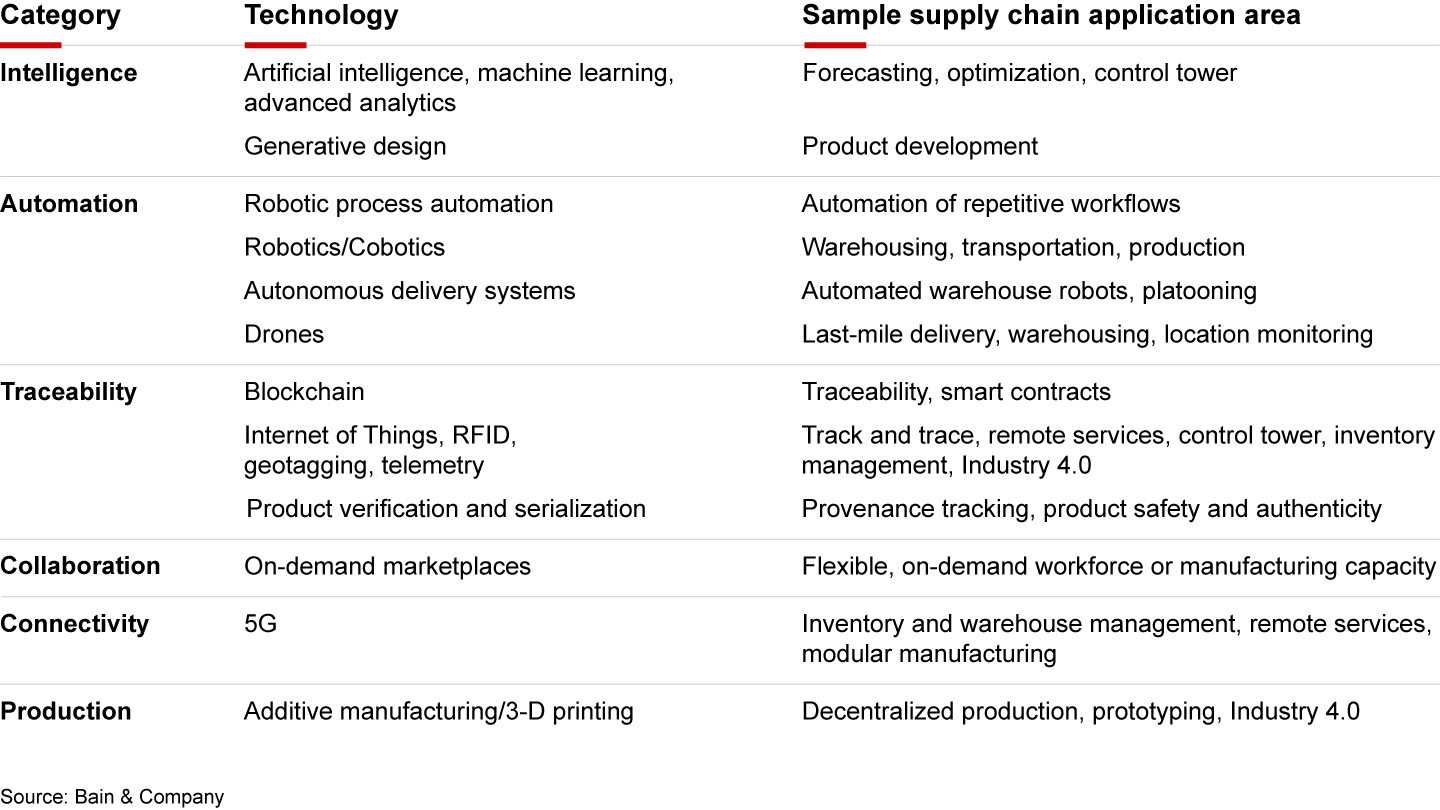
But the list of technology innovations is long and often intimidating (see Figure 1). Innovation is accelerating, and the vendor ecosystem is evolving rapidly. For many leadership teams, implementation poses new challenges and risks, such as scaling solutions across heterogeneous operations. As a result, few companies take full advantage of new technologies. Only 8% of global firms have achieved their targeted business outcomes from investments in digital technology, according to a recent Bain survey.
Figure 1

Many executives eager to turn their supply chain into a competitive weapon wonder which innovations will provide the greatest advantage and how they can make the most of exciting new IT solutions. But successful companies view the challenge differently. They focus on creating the capability to reinvent their supply chains continually, based on changing market dynamics. And they remove the obstacles in their way.
In fact, the starting point for most companies is a core-heavy legacy architecture. Mergers and acquisitions often saddle organizations with multiple enterprise resource planning (ERP) systems that no one bothers to harmonize. Data typically resides in silos, with no master data-management concept. That makes it cumbersome to generate insights and analysis from the company’s data. Senior executives acknowledge the problem. In the Bain survey, they ranked legacy supply chain architecture as the No. 2 obstacle for achieving their company’s digital ambition. Adding to the sense of urgency, both SAP and Oracle have announced they’ll soon discontinue support for some legacy ERP systems.
A critical first step in moving toward a more supple supply chain is identifying the competitive elements of your supply network and those that offer no distinct edge. Leaders build on their advantages by adopting Agile ways of working and an adaptive tech architecture.
Core-light, adaptive technology architecture
A core-light technology architecture gives companies a rapid and flexible way to transform legacy supply chain systems. Leading companies achieve this flexibility by shrinking the ERP software core, so it becomes a single source of truth for critical data required by multiple applications (see Figure 2). The remaining tasks that the ERP previously carried out are broken up into smaller modules, often called microservices. These modules and the ERP core connect through application programming interfaces (APIs).
Figure 2
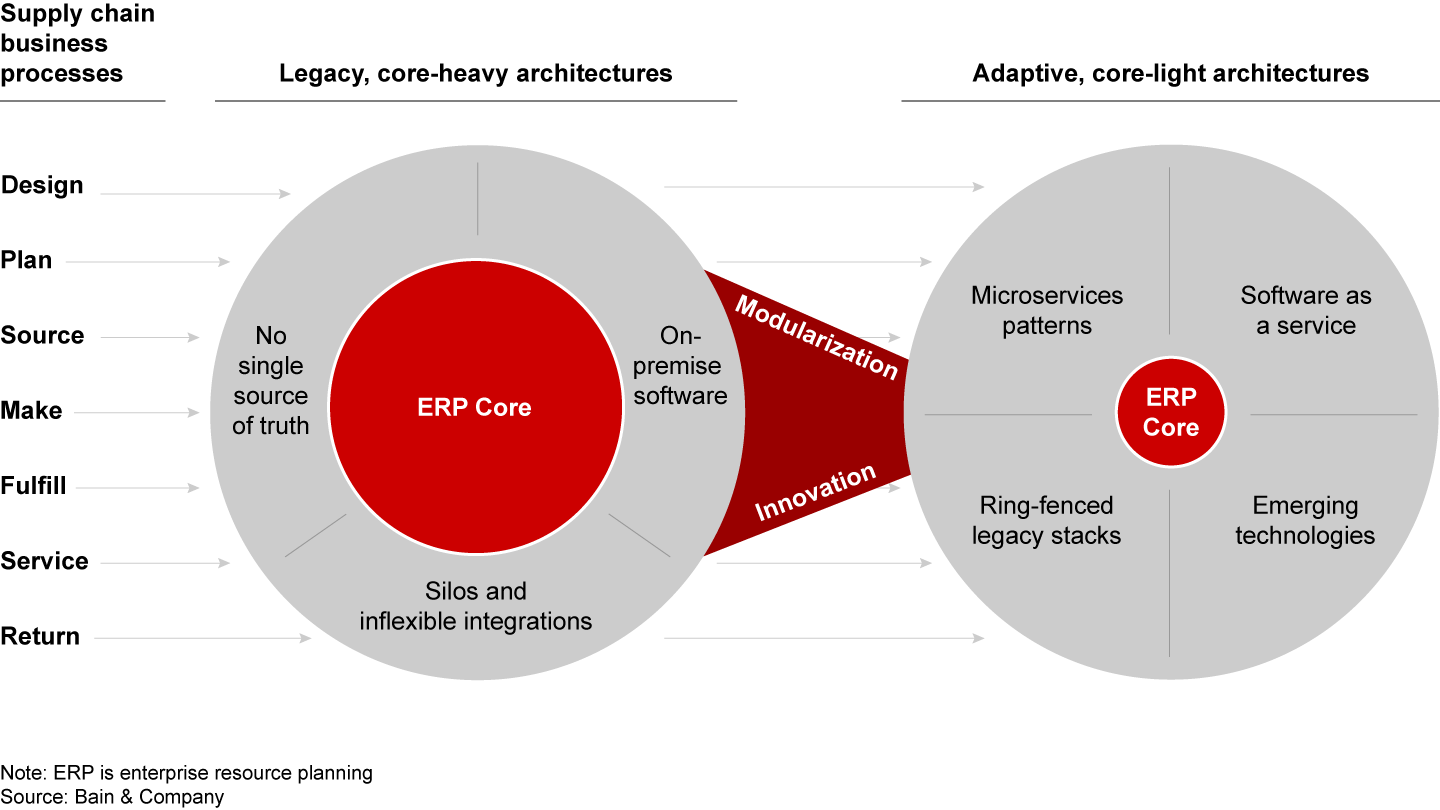

Leaders complement the ERP core with an ecosystem of best-of-breed business applications typically based in the cloud. They include capabilities such as real-time event management through software solutions such as those offered by Kafka or Confluent. The integration layer is critical because it connects different services while preserving the architecture’s flexibility and adaptability. Companies like MuleSoft, SnapLogic, or Dell Boomi offer integration capability as a service.
In recent years, many companies invested in demand planning, forecasting, quality, and logistics systems, but didn’t make them interoperable with the supply chain technology architecture. These organizations now struggle with inconsistent data models. As a result, developing data-based insights is tedious and time-consuming.
Companies pursuing a more flexible architecture avoid those problems by developing a data strategy and reevaluating current master data-management rules. Architecture components supporting data analytics include data lakes, data pipelines, event streams, and automation and analytics engines. During a transformation, forward-thinking executives don’t jettison legacy systems that are packed with business logic. They incorporate them in the new architecture.
Successful companies understand their supply-chain organizations need a secure and efficient way to exchange data and information with their partners, customers, and the broader ecosystem. That means tracing inputs and value added at every stage of the supply chain, from sourcing of raw materials to distribution to the customer. Upstream suppliers and partners in the ecosystem create visibility by pooling information on inputs and the conversion processes these inputs undergo. Circular business models, which extend the lifespan of a product and optimize the environmental footprint of operations, also need to trace products downstream, even beyond the point of sale.
To trace a product from creation to the point of sale, a company’s supply chain architecture needs to exchange data with various internal and external systems. These systems are decentralized and often sector-specific, addressing a specific use case. One example is Surgere’s AutoSphere, a cloud-based platform for automotive original equipment manufacturers, their suppliers, and transportation service providers. The platform identifies and traces assets across the supply chain, allowing suppliers, for instance, to track returnable packaging containers in real time. That improves allocation, availability, and distribution of the containers, optimizing logistical costs and service levels. Another example is MediLedger, a decentralized blockchain platform that pharma companies jointly built to comply with the US Food and Drug Administration’s Drug Supply Chain Security Act, which requires that manufacturers use a digital system to store transaction information and the history of a drug, starting in 2023.
Companies that use an adaptive architecture approach can rapidly add features and functionality without breaking existing relationships between systems and solutions. That enables companies to make more data-driven decisions powered by artificial intelligence and machine learning, and to optimize supplier, internal user, and customer interactions in real time. The architecture also offers a solid foundation for companies to build a control tower as an intelligent overlay on existing systems. Finally, replacing outdated solutions is easier and less expensive, so organizations can continually innovate and scale new capabilities.
Agile ways of working
Companies that wield their supply chain as a competitive weapon understand that Agile ways of working are just as critical as the right technology architecture. An Agile approach increases the success rate of transformation projects by 62%, compared with traditional methodologies. But in the 2020 Digital.ai State of Agile Report, only 1 out of 10 executives reported using Agile in operations.
The traditional boundary between information technology (IT) and the business is blurring, and rightly so. Functional silos make it nearly impossible for the organization to keep up with innovation in each domain. Leading companies typically follow a federated IT operating model. The chief information officer (CIO) manages the core IT capabilities and architecture building blocks. The CIO also selects the best-of-breed applications such as supply chain planning systems or customer relationship-management systems in collaboration with the relevant process or function leader. The goal is a core architecture that empowers the rest of the organization to access relevant data and to use new tools.
Leading companies create cross-functional teams to develop and manage supply chain technology architecture. These teams include supply chain practitioners, IT thought leaders, and data scientists. The supply chain practitioners understand the characteristics future supply chains will require to meet customer needs. The IT thought leaders keep track of the changing technology landscape, identify suitable solutions, and ensure seamless integration with the existing architecture. And the data scientists turn data into insights and action. Agile teams create solutions to user problems and continually elevate supply chain capabilities. According to the Digital.ai report, Agile teams are 58% more efficient, 70% better able to manage changing priorities, and 74% faster to market, compared with traditional project teams.
Over time, Agile teams become skillful in scaling new supply chain solutions and effectively managing the broader ecosystem, including partners. That’s one reason leaders focus on building internal supply chain technology talent instead of relying heavily on third parties. Overdependence on external technology providers can also shrink the internal talent pool over time. That approach risks slowing innovation and undercutting future growth.
Supply chain transformations need not drag on for months or years before delivering benefits. By adopting an Agile test-and-learn approach and adaptive technology architecture, companies can determine whether a product is viable in 30 to 90 days. Teams that don’t reach the desired outcome can pivot quickly. Many leading supply chain technology vendors are taking this approach to deliver value to customers within three months through coordinated, strategic deployments of minimum viable products.
Competitive edge
Leading companies put supply chain technology strategy on the C-suite agenda because it’s critical to competitive edge—and a huge opportunity to rebuild internal tech muscle. In the past, leadership teams left important architecture decisions to external providers and system integrators. As the supply chain grows in strategic importance, successful companies are taking a more independent approach to technology and moving away from a single large provider.
Taking a strategic approach to supply chain architecture allows companies to improve profitability, increase flexibility, and react rapidly to changing customer demands. Instead of one huge transformation, leaders launch several loosely coupled, strategic projects to start closing the gap between current and future supply chain capabilities. Some teams focus on shrinking the core and making it ready for integration, while others scout, test, and scale best-of-breed supply chain solutions. By combining a data management strategy with Agile implementation and clear governance, they’re moving quickly to build a winning supply chain architecture for the future.
First published in mayo 2021