

Article

Executive Summary
- Emerging markets such as China and Southeast Asia are critical for consumer products multinational companies (MNCs) seeking sustainable growth.
- However, many MNCs have lost critical ground as the “halo effect” they once enjoyed in the premium segment diminishes, the mass segment outpaces growth for many categories, and insurgents continue to rise.
- These challenges reflect Bain’s Elements of Value® framework, as local players have elevated their offerings, eroding MNCs’ differentiation.
- To stay competitive, MNCs should clarify their target segments, enhance value differentiation in the premium segment, and explore innovative strategies to accelerate growth in the mass segment.
Emerging markets are critical battlegrounds for consumer products companies that are chasing sustainable, volume-driven growth in today’s post-globalization world, according to Bain’s Consumer Products Report 2025.
In the report, executives identified two major global challenges—increased competition for shoppers and decreased consumer spending—that are particularly acute in China and Southeast Asia. For decades, multinational corporations (MNCs) have prioritized and thrived in emerging markets by delivering superior quality and unique value propositions—even creating new categories, as Coca-Cola did when it brought carbonated beverages to the Philippines in 1912. But consumers have grown more discerning, local competition is more intense, and macroeconomic uncertainties are rising. As a result, many MNCs have lost critical ground.
The crisis of value for MNCs in China and Southeast Asia
In China, the fast-moving consumer goods (FMCG) market has slowed significantly since the COVID-19 pandemic, primarily driven by price deflation. Foreign brands have struggled against domestic competitors, losing two percentage points of market share in 26 categories1 between 2019 and 2023 (from 31% to 29%), according to Bain’s China Shopper Report 2024, vol. 1.
Even traditionally strong MNCs have encountered setbacks. Only a few consumer goods MNCs, such as Danone and HEINEKEN, grew in China in the first three quarters of 2024. In Southeast Asia, the top 35 non-Asia-Pacific FMCG companies2 have lost market share in the past five years, with the steepest declines occurring in Indonesia, the Philippines, and Singapore,3 according to Euromonitor data.
MNCs’ challenges in China and Southeast Asia can be linked to the diminishing “halo effect” they once enjoyed in the premium segment and shifting category dynamics. MNCs are typically less competitive in the mass segment, which has been growing faster than the overall market for many categories. A new cohort of ambitious insurgents has added to difficulties faced by incumbents in these markets.

Takeaways for Asia-Pacific from Bain’s 2025 Consumer Product Report
Bain partners share perspectives on the state of Asia-Pacific CPGs and how leaders can sustain growth by leaning into tech and AI-led business transformation.
The diminishing “halo effect” in the premium segment
Historically, MNCs led the premium segment, supported by the perception that foreign brands were superior, aspirational, and symbolized trendiness and quality. However, in recent years, that “halo effect” has waned and local brands have substantially increased their quality and competitiveness. Maogeping, a high-end Chinese makeup brand, achieved 35%+ CAGR from 2021 to 2023—a period of negative industry growth. The company delivered high-quality, professional-grade products and emphasized Chinese cultural aesthetics to great success in the domestic market, going public in 2024.
Disadvantages in mass segments
Category dynamics in Southeast Asia and China are becoming unfavorable for MNCs. Mass segment growth has outpaced overall market growth in several categories.
Local incumbent players also have several advantages over MNCs, which are often restrained by higher cost structures, steeper margin requirements, and complex decision-making processes.
Compared to MNCs, local giants are more willing and able to employ low-cost, low-margin strategies or absorb prolonged losses to achieve scale. Local players also capitalize on proprietary route-to-market (RTM) networks, enabling them to distribute products efficiently and cost-effectively.
In Indonesia, food and beverage incumbent Mayora leveraged an extensive, proprietary distribution network and large-scale advertising to win market share. By offering affordable, “good-enough” products, it achieved 6% annual revenue growth and doubled net income between 2016 and 2023. In China, Liby worked with over 1,000 distributors to achieve extensive distribution for its laundry detergent. Liby also pioneered live-stream e-commerce in 2020, which helped fuel 6% annual revenue growth from 2021 to 2023.
The continued rise of insurgents
Insurgents in the Asia-Pacific region are also leapfrogging competitors by offering trendy products, tailored to address the unmet needs of local consumers. They often adopt digital-first marketing strategies, bypass traditional channels, and collaborate with ecosystem partners for production.
Chinese beauty insurgents, such as Skintific and O.TWO.O, have leveraged original design manufacturer/original equipment manufacturer (ODM/OEM) capabilities and expertise in e-commerce platforms like TikTok Shop to scale at an impressive pace in Southeast Asia. In Indonesia, Youvit disrupted the vitamin market by introducing products at a more affordable price than international competitors while addressing nutritional deficiencies in Indonesian diets.
Elements of Value in consumer products
These challenges are a classic manifestation of Bain’s Elements of Value® framework. In line with Maslow’s hierarchy of needs, Elements of Value measures consumers’ perceptions of 31 attributes across four categories: functional, emotional, life-changing and global impact (see Figure 1).
Figure 1
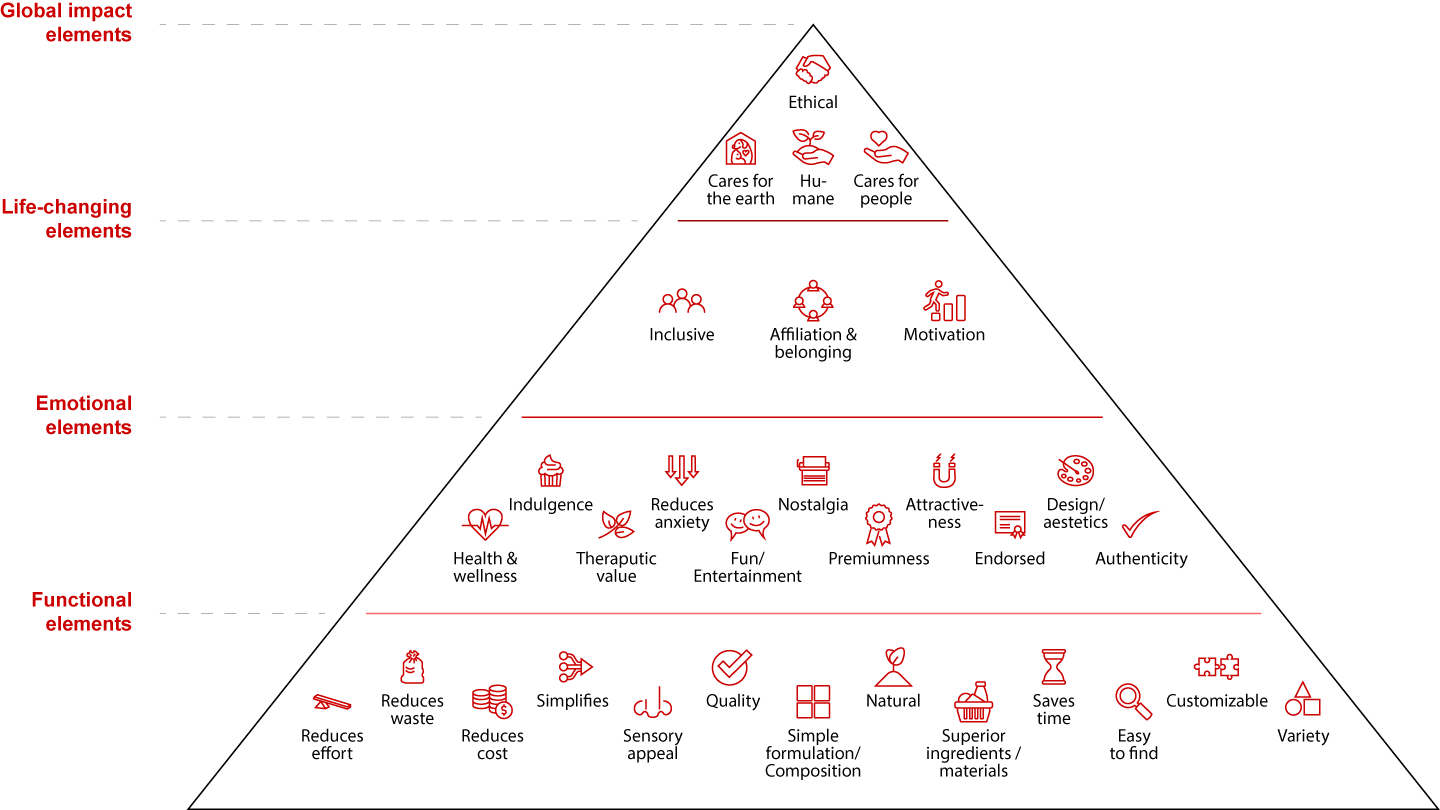

Mass market brands primarily focus on functional and emotional elements of value. For example, in the 2022 Bain Elements of Value Survey, the mass brand Nivea is primarily perceived as focusing on a functional Element of Value (quality) in China. The premium brand L’Occitane, which is priced three times higher, builds brand aspiration by embedding higher-level values and purpose into the brand (e.g., health and wellness, affiliation and belonging, care for the Earth, and being ethical). As L’Occitane illustrates, brands can sustain premium pricing by out-delivering sufficient elements of value relative to their alternatives.
In recent years, local incumbents and insurgents in the Asia-Pacific region have elevated their offerings, eroding MNCs’ value differentiation in the premium segment. Meanwhile, local mass brands have increased their functional value, making it more difficult for MNCs to defend their positions. Combined, these changes have created a crisis of value for MNCs in the consumer products sector in China and Southeast Asia.
Driving Elements of Value with bold, strategic actions
MNCs recognize the crisis, but few are taking bold enough actions to stay relevant in these markets. MNCs must make a strategic choice: strengthen their position in the premium segment, pursue growth opportunities in the mass segment—or both.
Solidify positioning in the premium segment
Now that local brands are more competitive in premium segments, MNCs must enhance their offerings to protect their leadership positions.
First, MNCs need to build brand aspiration by embedding higher-level values and purpose into their products, as L’Occitane has done.
Then, MNCs need to adopt a consumer-centric approach to innovate and adapt their brand positioning to resonate with local consumers. L’Oréal has adopted a consumer-centric approach across many of its brands in China. For example, to revitalize the Helena Rubinstein brand, L’Oréal changed the product’s positioning to focus on skin repair rather than recovery and customized its formulation for Chinese consumers. It also targeted savvy and knowledgeable Chinese customers with relevant content and visuals and a strong digital presence. The new positioning resonated with the local market, enabling Helena Rubenstein to achieve a 12x increase in sales over five years.
Building a premium brand requires consistent and sustained value delivery. One way to achieve that is by creating exceptional and memorable experiences. In Shanghai, Goose Island Taproom offers patrons a modern and inviting space to unwind with friends and savor premium craft beer to reinforce its brand values of being inclusive, fun-loving and explorative. Similarly, Nespresso offers interactive masterclasses in Nespresso boutique stores to share the art of coffee with the brand’s loyal fans.
Capture opportunities in the mass segment
MNCs need to compete like locals to capture opportunities in the mass segment. That requires a competitive cost structure, broad and deep distribution, and investments in marketing and trade— even at the expense of margins.
To achieve a competitive cost structure, MNCs can transform their cost structures organically or unbundle their value chains via partnerships.
Organic cost transformation requires a zero-based approach. Starting with product development, MNCs need to adopt design-to-cost strategies to ensure products meet target price points. This can be challenging for MNCs, since they often impose stricter standards on local operations than local competitors do. That said, successful examples exist, such as OMO in China’s laundry detergent segment, which competes effectively against local players like Liby and Lonkey.
Unbundling the value chain can be an effective way to achieve cost competitiveness. By partnering on specific operational elements—such as R&D, manufacturing, marketing, logistics, or RTM/sales—MNCs can leverage local partners' cost structures and capabilities. The success of Coca-Cola and PepsiCo’s global bottling models underscores the potential of this approach, as it enabled them to achieve both cost competitiveness and widespread distribution.
A balance sheet play could be another winning solution. This might involve acquiring a local brand with inherent cost or capability advantages in the mass segment. This has happened several times in the beer sector in China: Multinational AB InBev acquired Harbin Brewery, and Danish brewer Carlsberg purchased Chongqing Brewery. Alternatively, MNCs can consider spinning off or selling part of the business to local players that can operate more effectively in the mass segment. McDonald’s benefited from this approach. It spun off its China operations in 2017, bringing in well-connected, local shareholders. The move helped McDonald’s expand into lower-tier cities, localize its supply chain, and digitalize. McDonald’s presence in China grew from 2,500 restaurants in 2017 to 6,500 by September 2024.
Conclusion
MNCs will continue to find compelling growth opportunities in China and Southeast Asia. Their success in these markets demands boldness—not just in strategy, but in operations.
Bain’s Element of Value framework can serve as a useful tool to navigate today’s challenges. To start, MNCs should clarify where they want their brands to play: in the mass market, premium segments, or both.
For premium brands, success hinges on how well MNCs tailor their brand positioning for locals, embed higher-level values into their products, and bring those values to life. For mass brands, unbundling the value chain or leveraging balance sheet plays can be creative approaches when organic cost transformation falls short.
Incremental adjustments and short-term fixes are inadequate to meet shifting consumer demands and address intensifying competition. The future belongs to those who are willing to lead, innovate, and rewrite the rules of the game.
The authors extend gratitude to all those who contributed to this report, including Charlotte Apps, Miya Wang, Yifei Gao, and the Bain Capability Network.
Notes
- The 26 categories were (a) packaged food: biscuits, chocolate, instant noodles, candy, chewing gum, and infant formula; (b) beverage: milk, yogurt, juice, beer, ready-to-drink tea, carbonated soft drinks, and packaged water; (c) personal care: skincare, shampoo, personal wash, toothpaste, makeup, hair conditioner, diapers, and toothbrushes; and (d) home care: toilet tissue, fabric detergent, facial tissue, kitchen cleaner, and fabric softener.
- Including top 35 non-APAC headquartered CPGs by revenue in CY23 across Food, Beverages, Alcohol, Pet Care, Personal Care, & Household Care.
- Six Southeast Asia countries are included in the analysis: Indonesia, the Philippines, Singapore, Thailand, Vietnam and Malaysia.
First published in febrero 2025