
Skip to Content
  • Offices

    Offices

    North & Latin America
    • Atlanta
    • Austin
    • Bogota
    • Boston
    • Buenos Aires
    • Chicago
    • Dallas
    • Denver
    • Houston
    • Los Angeles
    • Mexico City
    • Minneapolis
    • Monterrey
    • Montreal
    • New York
    • Rio de Janeiro
    • San Francisco
    • Santiago
    • São Paulo
    • Seattle
    • Silicon Valley
    • Toronto
    • Washington, DC
    Europe & Africa
    • Amsterdam
    • Athens
    • Berlin
    • Brussels
    • Copenhagen
    • Dusseldorf
    • Frankfurt
    • Helsinki
    • Istanbul
    • Johannesburg
    • Kyiv
    • Lisbon
    • London
    • Madrid
    • Milan
    • Munich
    • Oslo
    • Paris
    • Rome
    • Stockholm
    • Vienna
    • Warsaw
    • Zurich
    Middle East
    • Doha
    • Dubai
    • Riyadh
    Asia & Australia
    • Bangkok
    • Beijing
    • Bengaluru
    • Brisbane
    • Ho Chi Minh City
    • Hong Kong
    • Jakarta
    • Kuala Lumpur
    • Manila
    • Melbourne
    • Mumbai
    • New Delhi
    • Perth
    • Shanghai
    • Singapore
    • Sydney
    • Tokyo
    See all offices
  • Alumni
  • Media Center
  • Subscribe
  • Contact
  • Spain | Español

    Select your region and language

    Global
    • Global (English)
    North & Latin America
    • Brazil (Português)
    • Argentina (Español)
    • Canada (Français)
    • Chile (Español)
    • Colombia (Español)
    Europe, Middle East, & Africa
    • France (Français)
    • DACH Region (Deutsch)
    • Italy (Italiano)
    • Spain (Español)
    • Greece (Elliniká)
    Asia & Australia
    • China (中文版)
    • Korea (한국어)
    • Japan (日本語)
  • Saved items (0)
    Saved items (0)

    You have no saved items.

    Bookmark content that interests you and it will be saved here for you to read or share later.

    Explore Bain Insights
  • Industries
    Main menu

    Industries

    • Aeroespacial y Defensa
    • Agroindustria
    • Químicos
    • Construcción e Infraestructura
    • Productos de Consumo
    • Servicios Financieros
    • Salud y Ciencias de la Vida
    • Maquinaria y Equipo Industrial
    • Medios y Entretenimiento
      Industries
      Medios y Entretenimiento
      • Media Lab
    • Metales
    • Minería
    • Petróleo y Gas
    • Papel y Empaque
    • Private Equity
      Industries
      Private Equity
      • Due Diligence
      • Exit Planning
      • Firm Strategy & Operations
      • Portfolio Value Creation
    • Sector Público y Social
    • Retail
    • Tecnología
    • Telecomunicaciones
      Industries
      Telecomunicaciones
      • Capital Expenditure
      • Telco Digital Transformation
    • Transporte
    • Viajes y Turismo
    • Servicios Públicos y Energías Renovables
  • Consulting Services
    Main menu

    Consulting Services

    • Customer Experience
    • Sustainability
    • Innovation
    • M&A
    • Operations
    • People & Organization
    • Private Equity
    • Sales & Marketing
    • Strategy
    • AI, Insights, and Solutions
    • Technology
    • Transformation
  • Digital
  • Insights
    Main menu

    Insights

    • Industry Insights
    • Services Insights
    • Bain Books
    • Webinars
    • Bain Futures
    View all Insights
    Featured topics
    • Tariff Response
    • Artificial Intelligence
    • Thriving in Uncertainty
    • Executive Conversations
    • Macro Trends
    • M&A Report
    • Healthcare Private Equity Report
    • Paper & Packaging Report
    • Technology Report
    • CEO's Guide to Sustainability
    • CEO Insights
    • CFO Insights
    • COO Insights
    • CIO Insights
    • CMO Insights
    View all featured topics
  • About
    Main menu

    About

    • What We Do
    • What We Believe
    • Our People & Leadership
    • Client Results
    • Awards & Recognition
    • Global Affiliations
    Further: Our global responsibility
    • Sustainability
    • Social Impact
    • World Economic Forum
    Learn more about Further
  • Carreras
    Main menu

    Carreras

    • Trabaja con Nosotros
      Carreras
      Trabaja con Nosotros
      • Find Your Place
      • Nuestras Áreas de Trabajo
      • Equipos Integrados
      • Estudiantes
      • Internships & Programs
      • Eventos de Reclutamiento
    • La Vida en Bain
      Carreras
      La Vida en Bain
      • Historias Profesionales
      • Nuestra Gente
      • Dónde Trabajamos
      • Apoyando tu Crecimiento
      • Grupos de Afinidad
      • Beneficios
    • Impact Stories
    • Nuestro Proceso
      Carreras
      Nuestro Proceso
      • Qué Esperar
      • Entrevistas
    FIND JOBS
  • Offices
    Main menu

    Offices

    • North & Latin America
      Offices
      North & Latin America
      • Atlanta
      • Austin
      • Bogota
      • Boston
      • Buenos Aires
      • Chicago
      • Dallas
      • Denver
      • Houston
      • Los Angeles
      • Mexico City
      • Minneapolis
      • Monterrey
      • Montreal
      • New York
      • Rio de Janeiro
      • San Francisco
      • Santiago
      • São Paulo
      • Seattle
      • Silicon Valley
      • Toronto
      • Washington, DC
    • Europe & Africa
      Offices
      Europe & Africa
      • Amsterdam
      • Athens
      • Berlin
      • Brussels
      • Copenhagen
      • Dusseldorf
      • Frankfurt
      • Helsinki
      • Istanbul
      • Johannesburg
      • Kyiv
      • Lisbon
      • London
      • Madrid
      • Milan
      • Munich
      • Oslo
      • Paris
      • Rome
      • Stockholm
      • Vienna
      • Warsaw
      • Zurich
    • Middle East
      Offices
      Middle East
      • Doha
      • Dubai
      • Riyadh
    • Asia & Australia
      Offices
      Asia & Australia
      • Bangkok
      • Beijing
      • Bengaluru
      • Brisbane
      • Ho Chi Minh City
      • Hong Kong
      • Jakarta
      • Kuala Lumpur
      • Manila
      • Melbourne
      • Mumbai
      • New Delhi
      • Perth
      • Shanghai
      • Singapore
      • Sydney
      • Tokyo
    See all offices
  • Alumni
  • Media Center
  • Subscribe
  • Contact
  • Spain | Español
    Main menu

    Select your region and language

    • Global
      Select your region and language
      Global
      • Global (English)
    • North & Latin America
      Select your region and language
      North & Latin America
      • Brazil (Português)
      • Argentina (Español)
      • Canada (Français)
      • Chile (Español)
      • Colombia (Español)
    • Europe, Middle East, & Africa
      Select your region and language
      Europe, Middle East, & Africa
      • France (Français)
      • DACH Region (Deutsch)
      • Italy (Italiano)
      • Spain (Español)
      • Greece (Elliniká)
    • Asia & Australia
      Select your region and language
      Asia & Australia
      • China (中文版)
      • Korea (한국어)
      • Japan (日本語)
  • Saved items  (0)
    Main menu
    Saved items (0)

    You have no saved items.

    Bookmark content that interests you and it will be saved here for you to read or share later.

    Explore Bain Insights
  • Industries
    • Industries

      • Aeroespacial y Defensa
      • Agroindustria
      • Químicos
      • Construcción e Infraestructura
      • Productos de Consumo
      • Servicios Financieros
      • Salud y Ciencias de la Vida
      • Maquinaria y Equipo Industrial
      • Medios y Entretenimiento
      • Metales
      • Minería
      • Petróleo y Gas
      • Papel y Empaque
      • Private Equity
      • Sector Público y Social
      • Retail
      • Tecnología
      • Telecomunicaciones
      • Transporte
      • Viajes y Turismo
      • Servicios Públicos y Energías Renovables
  • Consulting Services
    • Consulting Services

      • Customer Experience
      • Sustainability
      • Innovation
      • M&A
      • Operations
      • People & Organization
      • Private Equity
      • Sales & Marketing
      • Strategy
      • AI, Insights, and Solutions
      • Technology
      • Transformation
  • Digital
  • Insights
    • Insights

      • Industry Insights
      • Services Insights
      • Bain Books
      • Webinars
      • Bain Futures
      View all Insights
      Featured topics
      • Tariff Response
      • Artificial Intelligence
      • Thriving in Uncertainty
      • Executive Conversations
      • Macro Trends
      • M&A Report
      • Healthcare Private Equity Report
      • Paper & Packaging Report
      • Technology Report
      • CEO's Guide to Sustainability
      • CEO Insights
      • CFO Insights
      • COO Insights
      • CIO Insights
      • CMO Insights
      View all featured topics
  • About
    • About

      • What We Do
      • What We Believe
      • Our People & Leadership
      • Client Results
      • Awards & Recognition
      • Global Affiliations
      Further: Our global responsibility
      • Sustainability
      • Social Impact
      • World Economic Forum
      Learn more about Further
  • Carreras
    Popular Searches
    • Agile
    • Digital
    • Strategy
    Your Previous Searches
      Recently Visited Pages

      Content added to saved items

      Saved items (0)

      Removed from saved items

      Saved items (0)

      Expert Commentary

      Classify Demand Series to Improve the Forecast

      Classify Demand Series to Improve the Forecast

      Each class has different demand signal patterns that can help with model selection.

      By Yue Li

      • min read
      }

      Article

      Classify Demand Series to Improve the Forecast
      en

      Companies often group their demand series according to a business or organizational structure, such as a planning hierarchy or reporting hierarchy. Although this type of grouping is easy to organize and report, it is poorly suited for modeling purposes. Instead, companies should think about demand series from the perspective of demand signals and classify them accordingly to better understand them and guide the forecasting process.

      Special demand signals

      There are three special demand signals. Depending on the application, these might require a modeler to handle each in a special manner or ignore them by applying a simple method that improves the computational performance.

      • Retired product series. Sometimes demand series for discontinued products remain in the system. The expected forecast behavior should either filter out these series or generate zero or missing forecast values. The decision on whether to include these series in the modeling process depends on the case. For an important product or when this series can provide useful information to substitute products, the series should be included in the modeling process after adjustment.
      • New product series. Examples include a new product in an existing store, an existing product in a new store or a new product in a new store. The series usually has limited historical observations for modeling, and its use will depend on the application. For example, an assortment planning or pricing project might require new product forecast methods such as attribute-based models or life cycle analysis.
      • Extremely low-demand series. For demand with small values at relatively low frequency, such as demand for special machinery or some luxury products, the historical pattern alone will be hard to model. A critical series—say, products with high margins—might require modeling with additional explanatory variables to capture demand occurrence signals or borrowing information from other series. Otherwise, values from complicated models cannot exceed those from the simple average.

      Regular demand signals

      Regular demand signals can be classified in two ways.

      First, using a business- and project-planning perspective. By classifying demand based on volume, which indicates importance, and volatility, which indicates forecastability, we can classify the demand series into four categories and prioritize the forecasting efforts (see Figure 1).

      Figure 1
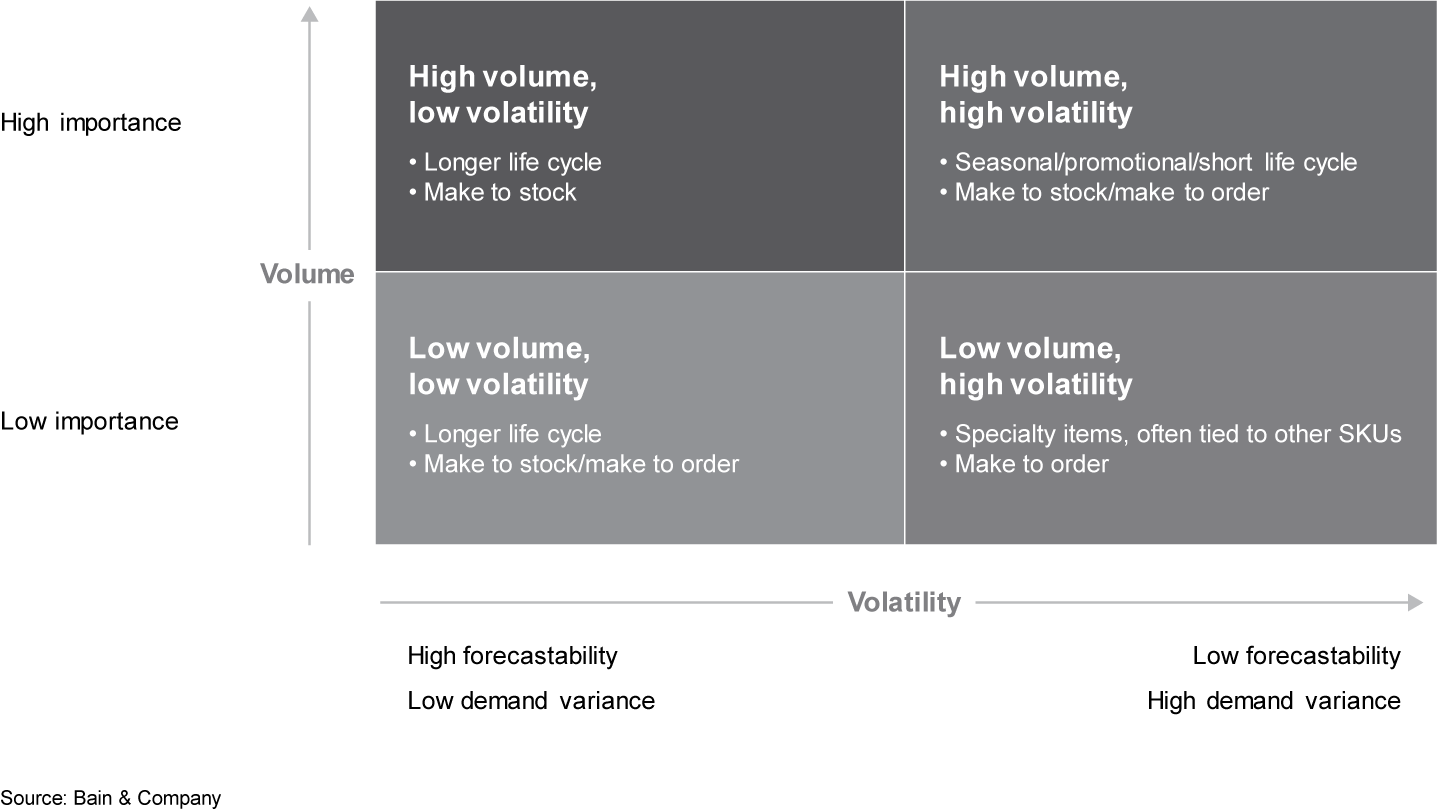
      Four demand classes help to prioritize forecasting efforts
      Four demand classes help to prioritize forecasting efforts
      Four demand classes help to prioritize forecasting efforts

      Usually, high volatility indicates low forecastability. Sometimes, the volatility of the original demand series does not directly serve to measure the forecastability, however, because highly seasonal series, such as one with a sine curve, are highly volatile but not hard to forecast. A more reasonable gauge of volatility in forecasting should be the volatility of the residuals from the benchmark model.

      The advantage of this classification is that it helps to prioritize the forecasting tasks. For an operational level forecast, there are usually thousands of demand series, too many to monitor. It’s more effective to focus on the high-volume, high-volatility class first, since improving forecast accuracy for this category yields the most value. Then we can focus on the high-volume, low-volatility category next, with the low-volume, low-volatility category after that and the low-volume, high-volatility category last.

      Using Pareto’s 80/20 principle, the four classes should be easy to manage and interpret. You can also split each dimension into three categories instead of two so that it has nine classes, similar to ABC/XYZ classification, with a slightly different measurement of volatility. Companies often use ABC/XYZ classification in supply chain management.

      Six categories for demand series

      Depending on the demand cycle pattern, seasonality and volume, we can classify demand series into six categories (see Figure 2).

      Figure 2
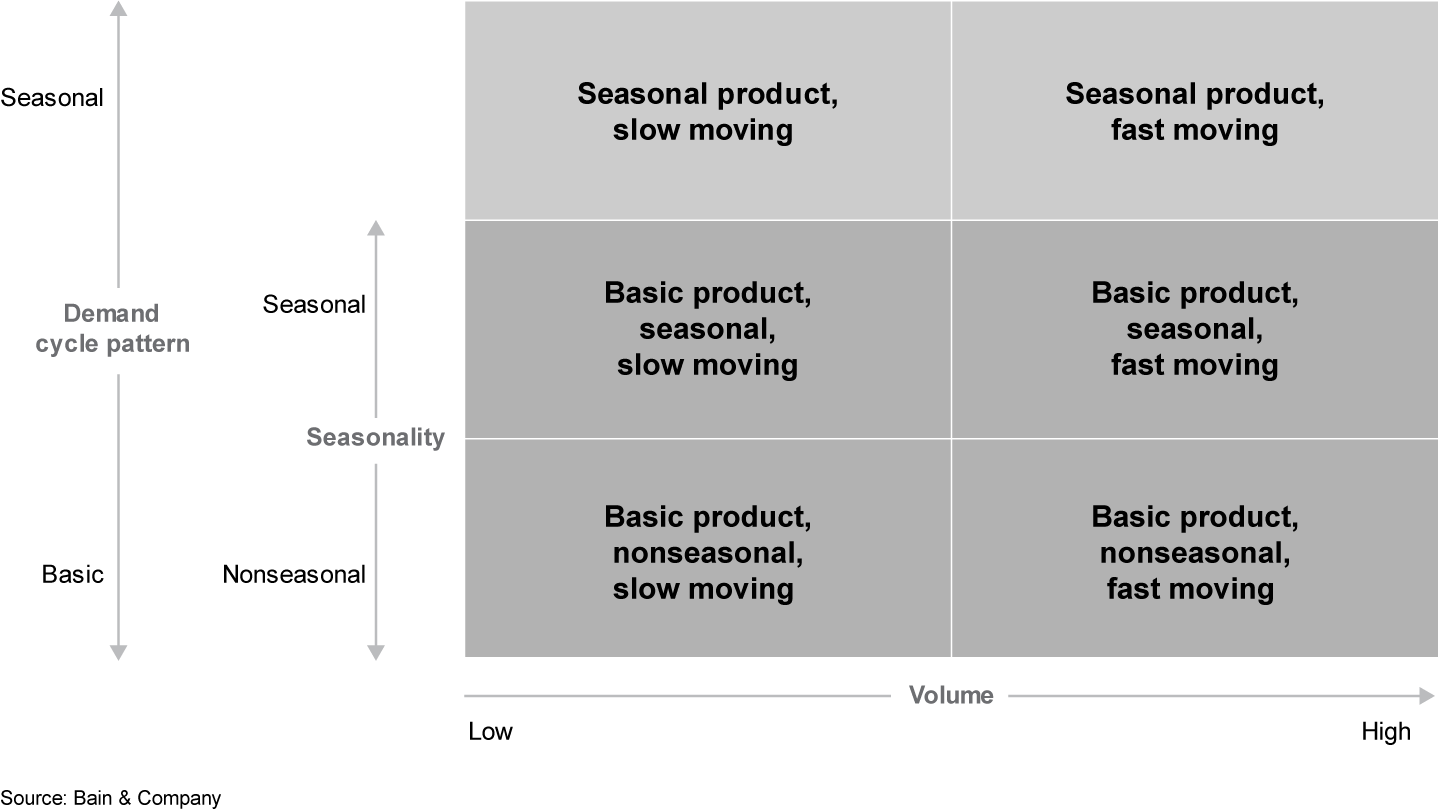
      Each class has different demand signal patterns that can help with model selection
      Each class has different demand signal patterns that can help with model selection
      Each class has different demand signal patterns that can help with model selection

      Each class has different demand signal patterns that can help with model selection. For example, slow-moving series, also called intermittent demand series, might require intermittent demand models or a probabilistic forecast model in order to understand the special distribution of the demand. Seasonal product series, which have big demand gaps during the off-season periods, require models that can handle that pattern, so we might model with a customized time interval or a regression-based model with interval indicators.

      We can use the six categories to diagnose problems with existing forecast results. For example, we might find that a forecasting team encounters issues with some of the products or regions. This classification method can help identify the common characteristics of such series and improve upon them.

      The classification method serves to improve business insights and build trust in the forecast. For example, when working with seasonal product series, such as demand for wood stove accessories, many forecasting models will generate some small, nonzero forecast values for the off-season part of the series. Although the forecast accuracy for these models might be good, it does not make sense from a business perspective because one might not trust a forecast that predicts demand for wood stove accessories during the summer. With the demand pattern in mind, we can avoid such mistakes and build trust in the forecast.

      The classification method can also guide consideration of the downstream decision process. For example, extremely low-demand series, slow-moving series and fast-moving series imply different demand distributions and models for inventory optimization. Therefore, it makes sense to consider them separately during the forecasting process.

      In summary, classifying demand series can help facilitate forecasting tasks by focusing time on high-value cases, understanding the data, identifying forecasting problems, selecting forecasting models, building trust in the forecast and guiding the forecast process.

      Yue Li is an expert with Bain & Company’s Advanced Analytics practice. She is based in Los Angeles.

      Read More

      Advanced Analytics Expert Commentary

      Success with advanced analytics requires both technical know-how and a thoughtful approach. In this series, Bain's experts offer practical advice on some of the most common data issues.

      Authors
      • Headshot of Yue Li
        Yue Li
        Expert Associate Partner, Los Angeles
      Contact us
      Related Consulting Services
      • AI, Insights, and Solutions
      How We Can Help
      • Demand Forecasting
      Advanced Analytics Expert Commentary
      How to Choose among Three Forecasting Models: Machine Learning, Statistical and Expert

      Get to know their strengths and weaknesses.

      Read more
      Advanced Analytics Expert Commentary
      Defining the Intelligent Enterprise

      A recap from DeepLearning.AI’s AI Dev 25 × NYC.

      Read more
      Demand Forecasting
      Predicting Consumer Demand in an Unpredictable World

      While it's more complicated than ever in the Covid-19 pandemic, don’t abandon forecast modeling. Just change how you do it.

      Read more
      AI, Insights, and Solutions
      How AI Is Starting to Transform Circular Packaging

      There are 15 AI use cases companies across the value chain can use today to accelerate circularity.

      Read more
      Advanced Analytics Expert Commentary
      Making Friends with Collinearity: How Driver Interactions Can Inform Targeted Interventions

      Driver analysis helps inform decisions on which drivers deserve the greatest effort.

      Read more
      First published in agosto 2019
      Tags
      • Advanced Analytics Expert Commentary
      • AI, Insights, and Solutions
      • Demand Forecasting

      How We've Helped Clients

      A New Demand Forecasting Approach Signals a Bottom-Line Boost

      Read case study

      Advanced Analytics Breakthrough Lets Metals Company Optimize Yield Cost

      Read case study

      Advanced Analytics powers up UtilityCo’s reliability, and customers notice

      Read case study

      Ready to talk?

      We work with ambitious leaders who want to define the future, not hide from it. Together, we achieve extraordinary outcomes.

      Stay ahead in a rapidly changing world. Subscribe to Bain Insights, our monthly look at the critical issues facing global businesses.

      *I have read and understand Bain’s Privacy Notice.

      Please read and agree to the Privacy Policy.
      Bain & Company
      Contact us Sustainability Accessibility Terms of use Privacy Modern Slavery Act Statement Cookie Policy Sitemap Log In

      © 1996-2026 Bain & Company, Inc.

      Contact Bain

      How can we help you?

      • Business inquiry
      • Career information
      • Press relations
      • Partnership request
      • Speaker request
      See all offices