

Brief

The UK banking industry is once again producing healthy margins, with the Big 5 banks reporting profits for the first three quarters of 2017 that were 50% higher than the same period the previous year. The sector’s performance has inspired investors, who bid up the FTSE All Share Banks Index by almost 12% in 2017.
Despite these auspicious trends, big UK banks face big challenges. Low interest rates continue to put pressure on the average net interest margin, which remains below 3.5% for the industry. Brexit looms large. The separation is likely to change the regulatory environment for UK-domiciled banks and restrict their access to some European capital markets.
At the same time, major UK banks have perennial problems attracting and retaining customers. UK banks have an average Net Promoter Score® (a key metric of loyalty) of 15 points. By comparison, big tech companies such as Amazon and Apple have scores in the 60s and 70s. Meanwhile, fintechs and other digitally adept rivals are nibbling away at both the big banks’ brand equity and their potential share of future growth.
By far the biggest challenge incumbent UK banks face is the advent of open banking—a series of reforms that took effect in January. The new rules, mandated by the Competition and Markets Authority, aim to foster competitive markets and encourage innovation. The regulations require banks to disclose performance and fee data, which will make it easier for customers to compare the offerings and results of different financial providers.
The new rules also direct banks to use open application programming interfaces (APIs). With open APIs, customers can readily share their financial information with other providers, if they choose to do so. Open APIs will also make it much easier for customers of big banks to transfer their accounts, manage payments, and conduct transactions through other banks and nonbanks—thereby creating new opportunities for aggregators to offer customers services from multiple providers on a single platform.
Open banking is good news for consumers, who are likely to gain easier access to a broader array of financial services offered by a larger selection of providers. With open APIs, many of the long-standing barriers to switching providers will dissipate. Big banks face the prospect that many of their customers may seek out the convenience of digital aggregators, taking their accounts, and the profit pools they represent, with them. Analysts estimate that 10% to 20% of current UK banking business is at risk of being disintermediated as a result of these changes in the industry.
John Ott, a partner with Bain's Financial Services practice, discusses why banks in Asia are paying attention to these new regulations and how they are preparing for the continuing shift in consumer expectations.
The risk of losing high-value customers
On the face of it, the big banks don’t seem to be in imminent danger. The Big 5—Barclays, HSBC, Lloyds, Royal Bank of Scotland and Santander UK—still dominate the UK retail banking market, with a collective share of 80%. With the exception of payment providers such as PayPal, Apple Pay and Android Pay—which are used, respectively, by 65%, 16% and 10% of UK consumers—nonbanks and other fintech platforms have made limited inroads.
Alternative platforms such as those provided by Atom, Azimo, Monzo and Xoom each have less than a 2% market share.
However, a survey of more than 4,000 UK banking customers conducted by Bain & Company, Salesforce and MaritzCX shows that big banks have reason to be concerned. Their most important customers—those who have a primary banking relationship, usually in the form of a current account—are at risk of leaving: 63% say they are willing to share financial information concerning their accounts with a competing bank, fintech or aggregator in pursuit of a better offer. In general, UK banking customers are very open to potential disruptors—a reality that open banking will magnify dramatically.
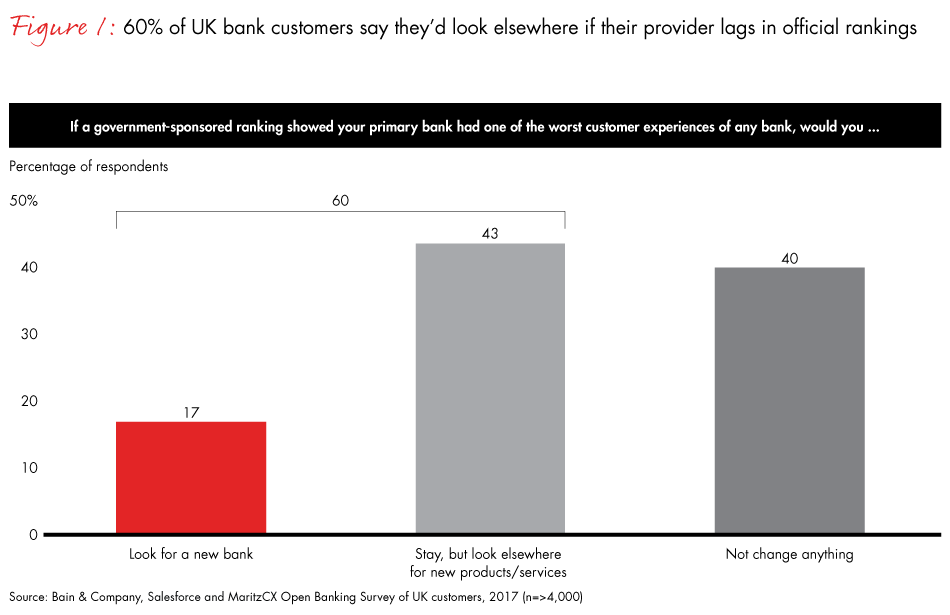
Additional provisions in the open banking regulations that require banks to participate in a regulator-run consumer benchmarking study and publish those results will further threaten primary bank relationships. When we asked consumers what they would do if a government ranking showed their bank was poor on customer service relative to its peers, 17% said they would look for a new bank and 43% said they would stay, but look elsewhere for new products and services (see Figure 1).
Traditionally, consumer-banking relationships in the UK have been stable. Only about 3% of current account holders switch providers each year, according to the Current Account Switching Service. However, consumer loyalty is not exclusive and not guaranteed: 32% of consumers report having two or more current accounts, 57% are in the market for new banking products every year and nearly all report holding some form of financial product with a competing provider.
Generally speaking, big bank customers who give their banks high Net Promoter Scores tend to behave in ways typical of loyal customers. These customers buy more products, are open with the bank about their financial needs, are less likely to churn their accounts and are more willing to refer their bank brand to their friends and family.
That said, in a market that is being disrupted by a force such as open banking, loyalty economics based on historical performance can break down. Competitor landscapes change, redefining for customers what is possible and creating a moment for them to reevaluate their long-standing relationships with brands.
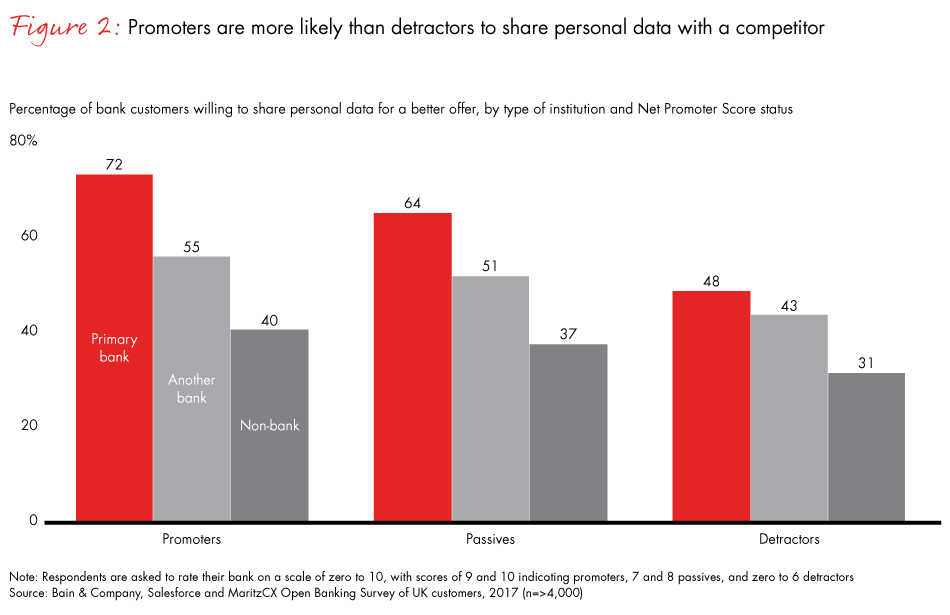
Traditional consumer metrics may predict what banking customers will do in the current marketplace, but may not foretell what consumers will do in a period of disruption. As an example from our survey, NPS® promoters are 24 percentage points more likely than detractors to share information with their existing bank provider, but promoters are also about 10 percentage points more likely than detractors are to share their information with another bank or a nonbank. This implies that customers who have a positive relationship with banks today can be open to innovative banking alternatives in the future (see Figure 2).
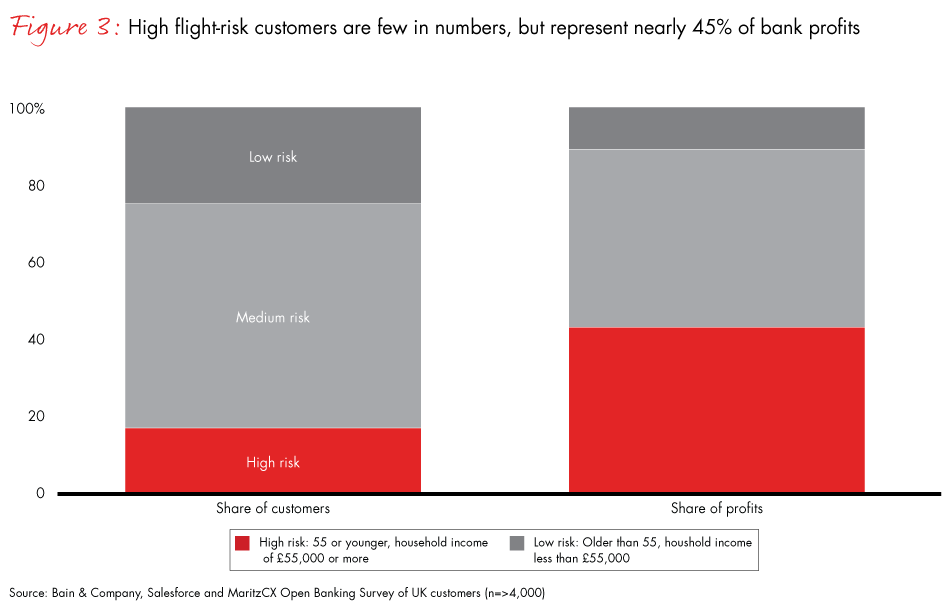
Our survey shows that certain customers are “high risk”—that is, more open to appeals from disruptors in an open banking environment. Those most likely to leave for another provider tend to be 55 or younger and have an annual household income of at least £55,000. Additionally, the majority of these consumers have already adopted at least one alternative fintech solution, such as Apple Pay. Amongst these high-risk customers, 65% are open to sharing their personal data with other banks or nonbanks in order to get better products or services. While high-risk customers account for only 15% to 20% of the total customer base, we estimate that they make up close to 45% of bank profits.
In contrast, about 25% of bank customers are “low risk”—that is, not likely to switch providers or adopt new technologies in an open banking environment. These safe consumers tend to be older than 55 and have an average annual household income of less than £55,000. They’re unlikely to have used fintech platforms, are less willing to share their data with other banks or nonbanks and are much less likely to try an aggregator. However, we estimate that these low-risk customers make up only about 11% of total bank profits (see Figure 3).
The rise of the aggregators
Along with the increased risk of losing high-value customers to competitors in an open banking environment, big banks must also contend with the potential for aggregators to siphon away large portions of their profit pools. Amongst all bank customers surveyed, 59% report already being willing to try a platform that aggregates banking products and other services (such as insurance and investment advice) in order to save money and simplify financial transactions. Within the high-risk group, that figure is much higher, at 74%.
Aggregation in open banking represents a deeper threat to banks than disintermediation by brokers or rate-comparison websites. In these traditional frontend origination services, the relationship with the customer is ultimately with the bank—not the broker or website—once the account is set up.
Aggregators, by contrast, can own the entire customer relationship. They have the potential not only to provide greater transparency and ease of access than banks but also to furnish holistic account management and transaction services on a single platform. If banks lose control of customer transactions to aggregators, they effectively become wholesalers for at least some of their customers.
This disintermediation trend is not unique to banking. Industries that are further along in the cycle of disruption, such as music and travel, have seen 10% to 20%, and sometimes more, of profit pools move away from incumbents in favour of aggregators. These shifts usually take fewer than five years to materialise.
A similar 10% to 20% of banking profits could be at risk of disruption. Bain estimates that within five years as much as £1 billion to £2 billion of annual pretax profits could be vulnerable to disintermediation, primarily driven by downward pressure on margins and accounts shifting to alternative sources of lending.
Strategies for dealing with change
As big UK banks develop strategies to ward off disruptors, they face several challenges with which their younger and nimbler digital rivals do not have to contend. Big banks have costly legacy distribution networks. Even though the top five retail bank brands have shrunk their number of physical branches by more than 25% over the past five years, collectively they still had more than 5,000 outlets at the start of 2017. Banks rely on both expensive and complex IT systems and inefficient manual processes to manage these networks.
In grappling with these challenges, the big banks may paradoxically be victims of their own recent success in the marketplace. After several relatively strong years of profit growth, driven by robust mortgage lending on the one hand and ongoing cost cutting on the other, bank management teams may find it harder to justify the large investments in innovation required to transform their operations to compete in an open banking world.
In spite of this inertia, UK banks can adopt strategies now that will prepare them for the disruption that open banking is likely to catalyse.
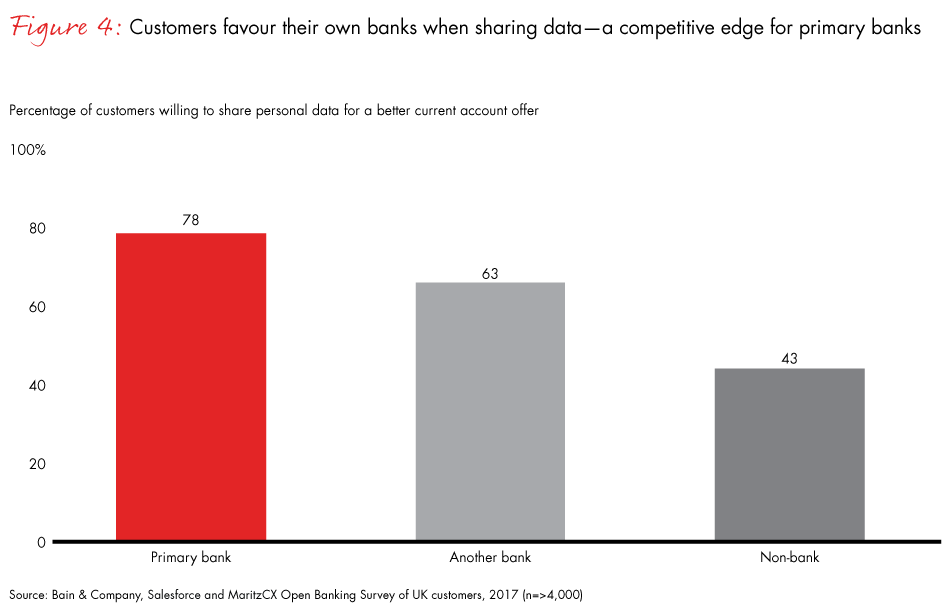
Deepen your relationships with your customers. Incumbents have at least one clear advantage in open banking: They already have access to a sizeable pool of customers and an opportunity to understand those customers better than their competitors do. The big banks also have an edge when it comes to trust. When we asked customers if they are willing to share more data with a provider in order to get a better product offering, 78% said they are willing to share with their primary bank, while 63% said they would share with another bank and just 43% would share with a nonbank (see Figure 4).
Banks can build on this competitive edge by keenly paying attention to what their customers—and their customers’ data—are saying about the products and experiences that they want most, both now and in the future, as alternative propositions evolve. Banks can enrich the picture they have of individual customers by mining and analysing data from banking apps and customer cash flows, as well as from external sources such as credit history, mobile location and browser histories. In particular, with the privilege of better access to information, big banks can increase their efforts to understand high-value customers, the ones most at risk of moving their accounts.
In addition to building the mandatory API infrastructure for open banking, banks that understand the advantage of knowing their customers are already taking further steps to enhance their competitive edge by, for example:
- building a complete picture of individual customer needs and how customers choose to meet those needs at the product and episode level;
- understanding bank strengths and weaknesses in the eyes of customers relative to direct competitors and digital alternatives for key customer segments;
- using data pools to predict customer needs, proactively avoid unpleasant experiences and recover customers when things go wrong;
- designing experiences that delight the customer across multiple channels that are simple and easy to use, digital and straight through (i.e., don’t need human intervention); and
- using data to personalise those experiences, such as providing propositions aligned to customer life events.
Be ready for the aggregators. UK banks have long gone to market primarily through two channels: direct to the customer and through brokers. In recent times, however, the direct channel has split into two—physical pathways, such as branches and telephony centres, and digital channels. Digital has quickly taken over as the preferred direct channel. Digital already accounts for more than 60% of purchases by UK bank customers, according to Bain’s 2017 Customer Loyalty in Retail Banking Report.
Aggregation looks likely to become an increasingly important fourth channel in open banking, bringing the potential to disintermediate both primary and secondary banking relationships. Forward-looking banks are taking a proactive approach to developing strategies to use aggregation as an extension of, and potential substitute for, the way they now distribute products. Potential strategies include:
- shoring up existing customer relationships and actively engaging on the journey towards open banking, thus ensuring that the bank remains a top-of-mind choice;
- partnering with third-party digital platforms and developing capabilities to distribute effectively through them;
- building robust and differentiated capabilities to price and personalise offerings for customers (e.g., tailored, fully preapproved, always-on lending);
- ensuring existing bank platforms can aggregate third-party data and information from other platforms; and
- investing in new data and service providers, such as digital brokers, to play further up the value chain.
The right strategy depends on the individual bank and builds in enough flexibility to accommodate some level of uncertainty. UK banks are already placing bets by investing in technology and data providers, and in some cases even developing their own aggregators. While strategies may differ, looking the other way is not an option. Banks need to develop an approach that recognises alternative banking platforms as potential disruptors.
Be nimble. Banks entering the open banking era need to develop the muscles to change and adapt quickly. Forward-looking banks are not only aiming to improve experiences for customers, they are organising themselves around customer needs in a way that enables faster innovation cycles and eliminates silos that get in the way of decision making. Change-ready banks are also taking a hard look at ways to simplify and automate back-end processes, remove legacy costs, eliminate options that customers no longer value and deliver experiences that are 100% digital.
Banks are evolving to be more nimble by, amongst other things:
- breaking down silos of activity by organising the work into a common set of customer needs (e.g., buying a home) and customer episodes (e.g., applying for a mortgage);
- consolidating the responsibility for each customer need and episode, with clear targets for cost, risk and commercial outcomes;
- unifying the accountability for the decision rights and underlying resources (systems, processes, funding and people) for each customer need; and
- simplifying technology and process architecture and governance to shorten time to market and allow for more regular platform upgrades.
While it is difficult to know for certain how open banking will affect major UK banks in the coming years, the industry clearly is heading for change. Greater sharing of information with, and by, consumers will bring both threats and opportunities for incumbents. Aggregators will redefine how at least some consumers research, purchase and manage their financial products and services day to day. As banks disclose more information, customers will gain greater insights into how their primary banks are performing compared with other providers, prompting many of them to try out new platforms and solutions.
Whole segments of UK bank customers are primed for change and willing to experiment with new ways to manage their money, borrow and protect their wealth. Industry leaders have an opportunity now to get ahead of the curve by redefining their battlegrounds and their strategies around key customer segments. Banks that do not prepare now will inevitably be forced to react when changes do arrive, which for some may be too late.
Stanford Swinton and Eduardo Roma are partners in Bain & Company’s Financial Services practice and based in London.
Net Promoter®, Net Promoter System®, Net Promoter Score® and NPS® are registered trademarks of Bain & Company, Inc., Fred Reichheld and Satmetrix Systems, Inc.
For this study, the financial services teams at Bain & Company and Salesforce and the research team at MaritzCX combined their expertise to provide insights into how new UK open banking regulations will affect the customer experience, as well as what implications the new rules will have for the strategy of major UK banks.
Bain & Company is one of the world’s leading management consulting firms in financial services and digital innovation. Salesforce is a global leader in customer relationship management (CRM), bringing companies closer to their customers in the digital age. MaritzCX combines customer experience research, technology and service to help companies connect with customers and respond to industry issues.
The authors would like to acknowledge the assistance of Alex Sukhareva, a consultant in Bain’s London office; at Salesforce, Joaquin De Valenzuela, head of financial services for Europe, the Middle East and Africa (EMEA), Luca Romagnoli, head of business development for EMEA, and Sergio Segura Canton, banking and insurance market director; and at MaritzCX, James Thornborrow, vice president, and Carol McCreadie, customer experience director.
First published in febrero 2018