

Brief

For most companies, cutting costs is simply a fact of life—a recurring drill that can sap employee morale and undercut new initiatives when handled the wrong way. Viewed through the lens of performance, most cost initiatives look even more marginal: 40% of company leaders said they did not hit their savings target and 80% did not expect the savings to stick, according to a recent Bain survey of more than 700 senior executives.
But what if a company’s leaders took a different approach? What if they wielded cost reduction as a powerful means to reinforce their strategic direction and increase competitiveness? Cost reduction, after all, is a resource allocation exercise in reverse—a systematic review of where and how the company will invest or divest scarce resources to ensure the success of its strategy.
This approach to sustained cost transformation goes well beyond cost-cutting. It’s about doing more with less to generate major productivity gains. By identifying poorly deployed resources, leadership teams can reallocate them to activities that can strengthen or reposition the company (see Figure 1).
In our experience, this strategic approach, combining clear targets from the top with bottom-up mobilization, injects organizations with new energy. It works in part by empowering staff at many levels to contribute their ideas and energy. Cross-functional teams reach beyond incremental improvements to deliver breakthrough gains, evaluating where to cut while selecting areas of strength to reinforce. Like an athlete who routinely checks his weight and tests his strength, it’s all about calibrating the right leanness and the right muscle needed to win.
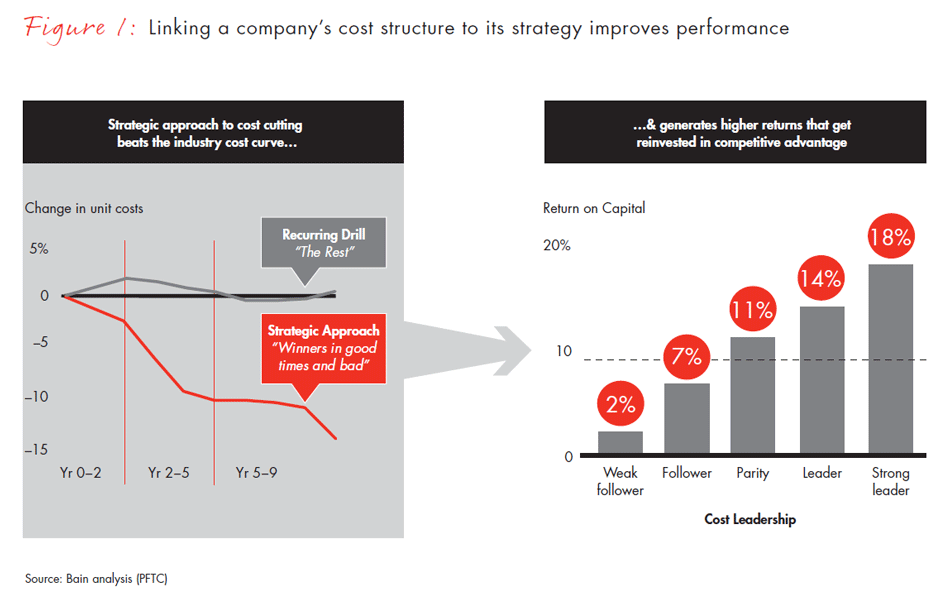
Companies in every industry, including those focused on premium products, can use sustained cost transformation to gain competitive advantage. Bain research indicates that 40% of cost leaders make or sell premium products. A cost leader can systematically out-invest rivals and capitalize faster and more readily on new opportunities. Even companies with world-class cost bases achieve new gains by rethinking the way they produce and deliver products and manage costs.
No question, real cost transformations take energy and commitment to implement. And the biggest challenge is also the source of the most value: sustaining the savings by creating a culture of continuous improvement. Done right, sustained cost transformation makes cost containment part of the company’s DNA. This ensures that costs don’t creep back up over time—a key weakness of conventional cost-reduction programs.
Adopt a CEO mindset
The alchemy of cost transformation is different for every company. Important clues about where a company is wasting resources and where it should spend more to bolster a competitive edge are buried deep within the organization. Putting those clues together effectively requires intelligence from the front line, CEO commitment, clear direction setting and a different way of thinking.
Successful companies enable teams to “think like a CEO,” and give them the tools to do so. Adopting a CEO mindset provides the strategic context for cost transformation. Specifically, it shifts the focus from cost effectiveness to winning.
A European industrial engineering company improved its strategic position significantly by combining a top-down and bottom-up approach to cost transformation. The catalyst for change was a benchmarking exercise that highlighted a €300 million pre-tax earnings gap between the company and its most profitable competitors. That alarming data helped convince frontline staff to propose cuts to close the gap.
Three questions underpin the focus on competitiveness as the key goal of cost transformation:
- What is the strategic rationale for our cost aspiration?
- What are our true sources of value and competitive advantage?
- What is our future-state cost position?
The rationale for cost targets is linked to a company’s position in the market. For example, where does the company have competitive advantage in the value chain? The optimum cost structure for low-cost champions will be different from that of premium players. Each company’s strategy will dictate investment priorities.
A US-based technology company launched a three-year cost-transformation program in human resources after discovering its HR costs were 30% higher than those of the competition and its services were not focused on management’s top priorities—compensation and recruiting. It decided to reduce HR costs by 32% over two years, generating more than $50 million in annual savings. Significantly, management redirected part of the savings to hiring experts to improve the quality of new hires—a key strategic goal.
Estimating the company’s future cost aspiration is a critical part of the exercise. Getting costs down today is important, but what cost base will the company need to be competitive in five years? How fast are costs dropping in the industry? What cost position will potential new entrants have? This outside-in perspective includes all the external elements driving costs down, from disruptive technologies to competitors’ actions. To determine this future-state cost position, companies need to identify the key elements of cost leadership or cost parity for each business segment, including the right mix between one-time and ongoing savings targets to get there.
One international low-cost airline embraced a cost-transformation program after watching competitors erode its profit. As part of a strategic overhaul, it cut unprofitable flights and operations, streamlined procurement, simplified the corporate agenda and added significant rigor to cost oversight. In three and a half years, the airline reduced its total costs significantly and more than doubled its profits. But the leadership team didn’t stop there: To keep pace with steadily declining costs industry-wide, it launched a second wave of reductions to be implemented by 2020.
Of course, no cost-transformation program is identical. A company’s business situation will dictate the pace and depth of change. In a slow-growth industry like consumer products, a sustained cost transformation offers the biggest opportunity for profit improvement, which can then fund long-term growth and market-share initiatives.
The experience of food giant H.J. Heinz Company highlights just how powerful a tool it can be. As part of a 2013 restructuring, Heinz eliminated excess layers of management, cut 7,000 jobs, banned corporate jets and implemented zero-based budgeting, which requires managers to justify spending each year, planning as if no money existed in the budget the previous year. And it provided strong incentives to new management to improve profitability. In 2014, Heinz’s profit surged to $657 million, up from $18 million in 2013.
The CEO mindset provides a strategic lens that shapes cost-cutting efforts. It helps management teams whittle down activities that don’t support strategy and invest in things that do. And when it comes to squeezing budgets, successful companies take an ax to some costs and use a scalpel on others. Following the 2008 takeover by InBev, Anheuser-Busch cut $2.25 billion in costs over three years and managed to grow revenues at the same time. The company dramatically reduced spending on executive perks, selling corporate jets and ripping up plush offices in the executive suite. But while it was making those cuts, management invested heavily in branding, including pricey Super Bowl ads, a move that helped accelerate topline growth.
Véronique Pauwels, a leader of Bain's Performance Improvement practice, discusses how to make strategic and sustainable cuts to costs and overhead.
Build the muscles
It’s nearly impossible to win a race without training. Companies also need to build the right muscles to implement a cost-transformation program effectively. The three most important capacities are cross-functional teams, accountability and a horizontal view.
Cross-functional teams are the biceps of cost transformation. They deliver a bottom-up assessment that helps companies go beyond incremental cuts to breakthrough ideas. Engaging cross-functional teams from the start increases support for a cost transformation because individuals working on the front line will make cuts when they realize it will free up investment for more strategic business areas vital to the company’s success.
One European technology company struggling with constraints on capital expenditure built cross-functional teams that combined network and sales experts to show where extra capacity mattered most.
Accountability and decision rights are equally important. Management teams need to clarify decision rights around key cost decisions, ensure a closed loop with the CFO and make the savings flow to the bottom line.
Finally, companies should pump up their ability to look horizontally across the organization for savings, not just vertically by business unit. The reason is clear: Excess costs grow in the seams of companies where business units and functions overlap and decision rights are ambiguous.
An Asian telco that thought it had world-class cost control unearthed a large and hidden inefficiency, thanks to a horizontal review of its service business. Its call center tried to reduce costs by keeping service calls short, dispatching trucks if a problem couldn’t be resolved quickly. But that practice sent the cost for rolling trucks, a separate service unit, soaring. To fix the problem, the company integrated the two service units and gave one executive responsibility for the entire service chain. That move helped increase the number of service calls resolved over the phone by 15%, saving the company millions of dollars.
Make it stick
Making sure cost savings don’t erode over time requires a continuous cost-containment mindset. Everyone from the front line to the executive suite should be thinking about how to take costs down by 3% a year.
Four actions will help leadership teams instill a new way of thinking about costs.
- Adopt clear rules and culture change. The CEO mindset is critical to achieving breakthrough gains.
- Align incentives and meaningful rewards to executives for delivering value by including key performance indicators in contracts. Leadership teams should, of course, select incentives that fi t the cultural and operating norms of the organization. Compensation may work best for some companies; for others, it may be recognition.
- Lead by example and consistently demonstrate the right behavior. Sustained cost transformation should be an integral part of the budgeting process, and it should be high on the agenda at all key business review meetings.
- Be patient, diligent and disciplined. It’s not possible to implement a cost-transformation program overnight. Those that succeed embrace a systemic, multiyear process, monitoring progress over time.
Sustained cost transformation is not easy, but the benefits are worth the effort. A well-executed program liberates assets and managers, and builds a competitive edge in the areas that matter most—whether it’s a strategic business, talent or training.
What’s the best yardstick for testing whether a cost-reduction program in the works can deliver on its goals? Companies can judge how it measures up by asking these questions:
- Is the program reinforcing competitive advantage?
- Is it led by cross-functional A-teams?
- Is cost transformation part of every management meeting and intrinsic leadership behavior?
- Is there a yearly target for cost reduction embedded in the yearly budgeting process? Are efficiency gains automatically built into the budget?
- Is cost transformation visible deep in the organization? Do managers and staff strive to reduce costs even when they are not supervised?
If the answer is no to any of these questions, it’s a signal that the cost-cutting program may be falling short of its full potential. On the other hand, if managers and staff have adopted a CEO mindset, the transformation will be hard to miss—and the benefits will stretch well beyond cost and enhance strategic agility.
Peter Guarraia is a partner with Bain & Company in Chicago and a member of the firm’s Performance Improvement practice. Véronique Pauwels is a partner in Bain’s Amsterdam office. She coleads the firm’s Performance Improvement practice in Europe, the Middle East and Africa.
First published in octubre 2015