
Skip to Content
  • Offices

    Offices

    North & Latin America
    • Atlanta
    • Austin
    • Bogota
    • Boston
    • Buenos Aires
    • Chicago
    • Dallas
    • Denver
    • Houston
    • Los Angeles
    • Mexico City
    • Minneapolis
    • Monterrey
    • Montreal
    • New York
    • Rio de Janeiro
    • San Francisco
    • Santiago
    • São Paulo
    • Seattle
    • Silicon Valley
    • Toronto
    • Washington, DC
    Europe & Africa
    • Amsterdam
    • Athens
    • Berlin
    • Brussels
    • Copenhagen
    • Dusseldorf
    • Frankfurt
    • Helsinki
    • Istanbul
    • Johannesburg
    • Kyiv
    • Lisbon
    • London
    • Madrid
    • Milan
    • Munich
    • Oslo
    • Paris
    • Rome
    • Stockholm
    • Vienna
    • Warsaw
    • Zurich
    Middle East
    • Doha
    • Dubai
    • Riyadh
    Asia & Australia
    • Bangkok
    • Beijing
    • Bengaluru
    • Brisbane
    • Ho Chi Minh City
    • Hong Kong
    • Jakarta
    • Kuala Lumpur
    • Manila
    • Melbourne
    • Mumbai
    • New Delhi
    • Perth
    • Shanghai
    • Singapore
    • Sydney
    • Tokyo
    See all offices
  • Alumni
  • Media Center
  • Subscribe
  • Contact
  • Spain | Español

    Select your region and language

    Global
    • Global (English)
    North & Latin America
    • Brazil (Português)
    • Argentina (Español)
    • Canada (Français)
    • Chile (Español)
    • Colombia (Español)
    Europe, Middle East, & Africa
    • France (Français)
    • DACH Region (Deutsch)
    • Italy (Italiano)
    • Spain (Español)
    • Greece (Elliniká)
    Asia & Australia
    • China (中文版)
    • Korea (한국어)
    • Japan (日本語)
  • Saved items (0)
    Saved items (0)

    You have no saved items.

    Bookmark content that interests you and it will be saved here for you to read or share later.

    Explore Bain Insights
  • Industries
    Main menu

    Industries

    • Aeroespacial y Defensa
    • Agroindustria
    • Químicos
    • Construcción e Infraestructura
    • Productos de Consumo
    • Servicios Financieros
    • Salud y Ciencias de la Vida
    • Maquinaria y Equipo Industrial
    • Medios y Entretenimiento
      Industries
      Medios y Entretenimiento
      • Media Lab
    • Metales
    • Minería
    • Petróleo y Gas
    • Papel y Empaque
    • Private Equity
      Industries
      Private Equity
      • Due Diligence
      • Exit Planning
      • Firm Strategy & Operations
      • Portfolio Value Creation
    • Sector Público y Social
    • Retail
    • Tecnología
    • Telecomunicaciones
      Industries
      Telecomunicaciones
      • Capital Expenditure
      • Telco Digital Transformation
    • Transporte
    • Viajes y Turismo
    • Servicios Públicos y Energías Renovables
  • Consulting Services
    Main menu

    Consulting Services

    • Customer Experience
    • Sustainability
    • Innovation
    • M&A
    • Operations
    • People & Organization
    • Private Equity
    • Sales & Marketing
    • Strategy
    • AI, Insights, and Solutions
    • Technology
    • Transformation
  • Digital
  • Insights
    Main menu

    Insights

    • Industry Insights
    • Services Insights
    • Bain Books
    • Webinars
    • Bain Futures
    View all Insights
    Featured topics
    • Tariff Response
    • Artificial Intelligence
    • Thriving in Uncertainty
    • Executive Conversations
    • Macro Trends
    • M&A Report
    • Healthcare Private Equity Report
    • Paper & Packaging Report
    • Technology Report
    • CEO's Guide to Sustainability
    • CEO Insights
    • CFO Insights
    • COO Insights
    • CIO Insights
    • CMO Insights
    View all featured topics
  • About
    Main menu

    About

    • What We Do
    • What We Believe
    • Our People & Leadership
    • Client Results
    • Awards & Recognition
    • Global Affiliations
    Further: Our global responsibility
    • Sustainability
    • Social Impact
    • World Economic Forum
    Learn more about Further
  • Carreras
    Main menu

    Carreras

    • Trabaja con Nosotros
      Carreras
      Trabaja con Nosotros
      • Find Your Place
      • Nuestras Áreas de Trabajo
      • Equipos Integrados
      • Estudiantes
      • Internships & Programs
      • Eventos de Reclutamiento
    • La Vida en Bain
      Carreras
      La Vida en Bain
      • Historias Profesionales
      • Nuestra Gente
      • Dónde Trabajamos
      • Apoyando tu Crecimiento
      • Grupos de Afinidad
      • Beneficios
    • Impact Stories
    • Nuestro Proceso
      Carreras
      Nuestro Proceso
      • Qué Esperar
      • Entrevistas
    FIND JOBS
  • Offices
    Main menu

    Offices

    • North & Latin America
      Offices
      North & Latin America
      • Atlanta
      • Austin
      • Bogota
      • Boston
      • Buenos Aires
      • Chicago
      • Dallas
      • Denver
      • Houston
      • Los Angeles
      • Mexico City
      • Minneapolis
      • Monterrey
      • Montreal
      • New York
      • Rio de Janeiro
      • San Francisco
      • Santiago
      • São Paulo
      • Seattle
      • Silicon Valley
      • Toronto
      • Washington, DC
    • Europe & Africa
      Offices
      Europe & Africa
      • Amsterdam
      • Athens
      • Berlin
      • Brussels
      • Copenhagen
      • Dusseldorf
      • Frankfurt
      • Helsinki
      • Istanbul
      • Johannesburg
      • Kyiv
      • Lisbon
      • London
      • Madrid
      • Milan
      • Munich
      • Oslo
      • Paris
      • Rome
      • Stockholm
      • Vienna
      • Warsaw
      • Zurich
    • Middle East
      Offices
      Middle East
      • Doha
      • Dubai
      • Riyadh
    • Asia & Australia
      Offices
      Asia & Australia
      • Bangkok
      • Beijing
      • Bengaluru
      • Brisbane
      • Ho Chi Minh City
      • Hong Kong
      • Jakarta
      • Kuala Lumpur
      • Manila
      • Melbourne
      • Mumbai
      • New Delhi
      • Perth
      • Shanghai
      • Singapore
      • Sydney
      • Tokyo
    See all offices
  • Alumni
  • Media Center
  • Subscribe
  • Contact
  • Spain | Español
    Main menu

    Select your region and language

    • Global
      Select your region and language
      Global
      • Global (English)
    • North & Latin America
      Select your region and language
      North & Latin America
      • Brazil (Português)
      • Argentina (Español)
      • Canada (Français)
      • Chile (Español)
      • Colombia (Español)
    • Europe, Middle East, & Africa
      Select your region and language
      Europe, Middle East, & Africa
      • France (Français)
      • DACH Region (Deutsch)
      • Italy (Italiano)
      • Spain (Español)
      • Greece (Elliniká)
    • Asia & Australia
      Select your region and language
      Asia & Australia
      • China (中文版)
      • Korea (한국어)
      • Japan (日本語)
  • Saved items  (0)
    Main menu
    Saved items (0)

    You have no saved items.

    Bookmark content that interests you and it will be saved here for you to read or share later.

    Explore Bain Insights
  • Industries
    • Industries

      • Aeroespacial y Defensa
      • Agroindustria
      • Químicos
      • Construcción e Infraestructura
      • Productos de Consumo
      • Servicios Financieros
      • Salud y Ciencias de la Vida
      • Maquinaria y Equipo Industrial
      • Medios y Entretenimiento
      • Metales
      • Minería
      • Petróleo y Gas
      • Papel y Empaque
      • Private Equity
      • Sector Público y Social
      • Retail
      • Tecnología
      • Telecomunicaciones
      • Transporte
      • Viajes y Turismo
      • Servicios Públicos y Energías Renovables
  • Consulting Services
    • Consulting Services

      • Customer Experience
      • Sustainability
      • Innovation
      • M&A
      • Operations
      • People & Organization
      • Private Equity
      • Sales & Marketing
      • Strategy
      • AI, Insights, and Solutions
      • Technology
      • Transformation
  • Digital
  • Insights
    • Insights

      • Industry Insights
      • Services Insights
      • Bain Books
      • Webinars
      • Bain Futures
      View all Insights
      Featured topics
      • Tariff Response
      • Artificial Intelligence
      • Thriving in Uncertainty
      • Executive Conversations
      • Macro Trends
      • M&A Report
      • Healthcare Private Equity Report
      • Paper & Packaging Report
      • Technology Report
      • CEO's Guide to Sustainability
      • CEO Insights
      • CFO Insights
      • COO Insights
      • CIO Insights
      • CMO Insights
      View all featured topics
  • About
    • About

      • What We Do
      • What We Believe
      • Our People & Leadership
      • Client Results
      • Awards & Recognition
      • Global Affiliations
      Further: Our global responsibility
      • Sustainability
      • Social Impact
      • World Economic Forum
      Learn more about Further
  • Carreras
    Popular Searches
    • Agile
    • Digital
    • Strategy
    Your Previous Searches
      Recently Visited Pages

      Content added to saved items

      Saved items (0)

      Removed from saved items

      Saved items (0)

      Brief

      How utilities should evaluate upstream and downstream integration

      How utilities should evaluate upstream and downstream integration

      Deregulation broke utilities apart, but many executives are now asking whether they should put the value chain back together.

      By Mark Gottfredson, John Norton, Julian Critchlow and Amit Sinha

      • min read

      Brief

      How utilities should evaluate upstream and downstream integration
      en

      Not long ago, most power utilities were vertically integrated, with generation, distribution and retail services all under one business. Then regulators, hoping to unleash the kind of fluidity and innovation that characterized deregulation in telecommunications, pushed for deregulation in utilities, separating retail services, distribution and generation into different organizations.

      But for a number of reasons, the energy sector hasn’t seen the same type of profit-generating innovation. Telecom innovations increased the use of their services dramatically. That hasn’t happened in power utilities and, given efforts to increase energy efficiency, wouldn’t necessarily be desirable.

      Having seen few benefits from pulling the value chain apart, many utility executives are reconsidering the benefits of putting it back together again. Expanding a business up or down the value chain offers some advantages— a bigger customer base, reduced exposure to market volatility and access to shifting profit pools. Some analysts and investors look at these factors and believe an integrated utility is more valuable than one that isn’t integrated because it can save transaction costs and hedge its business against price spikes and cyclical changes in profitability.

      Our analysis shows that while this may be true in some cases, it often is not. The benefits of vertical integration are frequently less than executives think, and focusing on integration can detract from success. Each case needs to be evaluated on its own merits. Power generation and retail are, of course, very different businesses, which demand different capabilities to succeed. For example, a generator’s costs depend on fuel supply, capital and depreciation expenses, and the costs of running power plants. The best way to cut costs is to improve operational efficiency. A retailer’s expenses, on the other hand, depend on sourcing costs for electricity and gas, as well as customer acquisition and retention. Cost-saving opportunities come more from building best-in-class trading capabilities, developing sharp customer insights, raising brand awareness and improving customer relations.

      Given these differences, what criteria can utility executives use to evaluate an opportunity to reintegrate, or for an integrated utility to remain so? The goal must be to create a company that is better equipped to deal with the broad trends facing the energy sector, including greater competition for customers, new investments in renewables and smart grids, stagnating demand due to rising energy efficiency and distributed generation gaining market share. In other words, how do you position yourself to win in the new energy world?

      Evaluating the benefits of integration

      Utility executives around the world are revisiting the relative advantages of vertical integration, weighing them against pure plays as retailers or generators. In addition to the question of how investors value the business, there are three major potential benefits. Understanding the value of each can help executives make the right decision about whether to integrate.

      Avoiding transaction costs. This unlocks some value, but in our experience the scope is limited. For example, a retail utility considering integrating upstream into power generation might know more about electricity prices and avoid paying the bid-ask spread it would incur on the open market. It would also avoid collateral costs and have a clearer picture of the relationship between electricity supply and requirements, improving its ability to acquire electricity based on demand.

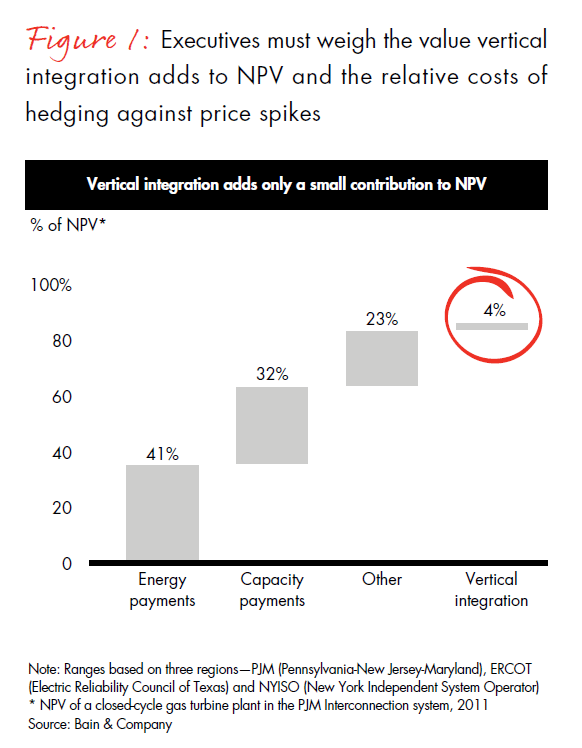
      Since the magnitude of these cost savings is fairly limited, the net present value (NPV) of a typical generation investment doesn’t change much by adopting a vertically integrated model, even when the bid-ask spread is eliminated completely. Consider the example of a typical combined-cycle gas turbine (CCGT) plant in North America. The overall plant NPV is affected more by energy and capacity payments, with avoided transaction cost accounting for less than 5% (see Figure 1). On their own, avoided transaction costs don’t offer enough incentive to vertically integrate, though they could tip the scales in a close decision.

      how-utilities-should-evaluate-upstream-fig-01_embed

      Integration helps hedge against volatility. Short-term risks occur when a retailer or generator fails to hedge against wholesale spot prices rising or falling dramatically. Retailers face short-term increases when demand spikes, but the issue is also becoming more relevant for generators, particularly in Europe where supply from solar and wind generators can spike on sunny or windy days. These sudden increases can depress prices for several hours, as happened in France and Germany in the summer of 2012.

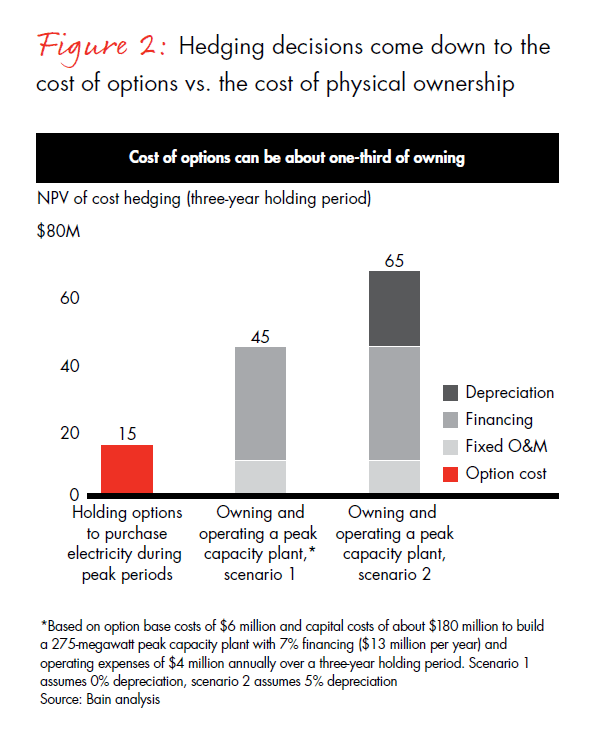
      But executives must weigh the costs of integration against the costs and availability of hedging without having to own the physical assets. Consider a hot summer in the southwest US. Would the ability to hedge against spiking electricity costs be enough to warrant an investment in generation as protection against high wholesale prices? In our analysis of that market, we found enough liquidity to allow retailers to affordably hedge without having to invest in generation (see Figure 2). On the other hand, retailers based in a market with very low liquidity (that is, where the peak reserve margins have narrowed significantly and where there is a limited market for heat rate options) would see a strong argument for integrating upstream as a means of hedging against high prices. To make these estimates, utilities will analyze historic and current loads, taking into account predictions for future loads.

      how-utilities-should-evaluate-upstream-fig-02_embed

      In India, power generators have moved even further upstream to ensure their access to fuel. India’s government still controls most coal mining, and some generators have had difficulty securing enough quality coal for their large power plants (the ultra mega power projects). To secure a steady supply, some have bought stakes in coal operations in Indonesia and other countries, following a model developed by Japan’s Coal Development Organization in the 1980s.

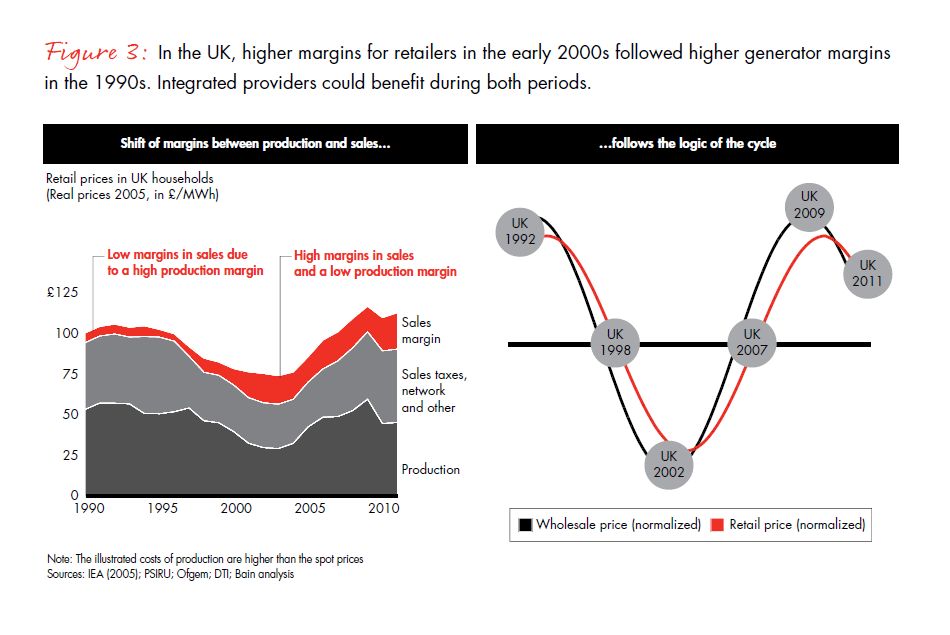
      Successful integration allows a utility to tap different profit pools. Since boom-and-bust cycles happen at different times along the value chain, integrated utilities can use the profit available in one segment to fund lean times in another. For example, higher margins and regulator pressure in the UK’s generation market during the mid-1990s led to a build-out of more power generation capacity, mostly CCGT plants. By 2000, excess generating capacity led to a price war and pressure on generators’ costs, which they had paid during the 1990s, taking advantage of the decline in wholesale prices to boost their margins. Integrated utilities were able to benefit during both periods (see Figure 3).

      how-utilities-should-evaluate-upstream-fig-03_embed

      When does integration make sense?

      One North American retail utility considered these three axes in evaluating whether to move upstream into power generation. Regarding costs, it found that the current low natural gas prices would keep wholesale electricity costs low for the foreseeable future; thus there was very limited incentive to integrate upstream to reduce sourcing or transaction costs. Low natural gas prices are also putting pressure on generators’ margins, further reducing the incentive to move into that business. For hedging, the utility’s analyses showed that it was cheaper to use options than to incur the costs of physical ownership, even in the riskiest markets it examined. In this particular market, the utility concluded that upstream integration did not make economic sense.

      Downstream integration, on the other hand, may make more sense in markets where retail is deregulating rapidly. In Germany, as in other countries, power generation remains profitable, but there are pressures, including regulators pushing utilities to generate more power from renewable sources and to move out of nuclear power. Rising energy efficiency is also likely to add pressure as power consumption stagnates, even as power generation continues to expand. RWE, the country’s largest generator, holds 25% of the market share for electricity generation but only 10% of the retail business. Its main competitors, E.ON and EnBW, have a more balanced portfolio of generation and retail.

      The counter argument to vertical integration is that pure plays—utilities that focus on one part of the value chain—outperform their diversified peers. Because the businesses are so different, the capabilities to excel in each are different—for example, great customer experience and innovation in retail, vs. reducing operating costs and ensuring supply in power generation. Executives need to have a clear understanding of whether particular company’s expertise limits them to a certain segment.

      Where to focus first

      Deciding whether, when and how to integrate is part of the development of a long-term strategy for any utility. Any forward-looking plan should include strategic options that give the utility flexibility to change its path when executives see signposts—events and trends that signal significant changes. For example, a shift in natural gas prices or export controls would be a signpost for US utilities and other businesses. (See Bain Brief “Utilities: The road ahead” for more on long-term strategy.)

      As they approach the question of integration, executives can take these three steps.

      • First, fix the basics that make a successful business. Executives in power generation should maintain a relentless drumbeat on operational excellence. (See Bain Brief “Using employee segmentation to bring out the best in your workforce” for more on improving performance.) In retail, customer loyalty is becoming a top priority as consumers gain more options and greater flexibility. (See Bain Brief “Turning on customer loyalty” for more on how to improve customer relationships.) Ensuring you are executing well in the parts of the value chain where you currently participate is the critical first step. Vertical integration will never be an elixir for poor performance in the base business.
      • Second, understand the relative benefits you can achieve by vertically integrating through reduced transaction costs, less market exposure and the ability to out-invest the competition by tapping into new profit pools.
      • Third, understand the regulatory environment that you are playing in and modify the strategy to take that into account.

      Mark Gottfredson and John Norton are partners with Bain & Company in Dallas. Julian Critchlow leads Bain’s Global Utilities practice in London. Amit Sinha is a Bain partner in New Delhi. The authors would like to acknowledge the contributions of Berthold Hannes, a partner with Bain & Company in Düsseldorf, and Joseph Scalise, who leads Bain’s Utilities practice in the Americas in San Francisco.


      how-utilities-should-evaluate-upstream-fig-01_full

      how-utilities-should-evaluate-upstream-fig-02_full

      how-utilities-should-evaluate-upstream-fig-03_full
      Authors
      • Headshot of Mark Gottfredson
        Mark Gottfredson
        Advisory Partner, Dallas
      • Headshot of John Norton
        John Norton
        Alumni, Houston
      Contact us
      Related Industries
      • Energy & Natural Resources
      • Utilities & Renewables
      Utilities & Renewables
      Utilities: The Road Ahead

      Successful utilities don’t look far afield for growth; they profit from their core and expand from there.

      Read more
      Performance Improvement
      Using employee segmentation to bring out the best in your workforce

      Employees, like customers, respond positively to offers customized to their needs and preferences.

      Read more
      Utilities & Renewables
      Utilities Can Power Growth Through a Better Customer Experience

      Top performers turn everyday interactions into loyalty, lower costs, greater revenue streams, and stronger reputations.

      Read more
      Utilities & Renewables
      Can the US Energy Grid Keep Up with AI Data Centers?

      Our latest forecast projects data centers will consume 9% of US electricity by 2030, straining the grid without new solutions.

      Read more
      Utilities & Renewables
      Sustaining Capital: From Chaos to Discipline

      Fragmented budgets, poor visibility, and missed forecasts are fixable with the right approach.

      Read more
      First published in febrero 2013
      Tags
      • Energy & Natural Resources
      • Utilities & Renewables

      How We've Helped Clients

      An Environmental Services Company Captures Massive Savings from a Merger

      Read case study

      Boosting a utility's workforce productivity

      Read case study

      Revitalizing a utility's market position with customer loyalty

      Read case study

      Ready to talk?

      We work with ambitious leaders who want to define the future, not hide from it. Together, we achieve extraordinary outcomes.

      Stay ahead in a rapidly changing world. Subscribe to Bain Insights, our monthly look at the critical issues facing global businesses.

      *I have read and understand Bain’s Privacy Notice.

      Please read and agree to the Privacy Policy.
      Bain & Company
      Contact us Sustainability Accessibility Terms of use Privacy Modern Slavery Act Statement Cookie Policy Sitemap Log In

      © 1996-2026 Bain & Company, Inc.

      Contact Bain

      How can we help you?

      • Business inquiry
      • Career information
      • Press relations
      • Partnership request
      • Speaker request
      See all offices