

Global Private Equity Report

Executive Summary
- While corporate carve-outs used to routinely outperform the average private equity buyout, that spread has narrowed dramatically in recent years.
- Tough competition and elevated multiples have made it significantly harder to generate strong returns with these highly complex transactions.
- The firms getting it right aren’t just expert in standing up an independent company—they also excel at using an ironclad value-creation plan to transform a hidden gem into a strong performer.
This article is part of Bain’s 2025 Global Private Equity Report
Corporate carve-outs routinely produce some of the flashiest returns in private equity, right?
Well, yes … and no.
Before 2012, the typical deal to separate an unloved business unit from its corporate parent was a clear winner more often than not. These transactions generated an average multiple on invested capital (MOIC) of around 3.0x, well above the 1.8x average for all buyout deals.
But since then, results have been decidedly mixed. Top-quartile carve-outs continue to produce solid returns—a 2.5x MOIC vs. the 2.7x top-quartile buyout average. Yet the average carve-out deal since 2012 has earned just a 1.5x MOIC, or slightly below average buyout performance broadly (see Figure 1). Over that same period, the number of carve-outs has declined by around 50% to approximately 15% of the buyout total.
Figure 1
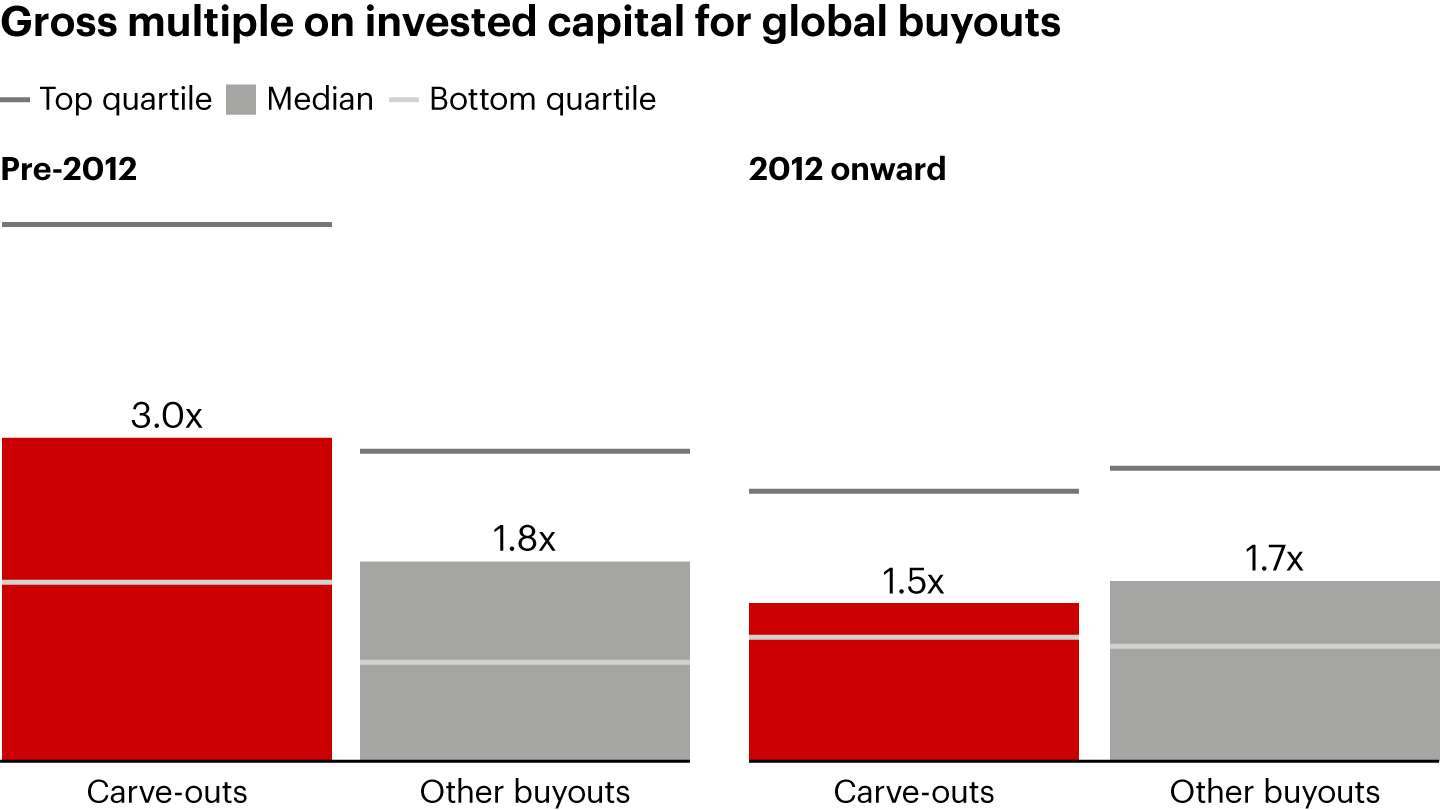

Notes: All calculations in US dollars; includes fully and partially realized global buyout deals with equity check sizes greater than $100 million
Source: DealEdgeWhat’s changed is that sponsors aren’t delivering the operational improvements they once did. According to DealEdge, carved-out companies increased enterprise value during ownership in the pre-2012 period by boosting revenue and margins 31% and 29%, respectively. Those numbers have slipped to 17% and 2% since 2012, and multiple expansion has fallen commensurately (see Figure 2).
Figure 2
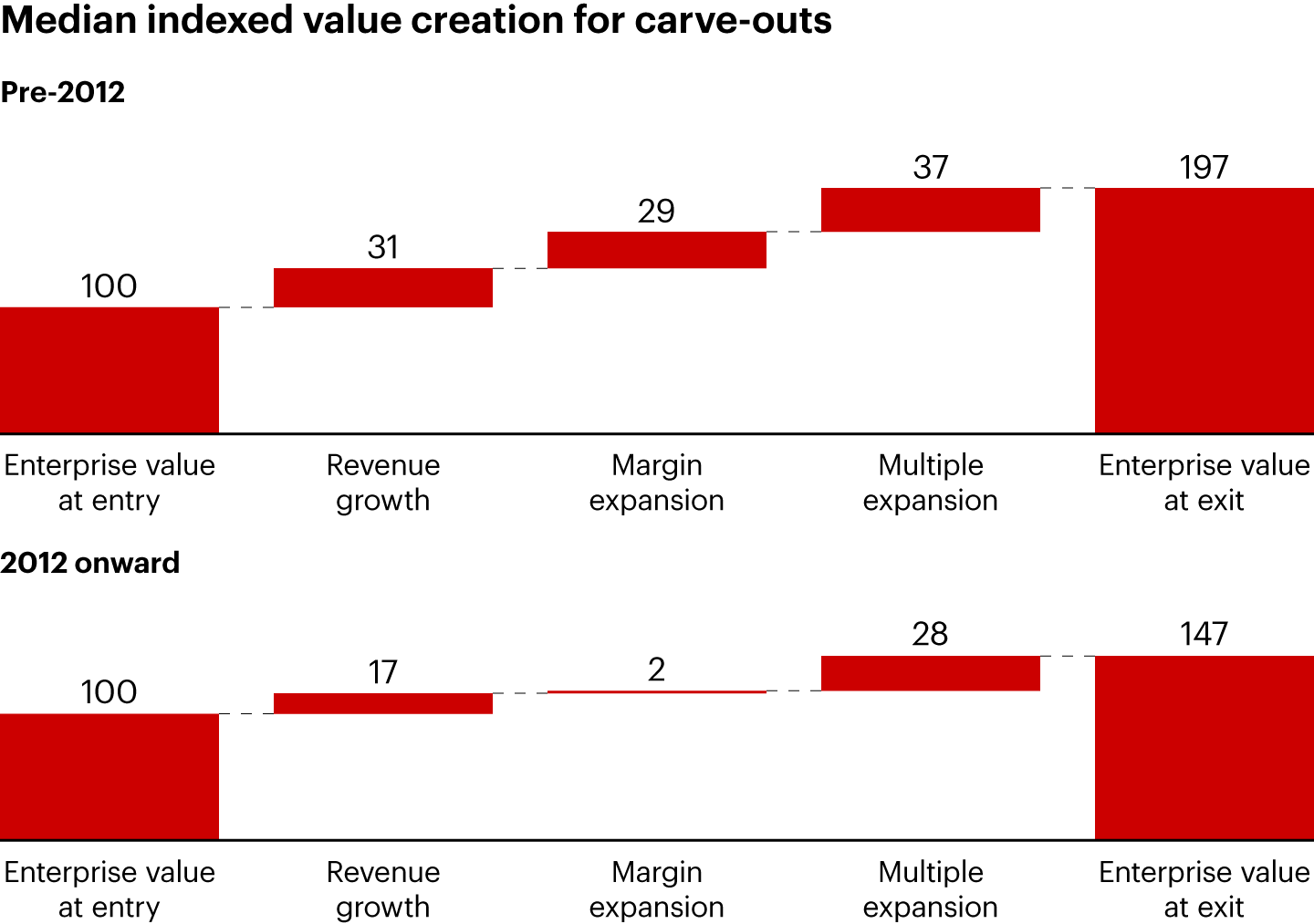

Notes: All calculations in US dollars; includes fully and partially realized global buyout deals with equity check sizes greater than $100 million
Source: DealEdgeThis drop-off in performance comes at a time when competition for these deals has increased sharply, pushing up sale multiples. That has clear implications: With the margin for error razor thin, carve-out sponsors need to up their game substantially if they want to join the investors generating those top-tier returns.
Loving the unloved
The classic corporate carve-out rides on the thesis that a private equity sponsor could unlock significantly more value from a noncore business than its corporate parent could. Value flows from focusing strategy, injecting capital, operating more efficiently, or finding new ways to grow, all while freeing the business from a stifling corporate culture and slow decision making. The upside potential is why corporate sellers often retain a minority stake in the new company.
Historically, another factor has also been critical—the carve-out discount. These assets have tended to sell at a lower multiple than standalone buyouts because separating them is costly and complex, limiting the number of potential buyers. As private equity has become more competitive, however, the increased volume of firms pursuing these deals has put upward pressure on multiples, and corporate owners have become smarter about running competitive auction processes. These factors have driven up acquisition prices and turned the spotlight on a sponsor’s ability to add value—or not.
Carving out success
To find out what separates top-tier carve-out deals from the rest, we analyzed 25 of them completed between 2013 and 2024. The common denominator was clear: Winning sponsors ensure that there is an unbreakable link between the core value-creation thesis and how the new company is set up to achieve it.
Given the complexity of separating a business from its parent, firms often “stand up” a newly independent company first and worry about fixing it second. But the best carve-out practitioners recognize that a two-step process only adds complexity to complexity. The most certain (and de-risked) path to a strong return is to underwrite a bulletproof value-creation plan (VCP) in due diligence and marry it to a separation plan, a talent strategy, and an execution blueprint specifically calibrated to the VCP’s unique requirements. Anything else will sap energy and waste time, blunting the rapid, active management needed from the day the deal is inked.
An integrated approach operates on several key principles.
Separation fundamentals count, but value creation drives the agenda. Any good buyout starts with a clear and actionable thesis for how the new owner can improve the asset. But carve-outs add an additional layer of complexity since the investor must extricate the business from its corporate parent and set it up as a fully independent enterprise. Few carve-outs have standalone financial reporting, making it difficult to develop a clear picture of how shared costs break down and how profitable the business actually is.
Seasoned carve-out sponsors know how to determine which of the business’s personnel, assets, legal entities, data, and systems are included in the deal perimeter (vs. held back by the parent). Planning must account for a spaghetti bowl of interdependencies with the parent across critical functions like finance, human resources, and IT. Separation requires amending hundreds or thousands of agreements with suppliers, service providers, and other third parties. And buyers need expertise in drafting the many transition service agreements (TSAs) that lay out the services and support the seller will extend to the new company for a defined period of time. Indeed, there’s an art to structuring the transaction so the seller views the separation process as “our problem,” not just “your problem.”
In negotiating this thicket of challenges, effective carve-out sponsors maintain their edge by never losing sight of the value-creation plan. The overarching deal rationale focuses the separation agenda to prioritize what’s critical to achieve and in what sequence. Crisp execution inevitably increases the odds of success. But if management is pulling cost levers when growth initiatives are called for, or spending two years transferring the ERP system at the expense of building new tools to better understand customer needs, the waste of time, energy, and resources will quickly erode returns.
Consider one global medical technology company that had struggled to grow profitably as part of a much larger conglomerate. The company had a strong offering for mid-market customers looking for easy-to-use, reliable testing products. But the parent’s emphasis on top-line growth led it to expand internationally into 97 countries while investing R&D dollars in a questionable point-of-care solution aimed at customers and use cases far from the company’s core business.
When the potential buyers dug into due diligence, they saw that the company had no clear idea of how profitable each of those 97 markets were or whether the new product soaking up investment had a right to win with the target customer. They recognized that building a stronger commercial capability and refocusing R&D on medium-sized customers in developed markets could ignite growth at a much lower cost.
This strategic intelligence streamlined the separation plan. The company steadily scaled back those 97 foreign offices to the 10 that were most profitable (avoiding major stand-up expense) and created a new indirect model for the others. It then refocused on the much larger US market by hiring 50 new salespeople and developed playbooks to increase penetration in the midsize segment. The company halted investment on the speculative point-of-care product to fund development of a new analytical tool that its core customers really wanted. The result was a significant jump in both revenue growth and earnings before interest, taxes, depreciation, and amortization (EBITDA), ultimately producing a 2.9x MOIC at exit.
Tough decisions can’t wait. Large, bureaucratic businesses often underperform because leaders kick sensitive or painful decisions down the road—perpetually. The list can be extensive, resulting in a willingness to fund underperforming business units, unprofitable geographies, excess management layers, inefficient marketing, subpar suppliers, and underutilized real estate portfolios.
But large corporations may also have different objectives than PE investors, not to mention a lower cost of capital and more lenient timelines. A corporate owner, for instance, might support a business with strong top-line growth but poor cash flow, simply to burnish quarterly revenue or avoid admitting defeat. PE owners rarely have that luxury.
What’s essential is to hit the ground at full speed with the license to make change happen right away. That’s what Platinum Equity did when it acquired Emerson Electric’s Network Power business unit in 2016 and renamed it Vertiv. The business was an amalgamation of nine separately managed units that made equipment vital to the large data centers that were fast taking over cloud computing. While Platinum determined that the product and services portfolio was strong, it also saw that the company had an opportunity to refocus its energy on a much faster-growing market.
The management team of Emerson’s Network Power business unit was largely focused on enterprise customers building one-off data centers, even as the world was rapidly shifting toward hyperscale cloud service providers, like AWS, Microsoft, and Google, and large colocation providers, like Equinix and Digital Realty. Several potential bidders, in fact, quickly backed away from the deal early on, concluding it was already too late to make up lost ground with these scale customers.
Platinum, however, thought it could reshape Vertiv fast enough to compete in the larger arena. Diligence showed that it could de-risk its investment by cutting costs, selling a noncore business, and pulling the plug on an unpromising software product in development. That opened up the real opportunity, which was to zero-base and rebuild much of the operating model—from product development and the go-to-market organization to manufacturing and shared service functions like finance and HR.
The goal was to create “One Vertiv,” a customer-focused organization capable of serving the exploding world of mega data centers. The integrated operating model also made it easier to add on several companies that Platinum helped Vertiv acquire to round out the product portfolio.
Vertiv’s new CEO had successfully built a company that made data center products, but when it ultimately ended up in the hands of Schneider Electric, he got a chance to build corporate acumen as he folded it into a scale operation. That blend of skills made him a perfect fit to manage what amounted to a $4 billion start-up with Vertiv. He moved aggressively to reshape what had been a heavily siloed organization, and by 2020, the company had gone from zero growth to almost twice the industry rate. That allowed Platinum to partially exit the investment with a blockbuster IPO just as the boom in artificial intelligence sent demand for data centers into overdrive.
Matching leadership to mission is foundational. The ability to solve talent issues like these quickly can often make or break a deal. Many carve-outs come with capable leaders who have grown up in a cozy, slow-moving corporate world. But PE-backed carve-outs are anything but cozy and slow moving. Managers not trained in transforming businesses may underperform when PE investors ask them to dial up the metabolism. And they might not have the skills that are mission critical to executing the new strategy.
Sponsors need to quickly identify which roles and functions are key to delivering on the deal’s ambition and what needs to be accomplished over what period of time. That provides a fact base for rapidly finding and installing executives with the right experiences, capabilities, and motivations to meet those requirements, whether they come from inside the company or are recruited externally.
When one private equity investor acquired the business unit of a multinational consumer goods company, new talent strategy was central to a transformative VCP. The unit had long been run as a low-margin, slow-growth commodity business selling to grocery stores, and an effort to upscale the brand had stalled. The new owners saw clear value in adding premium attributes at minimal cost. But funding the new strategy would require executing a major cost-out program to boost EBITDA. And it required introducing a level of marketing and product-development creativity the business unit had lost.
Success rode on installing a hard-nosed, change-oriented chief executive who was unafraid to make tough cost-cutting decisions and challenge the organization to compete effectively in the much more difficult branded world. The new company also needed a chief marketing officer capable of leading the massive rebranding challenge, someone with the disruptive mindset to reimagine the proposition and rebuild the organization to sell it efficiently. Getting these game-ready executives in place ASAP was essential to reaching the deal’s revenue objectives.
Change like this can obviously be jarring and disruptive across the organization. But it can also be liberating for a company culture long weighed down by “big company rules.” Effective change management often capitalizes on this newfound feeling of lightness.
When CVC carved out a packaging machinery asset from Bosch to create a new company called Syntegon, bringing the organization along proved to be a key element of success. Under Bosch ownership, Syntegon’s operating units were acquired over time and had never been fully integrated, meaning they were not able to realize the organization’s full scale benefits. Syntegon implemented a new operating model to rationalize costs and capture scale advantages—centralizing procurement and other functions, for instance—without limiting the entrepreneurial freedom of the units. The new model also offered the opportunity to build a fast-growing service organization with its own P&L, adding a resilient new revenue stream that would be accretive to earnings.
Creating a single, simplified enterprise depended on winning hearts and minds throughout the organization. The new owners hung the change management program on the German notion of a “Mittelstand” company—a traditional, midsize family-owned business run with a clear sense of entrepreneurship, something every German recognizes as the opposite of an inefficient, slow-moving corporate enterprise. Management asked employees to reimagine Syntegon as a nimble, fast-moving Mittelstand company and take pride in the transformation process and its results. This rallying cry became an effective means of cascading the new strategy down through the organization. As a result, Syntegon significantly improved its strategic position, business quality, and financial profile.
Going in prepared
What the recent drop-off in carve-out performance tells us is that it’s never been harder to pull off one of these uniquely challenging transactions. Yet we’ve also seen that deep expertise, careful due diligence, and active management can reliably pave the way to top-tier results. The firms getting this right start with a clear, actionable VCP that serves as a bright North Star for everything from executing the right TSAs to ensuring that the right new talent is in place to deliver the needed results.
A few key questions can bring the critical up-front issues into focus:
- Do we really know how much profit this company could generate on its own and what it will cost to establish it as a freestanding business?
- Is our proposed separation plan not only realistic given our value-creation thesis but also linked to the specific objectives and sequence laid out in the VCP?
- Do we have a dashboard of those key initiatives and objectives, which will let us track our progress?
- Do we have the right carve-out capabilities and expertise in-house, or do we know where to find them?
- Do we have a systematic, analytical approach to matching the right executives and managers to the mission-critical requirements of the VCP?
- Are we prepared to make the tough decisions on what to stop doing in order to pare losses, free up capital for new investments, and de-risk the business plan?
Standing up a new company is only half the battle when it comes to carve-out success. Outperforming the averages relies on moving rapidly from Day 1 to ensure that a clear deal thesis translates into next-level performance.