
Skip to Content
  • Offices

    Offices

    North & Latin America
    • Atlanta
    • Austin
    • Bogota
    • Boston
    • Buenos Aires
    • Chicago
    • Dallas
    • Denver
    • Houston
    • Los Angeles
    • Mexico City
    • Minneapolis
    • Monterrey
    • Montreal
    • New York
    • Rio de Janeiro
    • San Francisco
    • Santiago
    • São Paulo
    • Seattle
    • Silicon Valley
    • Toronto
    • Washington, DC
    Europe & Africa
    • Amsterdam
    • Athens
    • Berlin
    • Brussels
    • Copenhagen
    • Dusseldorf
    • Frankfurt
    • Helsinki
    • Istanbul
    • Johannesburg
    • Kyiv
    • Lisbon
    • London
    • Madrid
    • Milan
    • Munich
    • Oslo
    • Paris
    • Rome
    • Stockholm
    • Vienna
    • Warsaw
    • Zurich
    Middle East
    • Doha
    • Dubai
    • Riyadh
    Asia & Australia
    • Bangkok
    • Beijing
    • Bengaluru
    • Brisbane
    • Ho Chi Minh City
    • Hong Kong
    • Jakarta
    • Kuala Lumpur
    • Manila
    • Melbourne
    • Mumbai
    • New Delhi
    • Perth
    • Shanghai
    • Singapore
    • Sydney
    • Tokyo
    See all offices
  • Alumni
  • Media Center
  • Subscribe
  • Contact
  • Spain | Español

    Select your region and language

    Global
    • Global (English)
    North & Latin America
    • Brazil (Português)
    • Argentina (Español)
    • Canada (Français)
    • Chile (Español)
    • Colombia (Español)
    Europe, Middle East, & Africa
    • France (Français)
    • DACH Region (Deutsch)
    • Italy (Italiano)
    • Spain (Español)
    • Greece (Elliniká)
    Asia & Australia
    • China (中文版)
    • Korea (한국어)
    • Japan (日本語)
  • Saved items (0)
    Saved items (0)

    You have no saved items.

    Bookmark content that interests you and it will be saved here for you to read or share later.

    Explore Bain Insights
  • Industries
    Main menu

    Industries

    • Aeroespacial y Defensa
    • Agroindustria
    • Químicos
    • Construcción e Infraestructura
    • Productos de Consumo
    • Servicios Financieros
    • Salud y Ciencias de la Vida
    • Maquinaria y Equipo Industrial
    • Medios y Entretenimiento
      Industries
      Medios y Entretenimiento
      • Media Lab
    • Metales
    • Minería
    • Petróleo y Gas
    • Papel y Empaque
    • Private Equity
      Industries
      Private Equity
      • Due Diligence
      • Exit Planning
      • Firm Strategy & Operations
      • Portfolio Value Creation
    • Sector Público y Social
    • Retail
    • Tecnología
    • Telecomunicaciones
      Industries
      Telecomunicaciones
      • Capital Expenditure
      • Telco Digital Transformation
    • Transporte
    • Viajes y Turismo
    • Servicios Públicos y Energías Renovables
  • Consulting Services
    Main menu

    Consulting Services

    • Customer Experience
    • Sustainability
    • Innovation
    • M&A
    • Operations
    • People & Organization
    • Private Equity
    • Sales & Marketing
    • Strategy
    • AI, Insights, and Solutions
    • Technology
    • Transformation
  • Digital
  • Insights
    Main menu

    Insights

    • Industry Insights
    • Services Insights
    • Bain Books
    • Webinars
    • Bain Futures
    View all Insights
    Featured topics
    • Tariff Response
    • Artificial Intelligence
    • Thriving in Uncertainty
    • Executive Conversations
    • Macro Trends
    • M&A Report
    • Healthcare Private Equity Report
    • Paper & Packaging Report
    • Technology Report
    • CEO's Guide to Sustainability
    • CEO Insights
    • CFO Insights
    • COO Insights
    • CIO Insights
    • CMO Insights
    View all featured topics
  • About
    Main menu

    About

    • What We Do
    • What We Believe
    • Our People & Leadership
    • Client Results
    • Awards & Recognition
    • Global Affiliations
    Further: Our global responsibility
    • Sustainability
    • Social Impact
    • World Economic Forum
    Learn more about Further
  • Carreras
    Main menu

    Carreras

    • Trabaja con Nosotros
      Carreras
      Trabaja con Nosotros
      • Find Your Place
      • Nuestras Áreas de Trabajo
      • Equipos Integrados
      • Estudiantes
      • Internships & Programs
      • Eventos de Reclutamiento
    • La Vida en Bain
      Carreras
      La Vida en Bain
      • Blog: Inside Bain
      • Historias Profesionales
      • Nuestra Gente
      • Dónde Trabajamos
      • Apoyando tu Crecimiento
      • Grupos de Afinidad
      • Beneficios
    • Impact Stories
    • Nuestro Proceso
      Carreras
      Nuestro Proceso
      • Qué Esperar
      • Entrevistas
    FIND JOBS
  • Offices
    Main menu

    Offices

    • North & Latin America
      Offices
      North & Latin America
      • Atlanta
      • Austin
      • Bogota
      • Boston
      • Buenos Aires
      • Chicago
      • Dallas
      • Denver
      • Houston
      • Los Angeles
      • Mexico City
      • Minneapolis
      • Monterrey
      • Montreal
      • New York
      • Rio de Janeiro
      • San Francisco
      • Santiago
      • São Paulo
      • Seattle
      • Silicon Valley
      • Toronto
      • Washington, DC
    • Europe & Africa
      Offices
      Europe & Africa
      • Amsterdam
      • Athens
      • Berlin
      • Brussels
      • Copenhagen
      • Dusseldorf
      • Frankfurt
      • Helsinki
      • Istanbul
      • Johannesburg
      • Kyiv
      • Lisbon
      • London
      • Madrid
      • Milan
      • Munich
      • Oslo
      • Paris
      • Rome
      • Stockholm
      • Vienna
      • Warsaw
      • Zurich
    • Middle East
      Offices
      Middle East
      • Doha
      • Dubai
      • Riyadh
    • Asia & Australia
      Offices
      Asia & Australia
      • Bangkok
      • Beijing
      • Bengaluru
      • Brisbane
      • Ho Chi Minh City
      • Hong Kong
      • Jakarta
      • Kuala Lumpur
      • Manila
      • Melbourne
      • Mumbai
      • New Delhi
      • Perth
      • Shanghai
      • Singapore
      • Sydney
      • Tokyo
    See all offices
  • Alumni
  • Media Center
  • Subscribe
  • Contact
  • Spain | Español
    Main menu

    Select your region and language

    • Global
      Select your region and language
      Global
      • Global (English)
    • North & Latin America
      Select your region and language
      North & Latin America
      • Brazil (Português)
      • Argentina (Español)
      • Canada (Français)
      • Chile (Español)
      • Colombia (Español)
    • Europe, Middle East, & Africa
      Select your region and language
      Europe, Middle East, & Africa
      • France (Français)
      • DACH Region (Deutsch)
      • Italy (Italiano)
      • Spain (Español)
      • Greece (Elliniká)
    • Asia & Australia
      Select your region and language
      Asia & Australia
      • China (中文版)
      • Korea (한국어)
      • Japan (日本語)
  • Saved items  (0)
    Main menu
    Saved items (0)

    You have no saved items.

    Bookmark content that interests you and it will be saved here for you to read or share later.

    Explore Bain Insights
  • Industries
    • Industries

      • Aeroespacial y Defensa
      • Agroindustria
      • Químicos
      • Construcción e Infraestructura
      • Productos de Consumo
      • Servicios Financieros
      • Salud y Ciencias de la Vida
      • Maquinaria y Equipo Industrial
      • Medios y Entretenimiento
      • Metales
      • Minería
      • Petróleo y Gas
      • Papel y Empaque
      • Private Equity
      • Sector Público y Social
      • Retail
      • Tecnología
      • Telecomunicaciones
      • Transporte
      • Viajes y Turismo
      • Servicios Públicos y Energías Renovables
  • Consulting Services
    • Consulting Services

      • Customer Experience
      • Sustainability
      • Innovation
      • M&A
      • Operations
      • People & Organization
      • Private Equity
      • Sales & Marketing
      • Strategy
      • AI, Insights, and Solutions
      • Technology
      • Transformation
  • Digital
  • Insights
    • Insights

      • Industry Insights
      • Services Insights
      • Bain Books
      • Webinars
      • Bain Futures
      View all Insights
      Featured topics
      • Tariff Response
      • Artificial Intelligence
      • Thriving in Uncertainty
      • Executive Conversations
      • Macro Trends
      • M&A Report
      • Healthcare Private Equity Report
      • Paper & Packaging Report
      • Technology Report
      • CEO's Guide to Sustainability
      • CEO Insights
      • CFO Insights
      • COO Insights
      • CIO Insights
      • CMO Insights
      View all featured topics
  • About
    • About

      • What We Do
      • What We Believe
      • Our People & Leadership
      • Client Results
      • Awards & Recognition
      • Global Affiliations
      Further: Our global responsibility
      • Sustainability
      • Social Impact
      • World Economic Forum
      Learn more about Further
  • Carreras
    Popular Searches
    • Agile
    • Digital
    • Strategy
    Your Previous Searches
      Recently Visited Pages

      Content added to saved items

      Saved items (0)

      Removed from saved items

      Saved items (0)

      Brief

      Slow Slide? Europe’s Largest Banks Face Eroding Financial Positions

      Slow Slide? Europe’s Largest Banks Face Eroding Financial Positions

      Investors may be overly optimistic about banks with relatively weak balance sheets.

      By João Soares

      • min read
      }

      Brief

      Slow Slide? Europe’s Largest Banks Face Eroding Financial Positions
      en
      Executive Summary
      • Our latest annual analysis shows that, on average, measures of profitability, efficiency, capital adequacy and asset quality improved for European banks, and investors raised their valuations accordingly.
      • The market continues to be polarized, as there is no one homogeneous European banking system.
      • The largest banks, though, have lost ground relative to the sector for several years.  Investors have been especially lenient toward banks with weaker balance sheets.
      • Winning banks also have higher loyalty scores, which reflect their better customer experience and lead to stronger economics.

      European banks are benefiting from investor enthusiasm—and perhaps a dollop of overoptimism. By the end of 2017, investors raised their valuations for European banks, on average, from the previous year: The asset-weighted price-to-book ratio of their stocks rose from 0.82 in 2016 to 0.92 at year-end 2017. And investors have been increasingly and disproportionately tolerant of banks with relatively weak balance sheets, whether because they were reassured by recent recapitalizations or because they have not found better alternatives for their money.

      Higher valuations might be a prudent direction, on average, but greater risks emerge when one decomposes the average to analyze the situation by bank size and categories of health. The positions of the different banks highlight the polarization of banking in Europe, where there is no homogeneous banking system.

      Notably, on average, the largest European banks have lost ground in both profitability and capital position relative to the sector as a whole. They have been on a downward trajectory for several years—a trend that could spell trouble for investors and the broader financial system.

      These conclusions emerge from Bain & Company’s 2018 health check of the banking system, the fifth annual analysis, covering 100 banks in the base study. Our health check scoring model derives from three dimensions, two of which represent banks’ robustness (see the sidebar below "How the scoring model works"):

      • profitability and efficiency;
      • asset and liability health (here, we give a relatively heavy weighting to asset quality as essential for future earnings); and
      • stability of the operating environment.

      Our scoring brings together data from financial providers such as SNL Financial and Moody’s and combines their findings with banks’ own financial statements. The health check provides a uniquely integrated view, which stands in contrast to looking only at a balance sheet or income statement. Based on the combination of the critical financial ratios, we calculate a score for each bank and place it in one of four categories (see Figures 1 and 2).

      • Winners. Some 32% of the banks attained this strong position. Scandinavian, Dutch and Belgian banks continue to outperform on virtually all financial indicators. Investors pushed up the price-to-book ratio for this group very slightly from 1.29 to 1.32.
      • Weaker business model. Banks in this category represent 23% of the total, consisting primarily of UK and German banks, the business models of which continued to struggle. Investors kept pricing essentially flat, with a price-to-book ratio of 0.60 vs. 0.63 the year prior.
      • Weaker balance sheet. Some 19% of banks have a priority to fix weak balance sheets. Over the years, banks in this category have shown vulnerabilities not yet fully reflected in their profit and loss statements. The markets punished these banks far less harshly, with an average price-to-book ratio rising to 0.94 in 2017.
        Median Tier 1 capital for these banks, the core capital that regulators focus on, has reached 13.3%, which could help explain the higher valuations. Rational markets, however, would accord a lower valuation to a weaker balance sheet than to a weaker business model, as a bank’s long-term health depends critically on its balance sheet health.
        Spanish banks make up a large share of this category, with capital positions that are much weaker than the median European bank. Tier 1 capital ratios at roughly half of Spanish banks are below 13%, and all but one of these institutions have above-median ratios of problem loans. The largest Spanish banks have a particularly poor position. Any more stringent change in regulation or an economic downturn would raise the level of nonperforming loans and potentially force large Spanish banks into the highest concern category.
      • Highest concern. Of the total base, 26% of banks flash a high-risk signal. A troubling sign is that investors pushed valuations up by 11 points, to 0.43. Banks in southern Europe—including more than half of banks in Italy, Greece, Portugal and Cyprus—have distressed levels of profitability and asset quality. Note that every bank that failed in the past decade (for which there are financial statements available), as well as many others that merged with other entities, fell into this category before their demise. In fact, several banks in this quadrant at the end of 2016 disappeared throughout 2017, either by resolution or absorption into other entities.
      Figure 1
      Equity investors give winners a large multiple advantage
      Equity investors give winners a large multiple advantage
      Equity investors give winners a large multiple advantage
      Figure 2
      Southern Europe warrants the highest concern, while the UK and Germany continue to struggle with the business model
      Southern Europe warrants the highest concern, while the UK and Germany continue to struggle with the business model
      Southern Europe warrants the highest concern, while the UK and Germany continue to struggle with the business model

      Stepping back to look at the entire base of banks, we see several broad trends.

      First, profitability and efficiency indicators improved across the board. Net income as a share of risk-weighted assets increased by 0.3 percentage points, to 1.1%. Continued strong underlying economies in most countries helped banks in this regard. In addition, the median cost-to-income ratio dropped 3 percentage points, to 60%, although German and UK banks continue to lag the sector.

      Capital adequacy and asset quality measures improved as well. Tier 1 capital rose by 1 percentage point, to 16%, and tangible common equity as a share of risk-weighted assets rose by 3 percentage points, to 17%. Median asset quality improved, as problem loans declined by 1.1 percentage points, to 4.2%, and loan-loss provisions dropped by 0.1 percentage points, to 0.2%. Banks also improved their liquidity, with the loan-to-deposit ratio dropping from 116% to 111%.

      João Soares, a partner with Bain's Financial Services practice, outlines a proven formula that can help any bank become a winner in three to five years.

      Is the music still playing for large banks?

      Homing in on the largest banks, we see a greater cause for concern. Of the top 10 banks by assets, only one improved its financial position during the year; all others suffered a decline in financial health and resilience relative to the sector as a whole (see Figure 3) . If the top 10 were one institution, they would be in the weaker business model category for every year since 2013.

      Figure 3
      Of the 10 largest European banks, only one improved its relative position
      Of the 10 largest European banks, only one improved its relative position
      Of the 10 largest European banks, only one improved its relative position

      The biggest percentage-point difference between the largest banks and the rest occurs in the cost-to-income ratio, in which the median for the 10 largest is 69%, compared with 60% for other banks. A higher cost-to-income ratio hurts their ability to compete by forcing them to pay relatively more for inputs to drive returns rather than generating capital.

      On the other hand, the largest banks have a higher loan quality, on average, with 2.5% of loans deemed problem loans, compared with 5.1% for the other 90 banks. Higher-quality loans mean lower provisioning costs, which helps offset high operating expenses and boosts profitability.

      And how have investors responded? They pushed up the average price-to-book ratio of the top 10 to 0.86 in 2017 from 0.77 the prior year. Meanwhile, the ratio for the rest of banks rose to 1.01 from 0.89. Each group earned similar growth in valuation, despite large banks’ declining relative position.

      In aggregate, the top 10 have been moving down for between five and eight years, depending on the metric examined (see Figure 4) . Larger banks once had relatively stronger balance sheets than small ones, but that gap has greatly diminished. The large banks continue to be profitable, on average, which suggests they are either masking their balance sheet problems or trying to ride them out. With the risk of a recession increasing, though, the music could soon stop, and there will be no chairs left to grab.

      Figure 4
      Large banks now fare worse than smaller competitors
      Large banks now fare worse than smaller competitors
      Large banks now fare worse than smaller competitors

      The experience of the only large bank that managed to improve its financial position is instructive. Coming out of the financial crisis, similar to many other banks, this one attacked the easily identified costs. It went further, however, by rebasing the budgets of many functions and departments.

      In tandem, the bank has invested substantially in customer-friendly digital technologies, including a mobile app that has won praise from consumers, and thus migrated more routine transactions to lower-cost, self-serve channels and away from high-cost branches.

      The bank also simplified its value proposition in several respects. It pared down product lines to keep only products that would enhance the experience of target customer segments, rather than trying to offer broad lines for their own sake. The bank shed many noncore assets and businesses, such as downsizing investment banking in the UK, in order to focus on retail and commercial banking there. It also doubled down on being a strong franchise (No. 1 or No. 2) in its key markets.

      Customers have responded favorably to its simple digital tools, thoughtful cost reduction and sharper focus on key markets after the crisis. The bank saw its home market Net Promoter Score ®, a key metric of customer loyalty, rise by 6 points in 2017, which was the third-highest increase among 14 banks in the country.

      Indeed, loyalty and financial health are closely intertwined. Banks in the winners category have a weighted average Net Promoter Score 20 points higher than the highest-concern banks (see Figure 5) . It should come as no surprise that banks that invest in better identifying and addressing their customers’ needs, in solving their problems, and in making banking simple and digital are winning. What may be surprising is how analytical, focused and deliberate these improvements can be. No one size fits all, but clearly, there is a right size that every bank can work toward.

      Figure 5
      Net Promoter Score® and bank health score are correlated
      Net Promoter Score® and bank health score are correlated
      Net Promoter Score® and bank health score are correlated

      How the scoring model works

      The scoring model in Bain’s health check of the banking system gathers data in six areas, with the heaviest weighting on asset quality (see figure below).

      Profitability: The key determinant of sustainable success or failure, it measures the ability to create economic value and to preserve or improve risk protection for creditors. Performance metrics include preprovision income as a percentage of risk-weighted assets and net income as a percentage of risk-weighted assets.

      Efficiency: Cost containment is a strategic focal point; it allows banks to satisfy stakeholders’ requirements without overly aggressive risk taking. Performance metrics include operating expenses as a percentage of net revenue.

      Asset quality: A main factor in future earnings and capital generation or erosion, loan quality is a key to determining a bank’s stability. Nonperforming loans predict future losses. Performance metrics as a percentage of gross loans include problem loans, loan-loss provisions and corporate loans.

      Capital adequacy: Banks typically fail due to losses in the loan portfolio, poor business models or fraud—all of which lead to a decline in capital. In the case of low profitability, capital is the most important buffer for absorbing risk costs. Performance metrics include Tier 1 capital as a percentage of risk-weighted assets and tangible common equity as a percentage of average risk-weighted assets.

      Liquidity: Illiquidity is often a proximate cause of failure as banks might not any longer be able to finance themselves under pressure. Access to market funding may not be based on long-term relationships but rather on creditworthiness. Performance metrics include gross loans as a percentage of total deposits and total debt—that is, liquid assets as a percentage of total assets.

      Operating environment: Bank performance is often constrained by violent economic cycles, adverse political decisions or weak legal systems. Declines in economic growth correlate highly with worsening asset quality. Performance metrics include assessment of sovereign credit rating and corruption.

      Components of the banking health check scoring model
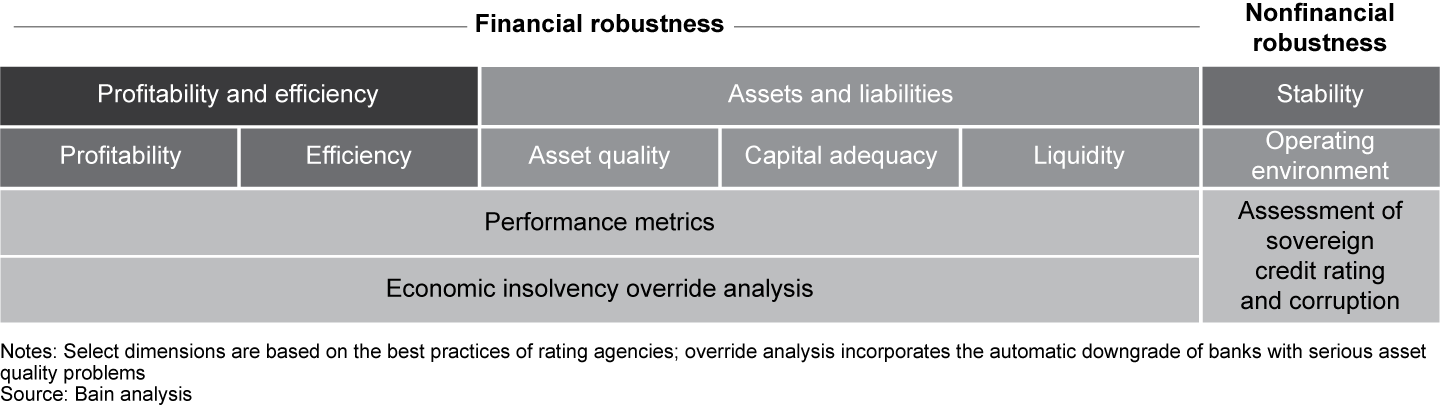
      Components of the banking health check scoring model

      Components of the banking health check scoring model

      João Soares is a partner with Bain & Company’s Financial Services practice. He is based in London. The author thanks Justyna Nowicka for her contribution to the European health check analysis and to this brief.

      Net Promoter®, Net Promoter System®, Net Promoter Score® and NPS® are registered trademarks of Bain & Company, Inc., Fred Reichheld and Satmetrix Systems, Inc.

      Related Video

      João Soares: Europe’s Largest Banks Face Eroding Financial Positions

      Bain Partner João Soares discusses the state of banking in Europe and how customer loyalty has become a key success factor for winning banks.

      Authors
      • Headshot of João Soares
        João Soares
        Partner, New York
      Contact us
      Related Industries
      • Banking
      • Financial Services
      How We Can Help
      • Zero-based Budgeting
      • Zero-based Redesign
      Financial Services
      Are Investors Mispricing US Bank Risks?

      The equity market is not making much distinction between weaker and healthier banks.

      Read more
      Financial Services
      João Soares: Battle of the Banks in Europe

      European banks can follow a proven formula to become a winner.

      Read more
      Banking
      João Soares: Europe’s Largest Banks Face Eroding Financial Positions

      Bain Partner João Soares discusses the state of banking in Europe and how customer loyalty has become a key success factor for winning banks.

      Read more
      Banking
      Six Threats Demand a New Playbook for Banks in Wealth and Asset Management

      AI, direct-to-consumer models, and the return of local priorities are redrawing industry lines.

      Read more
      Zero-based Budgeting
      The New Case for Zero-Based Cost Management

      A clean-sheet approach helps leaders produce savings that stick—even in turbulent times.

      Read more
      First published in septiembre 2018
      Tags
      • Banking
      • Financial Services
      • Zero-based Budgeting
      • Zero-based Redesign

      How We've Helped Clients

      A European Banking Giant Rises to the Fintech Challenge

      Read case study

      Redesigning a Bank’s Climate Strategy for Growth

      Read case study

      The change process unlocks potential and profits

      Read case study

      Ready to talk?

      We work with ambitious leaders who want to define the future, not hide from it. Together, we achieve extraordinary outcomes.

      Stay ahead in a rapidly changing world. Subscribe to Bain Insights, our monthly look at the critical issues facing global businesses.

      *I have read and understand Bain’s Privacy Notice.

      Please read and agree to the Privacy Policy.
      Bain & Company
      Contact us Sustainability Accessibility Terms of use Privacy Modern Slavery Act Statement Cookie Policy Sitemap Log In

      © 1996-2026 Bain & Company, Inc.

      Contact Bain

      How can we help you?

      • Business inquiry
      • Career information
      • Press relations
      • Partnership request
      • Speaker request
      See all offices