

Brief
Consumer products companies in every part of the world are coming to terms with a profound insight: The best way brands can grow over the long term is to grow their number of buyers. This is a key finding from the research of the Ehrenberg-Bass Institute for Marketing Science, summarized by Professor Byron Sharp, director of the Institute, in his book How Brands Grow, based on decades of observations of buying behavior.
Through Bain & Company analysis of the buying habits of nearly 100,000 shoppers across the globe, based on data collected by Kantar Worldpanel and our experience working on more than 600 brand growth projects over the past decade, we have been able to reconfirm this insight. It may sound obvious or even like circular reasoning, but this actually is a counterintuitive departure from the way generations of consumer goods executives have tried to outperform rival brands. Most brand plans typically call for tapping into a well-segmented group of shoppers, getting them to try the brand and progressively converting them into avid consumers who buy larger and larger quantities over time. While this approach may appear attractive, ample evidence shows that it just doesn’t work.
Instead, there’s a simple rule that successful brands follow: It’s all about increasing household penetration. (Penetration is defined as the percentage of households in a market that buy a particular brand in a given year.) Across dozens of diverse categories from yogurt to laundry detergent and in distinct markets from Indonesia to the UK, we have systematically confirmed the same insight. The one thing that all leading brands have in common is that they also lead their categories in penetration. We’ve observed that loyalty levels within a category can be extremely similar—and generally low—for all brands. And while loyalty across categories doesn’t vary significantly over time, household penetration does. No brand can truly make a difference by standing out on loyalty. Brands primarily stand out because more people buy them.
Look at China. Tsing Tao in beer, Pampers in baby diapers and Maybelline in color cosmetics all earned penetration rates that are significantly higher than the average of the top 20 competing brands—at least four times higher. These brands usually earn higher repurchasing and purchasing frequency rates than their rivals, but their outperformance in penetration is far more dramatic (see Figure 1).
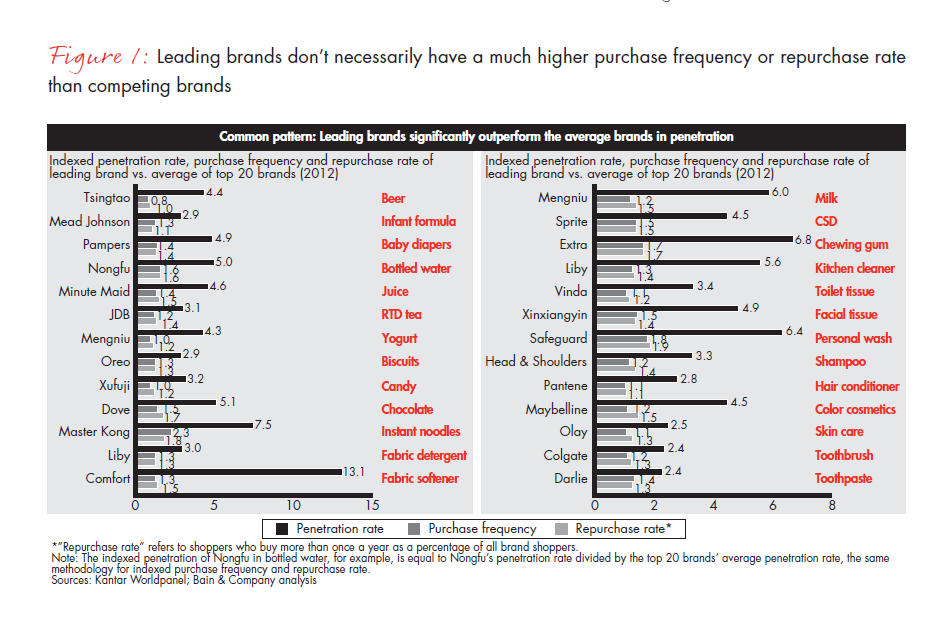
But while penetration may be the biggest contributor to brand growth, it shouldn't be taken for granted. If you analyze the population of shoppers that bought a brand in a given year, it is not unusual for a large majority not to be buying it the following year, and even top brands can experience churn rates of nearly 50%. The implication: Companies need to invest to re-earn penetration over and over again. Winners accept that it’s a game of constant recruitment. That’s why they invest on an ongoing basis to acquire more new consumers every year than they lose.
Despite the importance of this simple rule, we see a surprisingly high number of brands with chronically low levels of penetration. Across many categories, a large majority of brands will typically enjoy less than 5% penetration. While many companies can achieve this rate just by putting a brand out there in the market, it doesn’t position them to achieve scale. We’ve found that companies need to reach 10% to 15% penetration to earn the scale that would justify the kind of investments you need to sustain and grow your brand. Solid brands maintain penetration in the 25%–30% range, and perennial brands like Coca- Cola can achieve 50% or more.
Too many brands make the mistake of limiting their imagined universe of users to a narrow subset, often contained in the strict boundaries of their product sub-category. They typically overestimate their competitive positions and think they can’t possibly grow further—but they could, if they looked at penetration of the overall population instead. For many brands, this means there’s still a lot of untapped potential and headroom for growth.
Look at the success of brands like Blue Moon or Red Bull. They would have found themselves hitting a wall if they viewed their brands as competing only in “Belgian- style white beer” or “premium energy drinks,” respectively. But both realized they compete in a much broader competitive space. Many consumers could easily trade off a Blue Moon for a margarita, or a Red Bull for a cup of coffee or energy bar. By acknowledging this, those brands managed to boost their penetration in the US to above 5% and above 14% of the adult population, respectively.
So, how can brands grow their penetration rates?
For starters, brands must realize that they need to be in the game for the long run. Based on our experience, brands that make all the right moves can hope to add about 1% of penetration a year. At that rate, it takes a brand starting with 10% penetration close to 15 years to achieve 25% penetration. Unfortunately, few companies choose to lay plans for longer than the next 12 months, and many managers who take on a new brand will tend to change everything from the types of SKUs to the advertising strategy, rather than staying the course.
Companies that keep switching everything risk losing out to rivals that stick with a plan for slowly and steadily increasing penetration. It takes unwavering discipline and patience to gain ground. As many companies have found, it’s easy to veer off course in the hunt for revenues to meet short-term financial targets or in the pursuit of boosting volume sales. A brand can be tempted to temporarily drive up revenues with price increases, but it risks losing buyers who can’t afford the higher prices.
Or a brand can temporarily drive up volume by increasing pack sizes, but it risks losing occasional buyers—those who would buy a single SKU but not a six-pack, for example—but are necessary in the long term to build penetration beyond core heavy users. Over the years, it hurts the brand. Winners know they need to avoid such shortsighted moves to maintain a long-term and ruthless focus on penetration.
Boosting penetration is difficult to do in isolation from another critical performance indicator in consumer goods: brand consideration (defined as the percentage of consumers who would consider your brand for a given purchase occasion). Building penetration requires continually building consideration—which in turn helps increase penetration. The steady path for earning consideration and penetration requires investing in three key brand assets: memory structures, product portfolios and in-store assets. Let’s look at each area one by one.
Memory structures. Building memory structures means anchoring a brand in consumers’ long-term memories, using the full range of touchpoints. Winning companies broadcast a brand’s messages widely enough to be heard by the largest possible swath of consumers. To get into consumers’ heads, they articulate messages that are distinct and memorable, often in the shape of stories that tell consumers what the brand is, why they need it, how it’s different and when or how to use it.
Because individuals can remember only a limited number of brand names, and memorize only a few messages, memory structures are fragile and take long to establish. Winning companies therefore know that staying in consumers’ heads takes consistency, persistence and repetition. They use the same messaging and cues everywhere—from media advertising to packaging or point-of-sale signage. They avoid changes to messaging, logos, catch lines or music that erase memory structures. And they don’t shy away from repetition.
That is the approach that has supported brands like Nutella or Nivea for years. The iconic chocolate-spread brand hasn’t significantly altered the product formulation and taste, and rarely modifies its message. The skin care brand has essentially been using the same visual cues for its core product for decades: the same round tin since the brand was launched in 1911; the same blue-and-white colors since 1925; and the same logo and font since 1959. Finally, look at Innocent, the leader in the smoothie category in Europe. Every communication on its containers consistently reminds consumers that its products are natural and healthy, and that it helps them achieve their objective of “five-a-day” (the daily consumption of five different fruits or vegetables for nutritional balance).
Many companies limit their media investment per brand, either for budgetary reasons or because they’re trying to support too many. As a result, they never gain the share of attention necessary to boost consideration, and in turn, penetration.
What do winners do? First, they stick to the brand’s heritage to avoid eroding memory structures, but continually refresh it to keep it current. Then, they achieve reach, repetition and audibility by concentrating their resources on fewer brands. They identify those that either have enough scale to self-fund the required investments or enough potential to break into a new consideration set—and they commit.
Product portfolios. Indeed, winning brands know that product complexity is a quiet thief of penetration. Too many brands and SKUs can result in everything from ineffective levels of advertising to shopper confusion—woes that conspire to erode penetration.
Many companies rely on a business model that overemphasizes innovation, but they often fail to perform the simple math before introducing SKUs. For example, one personal care brand launched up to six new products a year in a European market. But the majority of shoppers have only one or two buying occasions a year. With too many SKUs chasing too few buying occasions, the company was destined to produce losers. Products never had a chance to get big.
Surprisingly few innovations eventually result in increased penetration. Not only do they fail at a high rate, they also distract marketing and commercial teams from supporting core SKUs.
For their part, hero SKUs generate higher volumes that increase scale, leading to bigger margins that enable investment to fuel growth.
Winners constantly invest in their hero SKUs to keep building on their success. They invest in product quality to keep private labels at a distance and earn a justified price premium. They invest in trade terms to deliver increased distribution, prime placements or promotional slots that attract new consumers to the category. Investments in advertising improve consideration. And investments in renovations and range expansions extend the bounds of consideration.
There’s a host of possibilities for creating incremental need. Pack size changes can boost volume per pack or decrease price per unit. Package innovations can make products more convenient. New formulations can make products more “permissible” for consumers. Consider the snack company that introduced mini-waffl es. The bite-size version made this rich treat more permissible. Or the water company that introduced smaller bottles with special caps—the perfect companion for thirsty joggers. Every new product should meet a high threshold for tapping into different consideration sets or consumption occasions, thus contributing to a meaningful increase in a brand’s penetration in its category.
In-store assets. Finally, having targeted the most important SKUs, it’s critical to adequately invest to activate them at the point of sale and ensure they’re always available, at the right place on the shelf or in secondary placements—and visible. Nivea in France, for instance, is known for having emphasized diligent in-store execution: the brand prioritizes its top SKUs, for which its salesforce must systematically fulfill an objective of 100% distribution. It also sets the challenge of “turning points-of-sales blue”—the iconic brand’s color.
Leading companies spend time identifying the store assets that are critical to own in their category. They define a compelling picture of success to guide the execution of their salesforce. These winners adopt a “store-back” view to reverse-engineer their core processes and make them compatible with the primary constraints of their trade customers. For example, they consider a retailer’s space constraints when defining their product portfolio, ensuring that the majority of the products actually see the light of day. They consider placement constraints when defining merchandising plans, and calendar constraints when defining promotional plans. And they ensure their entire organization is synchronized and delivers a coherent plan, resulting in maximum impact.
Consumer goods companies can learn from Apple, a champion in managing in-store assets. The technology company invests heavily to create a unique experience in its own stores. But in third-party stores, too, it works hard to attentively showcase its products, often by establishing what amounts to a shop-within-a-shop, which more than compensates for its relatively narrow range of products.
As consumer goods companies embark on the long journey of earning penetration and consideration, they can rely on an approach that has helped rejuvenate brands in a range of categories across channels and markets: The Bain Brand Accelerator®. Through this process, we first work with brand and category teams to rediscover the rules of their category and the real assets of their brand. We then help them define plans to ensure proper activation and funding to eventually get their brands to more and more people. This interactive journey, anchored in deep business facts and stimulated by vibrant creativity, brings together the best of consumer goods companies’ talent and capabilities to revitalize their brands.
Guy Brusselmans is a Bain & Company partner based in Brussels. John Blasberg is a partner based in Boston, and James Root is a partner based in Hong Kong. All are members of the firm’s Consumer Products practice.
First published in marzo 2014