
Skip to Content
  • Bureaux

    Bureaux

    Amérique du Nord et Amérique du Sud
    • Atlanta
    • Austin
    • Bogota
    • Boston
    • Buenos Aires
    • Chicago
    • Dallas
    • Denver
    • Houston
    • Los Angeles
    • Mexico City
    • Minneapolis
    • Monterrey
    • Montreal
    • New York
    • Rio de Janeiro
    • San Francisco
    • Santiago
    • São Paulo
    • Seattle
    • Silicon Valley
    • Toronto
    • Washington, DC
    Europe, Moyen-Orient et Afrique
    • Amsterdam
    • Athens
    • Berlin
    • Brussels
    • Copenhagen
    • Doha
    • Dubai
    • Dusseldorf
    • Frankfurt
    • Helsinki
    • Istanbul
    • Johannesburg
    • Kyiv
    • Lisbon
    • London
    • Madrid
    • Milan
    • Munich
    • Oslo
    • Paris
    • Riyadh
    • Rome
    • Stockholm
    • Vienna
    • Warsaw
    • Zurich
    Asie et Australie
    • Bangkok
    • Beijing
    • Bengaluru
    • Brisbane
    • Ho Chi Minh City
    • Hong Kong
    • Jakarta
    • Kuala Lumpur
    • Manila
    • Melbourne
    • Mumbai
    • New Delhi
    • Perth
    • Shanghai
    • Singapore
    • Sydney
    • Tokyo
    Voir tous les bureaux
  • Alumni
  • Presse
  • S’abonner
  • Contacter
  • Canada | Français

    Sélectionnez votre région et votre langue

    Global
    • Global (English)
    Amérique du Nord et Amérique du Sud
    • Brazil (Português)
    • Argentina (Español)
    • Canada (Français)
    • Chile (Español)
    • Colombia (Español)
    Europe, Moyen-Orient et Afrique
    • France (Français)
    • DACH Region (Deutsch)
    • Italy (Italiano)
    • Spain (Español)
    • Greece (Elliniká)
    Asie et Australie
    • China (中文版)
    • Korea (한국어)
    • Japan (日本語)
  • Saved items (0)
    Saved items (0)

    You have no saved items.

    Bookmark content that interests you and it will be saved here for you to read or share later.

    Explore Bain Insights
  • Expertises Sectorielles
    Menu principal

    Expertises Sectorielles

    • Aerospace et Défense
    • Agroalimentaire
    • Chimie
    • Infrastructures, BTP et Matériaux de Construction
    • Grande Consommation
    • Services Financiers
    • Santé
    • Engins & Equipements Industriels
    • Media et Divertissement
    • Metals
    • Mining
    • Pétrole & Gaz
    • Papier et Emballage
    • Private Equity
    • Secteur Public
    • Distribution
    • Technologie
    • Télécommunications
    • Transportation
    • Travel & Leisure
    • Utilities & Energies Renouvelables
  • Expertises Fonctionnelles
    Menu principal

    Expertises Fonctionnelles

    • Expérience Client
    • ESG
    • Innovation
    • Fusions et Acquisitions
    • Opérations
    • People & Organization
    • Private Equity
    • Sales & Marketing
    • Stratégie
    • IA, Perspectives et Solutions
    • Technology
    • Transformation
  • Digital
  • Points de Vue
  • About
    Menu principal

    About

    • Notre Activité
    • Nos Valeurs
    • Nos Collaborateurs et Notre Équipe Dirigeante
    • Notre Impact
    • Prix & Récompenses
    • Partenariats Internationaux
    Further: Our global responsibility
    • Sustainability
    • Impact Social
    • World Economic Forum
    Learn more about Further
  • Carrières
    Menu principal

    Carrières

    • Rejoignez-nous
      Carrières
      Rejoignez-nous
      • Find Your Place
      • Nos domaines d’expertise
      • Equipes multidisciplinaires
      • Étudiants
      • Stages et programmes
      • Événements de recrutement
    • La vie chez Bain
      Carrières
      La vie chez Bain
      • Blog: Inside Bain
      • Récits de carrière
      • Nos collaborateurs
      • Nos bureaux
      • Soutenir votre évolution professionnelle
      • Groupes d’affinités
      • Avantages chez Bain
    • Histoires d’impact
    • Notre processus de recrutement
      Carrières
      Notre processus de recrutement
      • Ce que vous pouvez attendre
      • Entretiens
    Trouver un poste
  • Bureaux
    Menu principal

    Bureaux

    • Amérique du Nord et Amérique du Sud
      Bureaux
      Amérique du Nord et Amérique du Sud
      • Atlanta
      • Austin
      • Bogota
      • Boston
      • Buenos Aires
      • Chicago
      • Dallas
      • Denver
      • Houston
      • Los Angeles
      • Mexico City
      • Minneapolis
      • Monterrey
      • Montreal
      • New York
      • Rio de Janeiro
      • San Francisco
      • Santiago
      • São Paulo
      • Seattle
      • Silicon Valley
      • Toronto
      • Washington, DC
    • Europe, Moyen-Orient et Afrique
      Bureaux
      Europe, Moyen-Orient et Afrique
      • Amsterdam
      • Athens
      • Berlin
      • Brussels
      • Copenhagen
      • Doha
      • Dubai
      • Dusseldorf
      • Frankfurt
      • Helsinki
      • Istanbul
      • Johannesburg
      • Kyiv
      • Lisbon
      • London
      • Madrid
      • Milan
      • Munich
      • Oslo
      • Paris
      • Riyadh
      • Rome
      • Stockholm
      • Vienna
      • Warsaw
      • Zurich
    • Asie et Australie
      Bureaux
      Asie et Australie
      • Bangkok
      • Beijing
      • Bengaluru
      • Brisbane
      • Ho Chi Minh City
      • Hong Kong
      • Jakarta
      • Kuala Lumpur
      • Manila
      • Melbourne
      • Mumbai
      • New Delhi
      • Perth
      • Shanghai
      • Singapore
      • Sydney
      • Tokyo
    Voir tous les bureaux
  • Alumni
  • Presse
  • S’abonner
  • Contacter
  • Canada | Français
    Menu principal

    Sélectionnez votre région et votre langue

    • Global
      Sélectionnez votre région et votre langue
      Global
      • Global (English)
    • Amérique du Nord et Amérique du Sud
      Sélectionnez votre région et votre langue
      Amérique du Nord et Amérique du Sud
      • Brazil (Português)
      • Argentina (Español)
      • Canada (Français)
      • Chile (Español)
      • Colombia (Español)
    • Europe, Moyen-Orient et Afrique
      Sélectionnez votre région et votre langue
      Europe, Moyen-Orient et Afrique
      • France (Français)
      • DACH Region (Deutsch)
      • Italy (Italiano)
      • Spain (Español)
      • Greece (Elliniká)
    • Asie et Australie
      Sélectionnez votre région et votre langue
      Asie et Australie
      • China (中文版)
      • Korea (한국어)
      • Japan (日本語)
  • Saved items  (0)
    Menu principal
    Saved items (0)

    You have no saved items.

    Bookmark content that interests you and it will be saved here for you to read or share later.

    Explore Bain Insights
  • Expertises Sectorielles
    • Expertises Sectorielles

      • Aerospace et Défense
      • Agroalimentaire
      • Chimie
      • Infrastructures, BTP et Matériaux de Construction
      • Grande Consommation
      • Services Financiers
      • Santé
      • Engins & Equipements Industriels
      • Media et Divertissement
      • Metals
      • Mining
      • Pétrole & Gaz
      • Papier et Emballage
      • Private Equity
      • Secteur Public
      • Distribution
      • Technologie
      • Télécommunications
      • Transportation
      • Travel & Leisure
      • Utilities & Energies Renouvelables
  • Expertises Fonctionnelles
    • Expertises Fonctionnelles

      • Expérience Client
      • ESG
      • Innovation
      • Fusions et Acquisitions
      • Opérations
      • People & Organization
      • Private Equity
      • Sales & Marketing
      • Stratégie
      • IA, Perspectives et Solutions
      • Technology
      • Transformation
  • Digital
  • Points de Vue
  • Carrières
    Recherches les plus fréquentes
    • Agile
    • Digital
    • Stratégie
    Vos recherches précédentes
      Pages récemment visitées

      Content added to saved items

      Saved items (0)

      Removed from saved items

      Saved items (0)

      Rapport

      Public vs. Private Equity Returns: Is PE Losing Its Advantage?

      Public vs. Private Equity Returns: Is PE Losing Its Advantage?

      Over the past decade, returns from private and public equity have converged. Should we be worried?

      Par Hugh MacArthur, Josh Lerner and State Street Global Markets & State Street Private Equity Index

      • min
      }

      Rapport

      Public vs. Private Equity Returns: Is PE Losing Its Advantage?
      en

      This article is Section 3 of Bain’s 2020 Global Private Equity Report. 

      Investors have poured more than $2 trillion into buyout funds over the past decade for a simple reason: They deliver. Over the past 30 years, US buyouts have generated average net returns of 13.1%, compared with 8.1% for an alternative private-market performance benchmark, based on the Long-Nickels public market equivalent (PME) method and using the S&P 500 as the proxy.

      Shorten the time frame, however, and the picture isn’t what most PE investors were expecting. Since 2009, when the global economy limped out of the worst recession in generations, US public equity returns have essentially matched returns from US buyouts at around 15% (see Figure 3.1).

      Figure 3.1
      US buyout returns have converged with public equity returns over the current cycle, closing a three-decade gap in performance
      US buyout returns have converged with public equity returns over the current cycle, closing a three-decade gap in performance
      US buyout returns have converged with public equity returns over the current cycle, closing a three-decade gap in performance

      While a 15% average annual return net of fees is impressive even by private equity’s own high standard, parity with public markets is not what PE investors are paying for. The institutions that allocate increasing portions of their portfolios to buyout funds have good reason to expect a premium. They lock up their money for a period of years with the presumption that professional managers will generate alpha through innovative value-creation strategies and leverage. All things being equal, public equities offer more liquidity at less cost.

      And that raises a disquieting question for buyout managers: Will the convergence in 10-year returns make it harder to raise the next $2 trillion?

      The power of cycles

      Working with Professor Josh Lerner of Harvard Business School, as well as State Street Global Markets and State Street Private Equity Index, we analyzed what’s been driving returns in both markets. Our study found little evidence to suggest that competition from the public markets is likely to persist. The first clue: The surge in public valuations following the global financial crisis is neither surprising nor unprecedented. Given the historic sell-off in the wake of the crisis, US stocks were teed up for an equally historic rebound.

      Over the ensuing decade, several factors created strong upward momentum. First, US monetary and tax policy couldn’t have been more accommodating, leading to a slow but steady expansion that produced the lowest level of unemployment in half a century. At the same time, US equities benefited from a global flight to quality as bad news in Europe―Brexit, sovereign default scares, the threat of recession in Germany and Southern Europe―drove investors to seek solace in the S&P 500. It’s worth noting that public and private returns have not converged in Europe. There, PE’s historic outperformance continues (see Figure 3.2).

      Figure 3.2
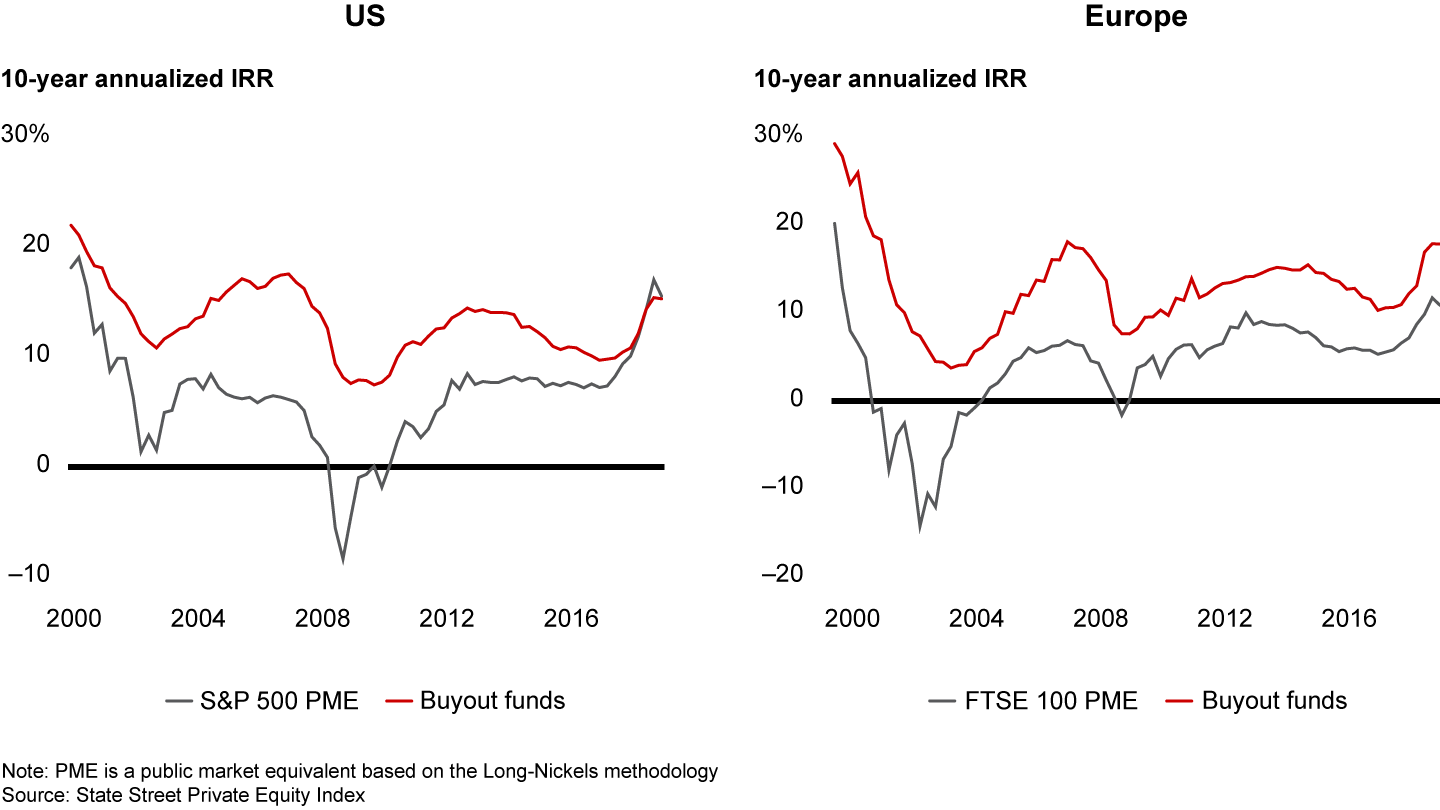
      The public-private convergence in returns over the past decade has largely been a US phenomenon
      The public-private convergence in returns over the past decade has largely been a US phenomenon
      The public-private convergence in returns over the past decade has largely been a US phenomenon

      Several periods in US market history have produced similar surges, including the decade ending in March 2000, when accommodating monetary policy and the inflating dot-com bubble drove a 19.4% 10-year return for the S&P 500 PME index. Of course, what came next also followed a pattern. Inevitably, such periods of exuberance in public markets are punctuated by years of lethargy as performance reverts to the mean. In the decade following the dot-com crash (through March 2010), the PME index’s annual return fell to 0.08%, while private equity maintained a 7.5% average. As noted earlier, the PME index has posted an 8.1% annualized return over the past 30 years, which is consistent with the 8% average logged by the S&P 500 over the 140 years for which public market data is available. In about  30% of those years, the public markets generated negative real returns—three times private equity’s down-year rate for its 30-year history (see Figure 3.3).

      Figure 3.3
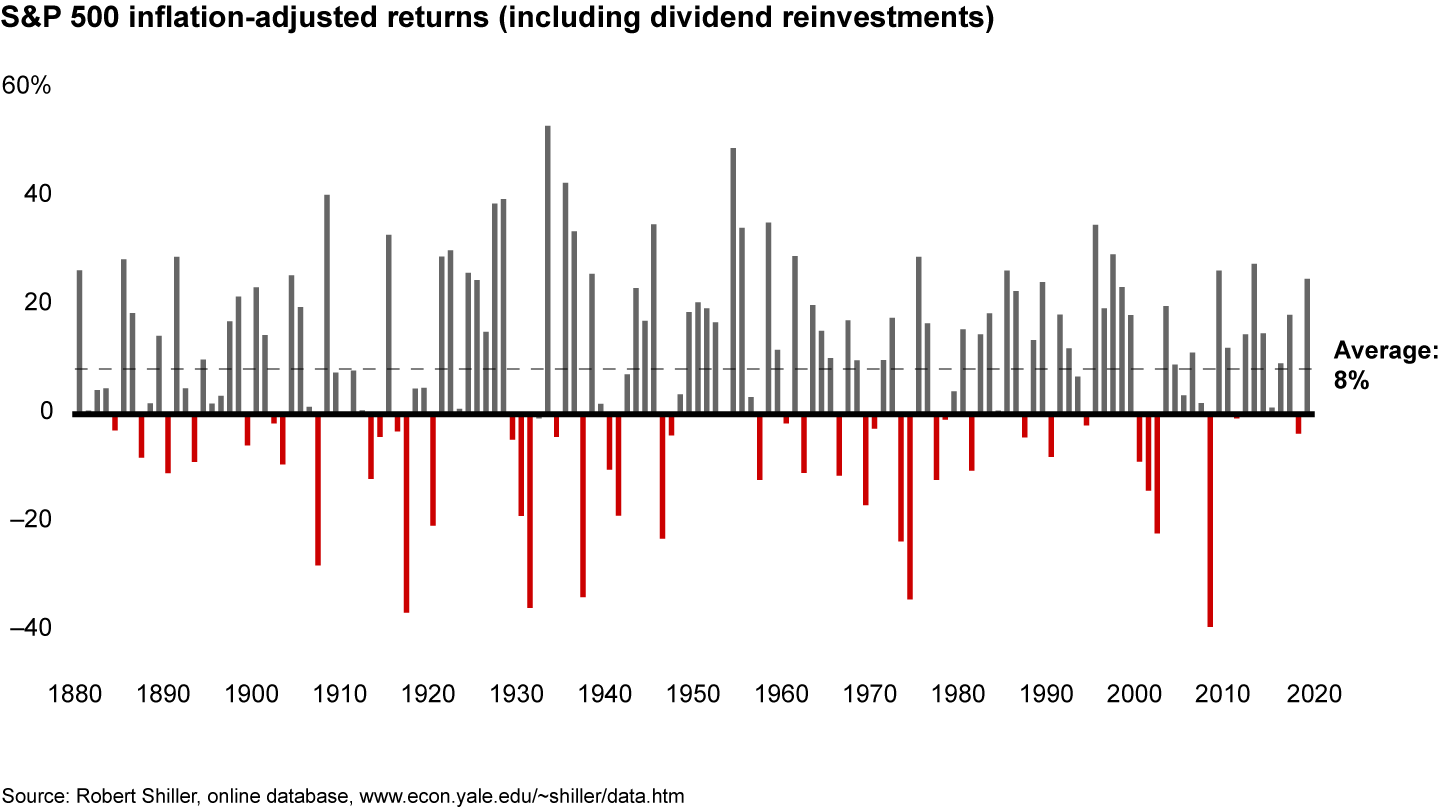
      The S&P 500 has averaged 8% returns for the past 140 years and was in negative territory 31% of the time
      The S&P 500 has averaged 8% returns for the past 140 years and was in negative territory 31% of the time
      The S&P 500 has averaged 8% returns for the past 140 years and was in negative territory 31% of the time

      There’s little reason to believe that US equities will somehow break out of this pattern and sustain these double-digit returns over the long term. Indeed, short sellers live for the predictions of a “new normal” that always seem to come at the end of a cycle. Private equity investors recognize this and continue to believe in the consistent, long-term outperformance that buyout funds deliver. They also continue to vote with their wallets. Since 2000, net asset value for global buyouts has grown 3.5 times faster than the public markets (see Figure 3.4). Most PE investors can’t get enough: Around 50% of LPs are heading into 2020 underallocated to private equity.

      Figure 3.4
      Since 2000, buyout asset value has grown 3.5 times faster than public equity market capitalization
      Since 2000, buyout asset value has grown 3.5 times faster than public equity market capitalization
      Since 2000, buyout asset value has grown 3.5 times faster than public equity market capitalization

      None of this means that the private equity industry should relax, however. While competition from the public markets will surely ease off at some point, the long-term trend in PE returns is more troublesome. As strong as private equity’s performance has been for the past decade, buyout returns have been trending downward over the past 30 years. If you draw a trend line between the 10-year return in 1999 and the 10-year return today, it would show a decline of 6 percentage points over that period (see Figure 3.5). Extend the same slope out another 10 years, and PE returns start to look a lot less compelling.

      Figure 3.5
      In a maturing market, average private equity returns have been trending downward, while top-tier returns remain steady
      In a maturing market, average private equity returns have been trending downward, while top-tier returns remain steady
      In a maturing market, average private equity returns have been trending downward, while top-tier returns remain steady

      To a large degree, this is a function of maturity. As private equity’s relative outperformance attracts increasing amounts of capital from investors, competition for a limited number of high-quality assets increases, driving up average purchase price multiples. Buying at premium prices makes it ever more challenging to create value during ownership and exit with an acceptable return. Add in growing pressure from well-heeled corporate buyers, and generating alpha becomes even more daunting.

      It’s also clear, however, that an elite group of firms has found a way to buck the trend. While average returns have declined over time, top-quartile returns have essentially held steady. This explains why a large majority of the capital flowing into private equity is targeting these top-tier firms. For those in the bottom quartiles, raising a fund is already becoming more difficult. And with deal multiples at record levels, it’s not going to get any easier in the years ahead to generate the kind of performance investors are looking for.

      What are these top-tier funds doing right? We recently studied a pool of 113 private equity firms that each have raised $5 billion or more since 2000. If at least 80% of a firm’s funds ranked in the top two quartiles of industry performance over that period, we defined it as a consistent outperformer (see Figure 3.6). There were 28 of these firms in our sample, and they clearly won on a deal-by-deal basis, as measured by internal rate of return. They had many more deals with an IRR above 15% (32% of their portfolios vs. 18% for the laggards) and far fewer write-offs (5% vs. 8%).

      Figure 3.6
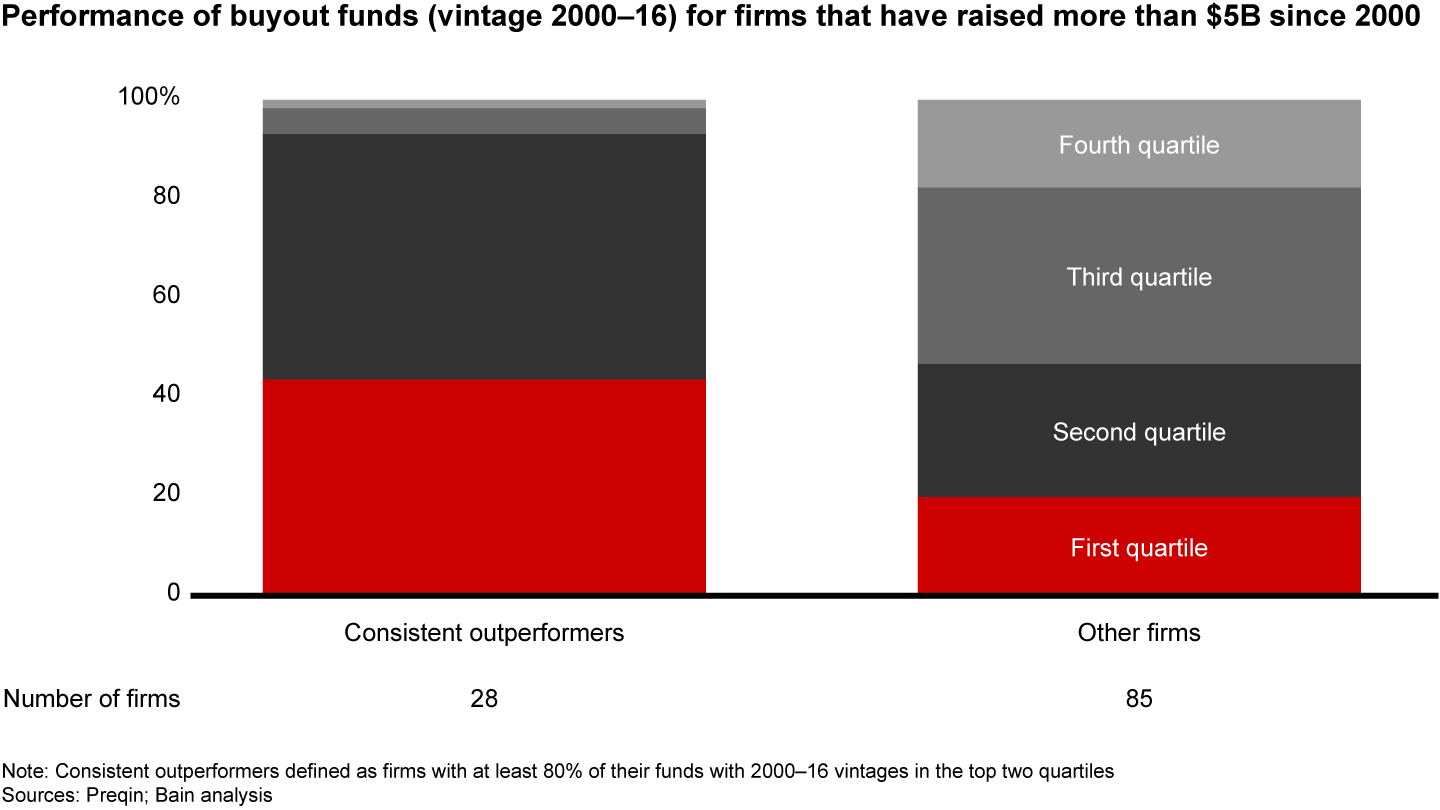
      It is possible to consistently outperform in private equity
      It is possible to consistently outperform in private equity
      It is possible to consistently outperform in private equity

      Data can’t really capture how these firms consistently outperform, but a more qualitative and experience-based analysis suggests it boils down to focus: The best firms know what they are good at and wield that as a competitive weapon. In a world of high prices and intense competition, they understand that expertise matters. You have to be much more focused on the sectors you’re investing in, the risks you’re underwriting and your ability to actually get the value once you own the asset.

      Funds do this in a variety of ways. Our consistent outperformers fell into four broad categories (see Figure 3.7).

      Figure 3.7
      Consistent outperformers generate alpha through a variety of investment approaches, but the common denominator is focus
      Consistent outperformers generate alpha through a variety of investment approaches, but the common denominator is focus
      Consistent outperformers generate alpha through a variety of investment approaches, but the common denominator is focus
      • Sector specialists. These firms make it their business to know more about a given sector than anyone else. They’ve become so smart in that area that they can assess risk and opportunities in ways the competition can’t. (Think Thoma Bravo, Silver Lake and Vista Equity in tech, Charlesbank and L Catterton in consumer.) The institutional knowledge these firms have built provides differentiated insights that win auctions and drive value creation.
        Silver Lake, for instance, focuses on technology and technology-enabled businesses. It understands how to manage very large deals and is adept at building platform companies. A strong tech network and a culture of collaboration between its investment and operating teams are differentiators. From 2000 through 2016, 95% of Silver Lake’s funds ranked in the top two quartiles. It has raised $41 billion since 2000, almost all of it for buyout funds.
      • Firms with a focused hunting ground. Like sector specialists, these firms target a sweet spot with a repeatable investment approach, but they don’t limit themselves to one sector. Instead, they may have a narrower geographic focus or stick to their core buyout asset class. The key is that they know exactly what kind of risks they are underwriting in any deal and are very comfortable they can manage those risks. They also know what risks they will never underwrite, and they have honed their approach to reduce loss ratios and capitalize on positive bias to volatility and risk. Examples include MBK Partners, Equistone Partners Europe, Veritas Capital and Audax Group, which focuses on buy-and-build strategies.
        Based in Seoul, MBK introduces itself as “a leading North Asia private equity firm, owned and operated by Asians.” The firm invests across sectors but is extremely deliberate about the kind of deals it goes after—mostly mature companies that operate in South Korea, Greater China and Japan. MBK has a strong focus on control investments, giving it more influence when working with management to create value. From the firm’s inception in 2005, all of its funds have performed in the top half of the industry, and the $16 billion it has raised (or is about to close) for buyout funds represents 95% of its capital.
      • Differentiated playbook funds. These funds know from pattern recognition what kinds of companies they can improve and how. They have a well-defined playbook that works on companies with certain characteristics, and by running it with great precision, they create significant value during ownership. Examples include Clayton, Dubilier & Rice (CD&R) and GTCR.
        CD&R focuses on companies with sustainable market-leading positions in industries poised for long-term growth. It looks for differentiated products, services or processes, but also the potential to improve growth and enhance productivity. CD&R does exhaustive up-front diligence, characterized by strong collaboration between its deal and operating teams. The resulting investment thesis usually relies on using operational enhancements to improve margins. CD&R placed 100% of its funds in the top two quartiles from 2000 through 2016, and the $25 billion it has raised for buyouts represents 97% of its total since 2000.
      • Scale managers with broad expertise. Scale funds capitalize on their size and breadth. Their point of differentiation is that they can bring massive resources to whatever they invest in and often do the biggest, most complex deals. Firms like Blackstone, KKR, CVC, EQT, Permira and Apax Partners raise tens of billions in capital and operate very large funds. They have teams of people with deep expertise, and they have the staying power to wait out troubled investments that otherwise would go bust.
        CVC invests in a cross section of global industrial and service businesses. In Europe and the Americas, it looks for companies with solid market positions, stable cash flows, strong management teams and attractive prospects for organic or acquisition-led growth. CVC uses its scale and incentive structure to attract top dealmaking talent. Between 2000 and 2016, 83% of its funds generated performance in the top two quartiles. The $74 billion in buyout capital it has raised since 2000 accounts for 97% of its total.

      Focused firms win—and win consistently—because commitment to a formula sharpens all phases of the value-creation cycle. They source deals better than others based on a keen understanding of what they’re looking for and where to find it. They assess value more precisely in diligence because they are confident in their ability to identify opportunities and manage risk. During ownership, they know what works and what doesn’t, and they have a clear, active strategy for capturing value. They’re more adept at developing the right management team, adding capabilities when necessary, and tapping into the right ecosystem of partners when that makes sense.

      Increasing competition for deals is driving specialization, which means that anybody you’re bidding against has an angle. In a carve-out deal, you don’t want to be the rookie in a process dominated by firms that have done 20 similar carve-outs and know precisely how much margin they can capture and how they will do it. Similarly, if you’re doing your first industrial turnaround, you might think twice if you’re bidding against a firm that is an expert at reducing costs quickly and at improving margin sustainably. If you don’t have an angle, you’re going to be the odd firm out. And if you win at a high price, you may come to regret it.

      Middling funds can step up their game by developing the kind of differentiated focus that distinguishes the top tier. That process begins with a few key questions:

      • Is your sweet spot clear and distinctive?
      • Is there a particular sector or geography that you know better than anybody else?
      • Can you confidently and repeatedly recognize patterns for value creation and deliver against them?
      • Do you have differentiated scale that allows you to overwhelm the competition with more resources and staying power?

      The imperative is to develop expertise both internally and by leaning on outside partners and ecosystems if need be. Limited partners will continue to gravitate to the industry’s top performers. The real lesson from this period of convergence is that if you aren’t in that group, your ability to raise funds in the future will likely be compromised.

      Explore the report

      More from our 2020 Private Equity Report

      • Letter from Hugh MacArthur

      • Private Equity in 2019: Strong Deal Activity Despite Worsening Macro Conditions

      • Technology: Bubble or Opportunity for Private Equity Investors?

      • Investing with Impact: Today’s ESG Mandate in Private Equity

      • Private Equity’s New Path to Payoff in Payments

      • Harnessing Pricing Power to Create Lasting Value

      • How to Assess Disruption in Due Diligence

      • Public vs. Private Equity Returns: Is PE Losing Its Advantage?

      Private Equity Report

      This article is part of our 2020 Global Private Equity Report.

      Download the 2020 Report (PDF) Explore our latest report
      Auteurs
      • Headshot of Hugh MacArthur
        Hugh MacArthur
        Partner, Boston
      Contactez-nous
      Synergies sectorielles
      • Private Equity
      Expertises fonctionnelles transverses
      • Fusions et Acquisitions
      Rapport Mondial sur le Private Equity
      The Private Equity Market in 2020: Escape from the Abyss

      The industry showed great resilience in the face of Covid-19 and accelerated into 2021.

      Voir plus
      Rapport Mondial sur le Private Equity
      Inside Bain's 2025 Private Equity Report

      Bain's Hugh MacArthur shares key insights from our 2025 Global Private Equity Report.

      Voir plus
      Private Equity
      Spotting the Downturn Early and Coming Out Ahead with Gryphon’s David Andrews

      We ask the co-CEO of Gryphon Investors how he spotted one of the harshest cycles in the industry’s history and when he thinks it may finally break.

      Voir plus
      Fusions et Acquisitions
      Media M&A

      AI and other tech tools can boost bidding confidence in this highly competitive environment.

      Voir plus
      Rapport Mondial sur le Private Equity
      PE-Backed Carve-Outs Used to Be Reliable Winners. So What Happened?

      Top-tier deals still deliver, but the average carve-out lags. Here’s how the best funds continue to win.

      Voir plus
      First published in février 2020
      Mots clés
      • Fusions et Acquisitions
      • Private Equity
      • Rapport Mondial sur le Private Equity

      Comment nous avons aidé nos clients

      A Strategic Vision Inspires a Strategic Acquisition

      Lire l’étude de cas

      Rapid Tech Due Diligence Helped a Private Equity Firm Invest with Confidence

      Lire l’étude de cas

      Broader market plus tighter sales strategy equals big success for a portfolio company

      Lire l’étude de cas

      Vous souhaitez continuer cette conversation ?

      Nous aidons des dirigeants du monde entier à matérialiser des impacts et des résultats pérennes et créateurs de valeur dans leurs organisations.

      Les points de vue de Bain : notre perspective sur des problématiques auxquelles sont confrontées les entreprises à travers le monde, envoyés chaque mois dans votre boîte de réception. 

      *J’ai lu la politique de confidentialité et j’accepte les conditions.

      Merci de lire notre politique de confidentialité.
      Bain & Company
      Contactez-nous Sustainability Accessibility Conditions d’utilisation Politique de Confidentialité Cookie Policy Mentions Légales Sitemap Log In

      © 1996-2026 Bain & Company, Inc.

      Contacter Bain

      Comment pouvons-nous vous aider ?

      • Business inquiry
      • Career information
      • Press relations
      • Partnership request
      • Speaker request
      Voir tous les bureaux