


M&A Report


|
At a Glance
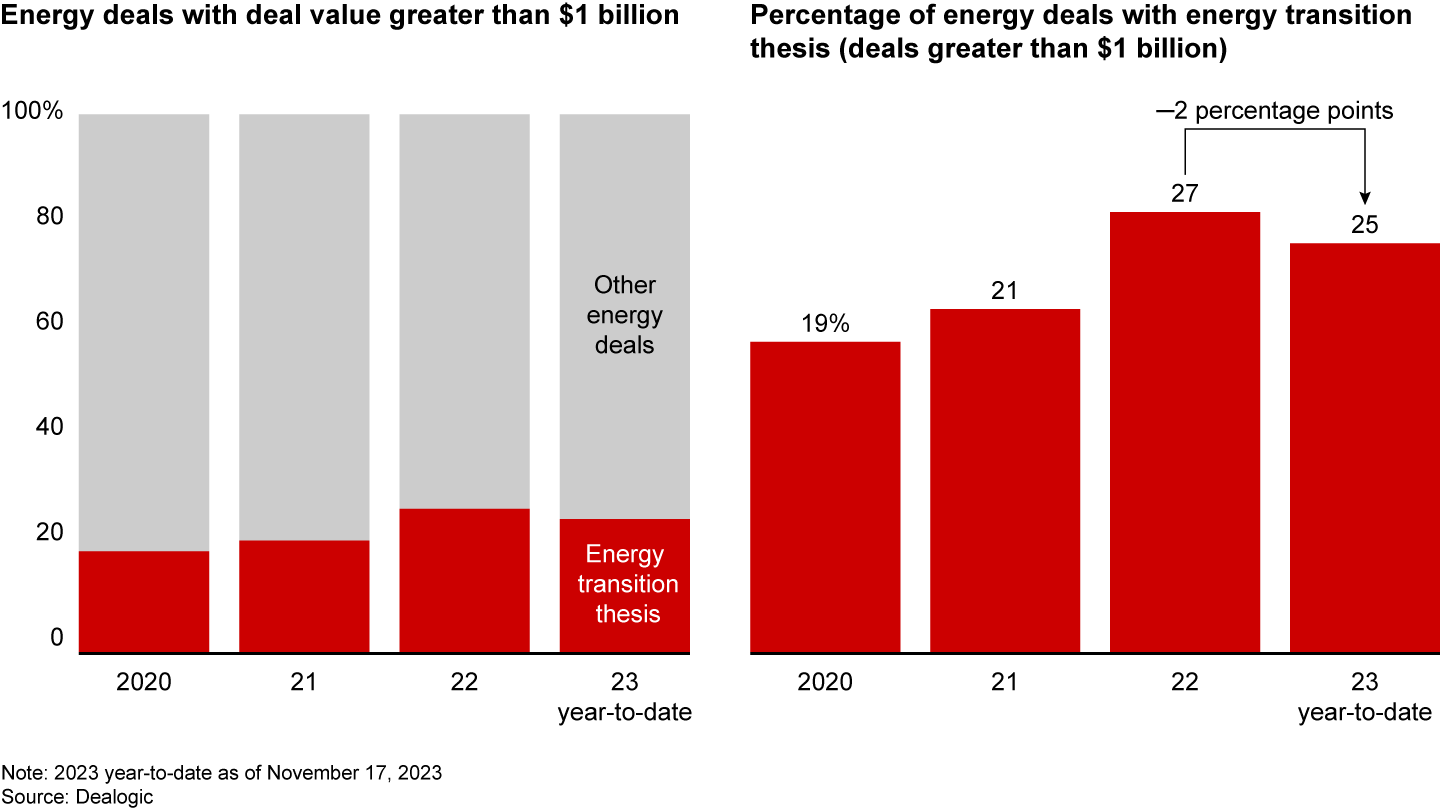
This article is part of Bain's 2024 M&A Report. Companies in the energy and natural resources (ENR) industries face a strategic crossroads. Do they invest and pursue deals to shore up their legacy higher-carbon businesses, where profit pools are potentially poised to decline given the world’s ambition to accelerate to net zero, or do they shift their focus to businesses that deliver on the clean energy transition, where profit pools are growing rapidly from a much smaller base? That question is at the heart of M&A strategy for all ENR companies, and the year 2023 gave us a glimpse of how they are answering it. After three years of increasing growth, the volume of energy transition deals plateaued (likely temporarily) as companies readjust their priorities and demonstrate that the movement to a lower-carbon future and a circular economy is not linear. That path now appears less straightforward, rockier, and more expensive than it did just a few years ago. Look at the numbers. In 2020, 19% of M&A total deal volume (for deals in excess of $1 billion) was related to the energy transition, and that number increased to 21% in 2021 and 27% in 2022 before leveling at 25% for the first nine months of 2023 (see Figure 1). We see this as an initial stabilization before continued capital rotation toward the energy transition in the latter part of the decade.
Figure 1

There are several factors influencing this shift. First, US government subsidies haven’t been enough to fully offset higher interest rates and supply chain costs, and geopolitical tensions are shifting some of the focus to energy security. A number of energy sectors have felt the impact—most prominently, the offshore wind markets. Ørsted had a record $4 billion impairment loss and canceled two high-profile projects in the US, for example. Also, equity markets have not valued energy transition investments. Valuation multiples for European international oil companies (IOCs) have traded at discounts to their more premium-rated US-based IOC peers. A specific goal for the European IOCs is to narrow and even close the structural valuation gap with US IOCs. Earlier this year, both Shell and BP signaled an intention to lean back into oil and gas, prolonging production. Similarly, market valuations for pure play renewable power companies have fallen, with the iShares Global Clean Energy ETF down 27% in 2023 as of December 1. A final reason for the shift: Energy transition investments typically involve project financing and modest debt levels, and today’s uncertain macroeconomic backdrop and higher interest rates have made project economics less attractive. This has made it even more difficult for energy companies to balance the dual challenge of continuing to spur performance in their core hydrocarbon businesses—in safety, productivity, cost, carbon, and capital productivity—while demonstrating that they also are worthy custodians of clean energy capital. This tension between improving performance in the core hydrocarbon business and advancing the fragmented, disorderly, and nonlinear energy transition can be seen in M&A activity throughout the industry. In oil and gas, ExxonMobil and Chevron recently invested more than $110 billion to acquire Pioneer and Hess, respectively. These are investments in their core businesses and are great examples of how companies are taking decisive action to enhance scale, reinforce the core components of their existing portfolios, ensure that their reserves and resources are abundant and competitive, and beef up their integrated value chains. But these large acquisitions do not need to be made at the expense of continued strategic investments in the energy transition. For example, ExxonMobil recently purchased lithium drilling rights on 120,000 acres in the US and aims to become a major US supplier for makers of electric vehicle (EV) batteries by 2030. It’s part of ExxonMobil’s long-term effort to reposition itself for the advancement of EVs and electrification in transportation. For its part, Chevron set an ambition to become a leader in renewable fuels by producing 100,000 barrels per day by 2030. It has a focused M&A strategy with two completed acquisitions and one joint venture—deals that advanced Chevron halfway toward that goal. As they rebalance their M&A strategies to reinforce the core to fuel investments during the energy transition, we see five things that ENR companies can do to improve their odds of success.
Read our 2024 M&A Report |