


Technology Report


|
At a Glance
This article is part of Bain's 2022 Technology Report. Over the past decade, the way businesses grow has taken a sharp turn. Digitalization, technology shifts and disruptions, regulatory changes, and a superabundance of capital have blurred traditional business boundaries and created radically different competitive sets. Bain & Company research has found that as much as one-third of all corporate value creation in recent years has come not from optimizing the core business or expanding into near adjacencies, but rather from entirely new businesses—what we call Engine 2s. In technology, Engine 2 businesses have been even more important; three-quarters of the value created in the sector in recent years came from new businesses. Similarly, among the sustained growth and value creators in tech, more than 80% derive significant valuation benefits from pursuing Engine 2 businesses. And in a recent Bain & Company survey, 60% of technology CIOs and CTOs executives said that building a new business is very important to their company's success. 75
of recent value created in the sector came from new business 80
of value creators in tech benefit from pursuing Engine 2 businesses Seven technology serial business builders—Amazon, Google, Apple, Microsoft, Tencent, Ping An, and Samsung—were responsible for 15% of all the positive market value created from 2007 to 2018 (see Figure 1).
Figure 1
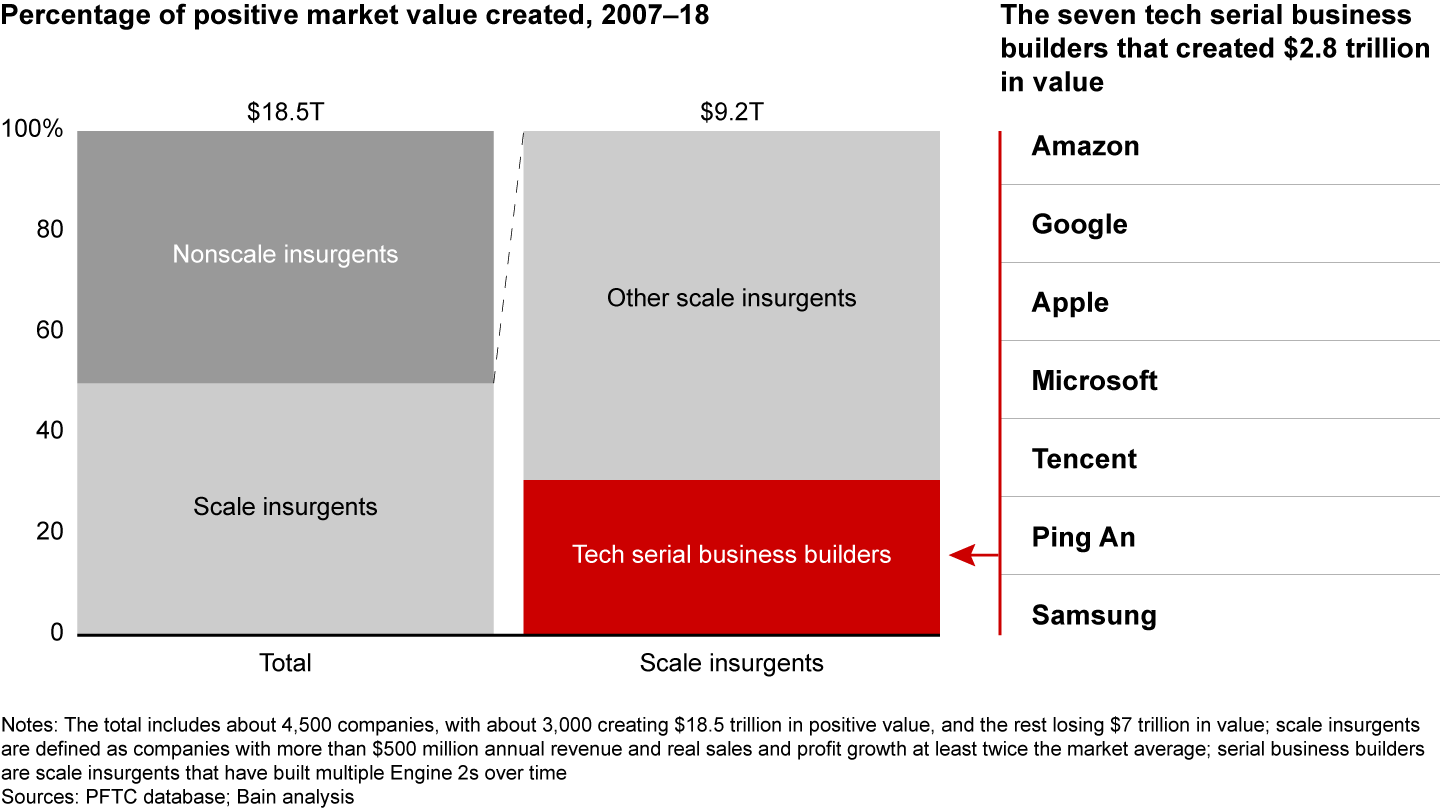

The recent stock market drop creates an opportunity for companies to invest in the future. M&A is a critical element in two of every three tech company Engine 2s, our research has found. Microsoft, for example, helped build its successful Engine 2 entry into artificial intelligence (AI) and the cloud with a series of strategic acquisitions, including GitHub, Lobe, and Citrus Data, that helped the company make AI accessible to developers. Successful Engine 2s come in various flavors. Some are next-generation business models of the original Engine 1. Software as a service (SaaS) is the evolution of software sold as a perpetual license, for example. A second model is built on something distantly adjacent to the core engine, but newly accessible competitively due to a technology change. Facebook parent Meta’s focus on the metaverse, for example, stands partly atop its 2014 purchase of the immersive virtual reality Oculus headset. Other Engine 2s are brand new businesses entirely unrelated to the core. Developing this type of growth engine is a specialty at Amazon, which now gets more profit each year from Amazon Web Services than the rest of the company combined, including its Engine 1 e-commerce site. Amazon continues to search out future Engine 2s. The company recently purchased One Medical for nearly $4 billion, for example, accelerating its aggressive move into the healthcare market. The most successful Engine 2s have one or more of the following things.
Figure 2
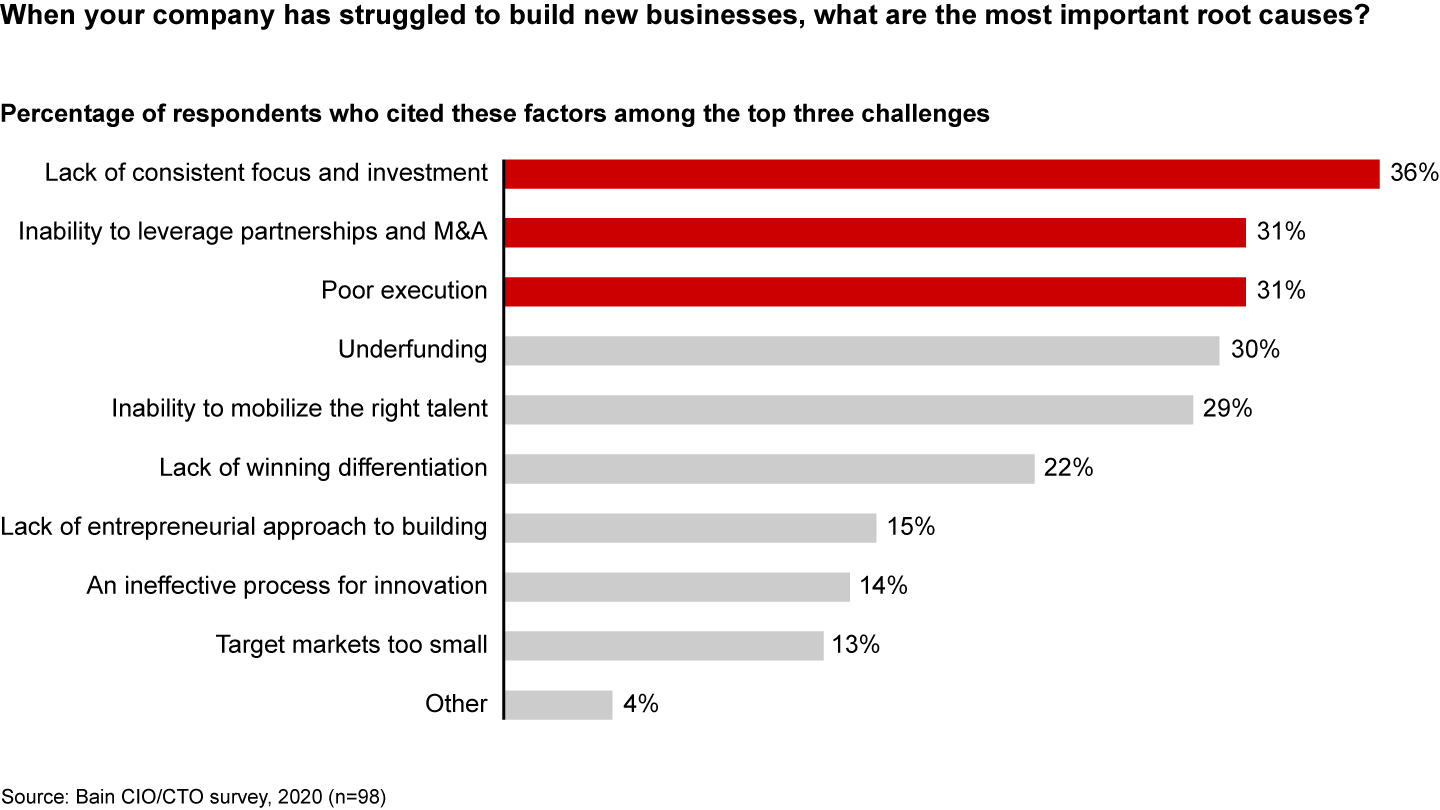

How to build an Engine 2The first step in building a second growth engine is committing to a big investment theme, making focused investments based on these bold bets on the future, and then experimenting. This may emphasize owning areas of underserved need(s) where they have a distinct advantage and see a large strategic and commercial potential. Meta spent $10 billion in 2021 on its metaverse vision, 18% of cash generated. It plans to hire 6,000 new engineers for the project and has set aside $150 million for training key staff. The next step is acquiring and building. Many companies grow their own business and use smart M&A simultaneously. Sometimes a company starts building internally and as it becomes more convinced of the power of its idea, looks for acquisitions to build scale quickly. Now is a good time for strong companies to take advantage of the downturn and make strategic investments. Mergers and acquisitions can seed the new Engine 2, scale and extend the Engine 2 into its adjacencies, or bring in essential skills and capabilities that couldn’t be built in-house fast enough. Salesforce has an extensive acquisition history, with CEO Marc Benioff publicly stating that inorganic growth is central to remaining competitive. Some of Salesforce’s largest acquisitions include: Slack, $27.7 billion in 2020, bolstering Salesforce’s social enterprise capabilities; Tableau, $15.7 billion in 2019, giving diverse visualization analytics and AI integration capabilities; and MuleSoft, $6.5 billion in 2018, which has an application programming interface-led approach to connectivity and helped expand to integration platform as a service (iPaaS). Integrating so many deals over the years, Salesforce has become especially good at getting its acquired products out to customers fast. The final step is executing in an Agile, iterative way. The idea is to rapidly test venture ideas and pivot or discontinue those that can’t establish a market fit, enabling the company to free up resources for pursuing better opportunities. One example is Amazon’s decision to end both its Haven healthcare joint venture with JPMorgan and Berkshire Hathaway and also its independent Amazon Care service so that Amazon can focus on its M&A-driven entry into primary and home healthcare services. The most successful companies design clear links between the core business and new ventures to take advantage of synergies and potential reintegrations. They outline team requirements and accelerate, build, and launch while developing the team in parallel. The one thing companies don’t need to do is worry about coming up with more innovation ideas. Only 10% of the tech executives in our survey cited that as a constraint. These companies don’t struggle to generate ideas; it’s prioritizing them that proves problematic. One way to start is by evaluating how many of the characteristics of successful Engine 2s an idea can tick off. Once the best bold idea has been identified, the company can begin to invest in building it in an Agile, iterative way, planting and nurturing the seeds of its future growth. Value EvolutionCompetitive BattlegroundsOperational AdvantageRead our 2022 Technology Report |