

World Economic Forum


|
Executive Summary
Clean fuels are—and will remain—more expensive to produce than fossil fuels, on average. However, when wider societal values and market-specific conditions—such as energy security, economic opportunity, and environmental benefits—are incorporated into their production costs, they can become competitive at a system level. These fuels are key to achieving a more secure, equitable, and sustainable energy system (see Figure 1). Liquid and gaseous clean fuels offer multiple sources of economic and social value: They reduce import dependence and exposure to volatile fossil fuel markets, stimulate domestic value chains, and create employment opportunities.
Figure 1
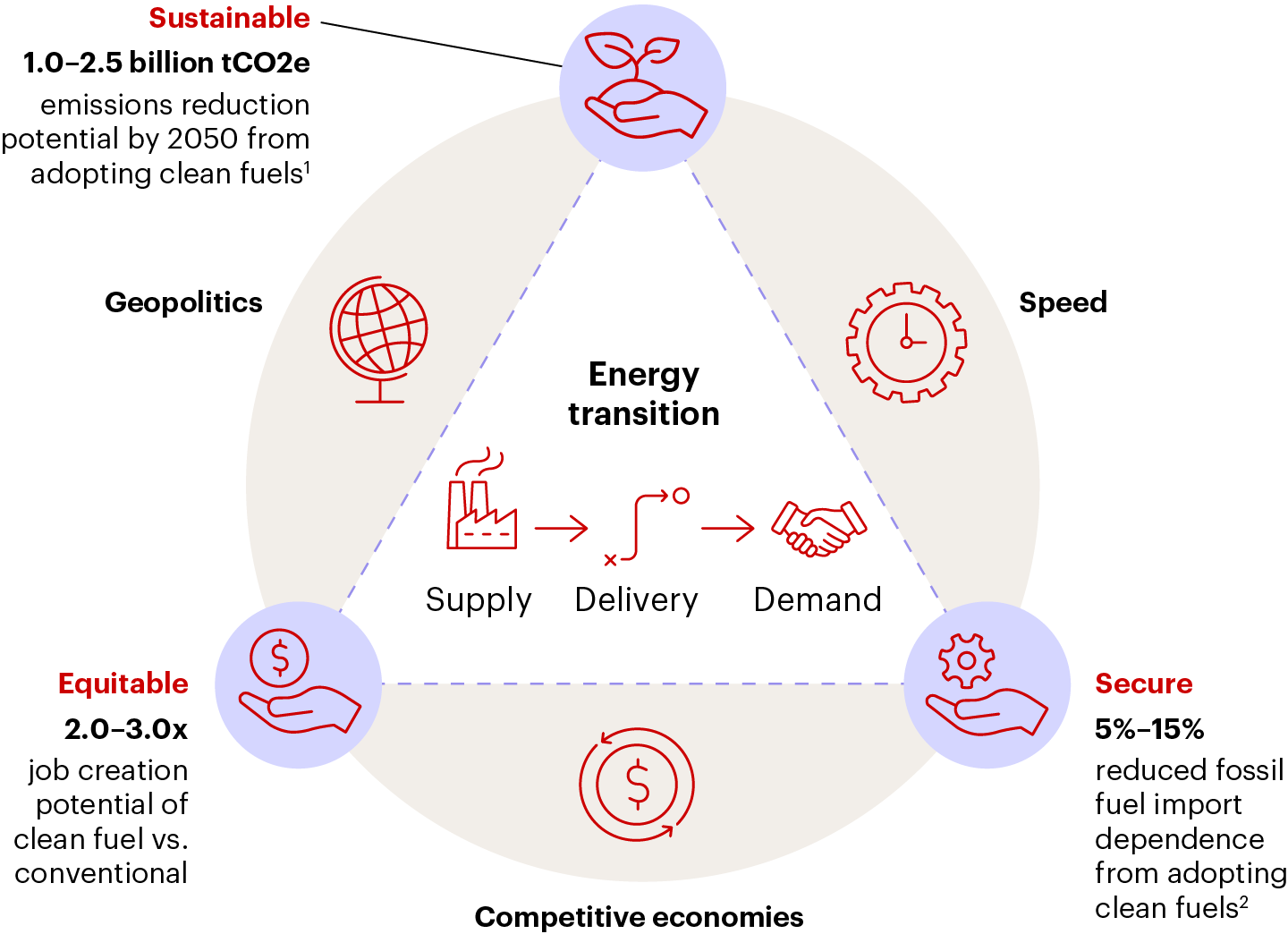

Notes: 1) Realized potential in selected net fossil fuel-importing countries; 2) Based on mid-range energy transition scenarios; tCO2e is tonnes of carbon dioxide equivalent Sources: World Economic Forum; Bain analysisAbout 75% of fossil fuel production is concentrated in a few regions, including the US, the Middle East, and Russia, according to the International Energy Agency (IEA). This geographic concentration creates imbalances, exposing import-dependent economies to supply disruptions, price volatility, and geopolitical risk. Clean fuels, by contrast, are produced from resources that are more widely distributed. By using organic waste, cover crops, agricultural residues, and surplus renewable electricity, countries in various regions can diversify their energy supplies and support more self-sufficient, stable, and competitive economies. The IEA reports that, already, liquid biofuels have reduced transport-fuel import dependence by 5%–15% across several net fossil fuel–importing countries, and an even greater impact was noted in Indonesia, India, Brazil, and Malaysia. Beyond energy security, clean fuels deliver economic benefits. Every $1 million invested in bio-based or synthetic fuel production generates 10–30 jobs, compared with 5–10 jobs from conventional fuels. A strong environmental imperative is another factor behind the demand for clean fuels. Bain & Company analysis shows that under midrange scenarios, use of clean fuels could reduce CO2 emissions by 1.0–2.5 gigatons annually by 2050. Some pathways have the potential to reduce emissions by at least 50%, and that number rises to more than 90%—or even net-negative—in optimal configurations, particularly when including carbon capture for certain bio-based processes. Market dynamics affecting clean fuelsThe current market dynamics for clean fuels can be analyzed through four lenses: demand, readiness and scalability, competitiveness, and sustainability (see Figure 2).
Figure 2
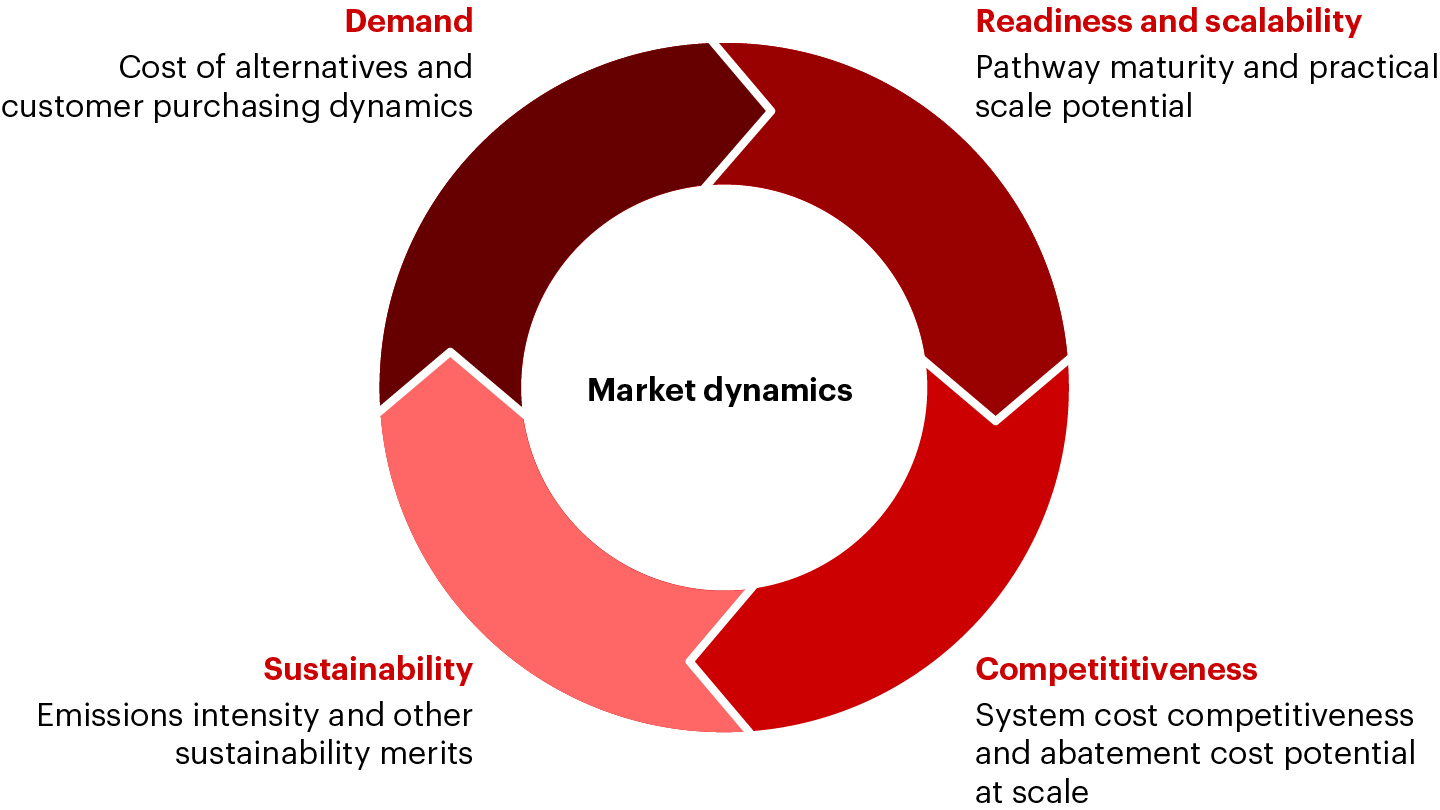

DemandThe clean fuels market supplies around 5.5 exajoules (EJ)—or 1.3% of global energy consumption—primarily through bioethanol and biodiesel blends, according to IEA data. Current uptake is largely policy led, and efforts to coordinate global demand through international negotiations have seen mixed success. However, demand is rising. It could grow two to three and half times by 2040, and according to Bain & Company analysis, that growth would be caused by road transport blends in the near term and by harder-to-abate applications in aviation, shipping, and heavy industry over time (see Figure 3). Under an accelerated scenario from the IEA—in which all announced policies and targets are achieved and market barriers are removed—demand could quadruple by 2035.
Figure 3
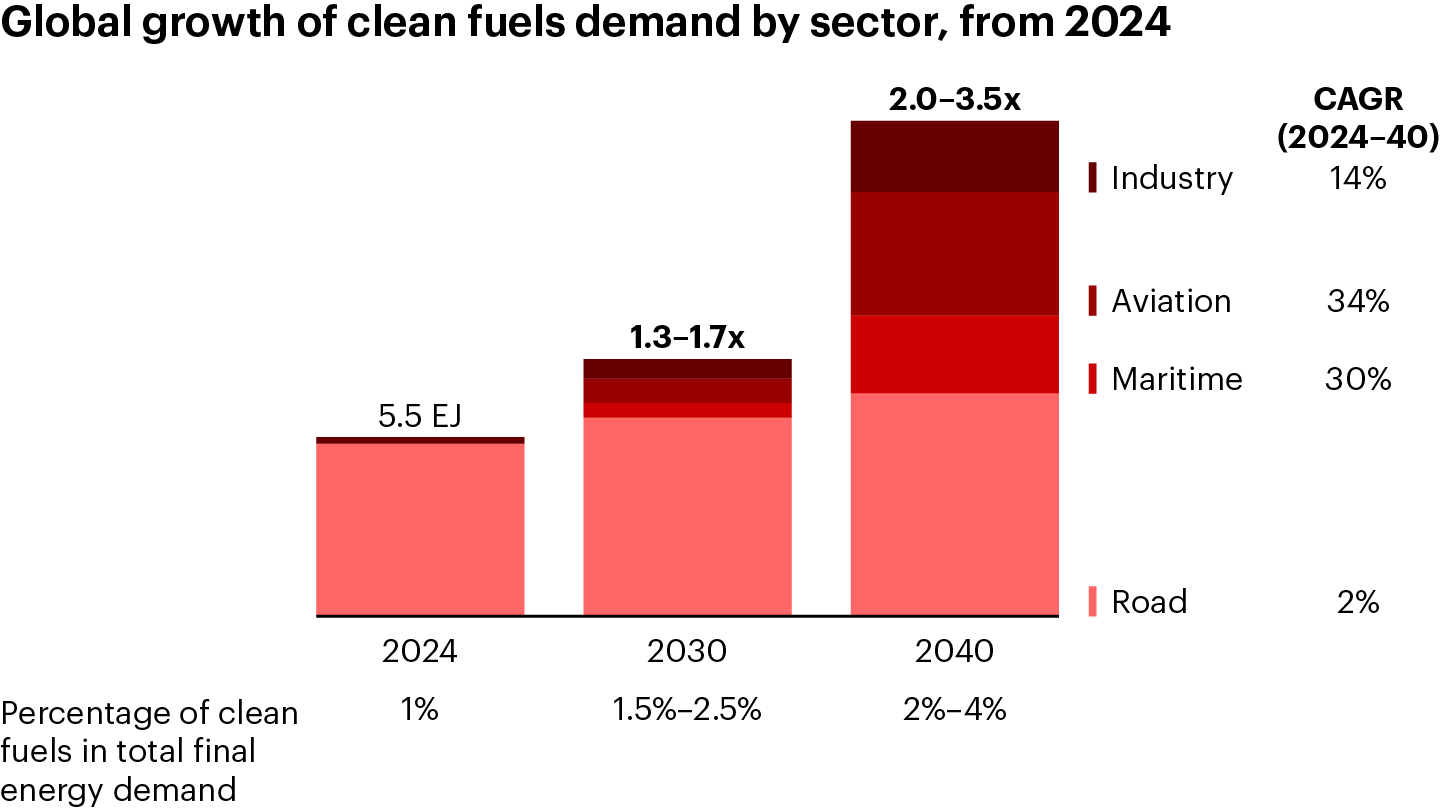

Notes: Only includes liquid and gaseous clean fuels; excludes power sector and district heating demand; excludes demand for fuels as chemical feedstocks; EJ is exajoules Source: Bain analysisReadiness and scalabilityReadiness varies widely by fuel type, location, and application, reflecting both the maturity of feedstock-to-fuel conversion technologies and the strength of the supply chain (from feedstock sourcing to end-use integration). Many clean fuels can be blended or used in existing engines and infrastructure. Some exceptions, such as ammonia and methanol, require engine retrofits or modified terminal, storage, and handling equipment. In most locations, carbon capture–based solutions also require new infrastructure for safe transport and storage. CompetitivenessClean fuels are typically more expensive to produce than fossil equivalents, because of capital intensity, feedstock and logistics costs, market risks, and technological immaturity. Costs vary widely by technology, feedstock, and region. Mature biofuels—such as ethanol, biodiesel, and hydrotreated vegetable oil renewable diesel—are currently the most viable options, with achievable cost parity in certain regions, under optimal conditions. However, feedstock constraints and technological maturity limit further cost reductions and scalable supply. Emerging pathways (including advanced biofuels, carbon capture–based solutions, and synthetic fuels) remain significantly more expensive but offer the potential to reduce costs and scale benefits over time. Because of higher operating costs, most alternative fuels will remain costlier than fossil fuels—in most markets and applications—in the near to medium term. Policy support is required for clean fuels to compete on abatement value. SustainabilityOnly fuels that deliver verifiable life-cycle emissions reductions and meet non–greenhouse gas safeguards will be able to secure policy support, market access, and demand. Beyond reducing emissions, clean fuels must account for competing land uses, impacts on water systems, and broader health and safety outcomes. The IEA has stressed that rigorous monitoring, reporting, and verification is needed to ensure that clean fuels deliver positive environmental and societal outcomes. Implications for scaleBain & Company analysis demonstrates that today’s mature technologies and feedstocks cannot meet the projected demand on their own. Achieving scale will require stimulating demand and overcoming supply constraints. Feedstock access is a key choke point to expanding supply. Competitive growth necessitates widening the sustainable resource base, advancing emerging conversion routes, and promoting production methods with lower life-cycle carbon intensity. In many cases, blended and drop-in pathways enable rapid deployment without major new infrastructure. The optimal mix of clean fuels will vary by region, sector, and time frame, reflecting resource availability, local priorities, and total system costs relative to alternative supply and abatement strategies. Progress will likely require a dual-track approach: continuing to scale commercially viable blend-in fuels, while boosting investment in innovations that improve competitiveness and sustainability over time. Investment barriers to advancing clean fuelsThe clean fuels project pipeline is expanding, with at least 12.5 EJ of new capacity planned to be operational by the end of the decade. However, according to Bain & Company analysis, only around 10% of projects have reached final investment decision (FID) (see Figure 4). Given the typical construction timelines of two to five years post-FID, the share of operating capacity is unlikely to grow rapidly.
Figure 4
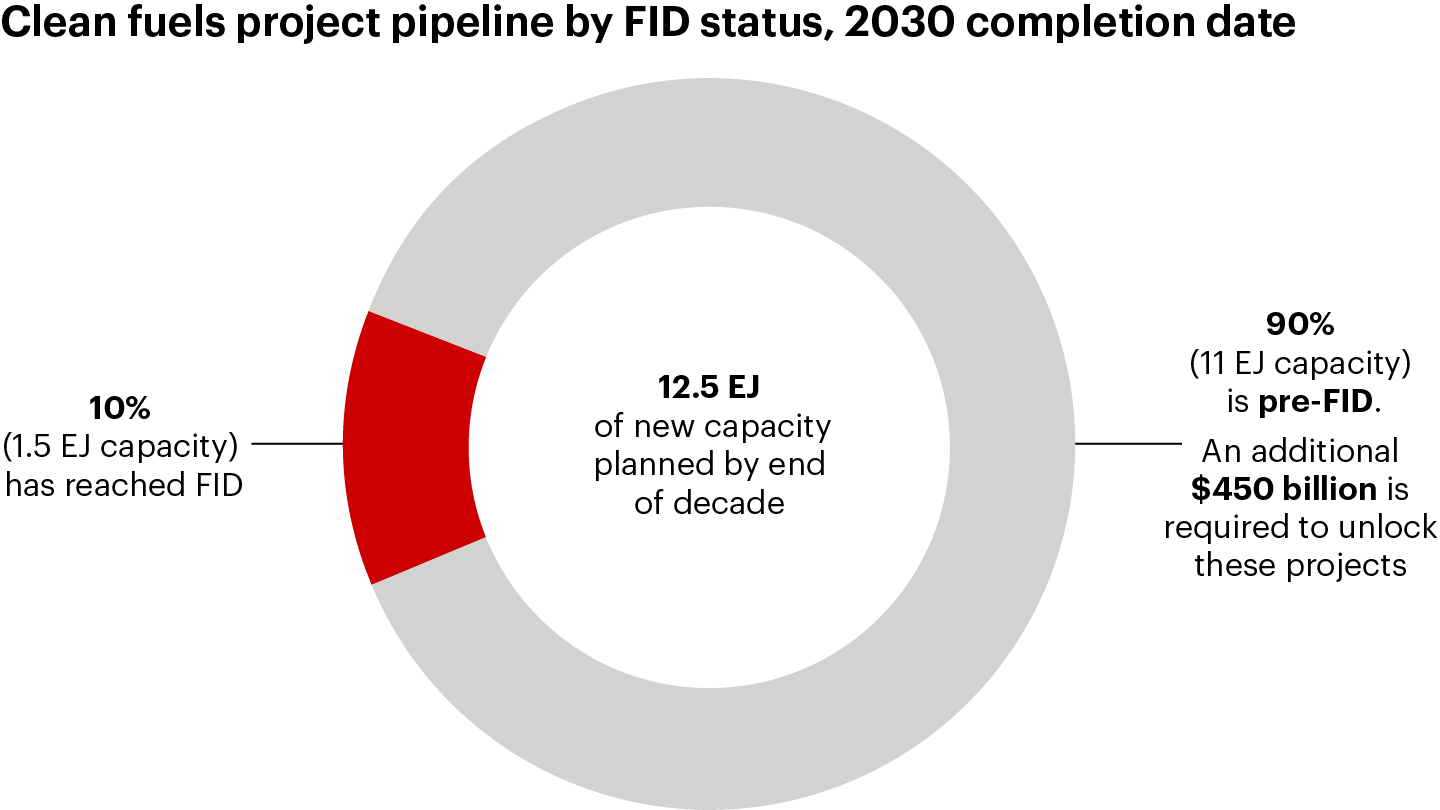

Notes: Includes projects targeted for energy use across e-fuel and key biofuels (e.g., sustainable aviation fuel, renewable diesel) with start dates between 2025 and 2030, excluding operational projects; post-FID includes projects that have secured FID or are in construction; FID is final investment decision; EJ is exajoules Source: Bain analysisAnnual investment in clean fuel production capacity rose by roughly 30% from 2024 to 2025 and reached $25 billion in 2025. Yet the IEA reports that this amount remains well below what is required. The agency’s data indicates that meeting current global pledges would require a fourfold increase—to approximately $100 billion per year—by 2030. While substantial capital exists to close this gap, companies have struggled to generate adequate returns. Projects are often delayed by uncertain or misaligned policies, weak coordination, or insufficient demand signals. Six major barriers stand out:
Clean-fuel value chains are inherently complex and interdependent, spanning multiple feedstocks, technologies, logistics networks, and end-use markets. Progress in one segment requires parallel development elsewhere. Financial risk profiles also vary widely. Clean fuel projects are capital intensive and expose investors to technology and market development risks. Existing policy and market frameworks are still evolving and have not kept pace with this complexity. Instead, fragmented standards, inconsistent certifications, and policy uncertainty have added friction, leaving many projects stalled between feasibility and FID. How to unlock investment in clean fuelsInnovative mechanisms and coordinated action are essential to overcome market barriers and mitigate investment risks. Encouragingly, proven solutions already exist, demonstrating effective ways to improve revenue visibility, pool risk, unlock profitable business opportunities, and internalize the societal value of clean fuels, in line with regional energy goals. Public and private actors play distinct but complementary roles. Together, they can activate nine solutions across three areas: policy, collaboration, and business (see Figure 5).
Figure 5
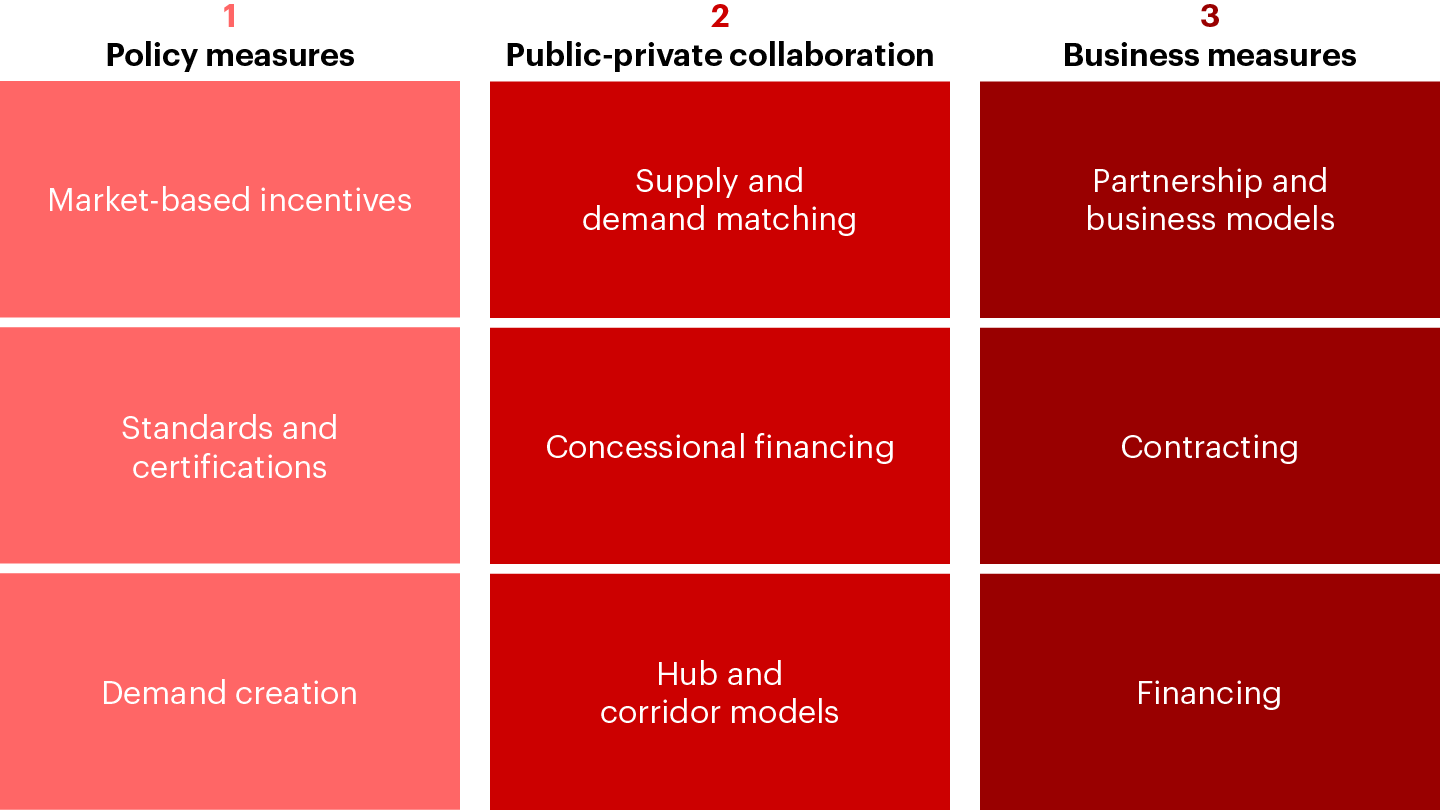

Policy actions to advance clean fuel investmentPolicy measures catalyze investment by rewarding system value and ensuring fair competition. Given plant lifetimes of 20–30 years, long-term policy predictability is essential. Market-based incentivesMarket-based tools narrow the price gap between clean and fossil fuels by internalizing system value. Carbon pricing penalizes emissions, while tax credits provide fiscal support to clean producers. Contracts for difference complement these mechanisms by guaranteeing fixed strike prices and compensating producers when market prices fall, reducing risk and unlocking capital. Incentives that price in local benefits—such as tax rebates tied to job creation—can further strengthen investment cases. In addition, targeted capital and development subsidies can crowd in private capital for emerging technologies with credible paths to competitiveness. In Brazil, the Fuels of the Future Bill establishes a comprehensive framework for promoting low-carbon, renewable, and advanced fuels across the country’s transport and energy mix. The legislation includes tradeable carbon credits for certified greenhouse gas reductions and biomethane guarantees of origin. Pairing performance-based incentives, such as tradeable credits, with concessional finance has lowered capital costs while rewarding verified emissions reductions. In the US, California established a Low Carbon Fuel Standard as a market incentive to reduce the average carbon intensity of transportation fuels in the state. Fuels with higher carbon intensity generate deficits, while fuels and blendstocks with lower carbon intensity generate credits. California’s credits are tied to life-cycle carbon-intensity metrics to encourage innovation and continuous improvement. Standards and certificationsConsistent taxonomies and transparent, stable certification systems have a great effect on investor confidence. They ensure that projects qualify for incentives, comply with regulation, and deliver verified environmental outcomes. International alignment and interoperability enable trade and efficient supply-demand matching. Consistent life-cycle assessments underpin performance-based tools such as credit issuance and trading, translating environmental integrity into economic value. The Rotterdam–Singapore Green and Digital Shipping Corridor includes several of these tactics, with established safety and measurement standards covering the Ports of Rotterdam and Singapore. In addition, interoperable certification ensures fuels can be bunkered and credited seamlessly at either end. Singapore has also issued methanol bunkering standards and licenses and is advancing ammonia bunkering projects on Jurong Island. Demand creationDemand-side mechanisms, such as blending mandates and public procurement, improve revenue certainty and project bankability. Brazil has implemented demand-creation mandates targeting ethanol, biodiesel, sustainable aviation fuel (SAF), and biomethane blending. Performance-based mandates reward verified carbon intensity, while public procurement uses government purchasing power to create early demand and attract private capital. These tools mirror those used among earlier market builders in liquefied natural gas and renewable electricity. In those contexts, long-term contracts, auctions, purchase agreements, and feed-in tariffs underpinned early investment and scale-up. Public-private collaborations to advance clean fuel investmentPublic-private collaboration can unlock viable business cases and accelerate deployment by pooling capabilities, mobilizing finance, and de-risking investments—especially in early markets. Supply and demand matchingSupply-demand matching mechanisms align producers and buyers, providing revenue visibility and certainty to attract investment and scale the clean fuels market. Platforms such as the World Economic Forum’s First Movers Coalition pool buyer commitments to create credible volumes and reduce transaction costs. Book-and-claim systems decouple environmental attributes from physical delivery, expanding market access in sectors like aviation and shipping. Double-sided auctions give producers long-term revenue certainty, while buyers gain flexibility and price discovery. The H2Global mechanism pairs long-term supply contracts with short-term demand contracts and uses public and philanthropic funds to bridge the cost gap. A contracting entity signs 10-year supply agreements with low-cost producers and then reauctions volumes annually to buyers. This structure provides long-term revenue certainty for producers and short-term flexibility for buyers. Concessional financingBlended finance, first-loss capital, guarantees, and transition bonds lower the cost of capital and crowd in private investment. Infrastructure coinvestments—for example, in transport or storage assets—reduce costs across value chains and improve overall viability. China has established a nationwide funding framework for carbon-reduction projects and zero-emissions transport corridors. Preferential and provincial finance—including concessional loans from policy banks, interest-subsidy programs, provincial guarantees, green funds, green bonds, and credit quotas—is available for clean fuel projects. In Southeast and South Asia, the Green Investments Partnership blends public, private, and philanthropic capital to fund sustainable infrastructure. It uses subordinated or first-loss capital to absorb initial losses and de-risk senior lenders, enabling private capital to participate in higher-risk clean fuel projects. The partnership has issued a $30 million green loan for distributed bioenergy projects and provided $80 million in cofinancing for solar and storage. Hub and corridor modelsHub and corridor models concentrate early activity within defined regions or trade routes, aligning supply, demand, infrastructure, and policy. Initiatives like the World Economic Forum’s Transitioning Industrial Clusters reduce first-mover risk and create replicable blueprints for scaling clean fuels. Business measures to advance clean fuel investmentBusinesses play a critical role by aligning incentives, deploying innovative financing, and adopting risk-sharing and contracting models. Partnership and business modelsOriginal equipment manufacturer–developer partnerships, investor-developer collaborations, and integrated ventures improve bankability by combining expertise, capital, and offtake certainty. A former petrochemical site in Sicily was transformed into an advanced biorefinery, constituting the Gela Biorefinery Italy’s first SAF production site in 2025. The project secured contracts with logistics companies and airlines to de-risk revenues and increase bankability. It also codeveloped its Ecofining technology with Honeywell UOP. ContractingAdvanced market commitments, take-or-pay agreements, tolling structures, and back-to-back offtake agreements create predictable cash flows and mitigate exposure to commodity price swings, helping projects move from feasibility to FID. In Denmark, European Energy and Mitsui Kasso’s e-methanol plant was de-risked through cross-sector offtake contracts across maritime, plastics, and pharmaceuticals. In Spain, the Repsol Ecoplanta waste-to-methanol plant was de-risked through a partnership with Enerkem (a technology provider) to help ensure product yield, quality, and cost performance. FinancingGreen and sustainability-linked loans, transition bonds, mezzanine capital, credit guarantees, and insurance products reduce capital costs and protect investors from early-stage risk, enabling first-of-a-kind projects to prove commercial viability. In the US, Infinium’s Project Roadrunner is under construction in Texas. Once completed in 2027, the commercial-scale e-fuels plant will produce e-SAF, e-diesel, and e-naphtha. The project was made possible through a combination of equity and debt financing under a project-based credit arrangement. More than $275 million in equity investment has been secured, with additional debt financing committed. Call to actionUse of clean fuels is a necessary tactic for meeting rising energy demand sustainably. Clean fuels can reduce emissions in transport and industry, diversify energy supply, create industrial and rural jobs, and harness resources that are more evenly distributed across geographies. Clean fuel ambition is rising, but too few projects are breaking ground. High risks, immature value chains, incongruent policies, uncertain demand, and complex market dynamics stand in the way. Overcoming these barriers is not a simple task. Progress will require durable policy frameworks, coordinated risk-sharing mechanisms, and new collaborative business models. Corporations—including those in the agribusiness, technology, refinery, investment, and demand sectors—must work together to de-risk projects and accelerate deployment. Real-world examples prove this is possible. Despite challenging economics, some projects demonstrate that clean fuels can deliver both financial return and societal value. Four focus areas to advance clean fuel
Clean fuels represent a major commercial opportunity and a pathway to a more resilient, competitive, and low-emissions energy system. Achieving that potential requires greater collaboration and transparency across the value chain. Together, all parties can turn clean fuel ambition into projects that succeed both commercially and societally. |