
Skip to Content
  • Offices

    Offices

    North & Latin America
    • Atlanta
    • Austin
    • Bogota
    • Boston
    • Buenos Aires
    • Chicago
    • Dallas
    • Denver
    • Houston
    • Los Angeles
    • Mexico City
    • Minneapolis
    • Monterrey
    • Montreal
    • New York
    • Rio de Janeiro
    • San Francisco
    • Santiago
    • São Paulo
    • Seattle
    • Silicon Valley
    • Toronto
    • Washington, DC
    Europe & Africa
    • Amsterdam
    • Athens
    • Berlin
    • Brussels
    • Copenhagen
    • Dusseldorf
    • Frankfurt
    • Helsinki
    • Istanbul
    • Johannesburg
    • Kyiv
    • Lisbon
    • London
    • Madrid
    • Milan
    • Munich
    • Oslo
    • Paris
    • Rome
    • Stockholm
    • Vienna
    • Warsaw
    • Zurich
    Middle East
    • Doha
    • Dubai
    • Riyadh
    Asia & Australia
    • Bangkok
    • Beijing
    • Bengaluru
    • Brisbane
    • Ho Chi Minh City
    • Hong Kong
    • Jakarta
    • Kuala Lumpur
    • Manila
    • Melbourne
    • Mumbai
    • New Delhi
    • Perth
    • Shanghai
    • Singapore
    • Sydney
    • Tokyo
    See all offices
  • Alumni
  • Media Center
  • Subscribe
  • Contact
  • Colombia | Español

    Select your region and language

    Global
    • Global (English)
    North & Latin America
    • Brazil (Português)
    • Argentina (Español)
    • Canada (Français)
    • Chile (Español)
    • Colombia (Español)
    Europe, Middle East, & Africa
    • France (Français)
    • DACH Region (Deutsch)
    • Italy (Italiano)
    • Spain (Español)
    • Greece (Elliniká)
    Asia & Australia
    • China (中文版)
    • Korea (한국어)
    • Japan (日本語)
  • Saved items (0)
    Saved items (0)

    You have no saved items.

    Bookmark content that interests you and it will be saved here for you to read or share later.

    Explore Bain Insights
  • Industries
    Main menu

    Industries

    • Aeroespacial y Defensa
    • Agroindustria
    • Químicos
    • Construcción e Infraestructura
    • Productos de Consumo
    • Servicios Financieros
    • Salud y Ciencias de la Vida
    • Maquinaria y Equipo Industrial
    • Medios y Entretenimiento
      Industries
      Medios y Entretenimiento
      • Media Lab
    • Metales
    • Minería
    • Petróleo y Gas
    • Papel y Empaque
    • Private Equity
      Industries
      Private Equity
      • Due Diligence
      • Exit Planning
      • Firm Strategy & Operations
      • Portfolio Value Creation
    • Sector Público y Social
    • Retail
    • Tecnología
    • Telecomunicaciones
      Industries
      Telecomunicaciones
      • Capital Expenditure
      • Telco Digital Transformation
    • Transporte
    • Viajes y Turismo
    • Servicios Públicos y Energías Renovables
  • Consulting Services
    Main menu

    Consulting Services

    • Customer Experience
    • Sustainability
    • Innovation
    • M&A
    • Operations
    • People & Organization
    • Private Equity
    • Sales & Marketing
    • Strategy
    • AI, Insights, and Solutions
    • Technology
    • Transformation
  • Digital
  • Insights
    Main menu

    Insights

    • Industry Insights
    • Services Insights
    • Bain Books
    • Webinars
    • Bain Futures
    View all Insights
    Featured topics
    • Tariff Response
    • Artificial Intelligence
    • Thriving in Uncertainty
    • Executive Conversations
    • Macro Trends
    • M&A Report
    • Healthcare Private Equity Report
    • Paper & Packaging Report
    • Technology Report
    • CEO's Guide to Sustainability
    • CEO Insights
    • CFO Insights
    • COO Insights
    • CIO Insights
    • CMO Insights
    View all featured topics
  • About
    Main menu

    About

    • What We Do
    • What We Believe
    • Our People & Leadership
    • Client Results
    • Awards & Recognition
    • Global Affiliations
    Further: Our global responsibility
    • Sustainability
    • Social Impact
    • World Economic Forum
    Learn more about Further
  • Carreras
    Main menu

    Carreras

    • Trabaja con Nosotros
      Carreras
      Trabaja con Nosotros
      • Find Your Place
      • Nuestras Áreas de Trabajo
      • Equipos Integrados
      • Estudiantes
      • Internships & Programs
      • Eventos de Reclutamiento
    • La Vida en Bain
      Carreras
      La Vida en Bain
      • Historias Profesionales
      • Nuestra Gente
      • Dónde Trabajamos
      • Apoyando tu Crecimiento
      • Grupos de Afinidad
      • Beneficios
    • Impact Stories
    • Nuestro Proceso
      Carreras
      Nuestro Proceso
      • Qué Esperar
      • Entrevistas
    FIND JOBS
  • Offices
    Main menu

    Offices

    • North & Latin America
      Offices
      North & Latin America
      • Atlanta
      • Austin
      • Bogota
      • Boston
      • Buenos Aires
      • Chicago
      • Dallas
      • Denver
      • Houston
      • Los Angeles
      • Mexico City
      • Minneapolis
      • Monterrey
      • Montreal
      • New York
      • Rio de Janeiro
      • San Francisco
      • Santiago
      • São Paulo
      • Seattle
      • Silicon Valley
      • Toronto
      • Washington, DC
    • Europe & Africa
      Offices
      Europe & Africa
      • Amsterdam
      • Athens
      • Berlin
      • Brussels
      • Copenhagen
      • Dusseldorf
      • Frankfurt
      • Helsinki
      • Istanbul
      • Johannesburg
      • Kyiv
      • Lisbon
      • London
      • Madrid
      • Milan
      • Munich
      • Oslo
      • Paris
      • Rome
      • Stockholm
      • Vienna
      • Warsaw
      • Zurich
    • Middle East
      Offices
      Middle East
      • Doha
      • Dubai
      • Riyadh
    • Asia & Australia
      Offices
      Asia & Australia
      • Bangkok
      • Beijing
      • Bengaluru
      • Brisbane
      • Ho Chi Minh City
      • Hong Kong
      • Jakarta
      • Kuala Lumpur
      • Manila
      • Melbourne
      • Mumbai
      • New Delhi
      • Perth
      • Shanghai
      • Singapore
      • Sydney
      • Tokyo
    See all offices
  • Alumni
  • Media Center
  • Subscribe
  • Contact
  • Colombia | Español
    Main menu

    Select your region and language

    • Global
      Select your region and language
      Global
      • Global (English)
    • North & Latin America
      Select your region and language
      North & Latin America
      • Brazil (Português)
      • Argentina (Español)
      • Canada (Français)
      • Chile (Español)
      • Colombia (Español)
    • Europe, Middle East, & Africa
      Select your region and language
      Europe, Middle East, & Africa
      • France (Français)
      • DACH Region (Deutsch)
      • Italy (Italiano)
      • Spain (Español)
      • Greece (Elliniká)
    • Asia & Australia
      Select your region and language
      Asia & Australia
      • China (中文版)
      • Korea (한국어)
      • Japan (日本語)
  • Saved items  (0)
    Main menu
    Saved items (0)

    You have no saved items.

    Bookmark content that interests you and it will be saved here for you to read or share later.

    Explore Bain Insights
  • Industries
    • Industries

      • Aeroespacial y Defensa
      • Agroindustria
      • Químicos
      • Construcción e Infraestructura
      • Productos de Consumo
      • Servicios Financieros
      • Salud y Ciencias de la Vida
      • Maquinaria y Equipo Industrial
      • Medios y Entretenimiento
      • Metales
      • Minería
      • Petróleo y Gas
      • Papel y Empaque
      • Private Equity
      • Sector Público y Social
      • Retail
      • Tecnología
      • Telecomunicaciones
      • Transporte
      • Viajes y Turismo
      • Servicios Públicos y Energías Renovables
  • Consulting Services
    • Consulting Services

      • Customer Experience
      • Sustainability
      • Innovation
      • M&A
      • Operations
      • People & Organization
      • Private Equity
      • Sales & Marketing
      • Strategy
      • AI, Insights, and Solutions
      • Technology
      • Transformation
  • Digital
  • Insights
    • Insights

      • Industry Insights
      • Services Insights
      • Bain Books
      • Webinars
      • Bain Futures
      View all Insights
      Featured topics
      • Tariff Response
      • Artificial Intelligence
      • Thriving in Uncertainty
      • Executive Conversations
      • Macro Trends
      • M&A Report
      • Healthcare Private Equity Report
      • Paper & Packaging Report
      • Technology Report
      • CEO's Guide to Sustainability
      • CEO Insights
      • CFO Insights
      • COO Insights
      • CIO Insights
      • CMO Insights
      View all featured topics
  • About
    • About

      • What We Do
      • What We Believe
      • Our People & Leadership
      • Client Results
      • Awards & Recognition
      • Global Affiliations
      Further: Our global responsibility
      • Sustainability
      • Social Impact
      • World Economic Forum
      Learn more about Further
  • Carreras
    Popular Searches
    • Agile
    • Digital
    • Strategy
    Your Previous Searches
      Recently Visited Pages

      Content added to saved items

      Saved items (0)

      Removed from saved items

      Saved items (0)

      Technology Report

      After the Chip Shortage, Fears of a Capacity Glut Are Overblown

      After the Chip Shortage, Fears of a Capacity Glut Are Overblown

      The industry and its customers are adept at balancing long-term capacity and supply.

      By David Crawford, Peter Hanbury, Anne Hoecker, and Michael Schallehn

      • min read
      }

      Report

      After the Chip Shortage, Fears of a Capacity Glut Are Overblown
      en
      Executive Summary
      • The semiconductor industry's post-pandemic rebound boosted capacity to the extent that some foresee an oversupply.
      • But cyclicality in the sector is normal, and it's actually been leveling out over time as the end markets for chips have broadened and suppliers have consolidated.
      • Even so, supply-and-demand balance could remain bumpy in three areas that customers should monitor: bleeding-edge, leading-edge, and super-lagging chips.
      • Companies can guard against the risks of imbalance by designing products for resilience and flexibility, taking advantage of moments of oversupply, and developing chip-specific strategies for mission-critical components.

      This article is part of Bain's 2023 Technology Report.

      Explore the report

      Many manufacturers that depend on the semiconductor supply chain are breathing easier now.

      As post-pandemic demand for PCs, smartphones, and consumer devices eased, capacity grew in the semi market. In fact, we’ve gone from a chip shortage in 2021–2022 to underutilization of capacity in some parts of the semi value chain. Some say this is a harbinger of a massive capacity glut, implying we no longer need to worry about securing our semiconductor supply chain. We disagree.

      Cyclicality and brief periods of underutilization are normal features of the semiconductor business cycle. But cyclicality has actually dampened over the past couple of decades for three main reasons (see Figure 1).

      • First, the law of large numbers suggests that the broad set of end markets, each with different demand cycles, helps counter-balance demand.
      • Second, although memory is the most cyclical part of the semi market, it now represents a smaller portion of total capex.
      • Finally, fewer suppliers of logic and memory result in a less irrational supply.
      Figure 1
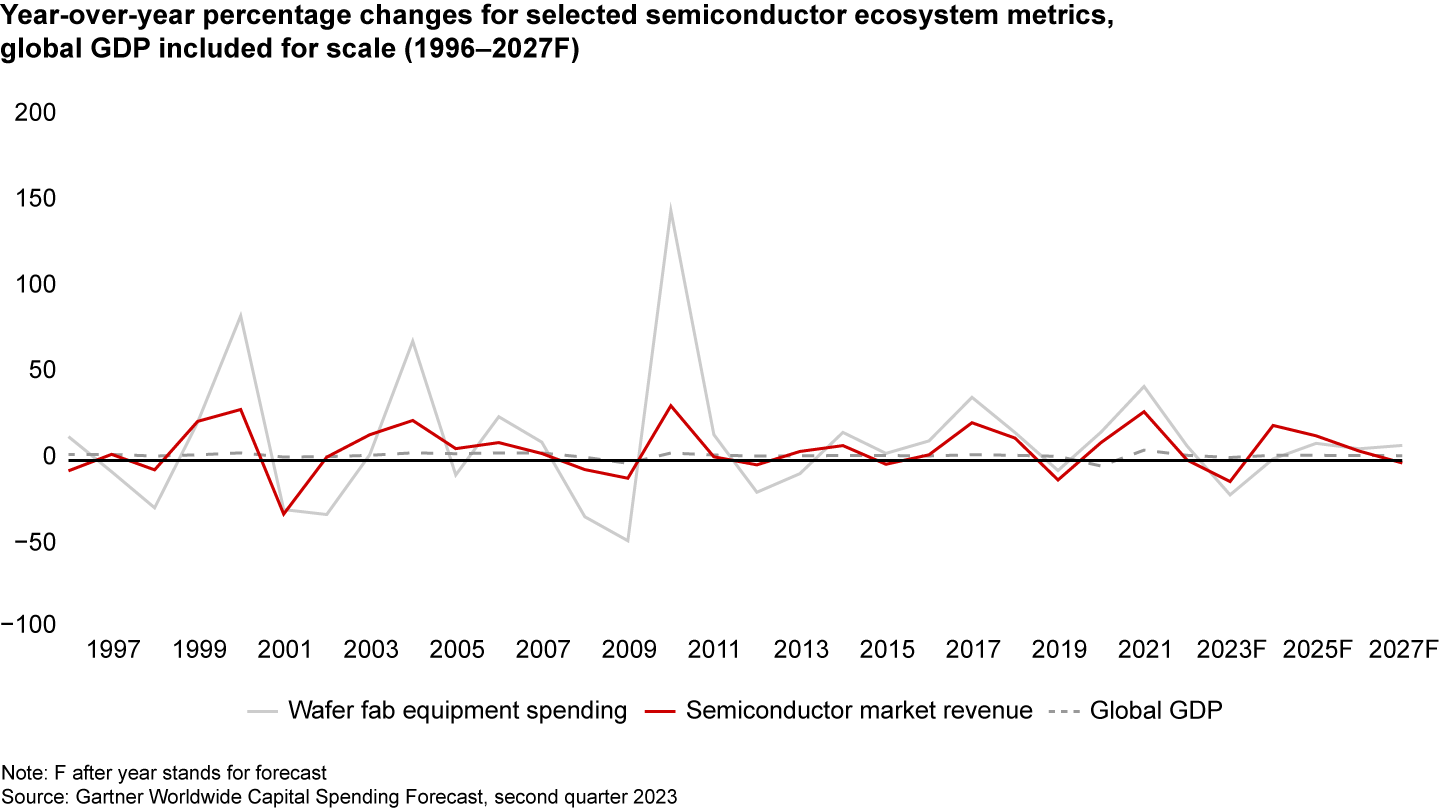
      Cyclicality has moderated in the semiconductor market
      Cyclicality has moderated in the semiconductor market
      Cyclicality has moderated in the semiconductor market

      Cyclicality is likely to continue, but structural or long-term overcapacity is unlikely for several reasons.

      One is the underlying secular growth of the industry combined with the pragmatic nature of semiconductor manufacturers when it comes to building out capacity. Bleeding-edge fab shells (7-nanometer nodes and below) are not cheap, costing about $2 billion and taking more than two years to build. Even greater expense lies in the equipment, which can run up to $9 billion and take up to 18 months to qualify and ramp up. When downturns reduce expectations to fill capacity, manufacturers often hit pause before adding machinery to prevent periods of overcapacity. This creates large swings of cyclicality in the semiconductor equipment market as projects are started and then paused abruptly. As the market for electronics returns to its historic growth, demand for semiconductors grows, quickly consuming any overcapacity, which is why we rarely see semiconductor downcycles lasting longer than two years.

      Another factor that absorbs overcapacity is that chips can be designed on a range of technologies, and products can be adapted to take advantage of available supply, thereby rebalancing demand. This redesign process takes 12 to 18 months. So, although it didn’t help alleviate the recent shortage, it does help prevent structural or long-term overcapacity.

      Similarly, large government subsidies don’t usually change this calculus. Although the US and EU are offering about $100 billion in subsidies through 2030, this is only a fraction of the $1 trillion in capex that the semiconductor industry plans to invest. Government subsidies might influence the location of fabs built, but they are unlikely to lead to structural overcapacity.

      Since the market is growing, overbuilt capacity is generally consumed by market growth within a year or two, as we have seen in previous cycles.

      Gauging supply, demand, and pockets of overcapacity

      Although cyclicality is leveling out over time, pockets of overcapacity still occur for short periods (one or two years) and for certain technology nodes or regions.

      The big question here is whether the semiconductor market remains a single global demand pool or splinters into competing blocs. A key indicator will be whether governments start to mandate where some chips are manufactured (domestically or via a trade partner). This would accelerate the splintering of semiconductor ecosystems and have a greater effect than subsidies on the global market for semiconductors.

      We also see specific technologies in which the current plan to build out supply could lead to challenges—for example, the bleeding-edge foundry capacity being added by TSMC, Intel, and Samsung in the US, or the older technologies largely being built out in China and Taiwan. 

      Given these dynamics, we expect that the supply-demand balance will be bumpy over time by node and by region, especially in three key areas.

      • Bleeding-edge foundry: If Samsung and Intel take some of TSMC’s customers or if government subsidies broaden the base of semi suppliers (such as the new Rapidus group in Japan), this would make capacity expansion decisions significantly more complex and prone to miscalculation, with overinvestment in boom times and underinvestment in busts.
      • Leading-edge technologies: In the Asia-Pacific region, many foundries (TSMC, UMC, SMIC, Samsung, GloFo) produce mid-tier mature nodes (28-nanometer to 90-nanometer nodes). The market for 28-nanometer nodes, in particular, is expected to see capacity grow at 12% annually over the next few years vs. 5% to 7% for 45-nanometer and 90-nanometer technologies. If significant capacity comes online at the same time, we could see overcapacity for these older nodes for a period of time. 
      • Super-lagging edge fabs will remain a challenge: There’s a long tail of low-end chips, usually produced on 6- and 8-inch wafers, that serves a wide range of applications from industrial and defense to automotive and consumer devices. Similar to how low-cost labor makes producing a cost-competitive T-shirt in the US challenging, the economics of depreciated fabs producing low-end chips make it harder to get new lagging-edge fabs built in nearshore locations. About 60% of new super-lagging edge foundry capacity is expected to be built in China.

      What does all this mean for industries that rely on semiconductor chips? Customers still need to pay attention to the semiconductor supply chain.

      • Deepen your semiconductor capabilities. The semiconductor market remains complex, with many moving pieces. Companies that rely on semiconductors should continue to design for resilience and traceability. Improving understanding and engagement with the semiconductor market is critical.
      • Leverage moments of oversupply. Close monitoring of fab build-outs and demand can help identify pockets of oversupply in which players should secure capacity and take advantage of favorable pricing opportunities.
      • Develop chip-specific strategies, part 1. For example, in low-end chips, an area where multiple suppliers can be qualified, it’s important to monitor the entire market. Unexpected demand spikes in emerging areas (for example, electric vehicles) could create shortages of specialty chips. Semi vendors have historically focused on the classic IT market of computers and other tech devices. But automotive and industrial applications for semiconductors are expected to grow faster over the next few years (see Figure 2). Monitoring the balance of supply and demand and working with multiple suppliers can help guard against bottlenecks.
      • Develop chip-specific strategies, part 2. For mission-critical chips such as microcontroller units, companies should partner with silicon vendors to consolidate architecture to a single chip and secure supply for long periods, monitoring that specific supplier closely. This is especially true for customer-specific chips, such as application-specific integrated circuits and other application-specific chips, particularly if manufactured in small volumes by one provider.
      • Think beyond semis. Supply chain leaders are building resilience for all components in their devices. They are securing their supply of other must-have pieces such as motherboards and batteries that might be unexpectedly disrupted in another supply crisis.
      Figure 2
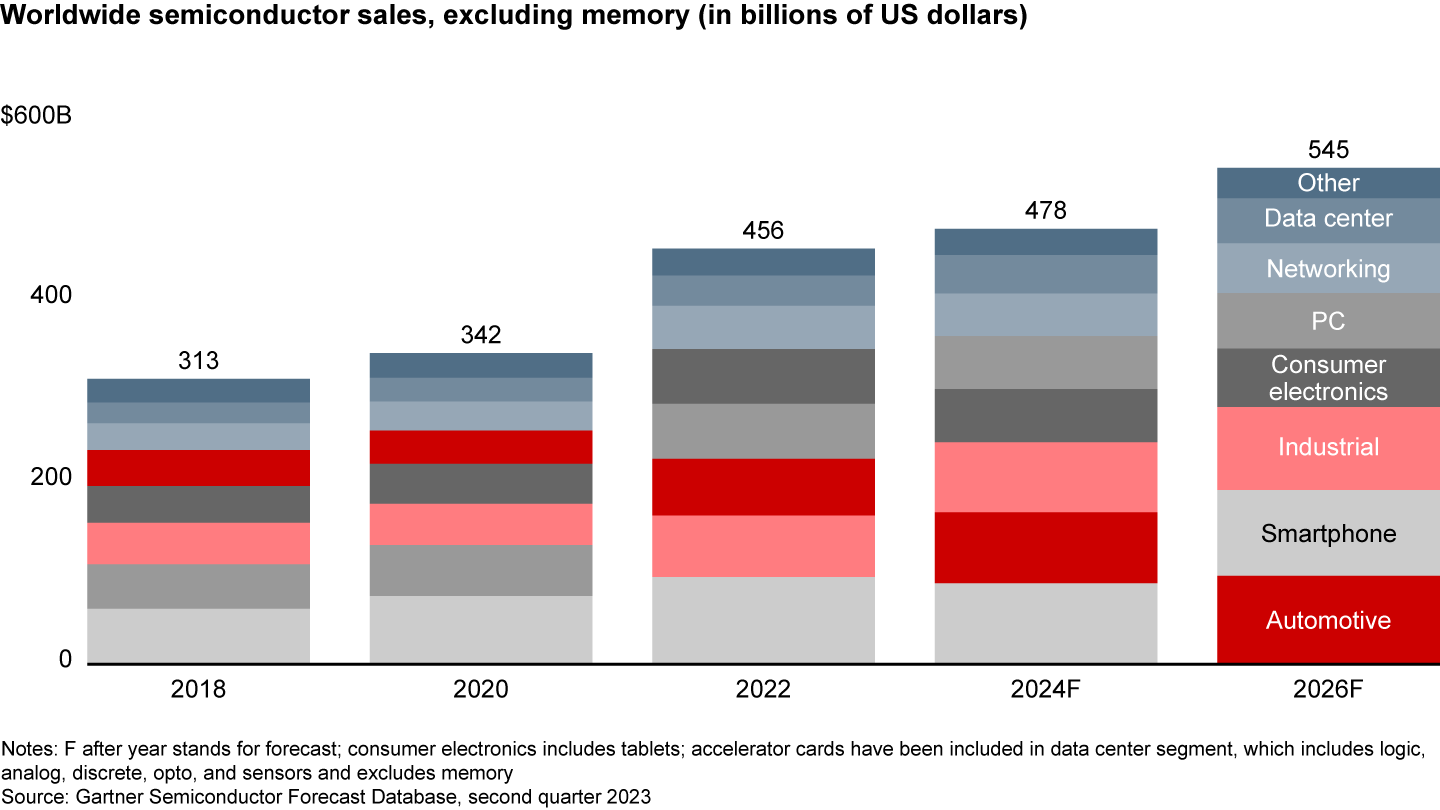
      Applications beyond classic IT are growing faster
      Applications beyond classic IT are growing faster
      Applications beyond classic IT are growing faster

      Read the Next Chapter

      Digital Innovation: Getting the Architecture Foundations Right

      Read our 2023 Technology Report

      Download the PDF Explore the report
      Authors
      • Headshot of David Crawford
        David Crawford
        Partner, Silicon Valley
      • Headshot of Peter Hanbury
        Peter Hanbury
        Partner, San Francisco
      • Headshot of Anne Hoecker
        Anne Hoecker
        Partner, Silicon Valley
      • Headshot of Michael Schallehn
        Michael Schallehn
        Partner, Silicon Valley
      Related Industries
      • Semiconductors
      • Technology
      Technology Report
      Will AI Disrupt Tech’s Most Valuable Companies?

      Hyperscalers and other market leaders have adapted well to technology shifts, but generative AI poses new challenges.

      Read more
      Technology Report
      Quantum Computing Moves from Theoretical to Inevitable

      Quantum will likely become part of a mosaic, working with classical computing to solve big problems.

      Read more
      Technology
      Humanoid Robots: How Early Commercial Exploration Can Lead to Large-Scale Use

      Although early uses exist, core technologies are years away from offering human-level capability.

      Read more
      Technology Report
      Sovereign Tech, Fragmented World

      In a post-globalized era of tariffs and decoupling, semiconductors and sovereign AI are realigning global power.

      Read more
      Technology Report
      How Can We Meet AI’s Insatiable Demand for Compute Power?

      Technological innovation, new revenue, and public support may be needed to fund and supply enough electricity.

      Read more

      Value Evolution

      • Creating Value in Tech Throughout the Life Cycle

      • Preparing for Exit: A Buyer’s Market Is Coming for Tech Assets

      • AI Investors: Act Fast, Act Wisely

      • Technology Enters Its Post-Globalization Era

      Strategic Battlegrounds

      • You’re Out of Time to Wait and See on AI

      • How AI Is Recoding the Software Business Model

      • Generative AI and Cybersecurity: Strengthening Both Defenses and Threats

      • Taking the Hyperbole Out of the Metaverse

      • The Untapped Value at the Intelligent Edge

      • After the Chip Shortage, Fears of a Capacity Glut Are Overblown

      Operational Transformations

      • Digital Innovation: Getting the Architecture Foundations Right

      • The Talent Implications of Generative AI

      • How Enterprise Sales Can Supercharge Product-Led Growth

      • How Your Revenue Can Grow Faster Than Your Salesforce

      • Decarbonizing Technology Supply Chains

      First published in septiembre 2023
      Tags
      • Semiconductors
      • Technology
      • Technology Report

      How We've Helped Clients

      Can Microchips Turbocharge Sustainability Improvement?

      See more related case studies

      Helping a Midsize ERP Player Compete against the Giants

      See more related case studies

      Aggressively growing an IT service provider with a high-performance culture

      See more related case studies

      Want to continue the conversation

      We help global leaders with their organization's most critical issues and opportunities. Together, we create enduring change and results

      Bain Insights. Our perspectives on critical issues global businesses face in today's challenging environment, delivered monthly.

      *I have read and understand Bain’s Privacy Notice.

      Please read and agree to the Privacy Policy.
      Bain & Company
      Contact us Sustainability Accessibility Terms of use Privacy Modern Slavery Act Statement Cookie Policy Sitemap Log In

      © 1996-2026 Bain & Company, Inc.

      Contact Bain

      How can we help you?

      • Business inquiry
      • Career information
      • Press relations
      • Partnership request
      • Speaker request
      See all offices