

Brief
Earning customers' loyalty: Isn't that for companies in consumer markets? Many business-to-business (B2B) executives figure that their customers act rationally and base decisions mostly on price—loyalty doesn't enter into the equation.
Increasingly, however, B2B executives in industries ranging from industrial goods to financial services to healthcare find loyalty to be a powerful lever for them. It can both accelerate growth and create sustainable competitive advantage. But earning loyalty in B2B markets poses unique challenges, often involving complicated channel structures, concentrated buyer communities or large accounts with many people influencing the relationship. Defining who the customers really are and how to best engage them requires tailored solutions and a higher level of sophistication.
For example, when Tata Steel Wire Division (TSWD) in India needs to understand how farmers are using its barbed-wire fences so that it can develop targeted new products, it has to work through its distributors and retail network. For any supplier to a large corporation, simply mapping who in the organization decides on, influences and uses the product can be a Herculean task.
In B2B markets, even those long regarded as commodities, deriving strategic advantage from loyal customer relationships requires true differentiation. Often that means not just great products at competitive prices, but also dependable delivery, tailored services and a high level of responsiveness and collaboration. The value in most B2B markets has shifted. Among manufacturers, for instance, profit pools have moved downstream to ancillary services, lifetime contracts or provision by the hour—all of which depend on addressing customer needs such as reliability or reduced risk. B2B companies thus need to go beyond mere satisfaction to earn customers' enthusiasm and loyalty so that they can improve the business's economics.
Business-to-business (B2B) companies face unique challenges when they use the Net Promoter System to build customer loyalty, says David Michels, a partner in Bain's Customer Strategy & Marketing practice. In this short video, he offers three tactics that can help these companies use the system more effectively.
As Lanham Napier, CEO of cloud hosting firm Rackspace put it, "Greatness is achieved when customers say we're great."
Can a B2B customer really promote or advocate for your business? Yes, but not just by saying favorable things or recommending the firm to others. Loyalty and advocacy also can be expressed as the customer's willingness to discuss how you can better serve his or her needs and add more value—critical to boosting revenues and profitability.
To that end, many B2B companies have adopted a comprehensive approach called the Net Promoter SystemSM. This system gives companies the foundation for determining which investments will yield the highest return. At the same time, it shapes behaviors, mindsets and decision making at all levels in order to form a more responsive, customer-centered organization.
Net Promoter® companies use regular customer feedback to understand what they are doing right and wrong. They loop the feedback quickly to frontline employees, their managers and senior executives. That allows employees to discover the root causes of both problems and areas of distinction, which then enables them to take targeted actions. Over time, the accumulation of improvements serves to build a powerful competitive differentiation.
Generating revenues from existing loyal customers can be done much more efficiently than acquiring new customers. Customer loyalty thus has a big upside on several fronts that combine to accelerate organic growth:
- In our work with B2B companies, we've found that customers who are "promoters" have an average lifetime value ranging between 3 and 12 times that of "detractors," depending on segment and industry. (We define promoters as respondents who give their company a Net Promoter ScoreSM, or NPS®, of 9– 10, while detractors give a score of zero to 6.) Promoters stay longer with the company, buy more products, usually cost less to serve and are more likely to refer the supplier to colleagues and friends.
- NPS correlates closely with sales growth, expanded share of wallet, sales force productivity, greater market share, greater employee engagement and higher profitability, according to Bain research and client work.
As a result, B2B loyalty leaders tend to grow four to eight percentage points above their market's annual growth (see Figure 1).
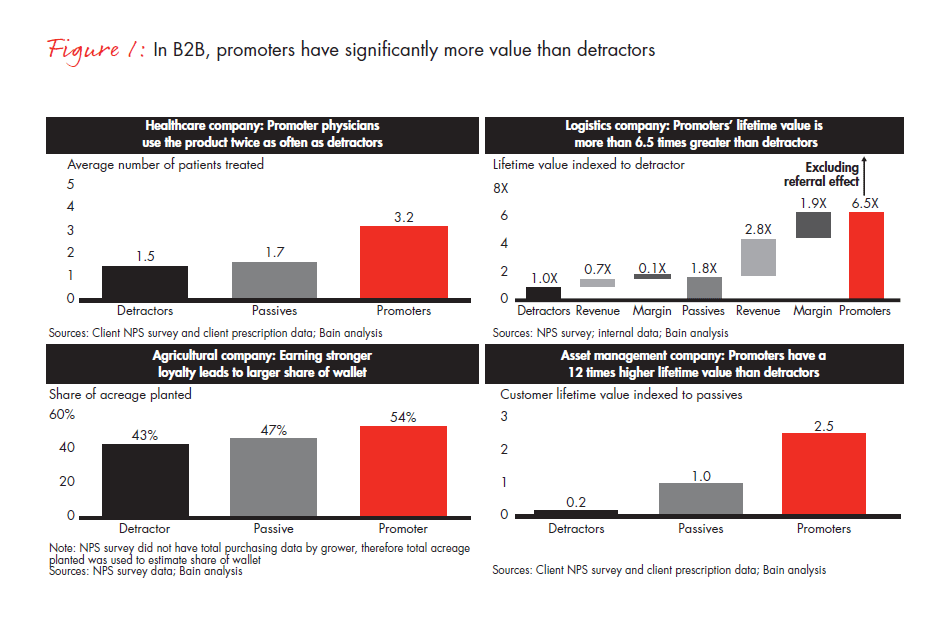
It might sound obvious that better economics flow from delighting customers. Yet this logic has only recently permeated the day-to-day operations of many B2B companies that have a legacy of focusing largely on product or technical innovation. And it's getting tougher to maintain customer relationships: In a recent survey by Bain & Company of 290 executives in B2B industries throughout 11 countries, 68% of respondents said customers are less loyal than they used to be.
Some B2B companies have reversed this trend through intensive, CEO-led efforts to earn customers' loyalty. While each organization has unique characteristics, they also share several common principles.
Identify what really delights and annoys customers
A delighted customer? Some B2B executives might think that's impossible. But in fact, loyalty leaders often find that they can, in fact, earn enthusiastic advocacy for their service or for the company overall.
That's because most B2B customers evaluate providers on a combination of several criteria: Do they create economic and strategic value for our business? Do they simplify our daily operations (and my own work life)? Can I trust them? Do I like working with them? An easy, trustworthy partnership in B2B markets can evoke personal feelings every bit as strong as with consumer products and brands.
Most B2B companies have various offerings that target quite different customer segments—say, equipment for a multinational agribusiness versus a version designed for local bakeries. To understand the needs and behaviors of target segments, and how well the firm meets the needs of each segment, it's important to push past the simple averages of NPS, share of wallet or profitability.
Regular feedback from customers provides the raw material for uncovering the root causes behind customers' attitudes toward the firm. Engaging customers in ongoing dialogue allows employees to learn exactly which elements of the business most appeal to or annoy customers. Through these dialogues, companies often realize that they have been over-serving assumed needs and under-serving real needs.
The feedback comes from contacting customers after key episodes like a new contract negotiation or a service event, ideally prefaced by just three questions to ensure high participation: Would you recommend? Why? Would you be willing to comment on a few specific areas?
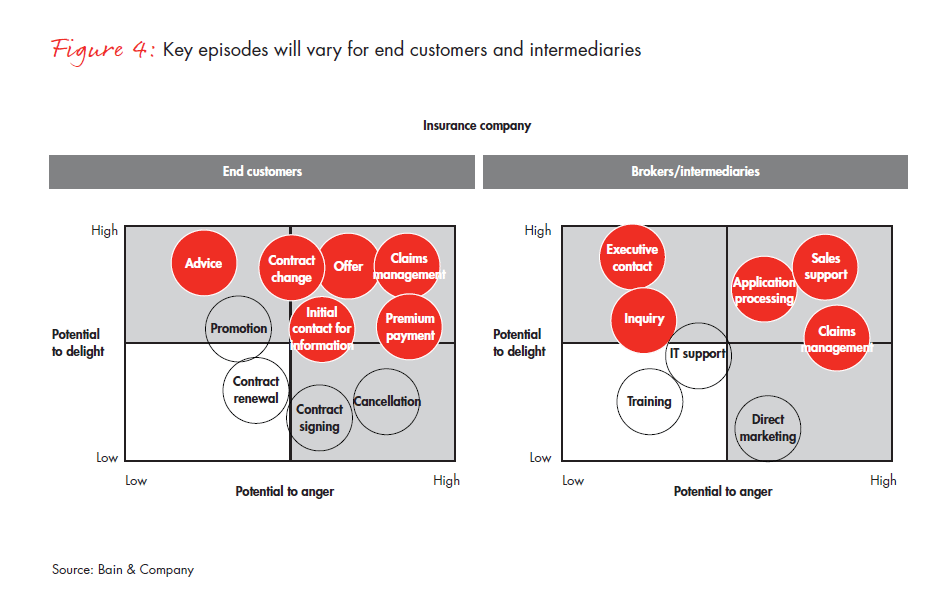
An NPS set-up should be highly tailored to the dynamics of the particular industry. B2B settings often involve several customer constituencies including gatekeepers, business leaders and operational users. Each group has different needs and requires different types of interactions from providers. The design around when, how and with whom to engage will depend on the provider's channel structure (intermediaries or not), the structure of decision making in the account (external influencers or not), and relevant episodes or moments of truth for the customer (see Figures 2 and 3).
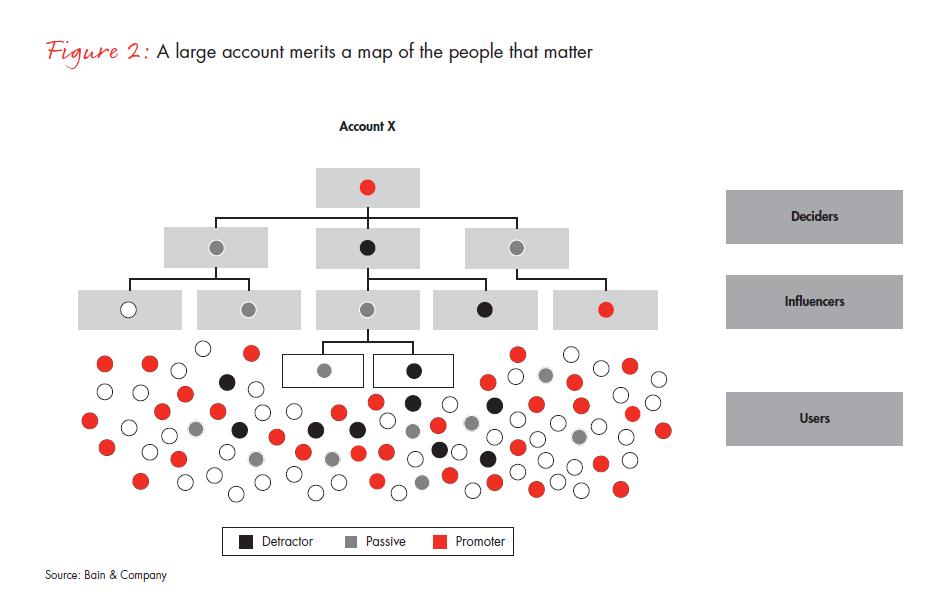
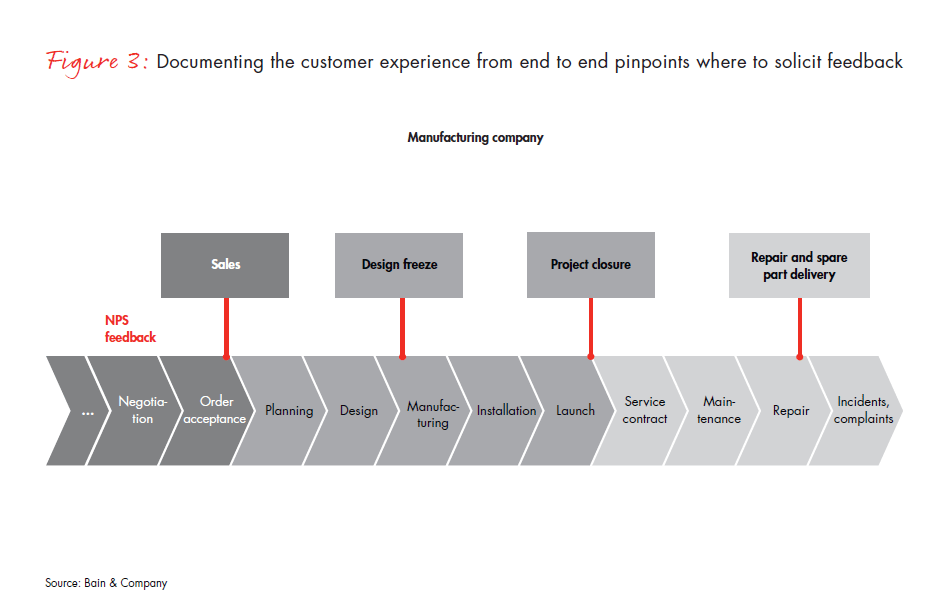
In construction, jet engines or automotive supply, for instance, loyalty depends largely on relationships and project results. Dürr, the German supplier of paint and assembly shops, may have only about 40 accounts, but each is a huge automotive manufacturer with hundreds of decision makers and influencers. Also, most departments within Dürr have interactions with many individuals at these customer organizations. As a result, mapping Dürr employees with customer contacts is relatively complex, and the NPS process requires thoughtful choices about whom to ask for feedback and how to communicate back when acting on customers' comments.
When a company sells to distributors or other intermediaries, getting feedback from retailers and end users, not just the intermediaries, will be quite valuable as well (see Figure 4). For TSWD, the insights gleaned from such conversations formed the basis for a new product that is shaping up to be one of its most profitable.
TSWD has long sold steel wires to distributors in India, but the company tended to view end users as a homogeneous group. It did not possess detailed information on how different types of farmers and growers used the wire and what features were most valuable to them.
As the market grew more competitive, TSWD decided to improve its overall value proposition and introduce new products, but it needed a much better understanding of the action downstream.
Working closely with its distributors, TSWD spoke with 1,100 end users and more than 200 retailers, contractors and other influencers— conversations that revealed significant openings to target certain segments with premium products. One segment of farmers, for instance, prized durability because if the wire broke, entire rows of grapes would fall and rot. Another segment valued ease of installation, so that they could install the fencing in one section of the farm for a crop's growing season, then dismantle it and reinstall it elsewhere for a new crop.
Use insights to inform where to place bets
Once customers raise issues that need to be addressed, a company can close the loop by fixing those issues and contacting detractors to update them personally on progress. Typical issues include excessive handoffs, long cycle time or rework of a job. It's equally important to learn about and replicate those areas where the company exceeds customer expectations, including its strengths relative to competitors’.
Insights gleaned from the feedback will help a firm align investments with its customers' priorities, size the potential benefits and chart the best course to get there.
Consider the experience of the US-based accounting and financial software firm Intuit. Tax accounting software has hundreds of features that can sometimes be complicated, even for accountants. So when Intuit started to regularly solicit feedback from new accountant customers, it learned that many didn't realize the products’ full capabilities and weren't aware of Intuit’s webinars and other instructional channels.
Based on such insights, Intuit's ProTax Group formed a New Client Services team to bring on board new customers, walk them through key product functionality and make learning a new system as easy as possible. As a result, accountants who participate in the program are 49% more likely to renew, leading to nearly 50% more second-year customer revenue.
Today, Intuit's ProTax Group solicits feedback from roughly 100,000 accountants right after a few key touchpoints. Keeping the customer's perspective front and center has allowed Intuit to steadily strengthen advocacy among its business customers and improve the company's financials.
Returning to the experience of TSWD, feedback from farmers and retailers led the company to design a new wire product that is thicker and has a more advanced protective coating for durability. Sub-branded as "Farming Gold," the wire comes with a 15-year warranty, approval by an external testing lab and a price 25% higher than the existing product. Early results show Farming Gold to be one of the most profitable wire products in TSWD's portfolio, so the company is working on sub-brands for the security-conscious and do-it-yourself customer segments.
UCB, a Belgium-based global specialty pharmaceuticals company, has employed NPS to better understand the needs of healthcare professionals and patients. In Europe, regular feedback from physicians has also allowed UCB sales representatives, medical science liaisons and executives to become more responsive by providing more and better educational materials and product information for physicians.
Similarly, a major luggage manufacturer used customer feedback to learn that most of its retailer customers wanted sales representatives to visit more often during the year, so that they could learn about the latest products. The firm invested in more sales visits, especially to high-potential stores, and worked to keep its line in display windows for a longer period of time. These actions generated 5% sales growth—and profitable growth.
Philips, the Dutch conglomerate, even uses NPS feedback to evaluate acquisitions, "to make sure it doesn't buy an empty box," said CMO Geert Van Kuyck.
Build a repeatable model for improvements
After the first insights and resulting actions materialize, the challenge is to make the process repeatable, through adjustments to key account management, by holding regular cross-functional sessions and other mechanisms.
First, however, senior management has to paint a simple, compelling and differentiating vision of what the customer's experience should be. That comes from exploring the questions: What does the company stand for? Why are we different? How does this vision translate to each episode in the customer's experience? The answers will have implications for channels, products and how work gets done on the front lines.
One critical aspect of the vision involves articulating a simple definition of success—a single universal customer currency such as NPS that's relevant for everyone in the company no matter which geography, function or line of business. At DHL, the global logistics firm based in Germany, top management uses NPS to track the firm's competitive position by business, country and customer segment. At the same time, a DHL Global Forwarding service employee in the Netherlands uses the NPS currency to assess and learn what she could do better to help a customer handle an exception around a specific container shipment issue and, more generally, to create promoters.
With that vision in place, it usually takes the active collaboration of several functions to identify what critical changes are needed, such as pricing optimization, defect elimination or new governance over decision making. A company must then equip its teams with the right tools and embed the capabilities in existing operating rhythms and decisions.
Intuit's ProTax Group has developed a structural equation model that considers the key product or service attributes influencing loyalty, examines each initiative in place or planned for a given department, then predicts the likely impact on NPS with an accuracy of two percentage points. "It's one thing to make customer issues visible, but a tougher thing to prioritize all the possible puts and takes in the end- to-end customer experience," said Tim Rollins, customer experience leader for the ProTax Group. "The predictive model proves very useful for that assessment."
Committed, visible leadership is the other essential ingredient. Senior executives including the CEO need to be intimately involved in regular interactions with customers in order for a customer-centered culture to take root and thrive.
UCB maintains a customer-centered culture by ensuring that decisions requiring more extensive change escalate to regular meetings of senior executives. In Europe, more than 700 physicians engage in detailed feedback calls with UCB senior management, right up to the CEO. This is a tangible way for UCB to bring the corporate vision of "global biopharmaceutical leader transforming the lives of people living with severe diseases" to life.
Intuit also involves leadership at several levels in regular talks with customers. Frontline supervisors do feedback surveys of accountants at specific touchpoints, while directors and vice presidents handle the longer, annual relationship conversations. "Having the customer voice in senior executives' minds is invaluable during strategic or business improvement planning," said Rollins.
Indeed, using regular customer feedback dates back to Intuit's early days, when founder Scott Cook was known for lingering at a local big-box retail store and approaching people who bought early versions of Intuit's personal finance software. With their permission, he actually followed them home to watch them install and use the product.
Give employees the tools and leeway to unleash their discretionary effort and deliver a superior experience for customers
As B2B companies battle to earn loyalty and expand their share of wallet, their most effective weapon consists of highly engaged employees who go the extra distance to deliver. Engaged employees provide better experiences for customers, approach the job with energy—which enhances productivity—and come up with creative product, process and service improvements.
Because NPS feedback goes to employees at such high velocity—often close to real time—they can understand how their own actions affect the customer's experience of the company and its products (see Figure 5).
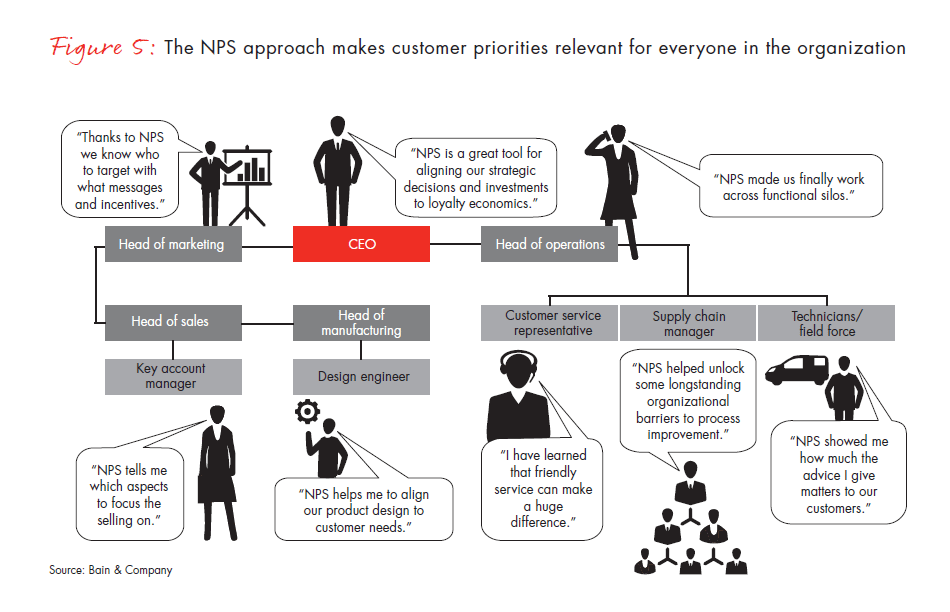
"There is a real hunger for new customer feedback so that employees can raise the bar," said Simon Lyons, global director of marketing for Aggreko, the UK-based supplier of generators and temperature-control devices.
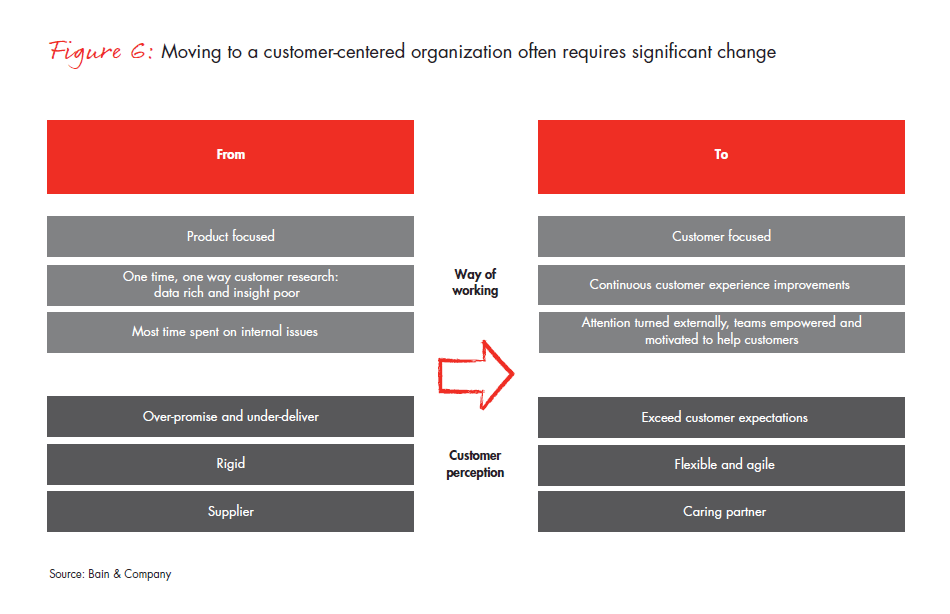
A customer-centered mindset often entails changing processes to give employees more autonomy within a framework (see Figure 6). The call center for small business customers, for example, might shift from using a rigid script and protocols to flexibility in dealing with flagship customers. Performance metrics might have to change accordingly, from cost-driven metrics such as average handle time to handle time plus first-call resolution. This does not mean "anything goes." The most effective companies give employees decision rights and accountabilities for daily operational decisions that can add or destroy a lot of value—but within an explicit decision framework that has clear guidelines for behavior.
Net Promoter companies also find that bringing the voice of the customer into decision-making forces different departments— Manufacturing, R&D, Sales and so on—to intensify their collaborations. When Tata Steel launched its Farming Gold product, it chose to do so in the factory, with hundreds of workers attending as the head of the wire division led a prayer ceremony.
The same logic applies to a company's channel partners and other intermediaries who serve as the face of the supplier to the customer and thus can enhance or degrade its reputation. E.ON, a multinational power and gas company based in Germany, learned this lesson in one of its country operations, which relies on third-party agencies to acquire new small and medium-sized enterprise (SME) customers. There, NPS feedback from newly signed customers showed significant gaps between the rebates, tariffs and features that SMEs thought they would receive, and what E.ON actually provided. This disconnect prompted a stream of calls from confused business owners.
In response, E.ON invested in agent support tools and training events for its agencies to convey more accurate information about the company's products and overall value proposition. It established quality targets as part of the agencies’ compensation, in order to motivate the desired behaviors and reward the best agencies. Early results suggest the value of working with the channel to set customer expectations, as E.ON’s new SME customers in this country have recently been brought on board with greater clarity and fewer complaints.
A simple proposition—think like a customer— can transform performance in even the most complex B2B markets and lead to sustainable competitive advantage. But becoming customer-centered requires substantial changes in ways of working, behaviors and mindsets: from an exclusive focus on product to a wider view that includes customers; from a single department's key performance indicators to an entire organization looking at one reliable metric; from rigid protocols to teams empowered to help customers. As more companies have discovered, an obsession with customer loyalty pays off with superior growth on the top and bottom lines.
David Michels is a Zurich-based partner in Bain & Company's Customer Strategy & Marketing practice. Andreas Dullweber heads the firm's Customer Strategy & Marketing practice in Europe and the Middle East and is based in Munich.
First published in febrero 2014