

Brief

In 2006, Ford Motor Company needed help. The company’s finances were shaky—it had lost about a point of market share in the US every year for the previous 10 years—and its future was uncertain. But within just a few years, Ford returned to profitability—without a bailout from the American taxpayer, even after the financial crisis of 2008.
At the heart of this remarkable turnaround, the senior team under new CEO Alan Mulally set a strategic path that included divesting noncore brands, such as Aston Martin and Volvo, and accelerating development of fuel-efficient cars and common vehicle platforms for global markets. Mulally also realized he would need to overhaul Ford’s operating model to execute the new strategy.
The organization moved from regional business units to a global functional model, setting the stage for more efficient and effective operations. For example, creating a global head of product development allowed Ford to reduce the number of vehicle platforms from roughly 40 to 10. But Ford didn’t just add a box to the org chart. Each regional unit assumed global responsibilities: North America for large pickups, Europe for compact cars, Australia for small pickups and so on. This setup drew the business together, eliminating redundant activities and extending the reach of teams with expertise.
Governance and behaviors had to change as well. Mulally improved the effectiveness of the weekly business performance reviews, pushing executives for more open debate and honesty about where problems were cropping up. He encouraged his team to simplify the way they worked, eliminating ineffective meetings and liberating thousands of unproductive hours. The company even distributed laminated “One Ford” cards to communicate the new expected behaviors to all employees.
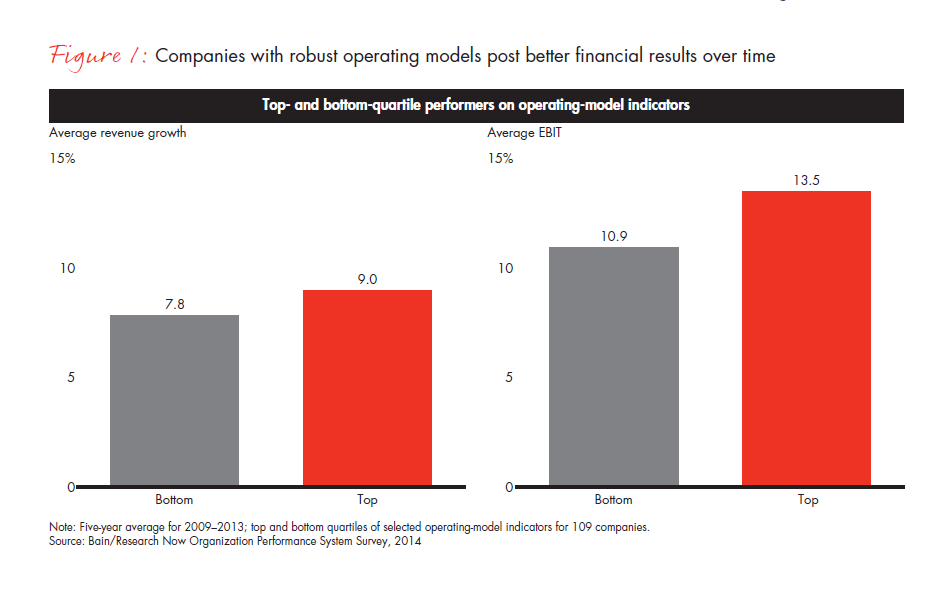
As Ford’s experience illustrates, redesigning the operating model may be one of the smartest investments that executives can make to achieve profitable growth. Bain & Company’s analysis of companies in eight industries and 21 countries finds that companies with top-quartile operating model indicators—those with clear, robust operating models—have five-year compound average revenue growth that is 120 basis points faster and operating margins that are 260 basis points higher than for those in the bottom quartile (see Figure 1). These high-performing companies have set up their operating models so that organizational structure, accountabilities, governance and employee behaviors, along with the right people, processes and technology, all work together to support the strategic priorities.
It’s not surprising that many companies consider evolving their operating model as a top-three priority, given that only one-fifth of executives who Bain surveyed feel their operating model provides a competitive advantage. This concept, which barely registered a decade ago, now permeates the mainstream business media, with roughly 6,700 mentions last year.
Why has this topic become a major concern? Several factors have heightened the need for operating models to evolve in recent years:
- Complexity: The pursuit of growth has led to organizational complexity as companies extend to adjacent businesses and new customer segments, products and geographies. These incremental changes have accumulated over time, leading to complex organizational structures that create ambiguity and slow decision making.
- Customer experience: In many industries, the customer experience surrounding a company’s goods and services has become an important source of differentiation. This shift puts a premium on deploying frontline employees with the right autonomy, motivation and tools to delight customers—and on ensuring that the entire organization supports them.
- Technology: Digital technology has changed every aspect of business operations, including how and where companies interact with customers. The rise of collaboration technologies alters how teams interact across geographies and time zones. There’s more information flowing into and around an organization every day, and those flows don’t always respect hierarchy. Although Big Data analysis can provide valuable new insights, the growing volume of data can drown an unprepared enterprise. Relevant data must get to the right people quickly to help them make good decisions.
- Dynamic business boundaries: The best location to perform an activity or make a decision may change over time, as brands and supply chains become global and tax-advantaged models such as inversions become more prominent.
These trends may render an operating model out of sync with the strategy—an issue of some urgency. In the past, companies could coast along with suboptimal operating models; today, there’s less room for error. Customers are more demanding, more vocal and less loyal. Institutional investors are less patient with shortcomings in execution. Also, risk events caused by weak governance or lack of accountability—a rogue trader in a bank or faulty engineering of a car part—can severely damage an entire enterprise.
Bridging the gap
When there’s a significant and persistent gap between strategy and execution, it’s imperative to rotate the lens for a wide-angle view of the entire organization. This will expose any elements of the operating model that are not working in harmony. Without this perspective, companies run the risk of focusing on one-off changes—like adjusting spans and layers—which on their own may not address a fundamental misalignment of the operating model.
The operating model serves as a blueprint for how resources are organized and operated to get critical work done. It encompasses decisions around the shape and size of the business, where to draw the boundaries for each line of business, how people work together within and across these boundaries, how the corporate center will add value to the business units, and what norms and behaviors should be encouraged.
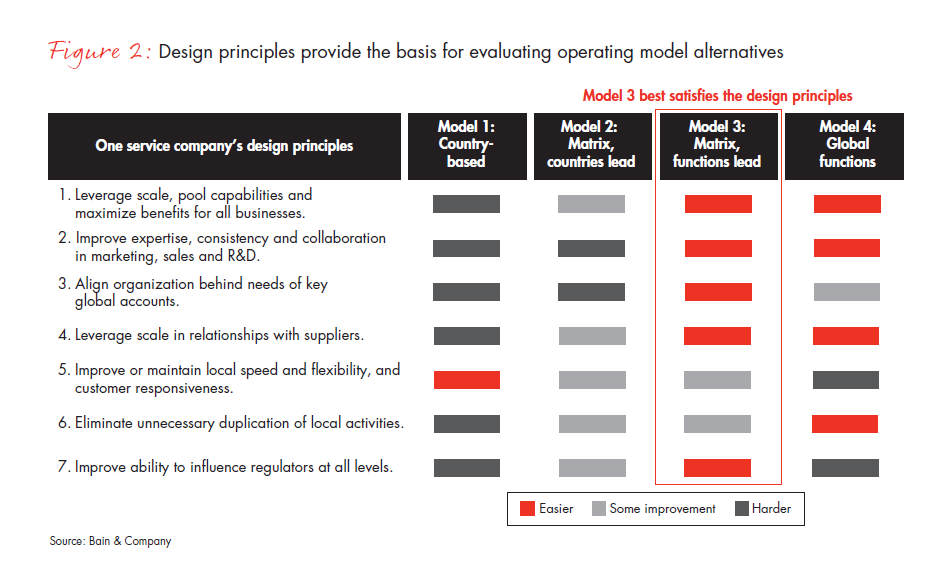
Design of an operating model starts by describing the strategy in sufficient detail that one can articulate a set of design principles—simple yet specific statements defining what the organization must do to enable execution of the strategy. Effective design principles should be concise and clear; for example, “Make it easy for our distributors to do business with us;” “Facilitate integration of future acquisitions;” “Enable the creation and delivery of solutions instead of standalone products;” “Enable a lower-cost position.” These principles also provide the criteria for testing and adjusting the model over time, bringing objectivity to what can be a politically charged process (see Figure 2).
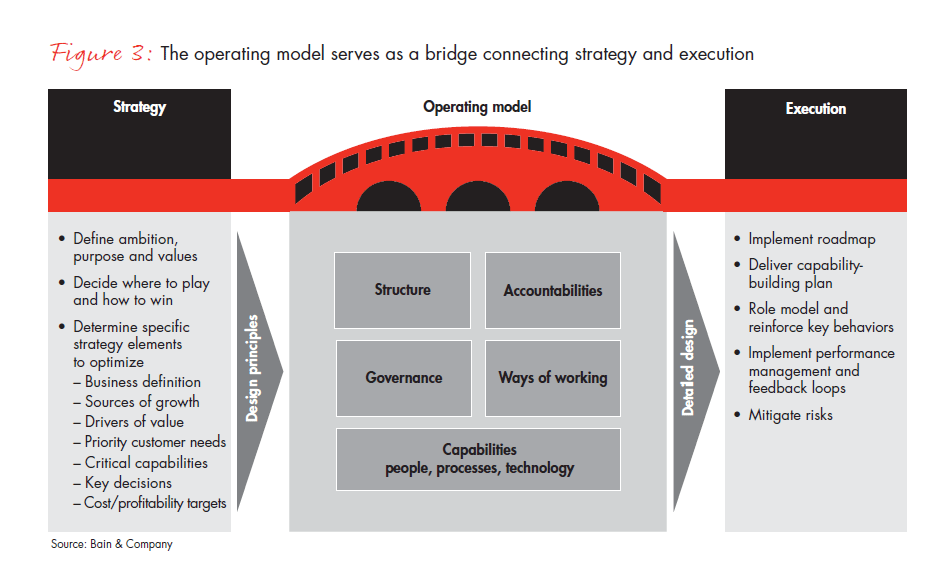
Based on the design principles, the operating model takes shape through choices in five areas (see Figure 3):
- Structure involves drawing appropriate boundaries for lines of business and defining shared services, centers of expertise and other coordinating mechanisms that allow a company to leverage scale and expertise. It also specifies the size and shape of the organization with indicative resource levels and locations. Think of this high-level org chart as the “hardware” of the operating model, with the next four dimensions serving as the “software” that makes the hardware run.
- Accountabilities describe the roles and responsibilities of the main organizational entities, including ownership of P&Ls and a clear, value-adding role for the corporate center. There should be clear guidelines for the roles each organizational unit will play in critical decisions. A rewards framework linked to these accountabilities reinforces strong execution.
- Governance refers to executive forums and management processes that yield high-quality decisions on strategic priorities, resource allocation and business performance management. A management dashboard with the key metrics keeps the focus on the company’s top priorities.
- Ways of working describe the expected cultural norms for how people collaborate, especially across the boundaries between functions or teams. This dimension goes beyond communicating values such as “trust” and “respect” to being explicit about which behaviors make for effective decisions and execution. Establishing an appropriate decision-making style—whether through consensus, a single point of accountability or another approach—provides an important context for behaviors.
- Capabilities refer to how the company combines people, process and technology in a repeatable way to deliver desired outcomes. Where capabilities lead the design, all other aspects of the operating model must support them. In many other situations, the redesign looks first at structure and accountabilities that can only operate with the appropriate talent, processes and systems in place. In either situation, the elements are highly interdependent.
When a company’s strategy changes, certain elements such as governance or ways of working may need to be adjusted. And in some cases, the model may need to be overhauled—structure and all—as was true at Ford. However extensive the needed changes may be, all dimensions should be well integrated and internally consistent. Executives cannot afford to constantly rewire their organization to execute a new strategy, yet they have to adapt to rapid change in their markets. So how can they design and build an adaptive operating model that will sustain growth and profitability? There’s no single answer; instead, companies with superior execution have followed four best practices that allow them to build models that suit their current strategies and that can flex as new priorities emerge.
1. Stitch the organizational seams in the best places
An operating model should closely fit the company’s strategy, like a custom-made suit with seams drawn and stitched to accommodate movement and comfort, no matter the shape of the body. Every organizational structure creates boundaries between departments, geographic units or lines of business, and people must learn to collaborate across them.
What’s important is to define the seams in a way that reflects how the company creates value, that promotes better decision making and that balances operating-unit accountability with economies of scale.
Nike’s decision in 2008 to redesign its organizational boundaries is instructive here. Nike’s business units had been organized along products such as footwear, apparel and equipment, with geographic regions a secondary axis. But that matrix didn’t accommodate a shift in customer priorities that Nike had detected. Athletes, even amateurs, had become more serious about wanting high-performing, head-to-toe gear tailored to their particular sport.
In response, Nike redesigned its operating model around sport categories rather than individual product groups. It hired heads of sport categories, and began to report earnings for each sport so that these leaders worked toward the correct metrics.
Several positive effects flowed from this new operating model. Category products shipped together, which meant that shirts and shoes and other elements of the new season’s style for a sport arrived in stores at the same time. Resource allocation improved as well, because the category was a more effective way of understanding where to invest. Redrawing its organizational seams has helped Nike make higher-quality decisions, make them more quickly and execute them better.
Nike’s experience is consistent with Bain research showing that companies in the top quartile on operating-model indicators report decision-effectiveness scores that are nearly five times greater than bottom-quartile companies. Placing the seams in the right places, and defining the right accountabilities and behaviors so that people work effectively across the seams, leads to more effective decisions.
Defining the best boundaries not only improves decision making but also can be critical for sustained, substantial cost reduction. A chemical company that had seen costs rise for several years was plagued with complexity, duplication and dysfunctional behaviors. After it pivoted from organizing along product lines to organizing around the value chain (upstream, operations, sales and marketing), the company was able to shrink the number of organizational entities by a third. Prior incremental initiatives had failed to achieve the target cost savings; only by changing the operating model could the chemical company dramatically simplify the organization and fundamentally improve its cost position.
2. Put customer priorities at the center of the design
Companies in most industries aspire to become more customer-focused. The ones that succeed understand not just the needs and priorities of their target customers but also the best organizational setup to address those needs.
One multinational retail bank several years ago set ambitious customer loyalty goals to counter the pressure from locally based competitors in a particular region. These firms were gaining ground on a key measure of customer loyalty, the Net Promoter ScoreSM or NPS®.
The bank used NPS customer surveys and other data to analyze 11 customer episodes, such as onboarding and credit card loyalty programs, to understand precisely which interactions delighted or annoyed customers and why. It became clear that each country had its own approach for these interactions, which added cost and complexity.
In response, the bank decided to standardize at the regional level certain areas, including product development, marketing and branding for items such as welcome packs and the website. At the same time, to preserve local flexibility, country-based teams were empowered to tailor the experience in the branches and call centers to local preferences. Country teams could refocus their attention and resources on delivering excellent service at the front line and providing regular customer feedback to the region. This realignment of structure and roles, and a focus on building greater trust and collaboration among the groups, has put the bank on track to achieve its NPS goals.
Centralizing some activities and decisions, however, is not always the best route to fulfilling customers’ needs. In fact, the choice to centralize should face a high hurdle because companies often underestimate how much frontline accountability they lose in doing so.
Case in point: At a major retail chain, most activities were managed either centrally or regionally. Comparable store sales and customer loyalty were in decline, and the senior team realized that they needed to allow local districts more leeway. In response, the chain eliminated regional layers, centralized only those activities that would benefit from scale, and shifted significant responsibilities around merchandising and planning to the local districts. Once districts had significant input into sales plans, space allocation and product assortment, they could better tailor each individual store for local customer preferences. For example, individual stores could now team up with local food brands to cross-merchandise and market products relevant to the local community. Also, a store in a lower-income urban center could shift to brands, styles and price points that better appeal to local tastes. By putting customer preferences front and center, the chain regained its edge with customers even as it reduced operating expenses.
An operating model that’s truly centered on customers goes all the way to defining accountabilities on the front lines so that employees can be highly responsive to customers. For many years, the Ritz-Carlton hotel chain has had a policy of giving front-desk staff $2,000 of discretionary funds to solve any customer complaint in the manner the employee feels appropriate. This local autonomy reminds employees of the company’s dedication to honoring a customer’s lifetime value, and frees employees to do the right thing quickly, without having to navigate a lot of time-consuming procedures.
3. Organize to develop and deliver the capabilities that matter most
It’s difficult and resource-intensive to be great at everything—in fact, it’s not necessary or even healthy. Instead, companies with highly effective operating models have decided to excel at only those few capabilities essential to realizing the strategy while being “good enough” where that’s sufficient. When a company realizes it doesn’t have to gold plate every service that a support function provides, for example, it can shift resources to the services that are essential to winning in the market.
Once senior leaders have agreed on which capabilities matter most, they must harness the right people, processes and technology to deliver the capabilities and make sure each dimension of the operating model supports this effort.
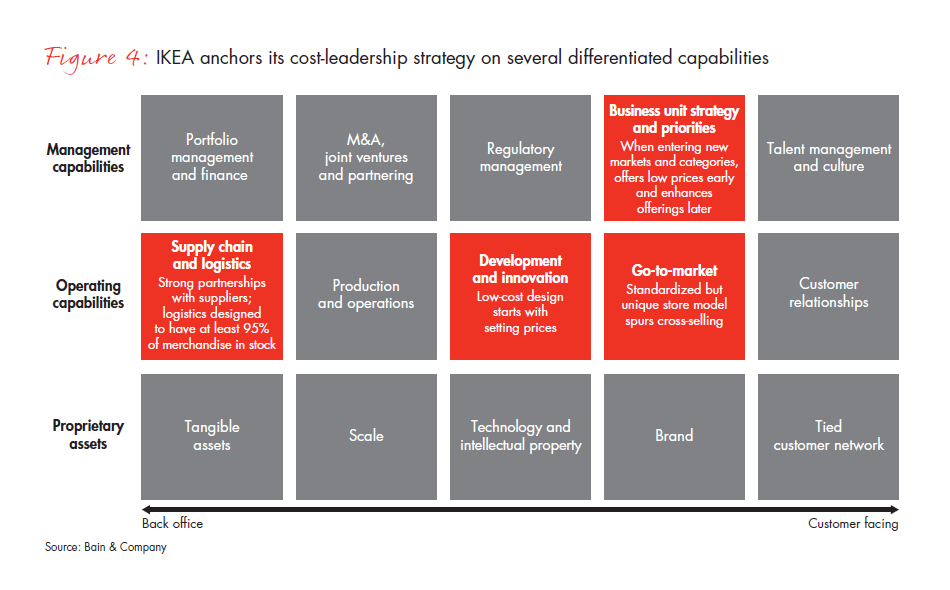
Home furnishings retailer IKEA, for example, has anchored its cost leadership strategy to a small set of differentiated capabilities (see Figure 4). One capability, for instance, is developing supplier partnerships that ensure more than 95% of inventory will be in stock. To support this capability, IKEA located its procurement units closer to strategically important suppliers, and created strong forums for supplier evaluation and coordination. Another capability consists of a repeatable product design process: Set the price, choose the manufacturer and collaborate to design a high-quality product that meets the price point.
Smart capability development is essential not only for meeting customer needs but also for containing costs. Knowing which capabilities can be merely adequate frees up funds for more important capabilities—like an athlete getting fit by replacing fat with muscle. This discipline of emphasizing key capabilities applies not just to the current business but also for the next phase of its evolution.
A global forwarding company realized that thin industry margins and a challenging economic environment threatened its long-term outlook. It would need to improve not only its historic sources of differentiation, such as capacity management and procurement, but also areas where it had lost ground, such as customer service. The company’s existing operating model undermined this objective, as each local station was run by generalists who struggled to keep up with innovations in each of the multiple operational areas they oversaw. Processes had not been standardized across countries, which made it difficult to share best practices and upgrade critical systems.
So the forwarding company created strong functions with deep expertise in each capability domain, deployed at the relevant geographic level. To step up performance in procurement and capacity management, for instance, the company centralized these functions at country and regional levels, increased training requirements and mandated best-practice sharing among stations on items such as route optimization and other processes. It also migrated to a new systems platform. This massive retooling and upgrading of skills has positioned the company for long-term success.
Operating model transformations often involve changing an organization’s profile of skills and experience, as the forwarding company did. Sandy Ogg, former chief human resource officer of Unilever, remarked when the company was shifting its operating model, “In the old world, we needed a lot of independent 400 meter runners. Today, we need a 4 x 100 meter relay team.”
4. Energize and align employees through principles, not exhaustive rules
A flexible operating model cannot work according to a paint-by-numbers design. That would lead to proliferation of rules within a rigid framework, which limits employees’ problem-solving ability and can’t possibly account for every situation.
It’s far more effective to define clear principles for how people work together within and across the seams so that the company can stay agile with minimal bureaucracy. Principles liberate people to do the right thing as long as they have a framework in which they can make the right choices. A healthy principles-driven culture promotes agility. Rules remain important in some areas, such as defining safety practices in mines, but companies can limit where such explicit guidance is necessary to put the principles into practice.
Principles can clarify expectations around ways of working, serving as a compass to guide behavior in any situation that might arise. One of semiconductor-maker Intel’s strongest, most enduring principles is to “disagree and commit.” Former senior leaders Robert Noyce, Gordon Moore and Andy Grove put the principle in place to rein in the tendency of Intel employees to reopen and escalate decisions they disagreed with. The principle encourages Intel employees to debate proposals openly. But once a decision is made, Intel leaders are expected to play their part in executing the decision and bringing their teams with them.
Other principles focus on accountabilities, providing clarity on the mission for each organizational unit and where ownership for different types of decisions should lie. Such clarity is particularly helpful where a structural change creates ambiguity or tension along a new seam.
When The Hartford, a US-based insurance company, redesigned its operating model a few years ago, it put in place a structure of multiple business units supported by several central functions. Historically, corporate functions had operated largely within each autonomous business unit, so the new model initially left unclear how decisions would be made involving HR, finance, marketing and shared areas such as claims.
Rather than map out roles for every decision, then-CEO Liam McGee articulated that the “center of gravity” rested with the businesses, not the functions. A set of principles clarified the respective roles of each. For example, one principle stated that functions would establish policies and guidelines, and the business units would have authority to make decisions within those guidelines; they would need to defer to central functions only if they felt the need to go outside the framework.
As a result, decisions such as offer packages for senior hires no longer had to involve time-consuming debates between HR and the business unit; the business leader could move quickly as long as the offer was within compensation guidelines determined by HR. Applying these principles across dozens of decisions helped The Hartford speed up and improve the quality of decision making. That helped to fuel better earnings, return on equity and a 68% share price increase (vs. 38% for the S&P index) over the subsequent two-and-a-half years.
By reducing the need for detailed prescriptions for every situation that might arise, principles help companies to become more agile. And where it is important to have detailed rules, clear guidelines align the rules with the strategic intent of the operating model.
Do you need to modify your operating model?
The practices described here, in combination, substantially raise the odds of producing an organization that has the right shape and size, accountabilities, governance and behaviors to execute the chosen strategy.
Sometimes it’s obvious that you need to adjust an operating model when, say, your company changes its strategy or makes a major acquisition. At other times, though, it’s less clear. Several questions can serve as leading indicators that a partial or full redesign may be in order:
- Do you persistently see execution gaps between your strategic ambitions and business results?
- Are you set up to capture your biggest growth opportunities?
- Are you able to consistently meet the needs and priorities of target customers, or does your organization get in the way?
- Have complexity or costs grown faster than you can mitigate them within the current model?
- Do you make decisions at the pace required by the market, or are you held back by a constant swirl of revision?
- Do you have the key capabilities, including talent, that you need for future success, and will your model help deepen the capabilities that matter most?
- Do your leaders commit the right focus and time to the top strategic priorities?
- Do you have a culture of accountability and collaboration to enable you to execute effectively?
If the answers to a number of these questions cause concern, then it could be time to revisit your operating model to ensure it is providing a sturdy bridge between your strategic ambition and execution.
Marcia Blenko is an advisory partner with Bain & Company’s Organization practice. Eric Garton is a partner and the global leader of the practice. Ludovica Mottura is the director of the practice. They are based, respectively, in Boston, Chicago and Boston.
Net Promoter ScoreSM and NPS® are trademarks of Bain & Company, Inc., Fred Reichheld and Satmetrix Systems, Inc.
First published in diciembre 2014