


Brief


|
한눈에 보기
Bain & Company research finds that only about 9% of companies are sustained value creators with profits that exceed their cost of capital and real top-line growth over the majority of a 10-year period. What’s holding the rest back? The barrier reported by 85% of respondents is not a lack of strategy, ideas, or opportunities. The main obstacle is their inner game. In other words, their organization is holding them back. This execution challenge is widespread: Bain’s CEO Agenda research finds that CEOs are considerably more confident in their strategic ambition than in their organizations’ ability to translate it into results. Only half believe their governance processes are simple enough to support speed and agility. Evolving the operating model is one of the most important steps a company can take to improve performance. Consider Unilever’s experience in the early 2020s. The consumer products giant faced a series of challenges. A complex blend of geographies, categories, and functions created cumbersome approval processes that slowed decision making and made the company less responsive to market trends. In what became the company’s largest transformation in three decades, Unilever replaced its matrix model with a category-focused operating model, creating five distinct business groups: beauty and well-being, personal care, home care, nutrition, and ice cream. Each new business group had end-to-end P&L ownership, full strategic control, and direct accountability for global performance. This shift helped make Unilever simpler and speedier. Faster decision making allowed the company to respond more quickly to consumer and channel trends. This helped streamline product innovation and strengthen retailer relationships. Unilever also shed lower-growth, less-scalable assets. A leaner corporate center continued to set overall strategy, and Unilever’s business operations supported all groups with shared services, technology, and operations. By 2024, volume was growing again, up 2.9% compared to down −2.1% in 2022. Operating profit increased by 15.5% since the restructuring began, and the operating margin expanded from 16.1% to 18.4%. What is an operating model?An operating model is the blueprint that defines how a company’s structure, accountabilities, governance, ways of working, and capabilities are configured to execute its strategy (see Figure 1). It has six dimensions that guide how people and teams inside a company get work done.
Figure 1
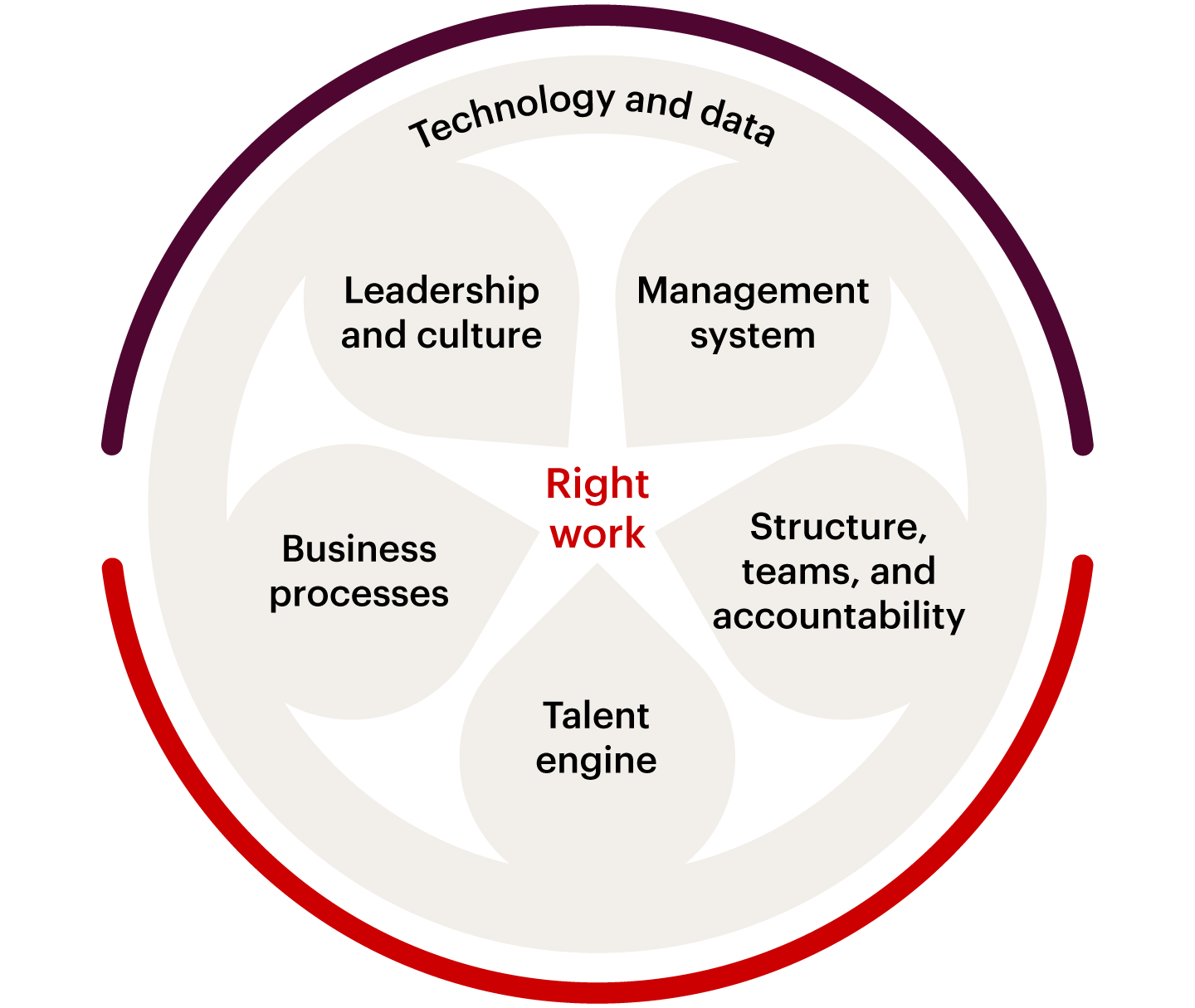

Bain & Company’s research has found that companies with effective operating models outperform competitors by three times or more in total revenue growth, EBIT growth, and shareholder returns. When should you evolve your operating model?Many internal and external factors can prompt companies to evolve aspects of their operating models:
Operating model design: How companies turn strategy into resultsWhen evolving their operating model, companies should start with a clear view of strategic objectives and an understanding of organizational pain points grounded in data. The four best practices of a winning operating modelStitch the organizational seams in the right spots. An effective operating model reflects how the company builds competitive advantage in the market. Similar to a well-made suit with seams stitched exactly in the right places, departments and accountabilities should follow natural customer, cost, and capability-sharing considerations. Determining where P&L responsibility should sit typically involves asking questions such as:
Properly defining the right business boundaries is necessary not only to capture relevant market trends but also to realize benefits of scale. A chemical company was having trouble managing rising costs. An asset-centric operating model had caused the proliferation of many uncoordinated functional activities. Central functions strove for excellence, but the businesses did not value the services they provided. People were too focused on interacting with one another and not focused enough on the customer. As one executive put it, “We are spending a lot of time doing business with ourselves.” Cost-reduction initiatives had reduced the budget and the headcount but not this underlying busywork. A pivot to a model oriented around the value chain (upstream, operations, sales and marketing) helped the company reduce its total number of business units and functions by one-third. This simplification structurally lowered costs and helped eliminate unnecessary work, duplication, and dysfunctional behavior that staff had dubbed “horizontal rain.” This type of macro structure change is always disruptive and shifting line-of-business and departmental boundaries can be contentious. To ensure that these decisions are anchored in the right goals, design principles—simple yet specific statements defining what the company must do to enable execution of the strategy—can provide an objective set of criteria for shaping and debating alternatives. Specify the center of gravity of decisions and activities. Debates over organizational change often start with org charts, but changing a company’s structure is generally overrated as a lever for strategy execution. It’s the ways people work that need to evolve to drive better results. To create change and improve decision making, companies should always take the time to specify the collaboration models they want to deploy in their new structure. At one operator of entertainment venues, a fragmented, attraction-centric operating model created inefficiencies and role duplication across sites. Strategic capabilities within global functions were limited, and the company struggled to leverage scale and ensure consistency. The operator made a crucial breakthrough by clearly assigning decision-making responsibilities across global, regional, and local levels. The new model reset roles and decision rights to focus attraction leaders on guest experience and park operations while reserving pricing and investment decisions for regional leaders and functional experts. Today, a lean global team of specialists ensures consistency and provides expertise to all the company’s attractions, reducing role duplication. Dedicated teams of regional business partners connect frontline teams with those global functions, freeing local teams to focus on execution and guest experience within attractions. Refreshed governance forums and clarified decision rights have codified how decisions are made in the new model. It generally works best to have one or two centers of gravity for decision making. A large spirits company suffered from significant confusion among country, cluster, region, and corporate levels, particularly around budgeting, P&L performance management, and sales and marketing. After studying how various activities and decisions create value, the company refocused country leaders on marketing and channel management, two intrinsically hyperlocal activities. It empowered country clusters to manage the P&L for groups of countries with similar consumer and portfolio dynamics, and redefined the role of the regions to focus strictly on delivering shared services to optimize scale benefits, talent availability, and geographic proximity (see Figure 2).
Figure 2


Deploy mission-driven teams to ensure sufficient focus on changing the business. A pitfall of traditional operating models is that although P&Ls and departmental boundaries provide clarity and direction, they can make it difficult to pick up signals from the market and collaborate across organizational lanes. A distinguishing feature of successful companies is business agility, the ability to quickly pivot focus to the new, important, and unexpected while also executing on business-as-usual activities. Companies sometimes fall into the trap of reacting to the latest trends by creating dedicated C-level roles or proliferating cross-functional initiatives or overlays, but these efforts only add complexity. Successful companies cultivate a transparent backlog of enterprise-level strategic priorities and use multidisciplinary teams to pursue them. These priorities or missions may be assigned to an existing team or to new, often tech-enabled teams that are fully dedicated to developing quality solutions to the company’s toughest problems, whether that’s launching new product lines or transforming a process to make the most of AI (see Figure 3). (For more on how AI is reshaping teams, roles, and accountabilities, see the Bain Brief “An Operating Model for the Age of AI.”)
Figure 3


These teams do not operate in a vacuum but work in tandem with line leadership to test, learn, and scale new ideas. Successful companies also have mechanisms to identify which skills are needed in these priority missions at a given time and allocate the best-fit talent and required technology investment to these teams. They also quickly decommission other less-critical teams, ensuring that people (and the company at large) don’t end up spread across too many efforts. Prepare to live the operating model. Operating model change is inherently disruptive because it requires people to work differently. Leaders of operating model change efforts face a challenging task. Bain research has found that although 88% of senior leaders involved in such a transition believe their new organizational structure will achieve its aims, only 36% of the rest of the organization agrees. To close the gap, when designing the new operating model, leaders can begin by focusing on three key questions:
The benefits of this type of approach are evident in a consumer products company’s recent experience. To better capitalize on its global scale, the company decided to centralize more activities across market units. This would require country general managers to relinquish ownership of certain decisions, such as pricing, to central operations. Having identified the processes the rollout would disrupt the most, the working team identified key “moments of truth” in which country general managers and other key stakeholders would be most likely to revert to old behavior. Leaders built awareness of those points of tension and put in place the appropriate enablers to support the new behaviors, including aligning the financial incentives. Finally, leaders used feedback loops from the front line to help monitor implementation, identify what was going well or not well, and correct course along the way. These leaders realized that minimizing disruption to the business required reinventing ways of working, not just the operating structure. By seeing their people as part of the solution rather than the problem, they set them up for success in the new organization. This perspective will be increasingly important as companies seek to leverage AI to its full potential. Is your operating model fit for purpose?Leaders are always challenging the status quo, asking what needs to change to better deliver on their strategy. The most successful recognize that the company’s inner game is one of the most powerful levers for unlocking the full potential of their organization. This goes beyond structure and includes making better decisions, deploying mission-driven teams, and supporting behavior change at scale. If you and your colleagues are struggling to fully deliver on your strategy, it could be time to revisit your operating model and ensure it is focusing your people on the right work. |
First published on 10월 07, 2026