
Skip to Content
  • Offices

    Offices

    North & Latin America
    • Atlanta
    • Austin
    • Bogota
    • Boston
    • Buenos Aires
    • Chicago
    • Dallas
    • Denver
    • Houston
    • Los Angeles
    • Mexico City
    • Minneapolis
    • Monterrey
    • Montreal
    • New York
    • Rio de Janeiro
    • San Francisco
    • Santiago
    • São Paulo
    • Seattle
    • Silicon Valley
    • Toronto
    • Washington, DC
    Europe & Africa
    • Amsterdam
    • Athens
    • Berlin
    • Brussels
    • Copenhagen
    • Dusseldorf
    • Frankfurt
    • Helsinki
    • Istanbul
    • Johannesburg
    • Kyiv
    • Lisbon
    • London
    • Madrid
    • Milan
    • Munich
    • Oslo
    • Paris
    • Rome
    • Stockholm
    • Vienna
    • Warsaw
    • Zurich
    Middle East
    • Doha
    • Dubai
    • Riyadh
    Asia & Australia
    • Bangkok
    • Beijing
    • Bengaluru
    • Brisbane
    • Ho Chi Minh City
    • Hong Kong
    • Jakarta
    • Kuala Lumpur
    • Manila
    • Melbourne
    • Mumbai
    • New Delhi
    • Perth
    • Shanghai
    • Singapore
    • Sydney
    • Tokyo
    See all offices
  • Alumni
  • Media Center
  • Subscribe
  • Contact
  • Spain | Español

    Select your region and language

    Global
    • Global (English)
    North & Latin America
    • Brazil (Português)
    • Argentina (Español)
    • Canada (Français)
    • Chile (Español)
    • Colombia (Español)
    Europe, Middle East, & Africa
    • France (Français)
    • DACH Region (Deutsch)
    • Italy (Italiano)
    • Spain (Español)
    • Greece (Elliniká)
    Asia & Australia
    • China (中文版)
    • Korea (한국어)
    • Japan (日本語)
  • Saved items (0)
    Saved items (0)

    You have no saved items.

    Bookmark content that interests you and it will be saved here for you to read or share later.

    Explore Bain Insights
  • Industries
    Main menu

    Industries

    • Aeroespacial y Defensa
    • Agroindustria
    • Químicos
    • Construcción e Infraestructura
    • Productos de Consumo
    • Servicios Financieros
    • Salud y Ciencias de la Vida
    • Maquinaria y Equipo Industrial
    • Medios y Entretenimiento
      Industries
      Medios y Entretenimiento
      • Media Lab
    • Metales
    • Minería
    • Petróleo y Gas
    • Papel y Empaque
    • Private Equity
      Industries
      Private Equity
      • Due Diligence
      • Exit Planning
      • Firm Strategy & Operations
      • Portfolio Value Creation
    • Sector Público y Social
    • Retail
    • Tecnología
    • Telecomunicaciones
      Industries
      Telecomunicaciones
      • Capital Expenditure
      • Telco Digital Transformation
    • Transporte
    • Viajes y Turismo
    • Servicios Públicos y Energías Renovables
  • Consulting Services
    Main menu

    Consulting Services

    • Customer Experience
    • Sustainability
    • Innovation
    • M&A
    • Operations
    • People & Organization
    • Private Equity
    • Sales & Marketing
    • Strategy
    • AI, Insights, and Solutions
    • Technology
    • Transformation
  • Digital
  • Insights
    Main menu

    Insights

    • Industry Insights
    • Services Insights
    • Bain Books
    • Webinars
    • Bain Futures
    View all Insights
    Featured topics
    • Tariff Response
    • Artificial Intelligence
    • Thriving in Uncertainty
    • Executive Conversations
    • Macro Trends
    • M&A Report
    • Healthcare Private Equity Report
    • Paper & Packaging Report
    • Technology Report
    • CEO's Guide to Sustainability
    • CEO Insights
    • CFO Insights
    • COO Insights
    • CIO Insights
    • CMO Insights
    View all featured topics
  • About
    Main menu

    About

    • What We Do
    • What We Believe
    • Our People & Leadership
    • Client Results
    • Awards & Recognition
    • Global Affiliations
    Further: Our global responsibility
    • Sustainability
    • Social Impact
    • World Economic Forum
    Learn more about Further
  • Carreras
    Main menu

    Carreras

    • Trabaja con Nosotros
      Carreras
      Trabaja con Nosotros
      • Find Your Place
      • Nuestras Áreas de Trabajo
      • Equipos Integrados
      • Estudiantes
      • Internships & Programs
      • Eventos de Reclutamiento
    • La Vida en Bain
      Carreras
      La Vida en Bain
      • Blog: Inside Bain
      • Historias Profesionales
      • Nuestra Gente
      • Dónde Trabajamos
      • Apoyando tu Crecimiento
      • Grupos de Afinidad
      • Beneficios
    • Impact Stories
    • Nuestro Proceso
      Carreras
      Nuestro Proceso
      • Qué Esperar
      • Entrevistas
    FIND JOBS
  • Offices
    Main menu

    Offices

    • North & Latin America
      Offices
      North & Latin America
      • Atlanta
      • Austin
      • Bogota
      • Boston
      • Buenos Aires
      • Chicago
      • Dallas
      • Denver
      • Houston
      • Los Angeles
      • Mexico City
      • Minneapolis
      • Monterrey
      • Montreal
      • New York
      • Rio de Janeiro
      • San Francisco
      • Santiago
      • São Paulo
      • Seattle
      • Silicon Valley
      • Toronto
      • Washington, DC
    • Europe & Africa
      Offices
      Europe & Africa
      • Amsterdam
      • Athens
      • Berlin
      • Brussels
      • Copenhagen
      • Dusseldorf
      • Frankfurt
      • Helsinki
      • Istanbul
      • Johannesburg
      • Kyiv
      • Lisbon
      • London
      • Madrid
      • Milan
      • Munich
      • Oslo
      • Paris
      • Rome
      • Stockholm
      • Vienna
      • Warsaw
      • Zurich
    • Middle East
      Offices
      Middle East
      • Doha
      • Dubai
      • Riyadh
    • Asia & Australia
      Offices
      Asia & Australia
      • Bangkok
      • Beijing
      • Bengaluru
      • Brisbane
      • Ho Chi Minh City
      • Hong Kong
      • Jakarta
      • Kuala Lumpur
      • Manila
      • Melbourne
      • Mumbai
      • New Delhi
      • Perth
      • Shanghai
      • Singapore
      • Sydney
      • Tokyo
    See all offices
  • Alumni
  • Media Center
  • Subscribe
  • Contact
  • Spain | Español
    Main menu

    Select your region and language

    • Global
      Select your region and language
      Global
      • Global (English)
    • North & Latin America
      Select your region and language
      North & Latin America
      • Brazil (Português)
      • Argentina (Español)
      • Canada (Français)
      • Chile (Español)
      • Colombia (Español)
    • Europe, Middle East, & Africa
      Select your region and language
      Europe, Middle East, & Africa
      • France (Français)
      • DACH Region (Deutsch)
      • Italy (Italiano)
      • Spain (Español)
      • Greece (Elliniká)
    • Asia & Australia
      Select your region and language
      Asia & Australia
      • China (中文版)
      • Korea (한국어)
      • Japan (日本語)
  • Saved items  (0)
    Main menu
    Saved items (0)

    You have no saved items.

    Bookmark content that interests you and it will be saved here for you to read or share later.

    Explore Bain Insights
  • Industries
    • Industries

      • Aeroespacial y Defensa
      • Agroindustria
      • Químicos
      • Construcción e Infraestructura
      • Productos de Consumo
      • Servicios Financieros
      • Salud y Ciencias de la Vida
      • Maquinaria y Equipo Industrial
      • Medios y Entretenimiento
      • Metales
      • Minería
      • Petróleo y Gas
      • Papel y Empaque
      • Private Equity
      • Sector Público y Social
      • Retail
      • Tecnología
      • Telecomunicaciones
      • Transporte
      • Viajes y Turismo
      • Servicios Públicos y Energías Renovables
  • Consulting Services
    • Consulting Services

      • Customer Experience
      • Sustainability
      • Innovation
      • M&A
      • Operations
      • People & Organization
      • Private Equity
      • Sales & Marketing
      • Strategy
      • AI, Insights, and Solutions
      • Technology
      • Transformation
  • Digital
  • Insights
    • Insights

      • Industry Insights
      • Services Insights
      • Bain Books
      • Webinars
      • Bain Futures
      View all Insights
      Featured topics
      • Tariff Response
      • Artificial Intelligence
      • Thriving in Uncertainty
      • Executive Conversations
      • Macro Trends
      • M&A Report
      • Healthcare Private Equity Report
      • Paper & Packaging Report
      • Technology Report
      • CEO's Guide to Sustainability
      • CEO Insights
      • CFO Insights
      • COO Insights
      • CIO Insights
      • CMO Insights
      View all featured topics
  • About
    • About

      • What We Do
      • What We Believe
      • Our People & Leadership
      • Client Results
      • Awards & Recognition
      • Global Affiliations
      Further: Our global responsibility
      • Sustainability
      • Social Impact
      • World Economic Forum
      Learn more about Further
  • Carreras
    Popular Searches
    • Agile
    • Digital
    • Strategy
    Your Previous Searches
      Recently Visited Pages

      Content added to saved items

      Saved items (0)

      Removed from saved items

      Saved items (0)

      Brief

      How utilities can succeed in the construction boom

      How utilities can succeed in the construction boom

      Investments in electric utility infrastructure are at an all-time high in North America and Europe.

      By Matt Abbott and Joseph Scalise

      • min read

      Brief

      How utilities can succeed in the construction boom
      en

      Utilities in Europe and North America face the largest demand for new construction of electric generation and transmission facilities in more than a generation. They’ll need to relearn how to manage these projects and make the most of their resources to deliver.

      Investments in electric utility infrastructure are at an all-time high in North America and Europe. These investments aim not only to replace and upgrade aging infrastructure, but also to meet new requirements to deliver more electricity from renewable energy sources like solar and wind. California, for example, will require 33% of its electricity to come from renewables by 2020; Germany aims for at least 35% by the same year. 

      Sources of renewable generation are often far from load centers, creating the need for new transmission infrastructure. Two examples of the most complex projects in the US are the $5 billion Competitive Renewable Energy Zones (CREZ), a group of transmission upgrade projects to significantly increase wind generation in Texas, and Sunrise Powerlink, a 117- mile transmission line bringing renewable energy from the Imperial Valley to San Diego (costing about $1.9 billion). In Europe, the list of power generation and transmission projects planned or underway is also growing. Companies in EU countries have committed to raising offshore wind capacity (mostly in the North Sea) from the current load of about 3 gigawatts to approximately 40 gigawatts by 2020. That has generated a pipeline of about 150 major projects, each worth an average of approximately 750 million euros, depending on project size. Many of these projects are being managed by large utilities, such as Dong Energy, RWE, Vattenfall, E.ON and Centrica.    

      Taken together, utility sector investment levels are expected to more than double in Europe, from the relatively steady levels of approximately 35 billion euros annually in the early 2000s to projected peaks of around 85 billion euros each year in the middle of this decade. Utilities in the US see a similar trend in which investment levels that were relatively steady in the early 2000s are projected to grow rapidly throughout the decade. 

      This dramatic increase in activity comes with unique challenges that utilities must confront in order to succeed:  

      • Capability gap. Nearly a half century has passed since the last construction boom in electrical grid infrastructure, and in that time, the organizational and operational expertise for accomplishing such major projects has languished. While some level of power generation and transmission construction has been ongoing, utility companies are generally dusting off an outdated and incomplete playbook. Some may choose to outsource the construction and project management efforts, but many will choose to rebuild the capabilities in-house. While major projects vary significantly (from offshore wind to transmission interconnections), managing them from inception to completion is a companywide exercise. Project teams go well beyond engineering, procurement and construction experts. Given today’s complex environmental and regulatory environment, as well as intense public scrutiny, departments like public affairs, regulatory affairs and environmental compliance play critical roles on project teams.
      • Talent shortage. A further complication on the capability front is the workforce, which is both aging and inexperienced. Few engineers remain from the last construction boom, and those who are still working may not be as familiar with cutting-edge engineering technologies and productivity tools. Younger engineers flowing into the industry to support the boom may be technologically savvy, but they tend to lack experience designing and building major projects and are unfamiliar with the industry’s complex regulatory environment.
      • Complex set of external stakeholders. Before a shovel ever touches dirt, utilities must secure a daunting set of licenses and permits from public and private authorities. They must also coordinate with a range of other constituencies with a stake in the project (ratepayers, special interest groups, residents) who have differing, and sometimes competing, goals (low costs, clean energy, environmental protection, home values). Utilities face the classic conundrum of “hurry up and wait,” driven by the conflicting demand to rapidly bring new, cleaner power online while taking the time necessary for environmental impacts to be studied and mitigated. In many cases, the planning period is longer than the actual construction time; three to five years of planning for an 18-month construction project is not uncommon.

      Successfully managing through these challenges is an exercise requiring muscles not ordinarily flexed by utilities with siloed organizations. In our work with utility companies in Europe and North America, we have had the chance to observe and guide management teams and leaders on a wide variety of capital investment projects. The best way to efficiently deliver major projects is to build processes and approaches that ensure scarce resources are focused on the most critical projects, specify decision-making protocols, clearly articulate project progression from stage to stage and delineate team member roles—core project management skills.

      Get these things right

      Making efficient use of scarce and often inexperienced company resources takes focus and discipline, especially given the rapid pace required to meet the high expectations of customers and regulators. In our experience, applying the following disciplines across the full project lifecycle can make the difference between success and failure.

      • Make the right project commitments. Before any work begins, the first critical step is to identify and prioritize the projects that the utility will take on. Understanding the needs (population growth, rising demand, need to improve reliability), alternatives, scope, costs and risks are all crucial if utilities are to avoid starts and stops. With project teams kicking off five years or more prior to a new line being energized and project needs often spurred by independent generators that may no longer be solvent when the work is done, determining which commitments to make is not a straightforward exercise. But that inherent challenge does not lessen the pain of halting or significantly changing projects after they have begun, that is, after an investment of time, money and resources. Such halts can send a bad message to regulators and ratepayers, suggesting the utility does not have a clear vision of the project and is not making the most efficient use of ratepayer funds.
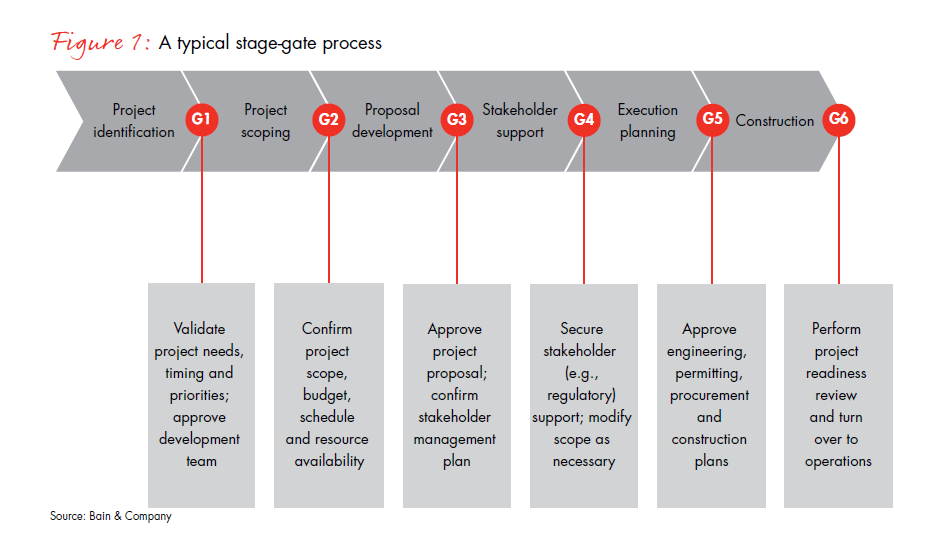
      • Delineate the stage-gate process. Efficient organizations manage smooth transitions from one stage to the next by clearly defining milestones and evaluating each project against consistent criteria, including a reevaluation of the demand that the project aims to meet. Project managers need a clear understanding of the inputs (technical analysis, stakeholder input, regulatory approval) required to satisfy the requirements of each milestone before moving on to the next stage (see Figure 1). And, of course, project managers need realistic measurements of project progress, allowing for an accurate set of forward-looking schedule and cost projections.
      how-utilities-can-succeed-fig-01_embed 

      Unfortunately, these massive projects rarely follow the classic model whereby the cost is established in the early design phases. For example, years into a project, its scope may expand significantly, as regulators and resource agencies demand route changes or additional environmental mitigations. Rigorous scope and cost management, reviewed at each gate, are necessary, but they’re not enough. They must be paired with frequent stakeholder education to maintain support and avoid surprises.


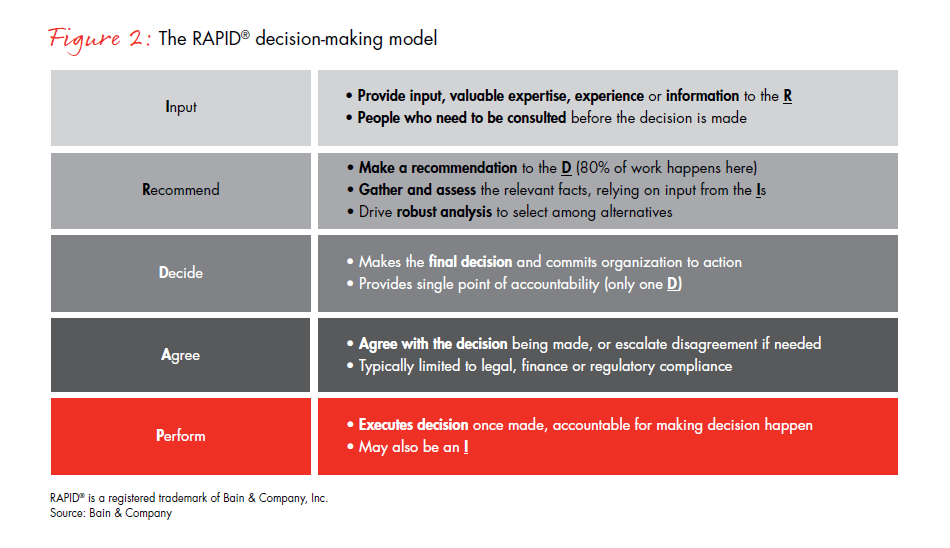
      • Determine how decisions will be made. Projects can only move efficiently from one stage to the next when departments have worked out ahead of time who will be responsible for decisions and how companywide input will be taken under advisement. A decision-making tool, such as Bain’s RAPID® model (recommend, agree, perform, input, decide), can help create a uniform process that provides guidance to decision makers throughout the project (see Figure 2).
      how-utilities-can-succeed-fig-02_embed

      At one utility company, there was a history of slow and contentious decision making, as departments lacked clear guidelines over who had decision rights. To break that pattern, the utility worked through a challenging evaluation in which representatives from each department clearly articulated what decisions were actually needed and what each department’s role was in those decisions. By applying the RAPID model, managers were able to ensure that the right departments had “the D” for the right decisions, while others felt comfortable knowing their voice was heard. The effort produced a decision playbook the company now uses as a reference for major projects. It defines a clear procedure to help remove emotions from important decisions. 


      • Describe the scope of each department’s work. Successful teams also take the time to clearly describe the expectations of each department. Team members need to agree on the level of detail and depth—especially if other departments are relying on that input to inform their own efforts. For example, if one department has provided only desktop analysis while another is out in the field staking structure locations, the discrepancy in detail is bound to create misalignment and, unfortunately, rework. Managers cannot develop a cohesive view of the project, with confidence in the assessment of costs and risk, when components are of unequal fidelity.

      As utilities confront the largest wave of infrastructure investments in a generation, they must enhance their project management capabilities in order to make efficient use of internal and external resources, all while maintaining a positive reputation with regulators and customers. Through our experiences advising utility clients, we have seen that clarifying project selection criteria, specifying decision-making protocol, detailing step-by-step project requirements and outlining team member roles will dramatically improve project team efficiency and help companies move projects more quickly through the pipeline.


      how-utilities-can-succeed-fig-01_full

      how-utilities-can-succeed-fig-02_full
      Authors
      • Headshot of Joe Scalise
        Joe Scalise
        Partner, San Francisco
      Contact us
      Related Industries
      • Advanced Manufacturing & Services
      • Energy & Natural Resources
      • Utilities & Renewables
      Utilities & Renewables
      Business Breakthrough Barometer 2025

      The annual pulse check from leading businesses on the pace of the net-zero transition.

      Read more
      Utilities & Renewables
      Southeast Asia's Green Economy 2025 Report

      Unlocking systems for growth and impact

      Read more
      Utilities & Renewables
      Energy’s Capital Projects Reset: Faster, Smarter, Leaner

      As costs rise and delays abound, executives are rethinking their approaches to capital projects.

      Read more
      Utilities & Renewables
      Business Breakthrough Barometer 2024

      The annual pulse check from leading business on the net zero transition.

      Read more
      Utilities & Renewables
      Five Predictions for the 2030 EV Battery Market

      Which battery chemistries will pull ahead—and how should OEMs proceed?

      Read more
      First published in junio 2012
      Tags
      • Advanced Manufacturing & Services
      • Energy & Natural Resources
      • Utilities & Renewables

      How We've Helped Clients

      An Environmental Services Company Captures Massive Savings from a Merger

      Read case study

      A roadmap for portfolio growth

      Read case study

      Revitalizing a utility's market position with customer loyalty

      Read case study

      Ready to talk?

      We work with ambitious leaders who want to define the future, not hide from it. Together, we achieve extraordinary outcomes.

      Stay ahead in a rapidly changing world. Subscribe to Bain Insights, our monthly look at the critical issues facing global businesses.

      *I have read and understand Bain’s Privacy Notice.

      Please read and agree to the Privacy Policy.
      Bain & Company
      Contact us Sustainability Accessibility Terms of use Privacy Modern Slavery Act Statement Cookie Policy Sitemap Log In

      © 1996-2026 Bain & Company, Inc.

      Contact Bain

      How can we help you?

      • Business inquiry
      • Career information
      • Press relations
      • Partnership request
      • Speaker request
      See all offices