

Brief

Executive Summary
- With unemployment near a 50-year low, workers are harder to find and cost more to keep.
- Many retailers have fallen into a doom loop: They cut labor hours or training to save costs, which undermines the customer experience, leading to lower sales and more cost pressure.
- The fast-changing technology landscape offers retailers new cost-saving options, but not every one helps the customer.
- Winning retailers will empower highly engaged employees while deploying technology that improves the customer experience and manages costs.
A growing US labor shortage puts retailers at risk of disappointing customers with long checkout lines, empty shelves and insufficient coverage on the sales floor. At the same time, retail executives are inundated with headlines on digitalization, as automation threatens to eliminate up to 25% of US jobs in the next decade.
Faced with these conflicting labor trends, how do retail executives decide where to invest? Should they focus on people, or on systems that reduce the need for people? In our view, the right answer is more nuanced: Companies that take a comprehensive approach and employ technology as an asset to an engaged and motivated workforce will win with customers in the long run.
Today’s uphill battle for talent
With unemployment at a near 50-year low, and ride-sharing companies Uber and Lyft drawing more people to drive for extra cash, workers are harder to find and cost more to keep. If companies do not manage rising wages effectively, labor costs as a percentage of revenue could increase by 4 to 6 percentage points, and—absent other changes—wipe out the single-digit operating margins typical in the industry.
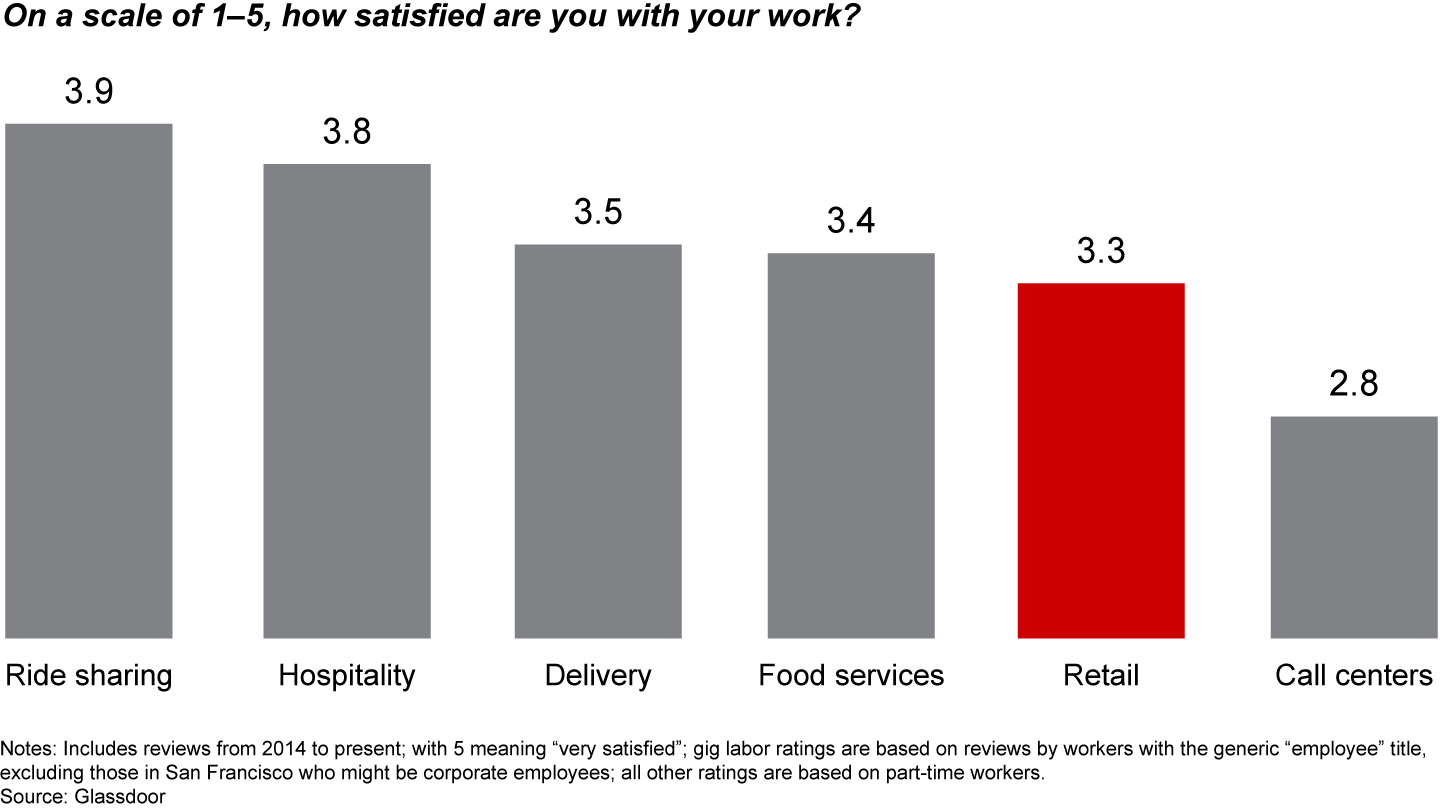
Store labor makes up about half of a retailer’s selling, general and administrative expenses, and many retailers prioritize managing costs over employee effectiveness and loyalty. Fifty percent of retail salespeople in the US earn less than $11.16 per hour, and one-third work part time. Beyond low pay, part-time employees also cite unpredictable schedules and weak management as common frustrations, based on Glassdoor reviews. Those factors have pushed turnover rates for part-time hourly store workers to 81% last year from 76% in 2017. When it comes to employee satisfaction, retail lags ride sharing, hospitality and delivery services (see Figure 1).
Figure 1

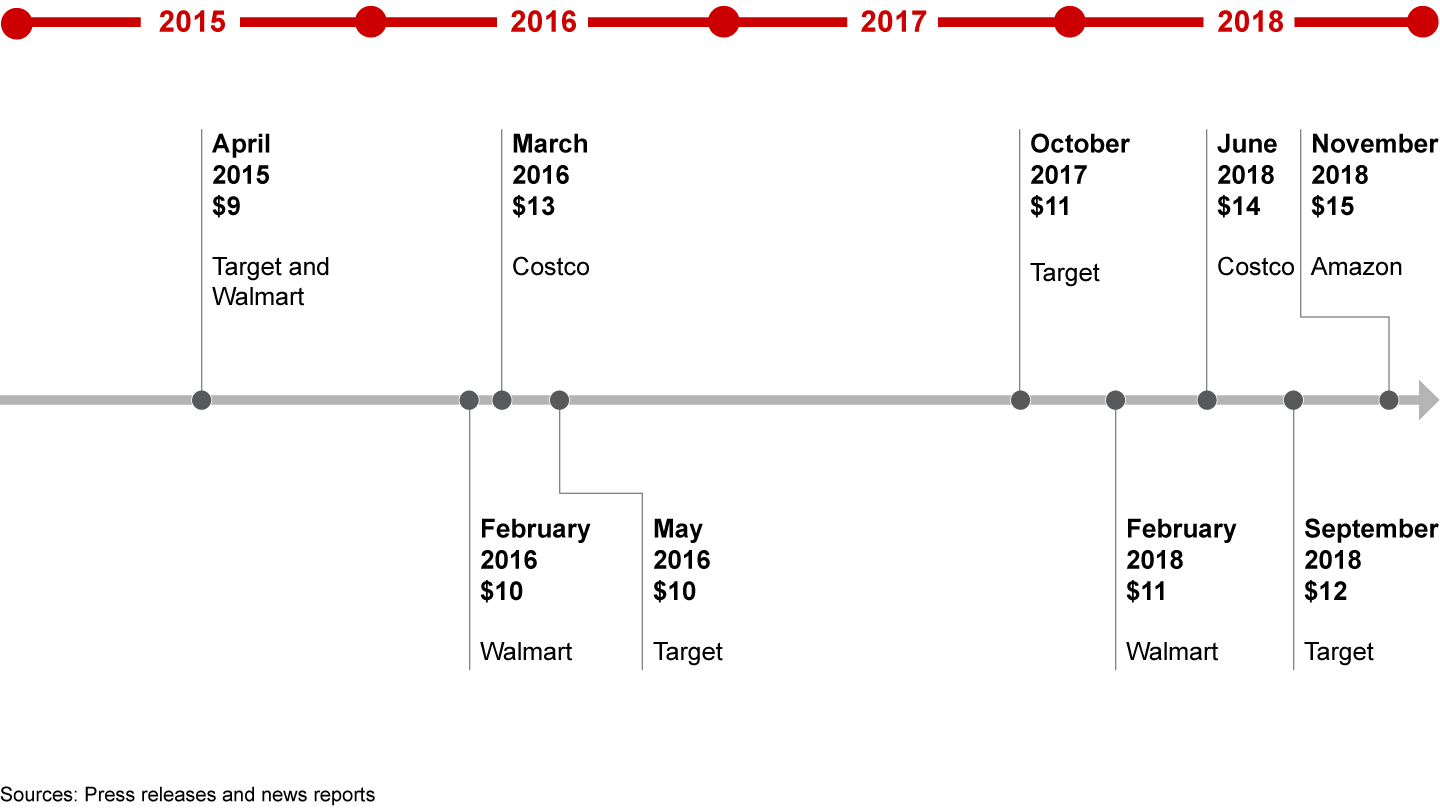
The talent war has forced many retailers to increase pay rates to compete. Retail wages have grown 2.3% annually over the last five years, outpacing inflation by 80 basis points. After the US government cut corporate tax rates, Walmart and Target boosted their hourly base wages to $11 and $12, from $10 and $11, respectively. Amazon made the biggest waves when it raised its hourly minimum to $15, effective November 1 (see Figure 2). Target plans to reach the same mark by 2020. In addition to competitive pressures, wage growth is likely to continue as states and localities take action in the absence of federal legislation. More than five million workers saw their pay increase on January 1, when 19 states enacted higher minimum wages.
Figure 2

Beyond higher pay, retailers are setting themselves apart from the pack by offering more incentives to prospective employees, including:
- Better bonuses and benefits. Sephora boasts bonuses for part-time and seasonal employees, based on company performance. Last year, Best Buy announced four weeks of paid family leave for part-time workers, while Ikea surpassed industry standards in 2016 by offering up to four months. Costco and H&M both provide paid vacation time for part-time employees.
- Substantial employee discounts. Whole Foods gives employees discounts of up to 30% for in-store purchases. Some apparel retailers also promise steep discounts—REI offers up to 50% and Men’s Wearhouse offers up to 55%.
- Unique perks. Apple subsidizes up to $100 a month in transportation costs for all US employees. Beyond the work day, REI workers can apply for “challenge grants” to cover the cost of gear for outdoor goals, from kayaking down the Colorado River to climbing Mount Everest. Starbucks “partners” receive free Spotify Premium accounts to stream music in stores and at home.
- Higher education. Starbucks, Amazon and Walmart are among an increasing number of retailers that provide education assistance for part-time employees. Walmart’s new program, launched in 2018, subsidizes the cost of higher education for an employee contribution of $1 a day.
Win with people, win with customers
Despite improvements in technology and the growth of e-commerce, people are still paramount to retail success. Employees build relationships with customers, providing a human touch that is hard to replace. A survey from Aspect Software found that 50% of UK shoppers prefer to interact with humans alongside technology when shopping in a store. Of course, human interaction requires the right humans; miserable employees can detract from an otherwise positive customer experience.
Providing the memorable experiences that customers will rave about on social media and to their friends demands engaged, even inspired, employees. After all, employees should be a company’s best advocates. Their enthusiasm rubs off on customers, encouraging them to come back and buy more. Return customers propel a company’s growth and reward employees for their efforts, creating a virtuous cycle (see Figure 3).
Figure 3
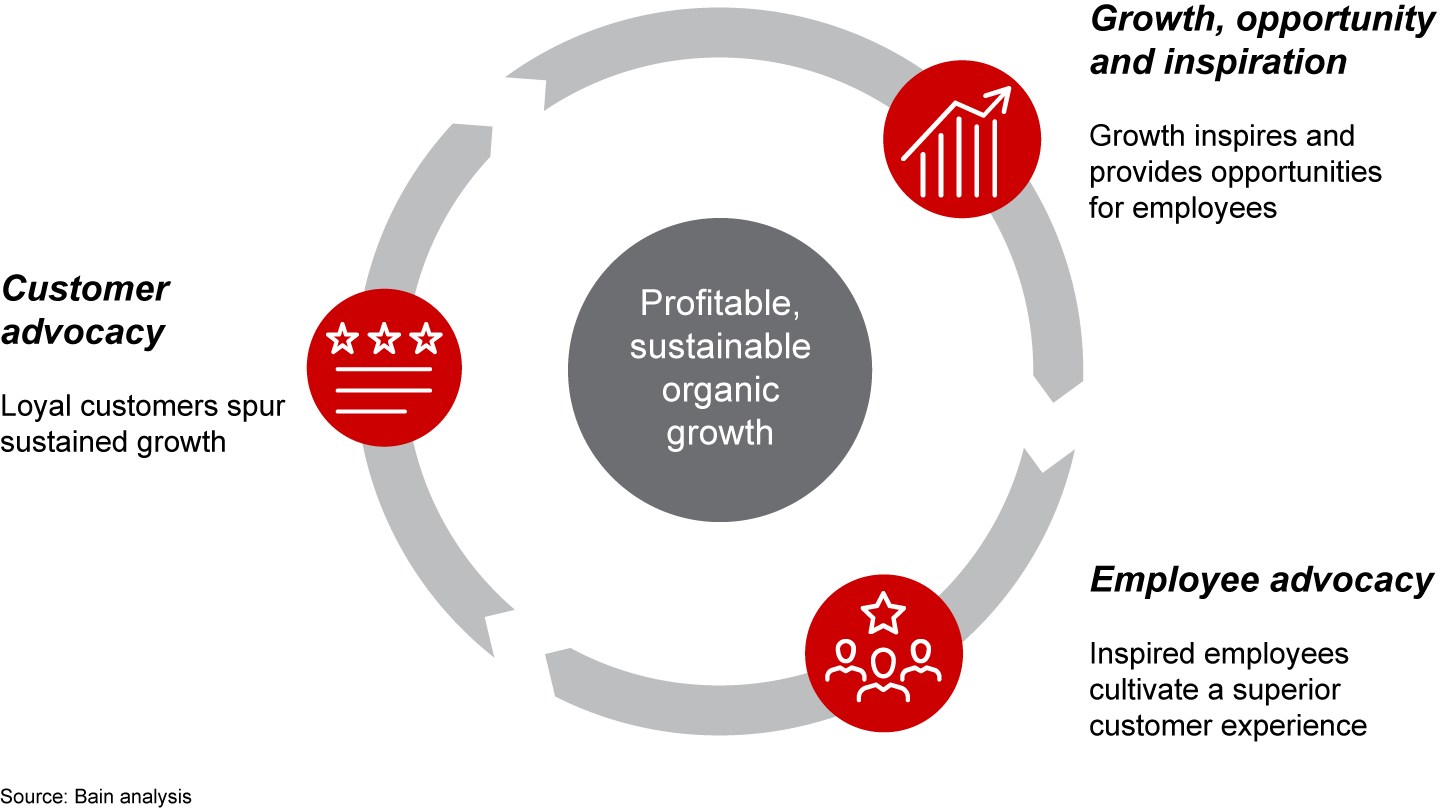

Customers who interact with highly engaged employees are up to 2.6 times more likely to recommend the company, according to a Bain survey. And companies with leading customer advocacy scores grow more than 2.5 times faster than the industry average. Conversely, poor in-store support hurts customer satisfaction and lowers sales, which might prompt a company to cut labor hours or training and further undermine its customer experience. This doom loop is hard to escape.
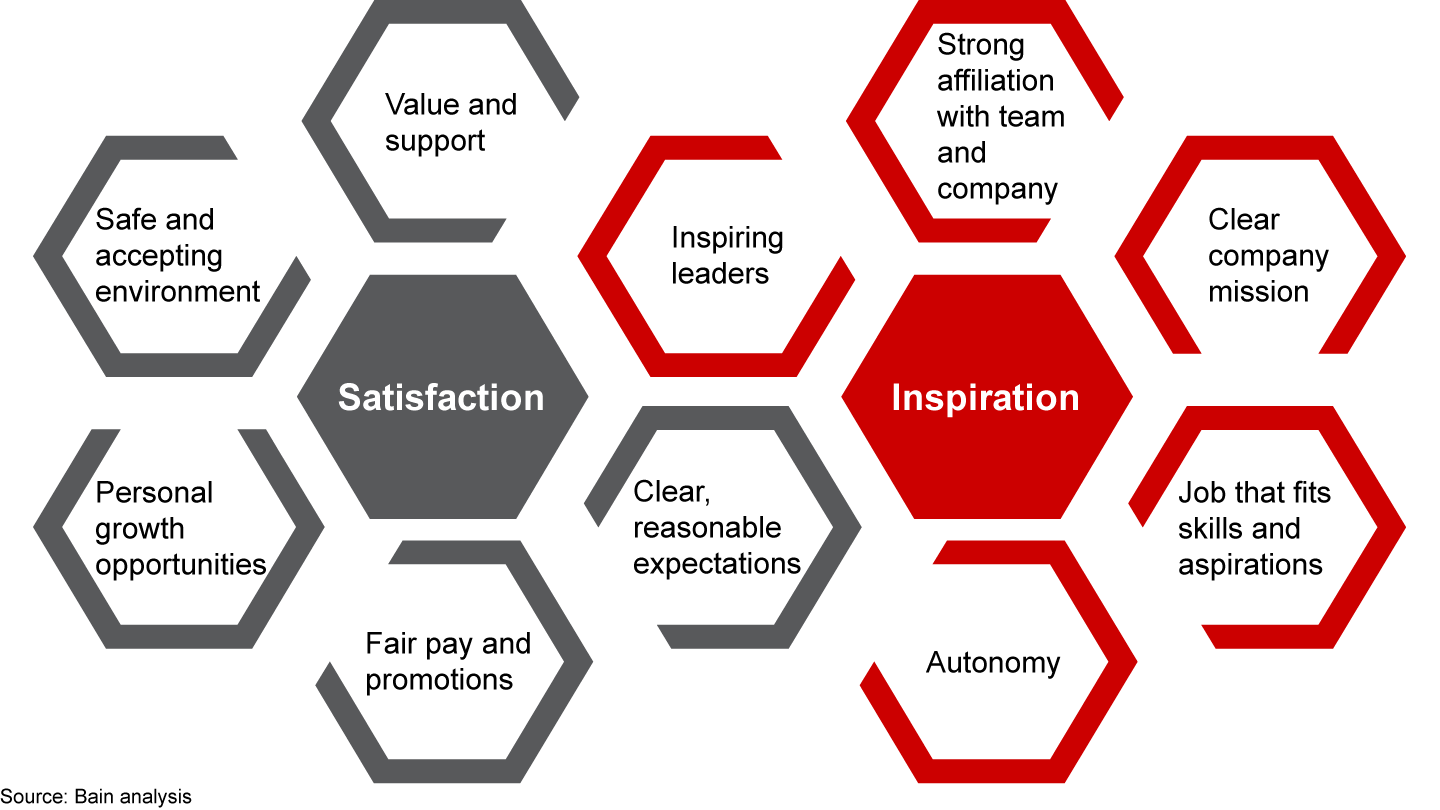
Companies with high employee engagement know how to satisfy and inspire their workforce (see Figure 4). To satisfy their workers, retailers must meet their basic needs for support, clear expectations and fair pay, among other things. That might sound obvious, but retailers have a lot to gain. For example, many retailers rely on erratic scheduling techniques to reduce costs, much to the frustration of part-time employees who must balance their childcare, education or personal lives. Yet a recent study revealed that stable schedules can actually be profitable, increasing both employee productivity and sales. As more cities pass predictive scheduling laws, while companies like Walmart promise consistent scheduling through digital apps for employees, retailers must match their approach to the needs of their workforce.
Moreover, failing to meet employees’ basic needs can increase employee stress and turnover, according to the Good Jobs Institute at the Massachusetts Institute of Technology. The opposite is also true. Consider Costco, whose average hourly wage of $22.50 outstrips the $18.50 average for all retailers. The wholesale retailer also offers store employees subsidized health and dental insurance, access to its retirement savings programs and consistent hours. The approach has satisfied employees and investors alike, with a Glassdoor rating that is 20% higher than those of peers and a return that has doubled the S&P 500 Index since 2013.
Successful retailers go beyond employee satisfaction and inspire their workers to apply their energy, enthusiasm and creativity to delighting customers. These companies build their culture on inspiration, starting with frontline managers. By offering adequate training, professional development opportunities and autonomy, companies can create a cadre of strong leaders to help motivate their workforce. In return, these inspired employees are more likely to create memorable customer experiences and less likely to quit, reducing costly turnover and creating more value for customers and shareholders. The convenience store QuikTrip not only provides detailed feedback on employee and store performance, it encourages staff to find creative ways make customers happy, according to Massachusetts Institute of Technology professor Zeynep Ton, author of The Good Jobs Strategy. The result is a highly motivated workforce that feels empowered to improve the QuikTrip experience. QuikTrip’s voluntary employee turnover rate is less than 15%, significantly lower than the retail average of 60%.
Figure 4

Automation nation
Higher wages, better benefits and more predictable hours win raves from workers’ rights organizations, but those headlines usually tell only part of the story. For most retailers, these investments require hard-to-find funding. To win with people, companies will need to free up funds through meticulous cost evaluation, while enhancing employee effectiveness with digital solutions.
For Amazon, shifts in the labor market strengthen one of the retail giant’s competitive advantages: its use of technology. Amazon is betting that it can automate faster than its competitors. The company last year expanded its use of robots in fulfillment centers by 25% from 2017. It is also increasingly using “machine-driven merchandising,” ordering products automatically based on how fast they sell, vendor compliance metrics and other factors.
Will other retailers be able to keep pace? To compete profitably in an automated future, retailers should use technology to make their workforce more effective. Leadership teams will need to consider both inspiring employees to boost sales, and investing in innovation and process redesign to increase productivity. Many are turning to technology to help find and train employees, automate store operations, and improve warehouse and delivery logistics.
Solutions to find and train employees
Hiring apps simplify recruiting processes. Mobile hiring portals can increasingly screen résumés and manage interviews. Merlin, for example, handles everything from publishing listings to filtering candidates and scheduling interviews for retailers such as T.J. Maxx, Sherwin-Williams and The Vitamin Shoppe. Tools such as Paradox’s Olivia or Google’s Hire app use artificial intelligence to automate aspects of the hiring process. Retailers such as CVS and Staples use Paradox’s Olivia to screen candidates automatically, schedule interviews and even field questions about the job, helping recruiters find better candidates faster.
Virtual reality enhances training. Retailers are using simulations to better prepare employees for real-life situations. In September, Walmart announced it will use virtual reality techniques to train employees for its more than 5,000 stores. Through more than 45 activity-based modules, the retailer plans to provide associates with experiential learning in new technology, customer service and compliance. Lowe’s is also using virtual reality to teach associates how to use in-store equipment, in the hope of improving customer service.
Automating store operations
Digital price tags offer flexibility with less manual effort. Printed price tags historically made it impractical and costly to change prices frequently. Years ago, French grocers wrestling with rising employee wages shifted from printed price tags to digital displays, cutting the high labor costs of changing product prices. With technology prices falling and wage rates increasing, the solutions have only advanced. Start-up Wasteless is using machine learning and electronic labels to dynamically price perishable products, preventing waste and boosting revenues. Beyond the grocery sector, Best Buy has spent $30 million to roll out digital price tags at 20% of its stores. The technology can save the company as much as $10 million of merchandising personnel costs in the first year.
Computer vision aids planogram compliance, shelf restocking and more. Close-range computer vision technology now outperforms human eyes and holds promise as a labor-saving solution for many manual activities. The computer vision company Trax uses image-capturing technology to create digital store aisles, helping retailers audit their inventories and save valuable labor hours. Last year, Alibaba unveiled its Futuremart store concept. At Futuremart, facial recognition cameras identify shoppers when they walk in. As they leave the store, the same cameras confirm their identity and RFID technology registers the items they have in hand. Facial recognition is also streamlining payments. Yum China recently expanded its “smile to pay” technology, which enables payment through facial recognition software, to over 300 KFC stores across China.
Automating in-store pickup desks. While “buy online pick up in store” (BOPIS) options have become more popular, early renditions were often cumbersome and labor-intensive. Consumers usually had to walk into a store, find and notify an employee, then walk to the back of the store and wait for the employee to locate their items. To add convenience, retailers such as Walmart, Dick’s Sporting Goods and Home Depot are using self-service or automation to expedite pickups. Last year, Walmart announced that it will add more than 700 pickup towers, large “vending machines” that retrieve online orders. Walmart is also partnering with Alert Innovation’s Alphabot technology to pilot robotic storage and retrieval to automate order collection. Beyond in-store pickup for customers, integrating these technologies opens the door for Walmart to scale microwarehousing models over the long term.
Improving warehouse and delivery logistics
Robots increase speed. Retailers are further automating distribution centers and processing orders faster. Logistics company XPO, whose clients include Ikea and Zara, said in October that it would deploy 5,000 autonomous robots to help workers fulfill up to 48 orders at once, doubling the processing speed. Cainiao, a Chinese logistics company, opened a 700-robot warehouse to prepare for Alibaba’s Singles Day shopping event on November 11. And Kroger plans to build 20 automated warehouses in the US to fill online grocery orders. The grocer struck an exclusive partnership with Ocado, which has significant experience with robotic customer-fulfillment centers in the UK.
Autonomous vehicles automate last-mile delivery. Moving goods from a transportation hub to their final destination accounts for an estimated 50% of a retailer’s total fulfillment costs. Within this so-called last-mile delivery, people are retailers’ greatest expense. Several retailers are already experimenting with autonomous vehicles, including cars and drones, to cut delivery times. Late last year, Kroger began deploying autonomous vehicles to deliver same-day and next-day orders in Arizona through a partnership with the start-up Nuro. Domino’s Pizza and 7-Eleven are working with Flirtey, which conducted the first drone delivery approved by the Federal Aviation Administration, to deliver food and drinks quickly, even during rush hour.
While these technologies offer great promise, they also present executives with difficult decisions. Does the expected benefit justify the significant capital expenditure? Can the organization handle the change management required? Will this version of the technology stick or will it be outdated in two years? Is it better to build or to buy? And while the possibilities are endless, wallets have limits.
Six questions to evaluate your labor strategy
Despite the uncertainty, leading retailers will not sit on the sidelines. They will continue investing in people to improve both the customer and employee experience. Investments in wages, training and tools will require sufficient funding, and winning retailers will rigorously evaluate cost to ensure that every dollar works toward their priorities. With increased funding, they will take a measured approach to testing, scaling ideas that work and learning from those that do not. They will develop a clear strategy and strong execution plan with game-changing innovations.
To win in the future, retailers should begin by evaluating their current people strategy. We recommend that executives ask themselves the following questions to determine where the company stands and how to get started.
- Why do our customers shop with us? Every retailer must know who their customers are, what they care about, how they engage across shopping journeys, the unique value proposition the retailer offers them and how the company competes with its peers. This perspective helps retailers identify experiences that should be physical rather than digital, and when to be best in class vs. best in cost.
- Do our employees feel satisfied and inspired? Leading companies consider their employees their biggest investment and constantly look for ways to motivate them. Putting this into practice requires companies to create a strong employee culture, which does not happen overnight. Retailers should consider providing competitive compensation, finding low-cost ways to delight the workforce and updating policies to show employees that they are trusted and valued.
- Does headquarters make decisions with employees and customers in mind? Strategic choices can have a high impact on labor. Leading retailers consider the integrated system and align decision making across merchandising, supply chain and marketing. They manage activities and ensure ease of execution through changes in such things as product mix, delivery, prices and shelf planning.
- Have we unlocked the full potential of our employees? Many employees spend too much time on activities that the customer does not value, or they lack the tools to succeed. Opportunities to increase revenue or decrease costs often succumb to complex processes or inadequate technology. Solutions start with simplification. Zero-basing what your company does and how it does it can reveal processes that you can streamline, eliminate or automate.
- Do we have an effective customer experience system in place? Successful companies never stop innovating customer experiences. They innovate the business processes that enable those experiences. And they innovate the tools and technologies that power the business processes that enable those experiences. They engage the entire organization in serving the customer. They listen and act on ideas, managing change to achieve results.
- Have we rooted out inefficiencies in other parts of the P&L to fund promising technology and people investments? With typical retail operating margins in the mid-single digits, finding investment dollars in an uncertain economy may be difficult. But given that Amazon spent over 10% of its revenue on IT in 2017 (vs. the average retailer’s less than 2%) and raised its minimum wage to $15 in 2018, companies will need to reinvent their cost structure to keep pace.
Kent Knudson and Karl Zimmermann are partners in Bain & Company’s Retail practice. They are based in Chicago and Boston, respectively. Michael Brookshire is a partner in the Dallas office, and leads Bain’s work in Service Design & Operations in the Americas. Aaron Cheris leads Bain’s Retail practice in the Americas and is based in San Francisco.
First published in marzo 2019