
Skip to Content
  • Offices

    Offices

    North & Latin America
    • Atlanta
    • Austin
    • Bogota
    • Boston
    • Buenos Aires
    • Chicago
    • Dallas
    • Denver
    • Houston
    • Los Angeles
    • Mexico City
    • Minneapolis
    • Monterrey
    • Montreal
    • New York
    • Rio de Janeiro
    • San Francisco
    • Santiago
    • São Paulo
    • Seattle
    • Silicon Valley
    • Toronto
    • Washington, DC
    Europe & Africa
    • Amsterdam
    • Athens
    • Berlin
    • Brussels
    • Copenhagen
    • Dusseldorf
    • Frankfurt
    • Helsinki
    • Istanbul
    • Johannesburg
    • Kyiv
    • Lisbon
    • London
    • Madrid
    • Milan
    • Munich
    • Oslo
    • Paris
    • Rome
    • Stockholm
    • Vienna
    • Warsaw
    • Zurich
    Middle East
    • Doha
    • Dubai
    • Riyadh
    Asia & Australia
    • Bangkok
    • Beijing
    • Bengaluru
    • Brisbane
    • Ho Chi Minh City
    • Hong Kong
    • Jakarta
    • Kuala Lumpur
    • Manila
    • Melbourne
    • Mumbai
    • New Delhi
    • Perth
    • Shanghai
    • Singapore
    • Sydney
    • Tokyo
    See all offices
  • Alumni
  • Media Center
  • Subscribe
  • Contact
  • Spain | Español

    Select your region and language

    Global
    • Global (English)
    North & Latin America
    • Brazil (Português)
    • Argentina (Español)
    • Canada (Français)
    • Chile (Español)
    • Colombia (Español)
    Europe, Middle East, & Africa
    • France (Français)
    • DACH Region (Deutsch)
    • Italy (Italiano)
    • Spain (Español)
    • Greece (Elliniká)
    Asia & Australia
    • China (中文版)
    • Korea (한국어)
    • Japan (日本語)
  • Saved items (0)
    Saved items (0)

    You have no saved items.

    Bookmark content that interests you and it will be saved here for you to read or share later.

    Explore Bain Insights
  • Industries
    Main menu

    Industries

    • Aeroespacial y Defensa
    • Agroindustria
    • Químicos
    • Construcción e Infraestructura
    • Productos de Consumo
    • Servicios Financieros
    • Salud y Ciencias de la Vida
    • Maquinaria y Equipo Industrial
    • Medios y Entretenimiento
      Industries
      Medios y Entretenimiento
      • Media Lab
    • Metales
    • Minería
    • Petróleo y Gas
    • Papel y Empaque
    • Private Equity
      Industries
      Private Equity
      • Due Diligence
      • Exit Planning
      • Firm Strategy & Operations
      • Portfolio Value Creation
    • Sector Público y Social
    • Retail
    • Tecnología
    • Telecomunicaciones
      Industries
      Telecomunicaciones
      • Capital Expenditure
      • Telco Digital Transformation
    • Transporte
    • Viajes y Turismo
    • Servicios Públicos y Energías Renovables
  • Consulting Services
    Main menu

    Consulting Services

    • Customer Experience
    • Sustainability
    • Innovation
    • M&A
    • Operations
    • People & Organization
    • Private Equity
    • Sales & Marketing
    • Strategy
    • AI, Insights, and Solutions
    • Technology
    • Transformation
  • Digital
  • Insights
    Main menu

    Insights

    • Industry Insights
    • Services Insights
    • Bain Books
    • Webinars
    • Bain Futures
    View all Insights
    Featured topics
    • Tariff Response
    • Artificial Intelligence
    • Thriving in Uncertainty
    • Executive Conversations
    • Macro Trends
    • M&A Report
    • Healthcare Private Equity Report
    • Paper & Packaging Report
    • Technology Report
    • CEO's Guide to Sustainability
    • CEO Insights
    • CFO Insights
    • COO Insights
    • CIO Insights
    • CMO Insights
    View all featured topics
  • About
    Main menu

    About

    • What We Do
    • What We Believe
    • Our People & Leadership
    • Client Results
    • Awards & Recognition
    • Global Affiliations
    Further: Our global responsibility
    • Sustainability
    • Social Impact
    • World Economic Forum
    Learn more about Further
  • Carreras
    Main menu

    Carreras

    • Trabaja con Nosotros
      Carreras
      Trabaja con Nosotros
      • Find Your Place
      • Nuestras Áreas de Trabajo
      • Equipos Integrados
      • Estudiantes
      • Internships & Programs
      • Eventos de Reclutamiento
    • La Vida en Bain
      Carreras
      La Vida en Bain
      • Historias Profesionales
      • Nuestra Gente
      • Dónde Trabajamos
      • Apoyando tu Crecimiento
      • Grupos de Afinidad
      • Beneficios
    • Impact Stories
    • Nuestro Proceso
      Carreras
      Nuestro Proceso
      • Qué Esperar
      • Entrevistas
    FIND JOBS
  • Offices
    Main menu

    Offices

    • North & Latin America
      Offices
      North & Latin America
      • Atlanta
      • Austin
      • Bogota
      • Boston
      • Buenos Aires
      • Chicago
      • Dallas
      • Denver
      • Houston
      • Los Angeles
      • Mexico City
      • Minneapolis
      • Monterrey
      • Montreal
      • New York
      • Rio de Janeiro
      • San Francisco
      • Santiago
      • São Paulo
      • Seattle
      • Silicon Valley
      • Toronto
      • Washington, DC
    • Europe & Africa
      Offices
      Europe & Africa
      • Amsterdam
      • Athens
      • Berlin
      • Brussels
      • Copenhagen
      • Dusseldorf
      • Frankfurt
      • Helsinki
      • Istanbul
      • Johannesburg
      • Kyiv
      • Lisbon
      • London
      • Madrid
      • Milan
      • Munich
      • Oslo
      • Paris
      • Rome
      • Stockholm
      • Vienna
      • Warsaw
      • Zurich
    • Middle East
      Offices
      Middle East
      • Doha
      • Dubai
      • Riyadh
    • Asia & Australia
      Offices
      Asia & Australia
      • Bangkok
      • Beijing
      • Bengaluru
      • Brisbane
      • Ho Chi Minh City
      • Hong Kong
      • Jakarta
      • Kuala Lumpur
      • Manila
      • Melbourne
      • Mumbai
      • New Delhi
      • Perth
      • Shanghai
      • Singapore
      • Sydney
      • Tokyo
    See all offices
  • Alumni
  • Media Center
  • Subscribe
  • Contact
  • Spain | Español
    Main menu

    Select your region and language

    • Global
      Select your region and language
      Global
      • Global (English)
    • North & Latin America
      Select your region and language
      North & Latin America
      • Brazil (Português)
      • Argentina (Español)
      • Canada (Français)
      • Chile (Español)
      • Colombia (Español)
    • Europe, Middle East, & Africa
      Select your region and language
      Europe, Middle East, & Africa
      • France (Français)
      • DACH Region (Deutsch)
      • Italy (Italiano)
      • Spain (Español)
      • Greece (Elliniká)
    • Asia & Australia
      Select your region and language
      Asia & Australia
      • China (中文版)
      • Korea (한국어)
      • Japan (日本語)
  • Saved items  (0)
    Main menu
    Saved items (0)

    You have no saved items.

    Bookmark content that interests you and it will be saved here for you to read or share later.

    Explore Bain Insights
  • Industries
    • Industries

      • Aeroespacial y Defensa
      • Agroindustria
      • Químicos
      • Construcción e Infraestructura
      • Productos de Consumo
      • Servicios Financieros
      • Salud y Ciencias de la Vida
      • Maquinaria y Equipo Industrial
      • Medios y Entretenimiento
      • Metales
      • Minería
      • Petróleo y Gas
      • Papel y Empaque
      • Private Equity
      • Sector Público y Social
      • Retail
      • Tecnología
      • Telecomunicaciones
      • Transporte
      • Viajes y Turismo
      • Servicios Públicos y Energías Renovables
  • Consulting Services
    • Consulting Services

      • Customer Experience
      • Sustainability
      • Innovation
      • M&A
      • Operations
      • People & Organization
      • Private Equity
      • Sales & Marketing
      • Strategy
      • AI, Insights, and Solutions
      • Technology
      • Transformation
  • Digital
  • Insights
    • Insights

      • Industry Insights
      • Services Insights
      • Bain Books
      • Webinars
      • Bain Futures
      View all Insights
      Featured topics
      • Tariff Response
      • Artificial Intelligence
      • Thriving in Uncertainty
      • Executive Conversations
      • Macro Trends
      • M&A Report
      • Healthcare Private Equity Report
      • Paper & Packaging Report
      • Technology Report
      • CEO's Guide to Sustainability
      • CEO Insights
      • CFO Insights
      • COO Insights
      • CIO Insights
      • CMO Insights
      View all featured topics
  • About
    • About

      • What We Do
      • What We Believe
      • Our People & Leadership
      • Client Results
      • Awards & Recognition
      • Global Affiliations
      Further: Our global responsibility
      • Sustainability
      • Social Impact
      • World Economic Forum
      Learn more about Further
  • Carreras
    Popular Searches
    • Agile
    • Digital
    • Strategy
    Your Previous Searches
      Recently Visited Pages

      Content added to saved items

      Saved items (0)

      Removed from saved items

      Saved items (0)

      The Visionary CEO’s Guide to Sustainability

      All Together Now: Partnerships Are Key to Circularity

      All Together Now: Partnerships Are Key to Circularity

      Broad alliances help circular businesses increase revenues and gain new customers.

      By Hernan Saenz, Joshua Hinkel, Tessa Bysong, Xavier Houot, and Simone Doms

      • min read
      }

      Report

      All Together Now: Partnerships Are Key to Circularity
      en
      Executive Summary
      • Circular partnerships speed access to market knowledge and sources of circular feedstocks.
      • More than 90% of companies with a circularity initiative have at least one partnership, according to a Bain survey.
      • Artificial intelligence can help extend a product’s useful life by determining when it needs repair or service.

      This article is part of Bain's 2024 CEO Sustainability Guide

      EXPLORE THE REPORT

      Many businesses recognize the power of circularity to shape the next economic era. Circular business models will enhance operational resilience, give rise to new markets, and offer a competitive edge in a world of limited resources. But most leadership teams are still uncertain about how to deliver on that promise. 

      Partnerships are vital to a successful circular strategy. They provide the knowledge and materials to design a circular business model. They can also lower production costs, create economies of scale, and enhance consumer loyalty. In a 2022 Bain & Company survey, 94% of respondents who said their company had a circularity initiative had at least one circular partnership. 

      Companies can develop in-house capabilities to manage a circular business model, but partnerships may offer a faster and more cost-effective approach. They speed access to market knowledge, lower the cost of circular materials, and help guide the policies and standards needed for a mass market in circular goods and services.  

      Partnerships will need to evolve quickly to include a wider range of stakeholders and companies beyond linear value chains. These alliances may comprise companies from diverse industries and even competitors. Cross-industry coalitions can help businesses agree on how to share the revenues, costs, and risks of circular business models. As more companies go circular, partnerships will expand into multi-stakeholder coalitions or circular ecosystems.

      Sources of value

      Companies can create value from circular processes in three different ways. The first involves reducing virgin material consumption by using recycled feedstock or redesigning products to reduce material needs. The second source of value is based on increasing a product’s useful life span through repair, refurbishing, and remanufacturing services. And the third focuses on transforming high-value products to services to increase capacity utilization. Leadership teams may forge a circular business model around one or more of these sources of circular value. Each industry will use the model that is best adapted to its needs.

      Partnerships will differ depending on the type of circular value sought. Companies may collaborate in seeking access to circular feedstocks, for example, or to refurbish products and extend their life. Others may partner to reinvent products as services that reduce resource consumption. In our experience, companies start with vertical partnerships and industry coalitions since they help pave the way for industry standards.

      An important step in building a circular business model is identifying the control points in the value chain and inflection points (see Figure 1). Control points include both material flows, such as access to circular feedstocks, and information flows, such as how to identify goods for repair or disposal. In the chemicals industry, for example, where recycled feedstock is in short supply, collection and sorting facilities for plastic waste are a vital control point.

      Figure 1
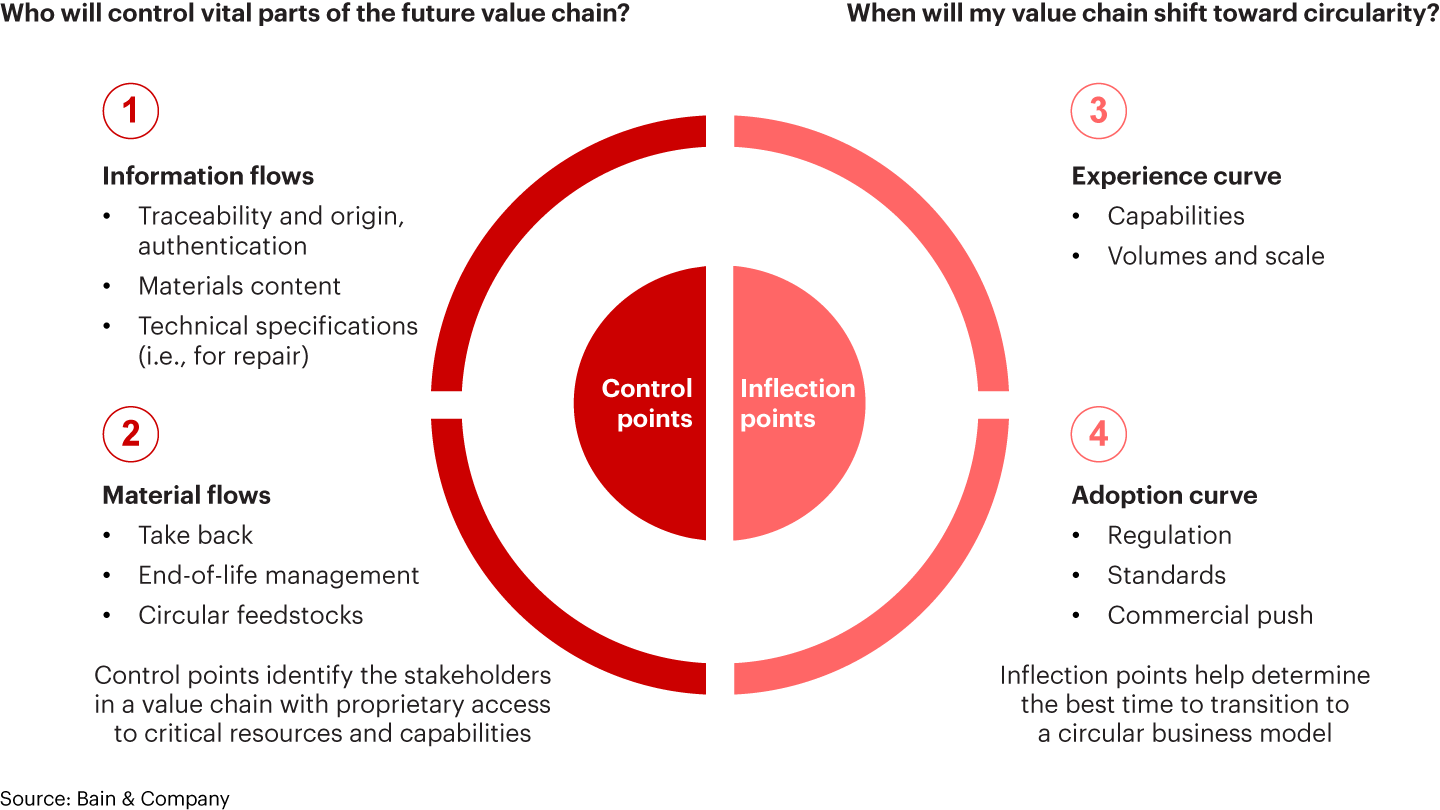
      Control points and inflection points help companies manage the transition to circular business models

      Inflection points include the factors that can make circular goods cost-competitive, increase consumer confidence in refurbished products, and create demand for new circular offerings.

      Successful partnerships help companies gain access to control points and understand how circular products can best compete with linear equivalents.

      Circular feedstocks

      The challenge with circular feedstocks is that demand often rapidly outstrips supply. Firms seeking circular feedstocks for plastics, textiles, or metals, for example, have already encountered those limits. One reason for feedstock scarcity is the lack of recycling technologies that are economically viable at scale. Another is the lack of affordable and accessible waste that can be used as feedstock.

      To develop large quantities of sustainable inputs, leading companies are partnering with those who have access to end-of-life material and the ability to generate value from reusing it. Partners can recycle materials either through traditional mechanical means or via emerging advanced chemical recycling capabilities that process hard-to-recycle plastics such as flexible films or thermoplastics.

      Dow Chemical and Freepoint Eco-Systems, for example, recently teamed up to increase the supply of circular feedstock for Dow. Under their agreement, Freepoint will build an advanced plastics recycling facility in Arizona that can provide Dow with approximately 65,000 metric tons of pyrolysis oil per year. Dow will use the pyrolysis oil to produce new virgin-grade equivalent plastics suitable for food packaging as well as medical and pharmaceutical packaging.

      Extending product life span

      Partnerships are also key to extending the useful life of products. Maintenance and service providers, for instance, have knowledge about common failure points and how to design products for easier upgrades. A partner may also supply critical data flows, including traceability of products and components, telemetrics (enabled by the Internet of Things), and predictive maintenance to determine when a product needs repair, upgrade, or refurbishment. Companies may connect products to their own cloud service or that of a partner and use artificial intelligence to improve performance and uptime. The data generated can increase customer confidence in refurbished products, accelerating adoption.

      Take the case of Apple, which extends the lifetime of its iPhones and other devices by offering certified refurbished products with Apple replacement parts and a one-year limited warranty. In China, Apple has two partners for recycling devices: Foxconn subsidiary iFengPai and ATRenew, the country’s largest secondhand consumer electronics service company.

      Since Apple launched its trade-in program in 2013, the secondary market for refurbished products has become a major source of profit and an environmental win (see Figure 2). Apple’s share of the global market for refurbished phones in 2022 rose to 49%, and the company sent 12.2 million devices and accessories to new owners for reuse in 2021, extending their lifetime and reducing the need for new virgin material. That strategy has helped Apple gain access to a larger customer base, particularly in countries and regions where lower-priced competitors are the market leaders.

      Figure 2
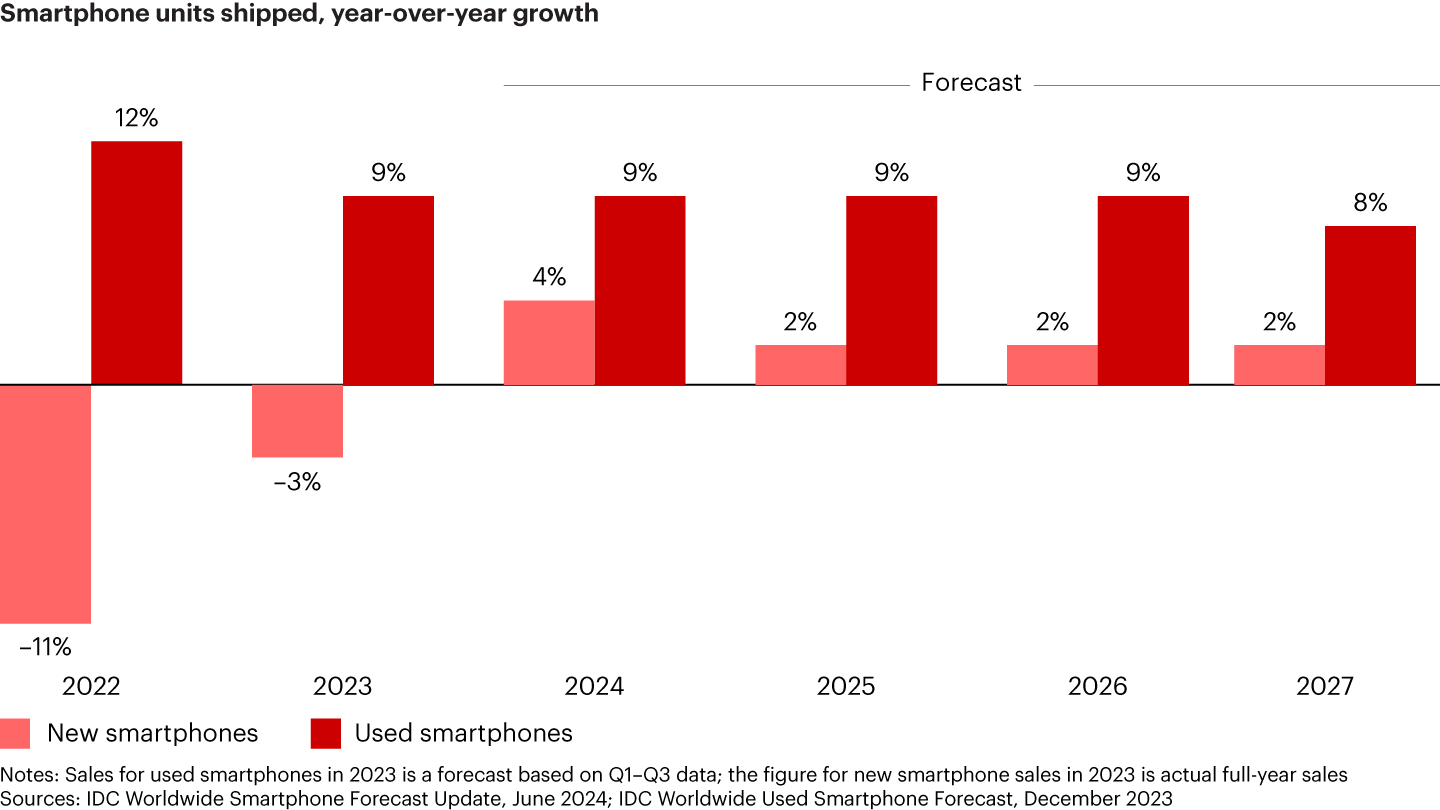
      Used smartphones outpace new smartphones in unit sales growth

      Transforming products into services

      Partnerships play a similarly important role in reinventing business models and transforming products into shared services. Companies that move to service-based business models often forge collaborations with financial partners and use software and AI solutions to maintain products at their optimum performance level for the longest possible time.

      In 2023, mobility company Lynk & Co partnered with used car auctioneer BCA Europe to increase the life span of Lynk’s cars by reselling them in the used car market. Lynk offers its members easy access to a car as a flexible, month-to-month service. After customers return their vehicles, Lynk inspects and reconditions them before BCA Europe seeks a buyer. The partnership, which covers seven European markets, helps increase the lifetime of each vehicle. 

      The shift to shared services can create new markets. German machinery maker The Trumpf Group and insurer Munich Re partnered in 2020 to develop an innovative business model for laser-cutting machine services. Instead of having to buy or lease laser equipment, Trumpf customers pay an agreed price for each cut sheet metal part, so the expenditure on equipment is tied directly to business need. 

      The pay-per-part model offers customers financial flexibility, allowing them to avoid significant capital expenditures on machinery and react faster to market changes. Trumpf remains the legal owner of the machine and takes care of all maintenance, repairs, production planning, and programming. Munich Re finances the machine and bears the investment risk.

      Though pay-per-part contracts represent less than 1% of Trumpf’s total business today, they are a win-win for the company and its customers. Under pay-per-part contracts, Trumpf sends its own engineers and mechanics to customers, who, in turn, can focus on their core business. The arrangement provides Trumpf with valuable data on the performance of its machines. Overall, the pay-per-part contracts enable Trumpf engineers to manage material use more efficiently, reducing carbon dioxide emissions by up to 65%. After 8 to 10 years, Trumpf takes back the machines and refurbishes them or reuses selected parts.

      Circular ecosystems

      Over time, industry partnerships are likely to evolve into broad ecosystems that stretch beyond a company’s value chain. These alliances will bring together all the parties needed to ensure that those who have access to feedstocks connect efficiently with those who can recycle them. They also will help shape industry standards and accelerate cost reduction over time.

      Already, companies are joining together in industry coalitions to lay the precompetitive foundation for circular business models. The Global Battery Alliance, for example, is working to scale a sustainable battery value chain and has more than 160 member organizations, including Tesla, BASF, Microsoft, and Volkswagen. The alliance has created a “battery passport” as a standard to increase transparency and accountability along the battery value chain. The passport, a digital twin of the physical battery, provides standardized data on the provenance of raw materials, manufacturing history, sustainability performance (such as carbon footprint), and recycling. The aim of the passport is to increase consumer confidence in electric batteries with trusted data on sustainability and performance.

      Companies in every industry are working together in new and more interconnected ways to lay the foundations for circular business models. Partnerships will exist both within a business’s value chain and outside of it. Leadership teams that start forging these vital alliances now will be best positioned to prosper as the transition to a more sustainable economy accelerates.

      Read the Next Section

      Faster by Design: New Models for Financing the Food Transition 

      Read our 2024 CEO Sustainability Guide

      EXPORE THE REPORT DOWNLOAD THE PDF

      More from the report

      • Four Questions for Every CEO

      • What Consumers Want

      • Selling Sustainability in B2B

      • Accelerating Decarbonization

      • AI and Sustainability

      • Voice of the CFO

      • Energy

      • Circularity

      • Food

      Authors
      • Headshot of Hernan Saenz
        Hernan Saenz
        Partner, Dallas
      • Headshot of Joshua Hinkel
        Joshua Hinkel
        Partner, Dallas
      • Headshot of Tessa Bysong
        Tessa Bysong
        Alumni, Chicago
      • Headshot of Xavier Houot
        Xavier Houot
        Partner, Paris
      • Headshot of Simone Doms
        Simone Doms
        Practice Director, Munich
      Contact us
      Related Industries
      • Advanced Manufacturing & Services
      Related Consulting Services
      • Operations
      • Strategy
      • Supply Chain
      • Sustainability
      How We Can Help
      • Circular Economy
      CEO's Guide to Sustainability
      How CEOs Can Turn Decarbonization Setbacks into Progress

      Successful companies are establishing a strong business case and then collaborating across the value chain.

      Read more
      CEO's Guide to Sustainability
      How to Master the Art of Selling Sustainability

      Our survey of 500 B2B buyers and sellers shows a widening chasm on sustainability. A new industrial sales model is needed to close this buy-sell gap.

      Read more
      Advanced Manufacturing & Services
      Technology in Building Products: Turn Cost into Value

      Bain experts reveal how companies in the building products industry are unlocking growth with bold tech investments.

      Read more
      Advanced Manufacturing & Services
      Sustainability: Less Talk and More Action

      Despite elusive targets, the business case is stronger than ever.

      Read more
      COO insights
      How AI Is Starting to Transform Circular Packaging

      There are 15 AI use cases companies across the value chain can use today to accelerate circularity.

      Read more
      First published in septiembre 2024
      Tags
      • Advanced Manufacturing & Services
      • CEO's Guide to Sustainability
      • Circular Economy
      • COO insights
      • Operations
      • Strategy
      • Supply Chain
      • Sustainability

      How We've Helped Clients

      Supply Chain Security Mitigates a Sovereign Wealth Fund’s Construction Disruptions

      Read case study

      How an Airline Used a Global Stall to Give Procurement a Lift

      Read case study

      An auctioneer makes a winning online bid

      Read case study

      Ready to talk?

      We work with ambitious leaders who want to define the future, not hide from it. Together, we achieve extraordinary outcomes.

      Stay ahead in a rapidly changing world. Subscribe to Bain Insights, our monthly look at the critical issues facing global businesses.

      *I have read and understand Bain’s Privacy Notice.

      Please read and agree to the Privacy Policy.
      Bain & Company
      Contact us Sustainability Accessibility Terms of use Privacy Modern Slavery Act Statement Cookie Policy Sitemap Log In

      © 1996-2026 Bain & Company, Inc.

      Contact Bain

      How can we help you?

      • Business inquiry
      • Career information
      • Press relations
      • Partnership request
      • Speaker request
      See all offices