
Skip to Content
  • Offices

    Offices

    North & Latin America
    • Atlanta
    • Austin
    • Bogota
    • Boston
    • Buenos Aires
    • Chicago
    • Dallas
    • Denver
    • Houston
    • Los Angeles
    • Mexico City
    • Minneapolis
    • Monterrey
    • Montreal
    • New York
    • Rio de Janeiro
    • San Francisco
    • Santiago
    • São Paulo
    • Seattle
    • Silicon Valley
    • Toronto
    • Washington, DC
    Europe & Africa
    • Amsterdam
    • Athens
    • Berlin
    • Brussels
    • Copenhagen
    • Dusseldorf
    • Frankfurt
    • Helsinki
    • Istanbul
    • Johannesburg
    • Kyiv
    • Lisbon
    • London
    • Madrid
    • Milan
    • Munich
    • Oslo
    • Paris
    • Rome
    • Stockholm
    • Vienna
    • Warsaw
    • Zurich
    Middle East
    • Doha
    • Dubai
    • Riyadh
    Asia & Australia
    • Bangkok
    • Beijing
    • Bengaluru
    • Brisbane
    • Ho Chi Minh City
    • Hong Kong
    • Jakarta
    • Kuala Lumpur
    • Manila
    • Melbourne
    • Mumbai
    • New Delhi
    • Perth
    • Shanghai
    • Singapore
    • Sydney
    • Tokyo
    See all offices
  • Alumni
  • Media Center
  • Subscribe
  • Contact
  • Spain | Español

    Select your region and language

    Global
    • Global (English)
    North & Latin America
    • Brazil (Português)
    • Argentina (Español)
    • Canada (Français)
    • Chile (Español)
    • Colombia (Español)
    Europe, Middle East, & Africa
    • France (Français)
    • DACH Region (Deutsch)
    • Italy (Italiano)
    • Spain (Español)
    • Greece (Elliniká)
    Asia & Australia
    • China (中文版)
    • Korea (한국어)
    • Japan (日本語)
  • Saved items (0)
    Saved items (0)

    You have no saved items.

    Bookmark content that interests you and it will be saved here for you to read or share later.

    Explore Bain Insights
  • Industries
    Main menu

    Industries

    • Aeroespacial y Defensa
    • Agroindustria
    • Químicos
    • Construcción e Infraestructura
    • Productos de Consumo
    • Servicios Financieros
    • Salud y Ciencias de la Vida
    • Maquinaria y Equipo Industrial
    • Medios y Entretenimiento
      Industries
      Medios y Entretenimiento
      • Media Lab
    • Metales
    • Minería
    • Petróleo y Gas
    • Papel y Empaque
    • Private Equity
      Industries
      Private Equity
      • Due Diligence
      • Exit Planning
      • Firm Strategy & Operations
      • Portfolio Value Creation
    • Sector Público y Social
    • Retail
    • Tecnología
    • Telecomunicaciones
      Industries
      Telecomunicaciones
      • Capital Expenditure
      • Telco Digital Transformation
    • Transporte
    • Viajes y Turismo
    • Servicios Públicos y Energías Renovables
  • Consulting Services
    Main menu

    Consulting Services

    • Customer Experience
    • Sustainability
    • Innovation
    • M&A
    • Operations
    • People & Organization
    • Private Equity
    • Sales & Marketing
    • Strategy
    • AI, Insights, and Solutions
    • Technology
    • Transformation
  • Digital
  • Insights
    Main menu

    Insights

    • Industry Insights
    • Services Insights
    • Bain Books
    • Webinars
    • Bain Futures
    View all Insights
    Featured topics
    • Tariff Response
    • Artificial Intelligence
    • Thriving in Uncertainty
    • Executive Conversations
    • Macro Trends
    • M&A Report
    • Healthcare Private Equity Report
    • Paper & Packaging Report
    • Technology Report
    • CEO's Guide to Sustainability
    • CEO Insights
    • CFO Insights
    • COO Insights
    • CIO Insights
    • CMO Insights
    View all featured topics
  • About
    Main menu

    About

    • What We Do
    • What We Believe
    • Our People & Leadership
    • Client Results
    • Awards & Recognition
    • Global Affiliations
    Further: Our global responsibility
    • Sustainability
    • Social Impact
    • World Economic Forum
    Learn more about Further
  • Carreras
    Main menu

    Carreras

    • Trabaja con Nosotros
      Carreras
      Trabaja con Nosotros
      • Find Your Place
      • Nuestras Áreas de Trabajo
      • Equipos Integrados
      • Estudiantes
      • Internships & Programs
      • Eventos de Reclutamiento
    • La Vida en Bain
      Carreras
      La Vida en Bain
      • Blog: Inside Bain
      • Historias Profesionales
      • Nuestra Gente
      • Dónde Trabajamos
      • Apoyando tu Crecimiento
      • Grupos de Afinidad
      • Beneficios
    • Impact Stories
    • Nuestro Proceso
      Carreras
      Nuestro Proceso
      • Qué Esperar
      • Entrevistas
    FIND JOBS
  • Offices
    Main menu

    Offices

    • North & Latin America
      Offices
      North & Latin America
      • Atlanta
      • Austin
      • Bogota
      • Boston
      • Buenos Aires
      • Chicago
      • Dallas
      • Denver
      • Houston
      • Los Angeles
      • Mexico City
      • Minneapolis
      • Monterrey
      • Montreal
      • New York
      • Rio de Janeiro
      • San Francisco
      • Santiago
      • São Paulo
      • Seattle
      • Silicon Valley
      • Toronto
      • Washington, DC
    • Europe & Africa
      Offices
      Europe & Africa
      • Amsterdam
      • Athens
      • Berlin
      • Brussels
      • Copenhagen
      • Dusseldorf
      • Frankfurt
      • Helsinki
      • Istanbul
      • Johannesburg
      • Kyiv
      • Lisbon
      • London
      • Madrid
      • Milan
      • Munich
      • Oslo
      • Paris
      • Rome
      • Stockholm
      • Vienna
      • Warsaw
      • Zurich
    • Middle East
      Offices
      Middle East
      • Doha
      • Dubai
      • Riyadh
    • Asia & Australia
      Offices
      Asia & Australia
      • Bangkok
      • Beijing
      • Bengaluru
      • Brisbane
      • Ho Chi Minh City
      • Hong Kong
      • Jakarta
      • Kuala Lumpur
      • Manila
      • Melbourne
      • Mumbai
      • New Delhi
      • Perth
      • Shanghai
      • Singapore
      • Sydney
      • Tokyo
    See all offices
  • Alumni
  • Media Center
  • Subscribe
  • Contact
  • Spain | Español
    Main menu

    Select your region and language

    • Global
      Select your region and language
      Global
      • Global (English)
    • North & Latin America
      Select your region and language
      North & Latin America
      • Brazil (Português)
      • Argentina (Español)
      • Canada (Français)
      • Chile (Español)
      • Colombia (Español)
    • Europe, Middle East, & Africa
      Select your region and language
      Europe, Middle East, & Africa
      • France (Français)
      • DACH Region (Deutsch)
      • Italy (Italiano)
      • Spain (Español)
      • Greece (Elliniká)
    • Asia & Australia
      Select your region and language
      Asia & Australia
      • China (中文版)
      • Korea (한국어)
      • Japan (日本語)
  • Saved items  (0)
    Main menu
    Saved items (0)

    You have no saved items.

    Bookmark content that interests you and it will be saved here for you to read or share later.

    Explore Bain Insights
  • Industries
    • Industries

      • Aeroespacial y Defensa
      • Agroindustria
      • Químicos
      • Construcción e Infraestructura
      • Productos de Consumo
      • Servicios Financieros
      • Salud y Ciencias de la Vida
      • Maquinaria y Equipo Industrial
      • Medios y Entretenimiento
      • Metales
      • Minería
      • Petróleo y Gas
      • Papel y Empaque
      • Private Equity
      • Sector Público y Social
      • Retail
      • Tecnología
      • Telecomunicaciones
      • Transporte
      • Viajes y Turismo
      • Servicios Públicos y Energías Renovables
  • Consulting Services
    • Consulting Services

      • Customer Experience
      • Sustainability
      • Innovation
      • M&A
      • Operations
      • People & Organization
      • Private Equity
      • Sales & Marketing
      • Strategy
      • AI, Insights, and Solutions
      • Technology
      • Transformation
  • Digital
  • Insights
    • Insights

      • Industry Insights
      • Services Insights
      • Bain Books
      • Webinars
      • Bain Futures
      View all Insights
      Featured topics
      • Tariff Response
      • Artificial Intelligence
      • Thriving in Uncertainty
      • Executive Conversations
      • Macro Trends
      • M&A Report
      • Healthcare Private Equity Report
      • Paper & Packaging Report
      • Technology Report
      • CEO's Guide to Sustainability
      • CEO Insights
      • CFO Insights
      • COO Insights
      • CIO Insights
      • CMO Insights
      View all featured topics
  • About
    • About

      • What We Do
      • What We Believe
      • Our People & Leadership
      • Client Results
      • Awards & Recognition
      • Global Affiliations
      Further: Our global responsibility
      • Sustainability
      • Social Impact
      • World Economic Forum
      Learn more about Further
  • Carreras
    Popular Searches
    • Agile
    • Digital
    • Strategy
    Your Previous Searches
      Recently Visited Pages

      Content added to saved items

      Saved items (0)

      Removed from saved items

      Saved items (0)

      Brief

      Why Some Merging Companies Become Synergy Overachievers

      Why Some Merging Companies Become Synergy Overachievers

      Some outperformers justify higher targets because they know how to achieve them.

      By Laura Miles, Adam Borchert and Alexandra Egan Ramanathan

      • min read

      Brief

      Why Some Merging Companies Become Synergy Overachievers
      en

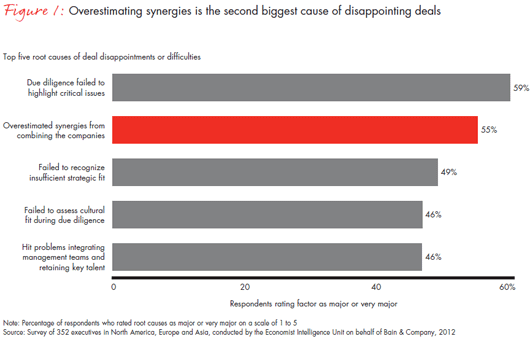
      The open secret about M&A is that most deals fail to generate the synergies companies expect when they announce a merger. In a Bain & Company survey of 352 global executives, overestimating synergies was the second most common reason for disappointing deal outcomes (see Figure 1).

      One of the causes of this overestimation is well known: Companies set aggressive targets to justify a deal price to financers. But new Bain analysis comparing deal announcements with the performance of more than 22,000 companies across a range of industries has unveiled another, even more fundamental contributor to the rampant overestimation. Most merging companies entering a deal don’t have a clear understanding of the level of synergies they can expect through increased scale. They typically make broad estimates based on prior deal announcements, without considering whether the cost structure of the combined entity is realistic based on benchmarks of like-sized companies. For example, if two $100 million companies merge, they rarely know what the resulting cost structure will look like based on their industry’s existing $200 million companies.

      We took a hard look at synergies in M&A to understand what the best companies do when estimating, announcing and pursuing them. We wanted to see whether merging companies’ announcements matched the synergies that should be expected given their industry, size and initial cost position. Are scale benefits alone justifying announced synergies? Are companies using due diligence and integration planning to improve underlying performance and reduce overlapping costs?

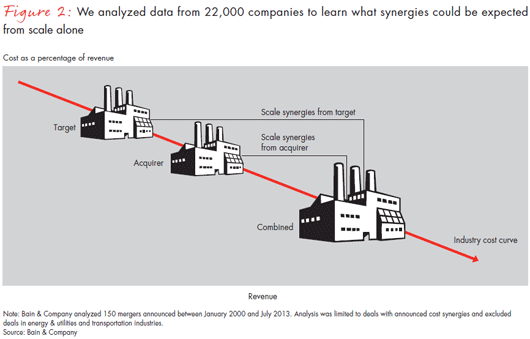
      To answer these questions, we embarked on an extensive M&A research effort. Bain recently analyzed data collected from SAP and FactSet Research Systems on the performance of more than 22,000 companies across a range of industries and geographies and spanning from the smallest public companies to those as large as $100 billion in revenues. We created cost curves for each industry, which showed the margins achieved for companies based on their size and industry. As expected, larger companies typically have lower costs as a percentage of revenues, and the benefits of scale differ significantly by industry. For example, telecom companies, with their fixed-cost infrastructure, show the most benefit, while retailers, with their distributed costs, show the least.

      why-some-merging-companies-become-synergy-overachievers-fig-01_embed.gif

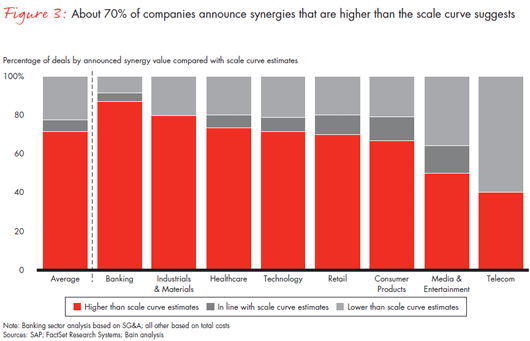
      By comparing the predicted margins for two standalone businesses with the margins for a single entity of their combined size, we estimated the scale synergies they could achieve by merging (see Figure 2). We then looked at mergers and compared announced synergies with what would be expected based on our cost curves. We found that across most industries we analyzed, on average 70% of companies announced higher synergy estimates than would be expected just by companies getting bigger (see Figure 3). We also wanted to examine the incremental benefits of M&A on companies whose cost structures had lagged industry norms before the merger. Like most merging companies, these companies announced higher synergies than would have been expected from scale benefits alone—but we learned that even their overestimated synergies wouldn’t have been enough to close the cost gap to competitors. In other words, they aimed high, but not high enough to put them on even footing.
      why-some-merging-companies-become-synergy-overachievers-fig-02_embed.gif


      why-some-merging-companies-become-synergy-overachievers-fig-03_embed.gif


      These findings helped us determine how companies can be more grounded in their estimates and learn from those that have been most successful in using M&A to win cost advantages. If most companies don’t achieve their announced synergies—and given the cost curves in their industries, those synergies announcements are too bold—how do the best companies beat the odds?

      Learning from outperformers

      The best companies justify higher targets and provide a roadmap for achieving them. They use the disruption caused by M&A to pursue broader changes like adopting zero-based budgeting initiatives and incorporate new ways of working that help them surpass rivals to become cost leaders. These companies gain at least—if not more than—the synergies they promised at the deal’s outset. In addition to reaping the benefits of scale, they also reach full potential for the combined companies by focusing on removing inefficiencies in their merged organizations and creating breakthrough performance.

      That approach requires merging companies to be far more disciplined about calculating expected synergies. It also requires them to use industry benchmark data to get a firm grasp on how each company’s costs stack up prior to the transaction and to understand how much can be gained from scale alone, as well as from the additional effects of achieving higher levels of cost performance. When setting their desired end point, the best companies also explicitly set a target for how their costs will ultimately compare with those of larger, best-in-class rivals, recognizing that the competition will continue to improve over time.

      Few companies illustrate this approach better than AB InBev, the world’s largest brewer created from the 2008 merger of Anheuser-Busch and InBev.

      Like many other companies, AB InBev announced anticipated synergies in its huge merger that were higher than what could be expected from scale alone. But unlike so many others, they entered the merger with both a track record for high synergies and a solid plan to back up their claim. They ultimately beat the ambitious announcement by generating synergies of $2.25 billion, much more than what could have been expected from scale. On average, merging consumer products companies increase EBITDA by 3.2% of target net sales. In the case of the AB InBev merger, those synergy gains contributed to a 16.8% improvement over a three-year period following the transaction.

      A diversified industrials company formed by the merger of two giants also serves as an example of synergy excellence. The merged company took advantage of the acquisition process to get everybody on board for transformation. Based on industry benchmarks, the merged company would have expected to achieve scale synergies representing just 1% to 2% of the combined companies’ revenues. It did far better. All told, the acquisition delivered synergies amounting to more than 5% of revenues.

      Most merging companies don’t have a clear understanding of the synergies they can create by increasing scale. However, some companies set bold targets and consistently hit them. Laura Miles, who leads Bain's global Mergers & Acquisitions practice, explains what sets these companies apart in this short video

      Synergy overachievers typically follow three critical rules for repeating success:

      Begin by using the deal thesis and rigorous due diligence to pinpoint where scale synergies and best practice benefits will have the most substantial effect. Winners always know exactly what they hope to gain in a merger.

      A deal thesis spells out the reasons for a deal—generally no more than five or six key arguments for why a transaction makes compelling business sense. According to Bain’s survey of nearly 250 global executives, in 90% of successful deals, an acquirer’s management team had developed a clear investment thesis early on.

      Knowing what you hope to achieve is the first step in clearly identifying where the deal can create value and which few things are critical to delivering that value. The deal thesis leads directly to the structure of the integration. It determines how quickly you need to move on each initiative to tackle the largest opportunities first and with the most resources. By conducting a deep business analysis of all target companies, the industrials company pinpoints where overlap of costs and customers will generate the greatest scale benefits, beyond traditional general and administrative functions.

      In areas that will deliver the most value, use benchmarks and the industry-specific scale curve to know your starting and desired end points compared with those of your competitors. In our experience, too few companies enter a deal really knowing how they measure up against competitors. Again, benchmarks and the industry-specific scale curve allow you to see where you stand and how much you need to deliver to be competitive with the median or the leaders. Such resources as SAP’s Value Management Center, which includes a database of more than 4,000 companies, arm acquirers with information to make more realistic predictions of synergies and also show them where to find those synergies.

      When the two industrials companies mentioned above merged, they relied on a deal thesis and function-by-function benchmarks to know where to expect the greatest synergies. They also examined costs down to the subfunction level—in areas like tax and treasury, for example—to identify potential synergies. And they considered benchmarks from multiple angles: Instead of just looking at the cost of a specific function like field human resources, they also considered such benchmarks as HR employees-per-field headcount—anything that could be contributing to the gap against the best performers. That allowed the combined companies not only to set aggressive goals but also to see where each had strengths that could be adapted to help the combined entity perform above industry benchmarks.

      Be deliberate if you choose to use M&A to gain cost benefits beyond scale improvements, and be realistic about your internal capabilities. The disruptive nature of M&A and the integration process opens up the opportunity to implement a broad performance improvement agenda across the organization. Winning companies distinguish between areas they are primarily integrating and those they are optimizing beyond pure scale benefits. They thoughtfully choose where to do one, the other or both, and they are generally selective about where they try to optimize.

      The merged industrials company approaches the goals of integrating and optimizing with different organizational oversight, tools and goal setting. For integration, the focus is on making sure the businesses come together seamlessly and don’t miss a beat in performance—teams’ missions and metrics are tailored to that objective. When the goal is optimizing, teams are given more aggressive cost targets and benchmarks for where the potential savings are likely to reside. They’re provided with financial support and resources to help identify opportunities and to execute, with performance clearly measured against their targets.

      In its acquisitions, AB InBev simultaneously establishes integration, oversight and change management programs from the outset. It then sets targets and ensures the right tools and processes are put in place to manage costs across the organization. For example, the company sets standards and benchmarks for best practice brewing operations. It also standardizes sales and delivery routines to increase efficiency, relying on the best approaches, either from AB InBev or the acquired company.

      The ultimate result: When it acquired the stake in Grupo Modelo it did not yet own last year, a considerable part of the earnings value came from new performance improvement initiatives, not from typical synergies.

      As M&A reshapes the competitive landscape in many industries, these three critical steps—deal thesis, benchmarking and performance improvement—are what make some acquirers synergy overachievers, while others wonder why they consistently miss the mark.

      Laura Miles is a Bain & Company partner based in Atlanta and leads the firm’s global M&A practice. Adam Borchert is a partner based in Boston, and Alexandra Egan Ramanathan is a partner based in Chicago.

      The authors wish to thank SAP’s Value Management Center for use of its benchmarking database of more than 4,000 companies. Together, Bain and SAP use the power of this database to assist clients with gauging the performance improvement potential of their businesses.

      Authors
      • Headshot of Laura Miles
        Laura Miles
        Partner, Atlanta
      • Headshot of Adam Borchert
        Adam Borchert
        Partner, Boston
      • Headshot of Alex Egan
        Alex Egan
        Partner, Los Angeles
      Contact us
      Related Consulting Services
      • M&A Due Diligence
      • Mergers and Acquisitions
      • Post-Merger Integration
      How We Can Help
      • Corporate Finance
      Mergers and Acquisitions
      The renaissance in mergers and acquisitions: How to make your deals successful

      Experienced acquirers know how to recognize good deals—and how to build up a repeatable M&A capability.

      Read more
      Mergers and Acquisitions
      The renaissance in mergers and acquisitions: The surprising lessons of the 2000s

      In the first decade of this century, many companies used M&A to deliver superior shareholder returns.

      Read more
      Mergers and Acquisitions
      Adam Borchert: Why some merging companies become synergy overachievers

      In this brief video, Bain Partner Adam Borchert discusses the tactics that companies use to achieve their cost savings targets during a merger.

      Read more
      Mergers and Acquisitions
      Defense M&A

      Bold moves will determine the winners as a continent rearms.

      Read more
      Corporate Finance
      CNBC’s 2025 CFO Council Summit: Rebuilding Finance in the Age of AI

      Leaders are using AI to transform finance into an insight engine.

      Read more
      First published in agosto 2014
      Tags
      • Corporate Finance
      • M&A Due Diligence
      • Mergers and Acquisitions
      • Post-Merger Integration

      How We've Helped Clients

      Aggressively growing an IT service provider with a high-performance culture

      Read case study

      Finance transformation: For one company, second time’s the charm

      Read case study

      Salesforce integration generates M&A success in healthcare

      Read case study

      Ready to talk?

      We work with ambitious leaders who want to define the future, not hide from it. Together, we achieve extraordinary outcomes.

      Stay ahead in a rapidly changing world. Subscribe to Bain Insights, our monthly look at the critical issues facing global businesses.

      *I have read and understand Bain’s Privacy Notice.

      Please read and agree to the Privacy Policy.
      Bain & Company
      Contact us Sustainability Accessibility Terms of use Privacy Modern Slavery Act Statement Cookie Policy Sitemap Log In

      © 1996-2026 Bain & Company, Inc.

      Contact Bain

      How can we help you?

      • Business inquiry
      • Career information
      • Press relations
      • Partnership request
      • Speaker request
      See all offices