


Forbes.com

|
|
Macroeconomic shocks will be a fact of life over the coming decade, with discontinuities that will shape the options companies have to adapt and grow. Yet behind the dire headlines and marketplace frictions, a handful of macro trends are at work. Cumulatively they will add up to $27 trillion in global GDP growth, which will swell to $90 trillion by 2020—40 percent larger than today. The macro trends’ growth potential will touch many corners of the globe. Rising wealth in emerging economies will continue to bring a broader range of goods to huge numbers of new consumers. And while the current turmoil gives business leaders and investors plenty of reasons to stay hunkered down, renewed economic vitality in the advanced economies over the next decade will require refurbishing and expanding critical infrastructure, and the job will present increasing opportunities for public-private partnerships. As economic power tilts toward Asia, political and military power will shift as well – China’s military outlays grew 6.7 percent in 2010 to reach $160 billion. Growing demand among more nations for oil and natural gas, grains and proteins, fresh water and extracted ores will create price volatility and transient shortages of a few of these commodities. The massive population shift from farm to factory has altered the social landscape in emerging economies, but social infrastructure has not kept pace. Aging populations in the advanced economies, more and better medical treatments, and changes in payment systems to make healthcare spending more efficient, will spur innovation and reform. Innovation will increasingly come in new forms beyond novel technologies like iPads and Twitter; businesses will invest more heavily in “soft innovations,” which will offer affluent customers premium products and services. And five potential platform technologies—nanotechnology, genomics, artificial intelligence, robotics and ubiquitous connectivity—show promise of flowering over the coming decade.
Today, many management teams are focused on the actions necessary to adapt to volatile markets, unstable currencies, political gridlock and stalled growth that plagues the big developed economies. But some companies will start to pull away from the rest of the pack as the larger trends come into focus. As businesses position themselves to profit from these macro trends, they need to be mindful of some important implications:
Turnover among industry leaders will almost certainly accelerate in the decade ahead. But leadership won’t hinge on simply surviving through a difficult economy. The companies at the top in 2020 will be those able to answer the question: What do we need to do today to capitalize on these longer-term macro trends? This post was written by Karen Harris, Austin Kim and Andrew Schwedel. Harris is director and Kim is senior economist with Bain & Company’s Macro Trends Group. Schwedel is a partner with Bain & Company and head of Bain’s Financial Services Practice in the Americas. 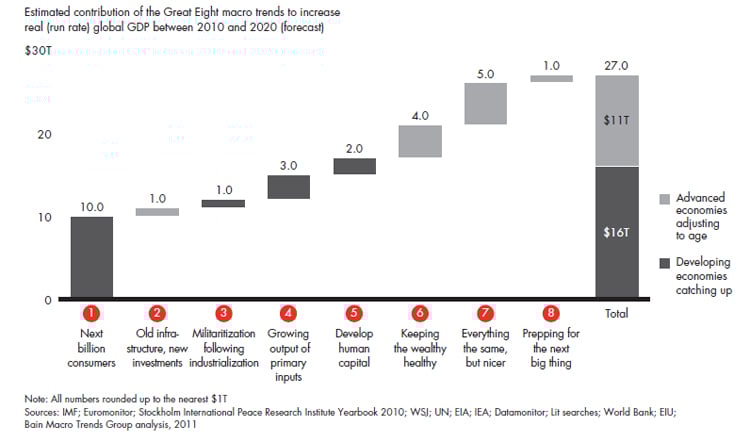 |