

Paper & Packaging Report

Executive Summary
- Companies that prioritize commercial excellence often see a 2–3x increase in company growth rate.
- Leading companies understand where they make the most money and where they are inadvertently giving money away, down to the SKU level.
- A data-driven approach helps sales teams understand where they should hunt for profitable growth, down to the customer level.
This article is part of Bain's 2026 Paper & Packaging Report.
Profitable EBITDA growth—especially from volume—has never been easy in paper and packaging; a laser focus on commercial excellence tactics borrowed from faster-growth industries can help companies grow profits and revenues. Recent years have been particularly turbulent in the paper and packaging industry due to fluctuating costs, inflation, interest rates, and lately tariffs—all of which are putting continued pressure on margins. Meanwhile, the conversation around sustainability has diverged, as paper and packaging companies in the US need to navigate state-by-state regulations, while those in Europe must comply with both continent-wide and country-specific sustainability regulations.
At the same time, the AI revolution is providing much more detailed customer insights that can be used to drive organic volume in paper and packaging. In packaging, the volume piece in particular has been extremely difficult to come by, but when achieved, it drives outsized results in total shareholder return (TSR). Research has shown that companies that grow profits and revenue earn extraordinary rewards, specifically 1.7x their TSR. Furthermore, Bain research has found that leading companies that prioritize commercial excellence often see a 2–3x increase in company growth rate.
Three steps to unlock the value in commercial excellence
1. Understand where you make the most money and where you are losing money
Surprisingly, most companies do not understand where their profit dollars come from—which products, which segments, and which customers. On the flip side, they also don’t necessarily know exactly where they are losing money. Since profitability can vary regionally, not to mention by customer, product, segment, and channel, it’s critical to start by understanding which plants, regions, and channels drive real economic value. Successful companies understand the most granular level of margin by fully accounting for all direct and indirect costs by customer and product to identify all sources of margin leakage.
A global labeling company, for instance, sought to grow and realized that understanding true profitability was critical to pinpoint the right places to reduce cost and where to double down to grow. First, it identified the true economic margin by calculating all direct and indirect costs of manufacturing, as well as all sales costs and working capital, which revealed which customers and products were really making money.
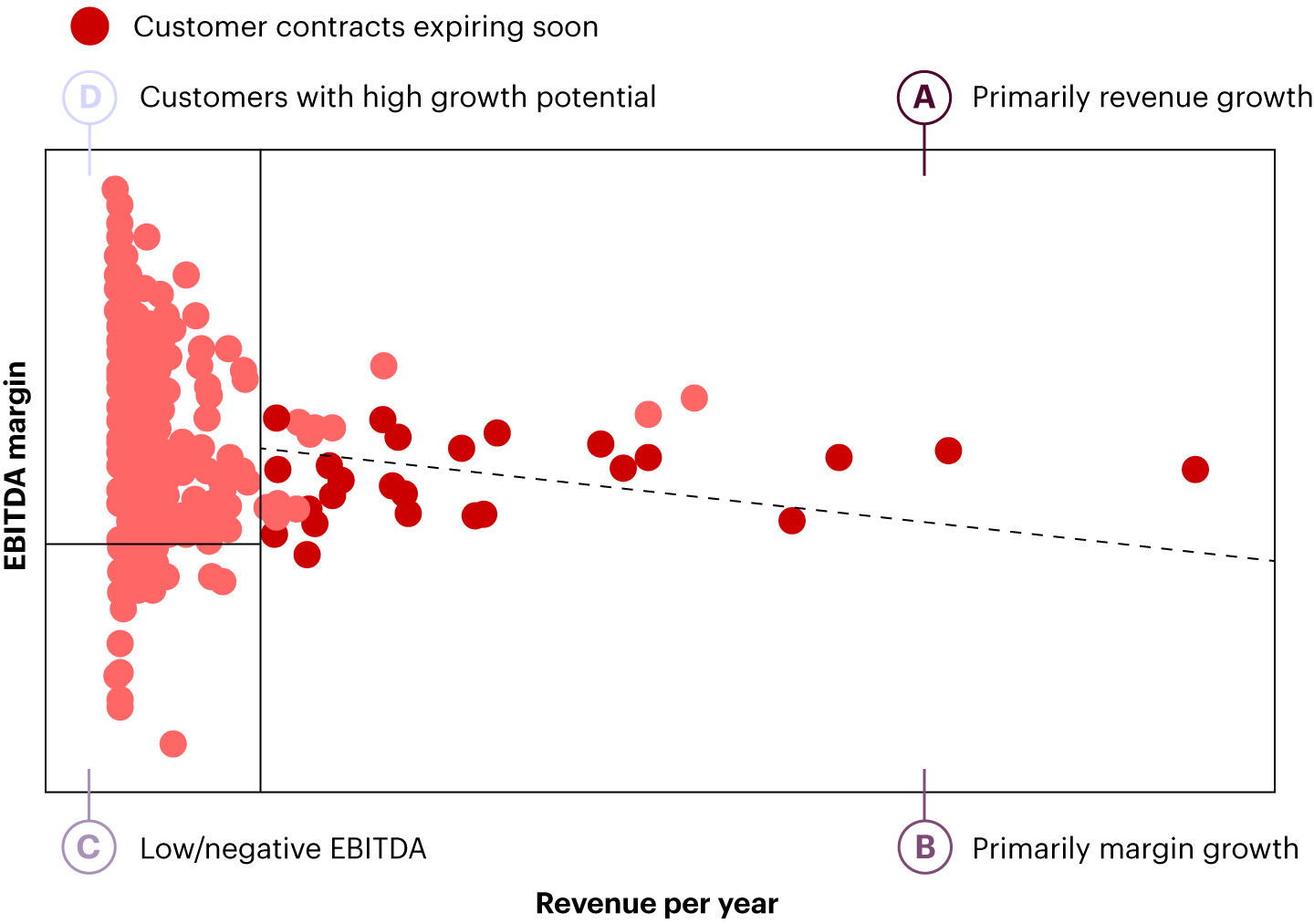
It also developed a holistic view of profitability by better understanding its costs from promoting and selling its products, as well as the profit and loss inputs at the most granular level. The team also identified several new opportunities for generating value, such as simplifying the portfolio and specifically flagging which stock-keeping units (SKUs) to prioritize and which added less value. Thanks to this multifaceted approach, they identified low-profitability customers and products (see Figure 1). With a better understanding of true profitability for each customer and product, they were able to prune their portfolio and prioritize certain SKUs commercially, ultimately achieving an EBIT uplift of $20 million to $30 million.
Figure 1

2. Develop a customer-based, data-driven understanding for where your sales teams should be hunting for growth
To determine precisely where sales teams should hunt for profitable growth, leading companies focus on where opportunity is greatest, which requires understanding the addressable market and share of wallet at the customer level (see Figure 2). They then optimize sales resources based on these growth opportunities. This approach enables account-level and customer-level decision making.
Figure 2
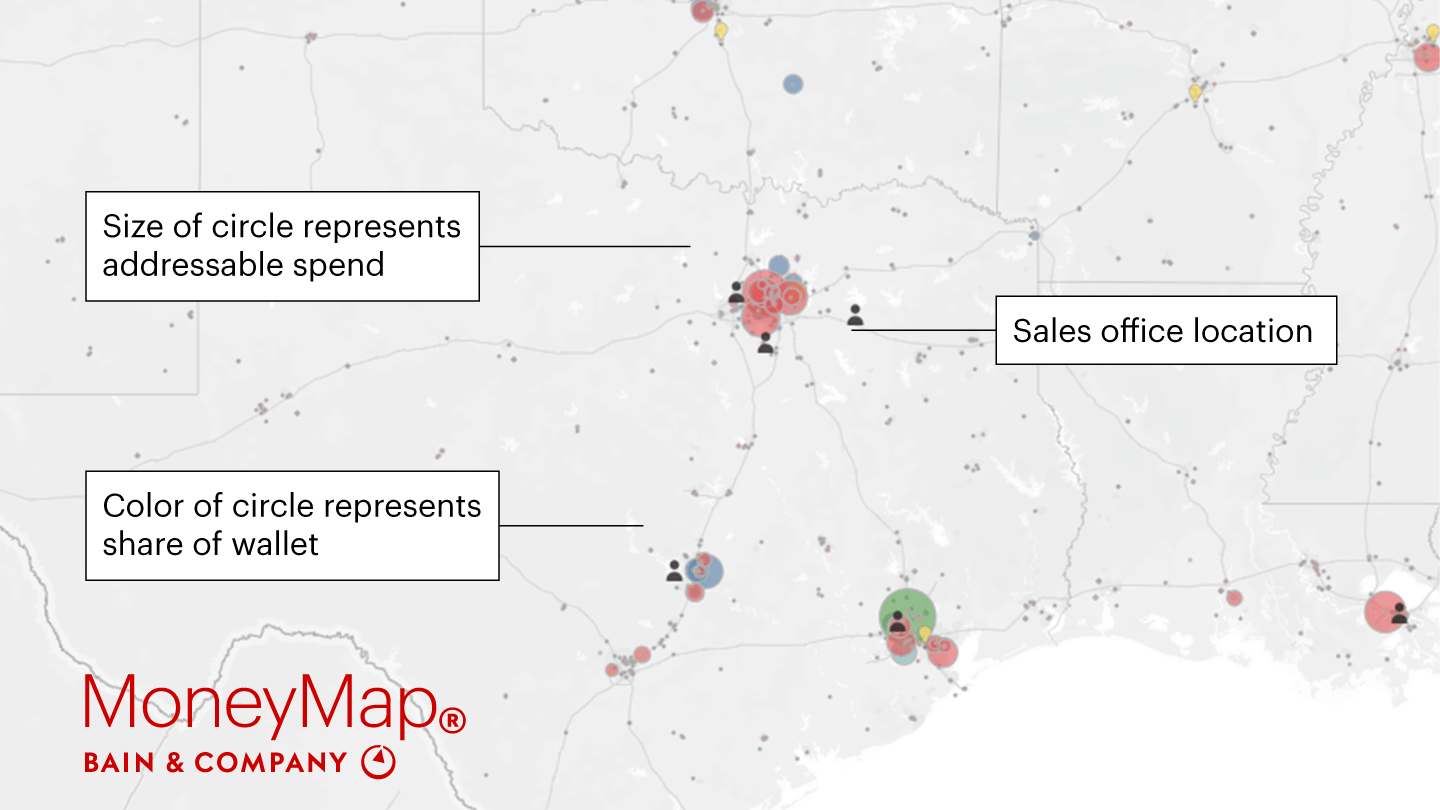

For example, a global packaging company that manufactures outside of the US wanted to sell more to American customers due to supply shortages in the US. Using AI to map customer locations and predict specific customer location volumes, the team was able to quickly understand where they were already winning with customers that were closest to their facilities and what white space was still available. They were also able to identify consumer hotspots where they might consider building new production capacity in the US. The AI system conducted data analysis and included criteria-based filtering of more than 100,000 customer data rows; then, it utilized a visualization tool so that sales teams could identify the best existing and new growth opportunities.
AI-powered web scraping enabled the team to identify which facilities were actively engaged in relevant packaging operations, filtering out unrelated sites and ensuring the analysis focused only on true demand centers. Geospatial mapping then went further, revealing not only precise facility locations but also estimated facility size (square footage) and production scale (volume), as well as proximity to other players to assess competitive density within each zip code. This allowed the team to pinpoint high-volume opportunities and white-space regions for expansion, later validated by industry experts.
Previously, this type of research could have taken months; it took just a few weeks using AI. They also discovered new potential customer segments that even salespeople with deep knowledge of the market had missed. Also, knowing in more granular detail what specific SKUs customers were likely to purchase helped determine which lines to put within given new facilities.
3. Determine how much value you create and the right price to capture fair share of the economics
A third key way successful companies use commercial excellence to drive growth stems from understanding how much value they create and then adapting their pricing strategy accordingly. First, they identify where they are leaving money on the table through unwarranted discounts or prices that are too low. Then, they segment their customer and product portfolio to understand where they create the most value and implement a clear price architecture that prices for value. Finally, they take a proactive, data-driven approach to contract renewals, negotiations, and optimization.
First, they identify where there are unjustified price variations and unwarranted discounts or prices that are too low. Then, they segment the portfolio, implement clear price architecture, and price for value. Finally, they take a proactive, data-driven approach to contract negotiations and optimization.
For example, a global closure company was starting to see decreased sales and price leakage. It ran a pricing diagnostic that identified where it was overly discounting and also where there were very low-margin products and unjustified variances. Armed with this knowledge, it executed a three-pronged strategy. First, it worked to remove unwarranted discounts. Second, it set up new processes and policies to prevent further price leakage. Third, it used these insights to move toward value-based pricing. Overall, it improved their run-rate EBITDA by roughly $15 million, with around $5 million EBITDA impact achieved through quick wins within six months and the rest through medium-term initiatives.
Unlocking the value in commercial excellence is not easy, but the most successful paper and packaging companies share a strategy that ultimately helps them understand their own operations and end customers in much greater detail. Specifically, they understand where they make the most money and where they are inadvertently giving money away, down to the SKU level. They develop a data-driven approach to understand where sales teams should hunt for profitable growth, down to the customer level. And they identify opportunities to improve pricing performance and capture more value in the market.