


Article


|
|
Given that every bank says that personalization is a top priority, every platform vendor claims to facilitate it, and every digital strategy is built around a vision of delivering real-time, next-best actions, we should be just about ready to slap “mission accomplished” on this long-sought goal. Right? Hardly. Across the UK, Europe, and North America the reality does not map to the ambition. Banks are drowning in process, starved for outcomes, and providing the illusion of personalization on top of operating models that undermine it. Meanwhile, the needle hasn’t moved at all on the customer engagement that personalization aims to foster. If anything, banks may actually be training customers to ignore them. Technology is not the problem. Data is not the problem. Customers certainly aren’t the problem. The problem lies with the banks themselves because they continue to personalize based on products, not people. Banks claim that they are customer-led, but typically, they operate like this: The mortgage team pushes mortgages, the card team pushes credit cards, the savings team pushes savings accounts, and every team fights for their slot in the app. Put another way, different parts of the organization think they need to solve their problem in order to solve the problem of poor customer engagement. That approach does not work because, as Alastair Campbell notes in Healthy Money, people don’t wake up wanting more banking; they want enriched financial lives characterized by stability, confidence, clarity, and progress. They want help organizing their money around their lives, not their lives around a bank’s products. Forget about campaign thinkingMost banks continue to operate from a 30-year-old playbook: campaign cycles of 60 to 120 days, endless handoffs (from legal to compliance to brand, risk, analytics, creative, and more), culminating in a big launch day, which is then followed by a long period of silence.
But you can’t deliver real-time relevance using workflows designed for quarterly campaigns. Meanwhile, because most banks are still personalizing based on products, customers treat the messages they receive as spam, and they aren’t wrong. Some banks have a click-through rate as low as 0.2%. Most banks are also held back by a long list of organizational blockers:
Moments outperform modelsReal personalization requires banks to break the org chart. How to get there? First, recognize that the unit of personalization is the moment, not the message: Relevance is temporal, not demographic. For example, a “mass affluent” segment tells you nothing, but a “received first paycheck” moment tells you a lot. Ditto for a “young professional” segment, which is vague, while a “bonus just landed” moment is actionable. In our client work we have found that a focus on moment-based engagement can deliver a 2x boost in conversion of new-to-bank cardholders into primary accounts, a 15% to 20% income uplift in the first 90 days, and improved retention at churn or rollover moments. In short, no campaign can match moments. As these moments accrue, they ultimately shift a bank’s focus from products to customer lifetime value (CLV). CLV is not just a marketing metric; it’s a way of running the entire business by changing how you talk, measure, and prioritize. By aligning their personalization engines with CLV, not product targets, banks can take an essential step toward true personalization. Critical to this approach is the acknowledgement that people don’t buy banking products all that often. In fact, they may go years between key moments such as graduation, marriage, divorce, a new job, and so on. Yet many bank marketers proceed as if they are in the consumer products business, blitzing customers with product offers rather than tuning in to behavioral patterns and signals that would guide much more effective outreach.
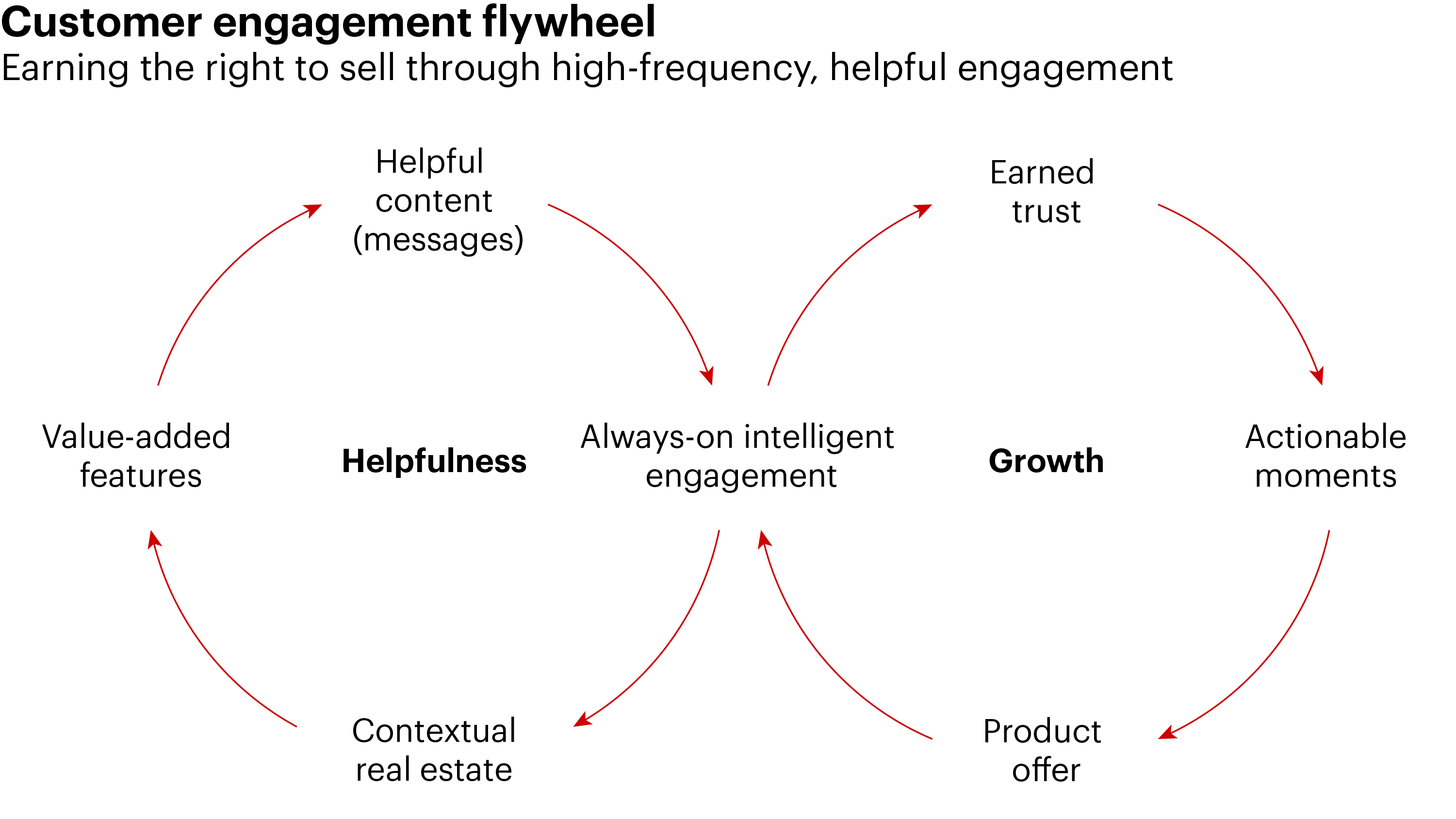
NatWest is that rare example of a bank that gets this right. When Zack Anderson served as group chief data and analytics officer, he applied what he had learned at video game giant Electronic Arts—namely, customers tune out when every interaction is ultimately a request for money, but engagement soars when the messaging provides help, education, and related forms of value. That inspired an application of the 80/20 rule: Roughly 80% of customer communications should be helpful, educational, or focused on engagement while only 20% should be explicit product or sales messages. For example, messages about how to detect and respond to potential fraud achieved high levels of engagement—even more so when they could be tied to a specific risk, such as a scam directed at customers of a specific online retailer. In that case only, customers whose credit card usage showed that they patronized that retailer got that particular alert. Similarly, messages about the benefit of a travel-focused credit card were only sent to customers whose transaction history indicated that they would benefit from knowing about certain perks. Those kinds of interactions strengthened trust between NatWest and its customers, which in turn ensures that commercial messages resonate. No matter where a bank starts, the end goal should be a single, continuously reinforcing customer engagement flywheel. Done well, it is not a playbook of steps; it is a system that earns permission, compounds trust, and converts at the right moment, without training customers to tune out. At the top of the flywheel is helpfulness. Banks build this through three practical levers inside the digital experience: contextual real estate (where and how the app surfaces information), value-added features (tools customers actually use), and helpful content (messages that educate, warn, or guide rather than push). Those levers drive daily engagement, shifting customers away from occasional logins to check a balance toward repeated, lightweight interactions that make the bank feel relevant to their lives. That daily engagement then powers the bottom of the flywheel: earned trust and earned permission. Trust makes customers willing to share signals (and accept the bank acting on them), which is what makes moments detectable and actionable. When the right moment arrives, the bank can place a product offer in a way that feels timely and useful rather than intrusive, because it is delivered into real estate the customer already uses, supported by signals the customer has effectively licensed through ongoing engagement. That, in turn, drives growth, which funds the next wave of features, content, and experience improvements that make the bank more helpful and attractive.
Most banks try to run this system backward. They start with life cycle campaigns or product pushes and then wonder why engagement stays flat. Without trust and without meaningful, high-frequency real estate, even well-targeted offers feel like spam, and they degrade the scarce attention the bank has earned. The practical implication is the 80/20 shift: Optimise the system so that most interactions are designed to be helpful and engagement-building and only a minority are explicitly commercial. The commercial messages work better precisely because the bank has earned the right to make them. Marrying that approach to a focus on CLV, NatWest invested more in communications that would prioritize customers with high or growing CLV and acknowledged that not all customers should be engaged in the same way or with the same intensity. We worked with NatWest to refine and scale this approach to enhanced customer engagement, applying a combination of AI, test-and-learn methods, and organizational restructuring. People first, then AIBut a focus on moments and an appreciation of CLV won’t mean much if banks don’t take the final, most important step: Change their operating models. While much has been written about the impact of AI—and, no doubt, it has a big role to play in personalization—it’s also true that four people in a room representing, say, analytics, compliance, marketing, and product, can achieve a lot if they’re simply empowered to do so. That means no committees, no front doors, no 16-person meetings, and no multimonth cycles. Just autonomy, with guardrails. “The unlock for us was when we stood up a small number of lean teams each aligned to specific customer missions, says Katie Ayaz, NatWest’s head of retail engagement. “These teams have ‘T-shaped’ people—cross-functional problem solvers who can learn on the fly and use AI tools natively—and they are empowered to cut across organizational siloes and make decisions fast.” Rethinking organizational structure and teaming strategies can, as NatWest has proven, eliminate 90% of manual work, dozens of handoffs, and multiple approval layers. It lets personalization run at the speed that customers live, not the speed at which banks approve things. Fresh thinking about organizational structure works hand-in-glove with technology strategy. “We really started to make progress when we did a clean-sheet refresh of our customer engagement technology and data stack,” says Gordon Jackson, NatWest’s head of customer data and personalization. “We identified some core technologies and tools in the current stack that we wanted to invest in and modernize, but equally, we pinpointed a number of hot spots where we could leapfrog to next-generation AI capabilities.” Getting there from hereIn working closely with NatWest and other banks, we’ve mapped out three practical pathways that can accelerate any banks’ journey to true personalization and enhanced customer engagement.
That kind of integrated system represents a big shift from the reactive, fragmented approach most banks currently use to an always-on, AI-powered system that moves from episodic to continuous, from campaigns to testing/experimentation, from manual processes to agentic workflows, and from fragmented, one-off efforts to reusable data and orchestration assets that can scale across customer journeys. So, are you ready?Until now, most banks simply wanted the appearance of personalization as long as no current structures, incentives, or ownership models needed to change. But the status quo is crumbling, and leading banks are demonstrating what’s possible when a company commits to turning customer engagement into enduring value. Yes, real personalization is uncomfortable. It shifts power, redefines roles, and collapses siloes. It forces teams to work together. And it demands a clear definition of “successful customer.” To win, banks have to redesign themselves around customer outcomes, not internal preferences. Platforms, data, and even AI are not sources of salvation. Changing how work gets done is. Personalization requires a leadership transformation, not a technology transformation. The banks that embrace that first will define the industry’s next decade. |

First published in noviembre 2026