
Skip to Content
  • Offices

    Offices

    North & Latin America
    • Atlanta
    • Austin
    • Bogota
    • Boston
    • Buenos Aires
    • Chicago
    • Dallas
    • Denver
    • Houston
    • Los Angeles
    • Mexico City
    • Minneapolis
    • Monterrey
    • Montreal
    • New York
    • Rio de Janeiro
    • San Francisco
    • Santiago
    • São Paulo
    • Seattle
    • Silicon Valley
    • Toronto
    • Washington, DC
    Europe & Africa
    • Amsterdam
    • Athens
    • Berlin
    • Brussels
    • Copenhagen
    • Dusseldorf
    • Frankfurt
    • Helsinki
    • Istanbul
    • Johannesburg
    • Kyiv
    • Lisbon
    • London
    • Madrid
    • Milan
    • Munich
    • Oslo
    • Paris
    • Rome
    • Stockholm
    • Vienna
    • Warsaw
    • Zurich
    Middle East
    • Doha
    • Dubai
    • Riyadh
    Asia & Australia
    • Bangkok
    • Beijing
    • Bengaluru
    • Brisbane
    • Ho Chi Minh City
    • Hong Kong
    • Jakarta
    • Kuala Lumpur
    • Manila
    • Melbourne
    • Mumbai
    • New Delhi
    • Perth
    • Shanghai
    • Singapore
    • Sydney
    • Tokyo
    See all offices
  • Alumni
  • Media Center
  • Subscribe
  • Contact
  • Global

    Select your region and language

    Global
    • Global (English)
    North & Latin America
    • Brazil (Português)
    • Argentina (Español)
    • Canada (Français)
    • Chile (Español)
    • Colombia (Español)
    Europe, Middle East, & Africa
    • France (Français)
    • DACH Region (Deutsch)
    • Italy (Italiano)
    • Spain (Español)
    • Greece (Elliniká)
    Asia & Australia
    • China (中文版)
    • Korea (한국어)
    • Japan (日本語)
  • Saved items (0)
    Saved items (0)

    You have no saved items.

    Bookmark content that interests you and it will be saved here for you to read or share later.

    Explore Bain Insights
  • Industries
    Main menu

    Industries

    • Aerospace & Defense
    • Agribusiness
    • Chemicals
    • Construction & Infrastructure
    • Consumer Products
    • Financial Services
    • Healthcare & Life Sciences
    • Industrial Machinery & Equipment
    • Media & Entertainment
      Industries
      Media & Entertainment
      • Media Lab
    • Metals
    • Mining
    • Oil & Gas
    • Paper & Packaging
    • Private Equity
      Industries
      Private Equity
      • Due Diligence
      • Exit Planning
      • Firm Strategy & Operations
      • Portfolio Value Creation
    • Social Impact
    • Retail
    • Technology
    • Telecommunications
      Industries
      Telecommunications
      • Capital Expenditure
      • Telco Digital Transformation
    • Transportation
    • Travel & Leisure
    • Utilities & Renewables
  • Consulting Services
    Main menu

    Consulting Services

    • Customer Experience
    • Sustainability
    • Innovation
    • M&A
    • Operations
    • People & Organization
    • Private Equity
    • Sales & Marketing
    • Strategy
    • AI, Insights, and Solutions
    • Technology
    • Transformation
  • Digital
  • Insights
    Main menu

    Insights

    • Industry Insights
    • Services Insights
    • Bain Books
    • Webinars
    • Bain Futures
    View all Insights
    Featured topics
    • Tariff Response
    • Artificial Intelligence
    • Thriving in Uncertainty
    • Executive Conversations
    • Macro Trends
    • M&A Report
    • Healthcare Private Equity Report
    • Paper & Packaging Report
    • Technology Report
    • CEO's Guide to Sustainability
    • CEO Insights
    • CFO Insights
    • COO Insights
    • CIO Insights
    • CMO Insights
    View all featured topics
  • About
    Main menu

    About

    • What We Do
    • What We Believe
    • Our People & Leadership
    • Client Results
    • Awards & Recognition
    • Global Affiliations
    Further: Our global responsibility
    • Sustainability
    • Social Impact
    • World Economic Forum
    Learn more about Further
  • Careers
    Main menu

    Careers

    • Work with Us
      Careers
      Work with Us
      • Find Your Place
      • Our Work Areas
      • Integrated Teams
      • Students
      • Internships & Programs
      • Recruiting Events
    • Life at Bain
      Careers
      Life at Bain
      • Blog: Inside Bain
      • Career Stories
      • Our People
      • Where We Work
      • Supporting Your Growth
      • Affinity Groups
      • Benefits
    • Impact Stories
    • Hiring Process
      Careers
      Hiring Process
      • What to Expect
      • Interviewing
    FIND JOBS
  • Offices
    Main menu

    Offices

    • North & Latin America
      Offices
      North & Latin America
      • Atlanta
      • Austin
      • Bogota
      • Boston
      • Buenos Aires
      • Chicago
      • Dallas
      • Denver
      • Houston
      • Los Angeles
      • Mexico City
      • Minneapolis
      • Monterrey
      • Montreal
      • New York
      • Rio de Janeiro
      • San Francisco
      • Santiago
      • São Paulo
      • Seattle
      • Silicon Valley
      • Toronto
      • Washington, DC
    • Europe & Africa
      Offices
      Europe & Africa
      • Amsterdam
      • Athens
      • Berlin
      • Brussels
      • Copenhagen
      • Dusseldorf
      • Frankfurt
      • Helsinki
      • Istanbul
      • Johannesburg
      • Kyiv
      • Lisbon
      • London
      • Madrid
      • Milan
      • Munich
      • Oslo
      • Paris
      • Rome
      • Stockholm
      • Vienna
      • Warsaw
      • Zurich
    • Middle East
      Offices
      Middle East
      • Doha
      • Dubai
      • Riyadh
    • Asia & Australia
      Offices
      Asia & Australia
      • Bangkok
      • Beijing
      • Bengaluru
      • Brisbane
      • Ho Chi Minh City
      • Hong Kong
      • Jakarta
      • Kuala Lumpur
      • Manila
      • Melbourne
      • Mumbai
      • New Delhi
      • Perth
      • Shanghai
      • Singapore
      • Sydney
      • Tokyo
    See all offices
  • Alumni
  • Media Center
  • Subscribe
  • Contact
  • Global
    Main menu

    Select your region and language

    • Global
      Select your region and language
      Global
      • Global (English)
    • North & Latin America
      Select your region and language
      North & Latin America
      • Brazil (Português)
      • Argentina (Español)
      • Canada (Français)
      • Chile (Español)
      • Colombia (Español)
    • Europe, Middle East, & Africa
      Select your region and language
      Europe, Middle East, & Africa
      • France (Français)
      • DACH Region (Deutsch)
      • Italy (Italiano)
      • Spain (Español)
      • Greece (Elliniká)
    • Asia & Australia
      Select your region and language
      Asia & Australia
      • China (中文版)
      • Korea (한국어)
      • Japan (日本語)
  • Saved items  (0)
    Main menu
    Saved items (0)

    You have no saved items.

    Bookmark content that interests you and it will be saved here for you to read or share later.

    Explore Bain Insights
  • Industries
    • Industries

      • Aerospace & Defense
      • Agribusiness
      • Chemicals
      • Construction & Infrastructure
      • Consumer Products
      • Financial Services
      • Healthcare & Life Sciences
      • Industrial Machinery & Equipment
      • Media & Entertainment
      • Metals
      • Mining
      • Oil & Gas
      • Paper & Packaging
      • Private Equity
      • Social Impact
      • Retail
      • Technology
      • Telecommunications
      • Transportation
      • Travel & Leisure
      • Utilities & Renewables
  • Consulting Services
    • Consulting Services

      • Customer Experience
      • Sustainability
      • Innovation
      • M&A
      • Operations
      • People & Organization
      • Private Equity
      • Sales & Marketing
      • Strategy
      • AI, Insights, and Solutions
      • Technology
      • Transformation
  • Digital
  • Insights
    • Insights

      • Industry Insights
      • Services Insights
      • Bain Books
      • Webinars
      • Bain Futures
      View all Insights
      Featured topics
      • Tariff Response
      • Artificial Intelligence
      • Thriving in Uncertainty
      • Executive Conversations
      • Macro Trends
      • M&A Report
      • Healthcare Private Equity Report
      • Paper & Packaging Report
      • Technology Report
      • CEO's Guide to Sustainability
      • CEO Insights
      • CFO Insights
      • COO Insights
      • CIO Insights
      • CMO Insights
      View all featured topics
  • About
    • About

      • What We Do
      • What We Believe
      • Our People & Leadership
      • Client Results
      • Awards & Recognition
      • Global Affiliations
      Further: Our global responsibility
      • Sustainability
      • Social Impact
      • World Economic Forum
      Learn more about Further
  • Careers
    Popular Searches
    • Agile
    • Digital
    • Strategy
    Your Previous Searches
      Recently Visited Pages

      Content added to saved items

      Saved items (0)

      Removed from saved items

      Saved items (0)

      Brief

      Automation’s Ultimate Goal: The Augmented Workforce

      Automation’s Ultimate Goal: The Augmented Workforce

      Few companies are taking a fully strategic approach to automation but doing so will change the way employers manage and reward workers.

      Ted Shelton and Rasmus Wegener

      • min read
      }

      Brief

      Automation’s Ultimate Goal: The Augmented Workforce
      en
      Резюме
      • Automation and artificial intelligence are changing the economics of work, leading executives to think differently about the possible value that each employee contributes.
      • When implemented correctly, automation does much more than improve efficiency; it augments the workforce, allowing people to focus on creativity, problem solving, and interpersonal interactions.
      • Successful automation programs depend on the support of the workforce, including contributors who can describe how processes can be improved and creators who learn how to build simple automations that improve processes.

      Efficiency is often the foot in the door for automation, but the real value of automation lies far beyond the traditional efficiency plays. Done right, automation enables employees to focus on truly human, high-value activities, creating what we call the augmented workforce.

      In our report The Working Future we highlighted the corporate shift toward focusing people on problem solving, creativity, and interpersonal connections—activities that are more variable in nature and more reliant on higher human faculties. Increasingly, employees will be able to enhance their performance in these higher-value domains with AI-powered virtual assistants, such as those demonstrated recently by OpenAI, while eliminating repetitive tasks using automation. We expect this augmented way of working to be very attractive to companies and their employees.

      Services Alliance

      Better Together: OpenAI and Bain Form an Alliance

      Harness the power of generative AI to transform your business.

      Automation is still underappreciated and underutilized in most companies today. But the coming changes are inevitable, and they follow a model seen before in technology adoption. Just as high-speed data networks altered the nature of outsourcing and the way that companies organized work, the advent of automation and artificial intelligence will change the economics of how work gets done. Automation and the rise of the augmented workforce should lead executives to think differently about the value of their employees and the value those employees can contribute. Ideally, these changes will not follow a “lift and shift” model, where an existing process or function is automated. A more proactive approach would be for companies to disentangle the high-value cognitive work (specifically, problem solving, creativity, and interpersonal connections) from the low-value work of information processing and physical labor.

      Across surveyed industries, workforce augmentation has led to a 21% to 30% reduction in costs.

      Focusing on higher-value work

      The challenges for enterprises developing an augmented workforce will not be technological but rather determining how to transition workers from lower-skill roles to the jobs of the future. Companies will need to provide the right training and support, encourage and reward workers to embrace change, and distribute the benefits of this transformation, not only to shareholders and customers but also to the employees whose roles are evolving. Our research has found that many employees want to use automation. Letting them do so will increase personal job satisfaction while also improving customer experience and delivering better outcomes for shareholders. How can business leaders help workers develop these capabilities?

      Instead of focusing on replacing people, companies position themselves better for success when they apply technology to augment the human workforce—providing better information, insights, and focus for the tasks that we still want people to perform. In each of the three areas where we see humans making their greatest contributions, workers can benefit from intelligent automation.

      • Problem solving. Companies can support workers with training in strategies that include establishing perspective, disaggregating problems, framing solutions, and deploying analogical reasoning—all of which can greatly improve decision making at work.
      • Creativity. Everyday creativity required for success in the jobs of the future can be taught by introducing workers to the right techniques. Provide employees with tools that make it easier and faster to prototype and test ideas.
      • Interpersonal communication. Empathy, introspection, and behavioral adaptation will be increasingly important. Equip employees with insights about the people they are interacting with and provide coaching on how best to engage them.

      Leading firms will develop internal communities of expertise, while automating or outsourcing tasks that do not require as much problem solving, creativity, or interpersonal skills. Our research finds that top-performing companies allocate more than 90% of their top talent to these mission-critical roles, while other companies allocate only 20% of their top talent to these roles. In this new model, employers must rebalance their investments in talent strategy and place greater value on the workforce.

      Four roles in the augmented workforce

      Most companies have years or decades of habits to overcome as they learn new ways to work. A concerted effort is necessary to redesign processes, encourage participation, and reimagine how work gets done.

      Even so, most companies do not achieve all their transformation objectives right away, whether measured by cost reduction, growth opportunities, or improved Net Promoter Score℠. Bain’s research into hundreds of initiatives found that only 12% of companies achieved their desired results. One of the biggest hurdles is getting workers to change their habits, and that takes communication, support, and incentives.

      When companies adopt large-scale automation initiatives, we see employees take on one or more of these four roles: contributors, creators, coordinators, and consumers. Understanding these roles and how they support the change to greater automation can help executives ensure a more successful transformation.

      • Contributors. The employees who are closest to a process are the ones who can usually describe how it can be improved. Successful transformations reward these people with incentives, support, and recognition. Because work might cross silos, these contributors may not know the root cause of problems, but they can point to symptoms, which can help process specialists map out the end-to-end improvement opportunities.
      • Creators. Creators are like “citizen developers” who can build simple automations that improve processes. Think of Excel macros: A few people in every department always know more about how to make and use macros, and they often become a resource for others. With support, training, and good governance, they can take on more complex tasks and become an important part of a transformation program.
      • Coordinators. These specialists provide tools, education, support, and ongoing monitoring for everyone whose job is touched by new automation. Regulatory changes, strategy shifts, market conditions, and technology upgrades all create the need for ongoing maintenance, learning, and process improvement.
      • Consumers. Almost all employees are in this group, since automation touches nearly every role in one of two ways: Scheduled automation provides information and insights to support good decision making, and on-demand automation triggers employee action. In both cases, the goal is to develop a system where automation manages the rote, repetitive, and rules-based aspects of the job, freeing the employee to do work that adds real value.

      Scaling a successful automation program

      Companies successfully transitioning to an augmented workforce typically get two important activities right: aligning the business and technology on a plan to create new value—both for the company and for employees—and ensuring they have the right tools and programs for enabling workers.

      A plan for creating value. Aligning automation goals with company strategy is the first step in developing a plan for creating value. Leading companies make a realistic assessment of the pace and potential value of implementing automation, and then they establish metrics at every level of the company to measure progress.

      Engaging frontline workers in the transformation and providing opportunities to contribute can help change the culture and bring the whole organization along on the change journey (see Figure 1).

      Figure 1
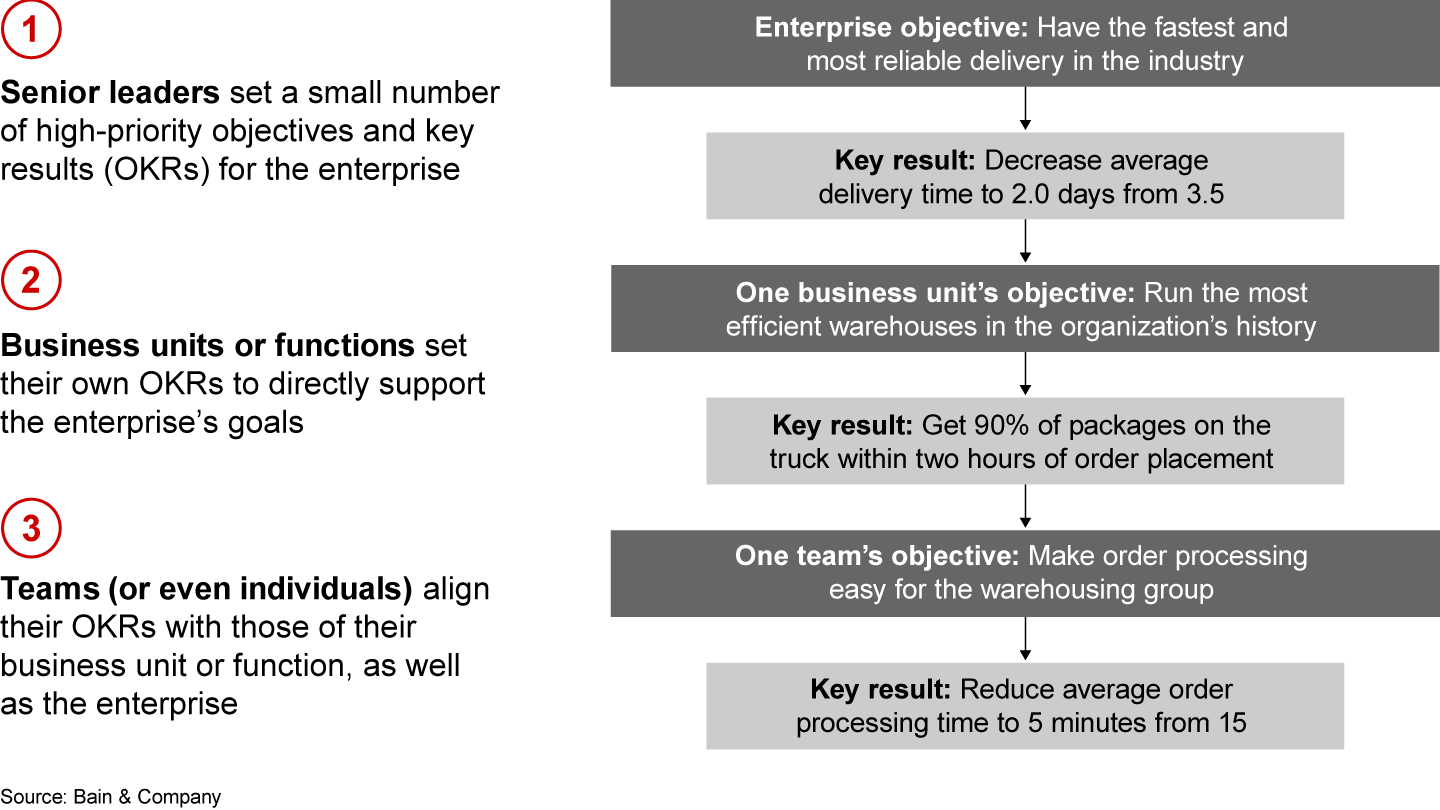
      Deploying automation to reduce delivery time touches multiple levels of the company
      Deploying automation to reduce delivery time touches multiple levels of the company
      Deploying automation to reduce delivery time touches multiple levels of the company

      In this example, leaders set a goal to reduce average delivery time from 3.5 days to 2 days. Business unit and function leaders who own parts of the process are contributors and provide suggestions. Individual creators build their own automations, eliminating some tasks under their own control. For instance, automating the validation that an item is in stock could shave 10 minutes off the order processing time. Coordinators look over the entire process and decide where to invest in professional developers. In the end, every employee who touches the process becomes an automation consumer.

      A detailed analysis at the start of the transformation helps set specific goals. The plan has at least three levels of detail: the size and shape of the target outcome, a prioritized list of initiatives with timing, and descriptions of how progress is measured. While productivity and cost are always important, automation initiatives should also try to deliver benefits for each category of stakeholder: customer and worker experience, risk mitigation, and career opportunities and rewards.

      Enabling workers. Automation is a rapidly evolving field, and that adds to the difficulty of choosing the right technologies and vendors to support the transformation. Finding a partner with a long-term platform strategy is a foundational step, but do not let that keep you from using best-in-class products from other vendors if they solve specific work automation problems.

      Just as important is supporting employees with an interest in building automations. Having a platform that supports codevelopment with professional developers allows these citizen developers to build up new skills that allow them to automate processes. Identifying these employees is key to the initiative’s success. However, as these employees' skills improve, they might be targeted for recruitment by companies that appreciate their potential. 

      Further, companies need to be thoughtful and support their employees’ adjustments as they move to and engage in a richer, higher-value work environment for a greater percentage of their time.

      Where to start

      When setting automation goals, it’s important to aim high, while also balancing business aspirations with the amount of change and time it will take to fully implement automation. Some automation, such as introducing bots, can be implemented relatively quickly and inexpensively, whereas core business process changes typically require more time and greater investments. In our experience, programs are more successful when they start with the easier moves first. These investments see returns within a year and allow a company to build their capabilities and reduce risk. 

      Companies should begin by prioritizing a few high-impact initial use cases to help the organization see the value of automation. Once a stable set of tools and processes have been established, companies can reach out to workers interested in using citizen development tools. Some companies have had success by starting with workers who are already using other simple technical tools, like Excel macros, Microsoft Access or similar databases, Tableau and other data analytics platforms.

      Education should include guidance on how to model and simplify business processes in addition to technical assistance on how to use citizen developer tools. Frameworks such as Six Sigma or Define Measure Analyze Improve Control (DMAIC) can be useful to adopt even when considering simple automation opportunities. And creating a recognition and reward model, with communications to the rest of the organization, will help to expand the implementation beyond the early adopters. Some companies have even used the same language of Six Sigma—“white, yellow, green, black belt” rankings—to indicate proficiency with automation tools and practices.

      Although the future augmented workforce model is enabled by technology, companies should recognize that a successful shift to this approach is fundamentally about culture change and people development. Done right, workers will feel excited and empowered to be a part of shaping the jobs of the future.

      Solution

      Net Promoter System®

      Focus on earning the passionate loyalty of customers while inspiring the energy, enthusiasm and creativity of employees to accelerate profitable, sustainable organic growth.

      Authors
      • Headshot of Ted Shelton
        Ted Shelton
        Alumni, Silicon Valley
      • Headshot of Rasmus Wegener
        Rasmus Wegener
        Партнер, San Francisco
      Contact us
      Related Consulting Services
      • Информационные технологии
      • Продвинутая аналитика
      • Automation
      • Digital
      How We Can Help
      • Advanced Digital Technologies for Industrials
      Технологии
      Beyond Cost Savings: Reinventing Business through Automation

      Adopting a programmatic approach to automation can deliver a competitive edge.

      Read more
      Информационные технологии
      Half of Companies Have Cut Roles Due to Automation

      Nearly two-thirds of executives say they are taking steps to mitigate automation’s impact, including training and transition support.

      Read more
      Стратегия
      Automation May Not Come for Everyone's Job After All

      Uniquely human skills are becoming more important as the composition of the workforce shifts.

      Read more
      CIO Insights
      To Deploy Generative AI Successfully, Look to Earlier Automations

      The most experienced firms are widening their lead in cost savings and productivity.

      Read more
      Digital Transformation
      Is Türkiye Ready for Generative AI?

      A new study, in collaboration with TÜSİAD, investigates the AI readiness of Turkish business and the biggest barriers to achieving scale and maturity.

      Read more
      First published in март 2023
      Tags
      • Информационные технологии
      • Продвинутая аналитика
      • Advanced Digital Technologies for Industrials
      • Automation
      • CIO Insights
      • Digital
      • Digital Transformation

      How We've Helped Clients

      Tata Steel Helps Home Builders Break New Ground

      Read case study

      Продвинутая аналитика Advanced Analytics Breakthrough Lets Metals Company Optimize Yield Cost

      Read case study

      Повышение эффективности деятельности Bain and Bosch Connected Industry Team Up to Help Automaker Build a New Plant Based on Industry 4.0 Technology

      Read case study

      Хотите продолжить обсуждение?

      Мы помогаем мировым лидерам бизнеса решать самые сложные проблемы и находить наилучшие возможности. Работая вместе, мы добиваемся устойчивых положительных изменений и результатов.

      Net Promoter®, NPS®, NPS Prism®, and the NPS-related emoticons are registered trademarks and Net Promoter Score℠ and Net Promoter System℠ are service marks of Bain & Company, Inc., Satmetrix Systems, Inc., and Fred Reichheld.

      Bain Insights. Our perspectives on critical issues global businesses face in today's challenging environment, delivered monthly.

      *I have read the Privacy Policy and agree to its terms.

      Please read and agree to the Privacy Policy.
      Bain & Company
      Contact us Sustainability Accessibility Terms of use Privacy Modern Slavery Act Statement Cookie Policy Sitemap Log In

      © 1996-2026 Bain & Company, Inc.

      Contact Bain

      How can we help you?

      • Business inquiry
      • Career information
      • Press relations
      • Partnership request
      • Speaker request
      See all offices