

Brief

Резюме
- The 10 Asean member countries lag China, Europe and the US in most of the disruptive trends that we call the “Five Races”: real customer focus, autonomous driving, connectivity, electric powertrains and shared mobility services.
- The region lacks a supply of electric vehicles, attractive consumer economics, government incentives (in most countries) and a charging infrastructure. Yet electric vehicles are certain to be a catalyst for building up Southeast Asia’s mobility industry.
- In other regions, passenger vehicles are leading the electric vehicle revolution, but in Southeast Asia, the near-term impetus is likely to come from commercial fleets, two-wheeled vehicles or a disrupter taking a new approach.
If there is a region that could use a mobility revolution, it is Southeast Asia. Much of the area grapples with persistent congestion, urban crowding, expanding environmental challenges and quality-of-life concerns. And at the current pace of change, only limited improvement is in sight. Oil demand to serve regional transport needs is set to grow by about 30% by 2030, according to the International Energy Association—a real economic burden for a region where most oil is imported and some nations still have subsidized or controlled fuel prices. Already a big contributor to pollution and health issues, carbon emissions are on the rise.
The 10 Asean member states are each at different stages of development, but all can reap economic and societal benefits by actively preparing for the disruptive trends that we call the “Five Races”: customer focus, autonomous driving, connectivity, electric powertrains and shared mobility services.
In China, Europe and the US, these Races are quickly changing how people think and move. Yet Asean nations largely are stuck in a traffic jam of indecision, stalled by limited incentives and clinging to old ways. The one bright exception is shared mobility services—in particular ride hailing, in which companies such as Grab and Go-Jek have altered behavior across the region to become accepted alternative modes of travel that complement public transportation.
Among the new mobility Races, the one with the most immediate potential is electric vehicles. It’s no news that on this track, Southeast Asia is moving slowly. Consider that in 2018, 1.1% of all new passenger cars sold in Europe were battery electric vehicles and that this number is expected to grow to around 28% of light vehicle sales by 2030, according to Bain analysis. Yet seeing an electric vehicle on the streets of Singapore or Thailand is rare.
What practical steps can Southeast Asia take to join the rest of the world in the adoption of electric vehicles? How can incumbent players in the transport or energy sector invest for the coming disruption when the economics remain uncertain and governments have been less aggressive than those in other regions to provide incentives for consumers to buy electric vehicles? How can an incumbent original equipment manufacturer (OEM) strategically position itself against any uncertain changes? Where are the opportunities for investors and new entrants?
What is clear is that the economy supporting electrification, mobility, charging and other services in Southeast Asia will be huge—in time. The region’s annual new investment in passenger electric vehicles will grow to $6 billion by 2030, according to Bain estimates, and it will need another $500 million in new charging infrastructure as service providers support electrification needs. On top of this, billions will be invested in telematics, fleets and their management, and passenger services, further increasing the potential profit pool. Indeed, it could become one of the largest growth segments of the next decade, with significant implications for the electricity grid, existing assets and incumbent players alike, and it could provide new opportunities and profit pools. By our estimate, this growth is likely to be slow over the next few years, but it should increase dramatically after 2025.
Electric vehicles: The catalyst for change
Indeed, the catalyst for the next stage in mobility will be a wider penetration of electric vehicles akin to what we have seen in markets such as China, Europe and the US. Many consumers in Southeast Asia are ready to make the shift. The bad news, however, is that consumer interest alone is unlikely to deliver electrification of the transport sector to Southeast Asia.
The experiences of other markets offer lessons about what it takes for electric vehicles, typically starting with passenger cars, to gain acceptance. It comes down to four prerequisites: available electric vehicle models, attractive purchase economics in terms of total cost of ownership (TCO) and purchase price, government incentives and convenient charging infrastructure. None of these factors is sufficiently developed in Asean countries today. We’ll look at these one by one to consider what path the region may take and how that path likely will be different from that of other markets.
Available electric vehicle models. Walk into a dealership in most Asean countries, and you will see few, if any, electric vehicles for sale. And the ones available are typically far more expensive than the alternatives. Given the scarcity and sticker price, interested electric vehicle customers often are encouraged to purchase hybrids. OEMs and dealers cite a variety of reasons why more models are not for sale. The most common explanation is that consumer interest is not there. Most OEMs also are not prioritizing their few models for sale in markets that are scaling up outside China, Europe or the US.
OEMs have announced ambitious plans, however, to augment their electric vehicle portfolios. Traditional OEMs, including premium brands from Asia, North America and Europe, plan to launch more than 250 electric vehicle models (battery and plug-in hybrids) by 2025. Volkswagen alone has announced plans to launch 80 models by 2025. But will these new model launches change the supply situation in Asean nations? We think there will be little effect in the near term. The reasons: Most OEMs are launching electric vehicles to challenge upstarts such as Tesla in their core markets and to meet future environmental emission standards in China and Europe (thus allowing them to continue to sell high-emission vehicles such as SUVs). Those OEMs are likely to lose money on every electric vehicle until the mid-2020s.
Indeed, most OEMs’ current battery electric vehicle offerings are not yet profitable. Bain estimates that leading OEMs will generate profits with the launch of new models in the next three to five years.
As long as they are losing, there is little economic incentive to push electric vehicles onto Southeast Asia and other second-tier markets.
Attractive purchase economics. Further complicating the equation are the consumer economics for the typical passenger car buyer. Fewer models typically means higher prices, and those prices are made even higher by local policies in Indonesia, Malaysia and other markets that discourage imports over local production or impose costs, such as Singapore’s 100% to 180% fees and taxes on imported cars. This limits much of the car-buying population from purchasing electric vehicles, thus discouraging OEMs to increase imports. According to Bain analysis, battery costs—the key component of electric vehicles—will drop by about 40% between 2018 and 2025, allowing for global purchase price parity between battery electric vehicles and internal combustion engine vehicles in major markets. Without this purchase price parity, consumers are unlikely to change their behavior.
Government incentives. These barriers have been overcome by early government support in other markets. Such moves range from direct tax credits in Norway and the US to preferential licenses in China. Indeed, such incentives played a major role in early adoption. For their part, Asean governments have taken limited action to encourage electric vehicle sales. While the region’s governments have not made statements publicly opposing electric vehicles, there is little true support for changes to the current fleet. Reasons for this are many: Governments in countries such as Singapore and Thailand prefer to prioritize getting passengers out of cars and onto public transportation. In other countries, governments worry about losing local manufacturing jobs as electric vehicles are not likely to be produced locally in the near future. Additionally, many governments in the region are reluctant to favor a foreign-inspired industry disruption over the local status quo. One also sees some governments, such as Thailand, promoting traditional hybrids or plug-in hybrids as electric vehicles—a face-saving move into electric vehicles that supports domestic manufacturing but results in a slower behavioral change among consumers.
Charging infrastructure. Given the above, it is little surprise that the economics and rationale of making investments in a charging infrastructure are generally slow moving. While all regional utilities are thinking carefully about how to adjust future investments in the grid to support electric vehicles, with some upstarts and developers looking for ways to invest, the economics of investing in charging are not great. It’s difficult to make charging stations profitable in most markets. Yet without the infrastructure build-out to support consumers and their passenger electric vehicles, penetration is going to remain stuck in the garage.
How is this chicken-and-egg situation likely to change? What can potential early investors expect? While technology transitions such as electrification are difficult to predict, Bain believes the pace of change in most Asean countries will not follow the path of China, Europe and US first movers, in which passenger vehicles led the transition. Instead, other classes of electric vehicles could set the pace in Southeast Asia, with passenger cars following behind.
Commercial fleets
While Asean consumers interested in electric vehicles are somewhat held hostage by the status quo, commercial fleet owners face an entirely different situation. First, fleet owners may develop their own charging infrastructure and only would need to make outside investments (or tap third parties) for top-up charging in outside locations. Second, their higher-intensity operations with light vehicles or trucks offer more attractive TCO economics—particularly in markets such as Singapore or Thailand, where fuel costs are relatively high.
There have been early successes. Consider the example of Grab’s program in Singapore, a joint venture with Hyundai supplying the vehicles and SP Group supplying the charging infrastructure. Together, they are leasing and managing 200 vehicles until the end of 2019 in Singapore alone, providing both the cars and charging infrastructure at attractive terms. Even after accounting for higher rental rates and waiting time to charge, which make the actual costs higher than normal, the average participating Grab driver should be able to make around 10% to 20% more per day than a driver leasing a typical internal combustion engine vehicle (see Figure 1). This is a strong incentive to switch. The same approach could be applied to food delivery and other fleets.
Figure 1
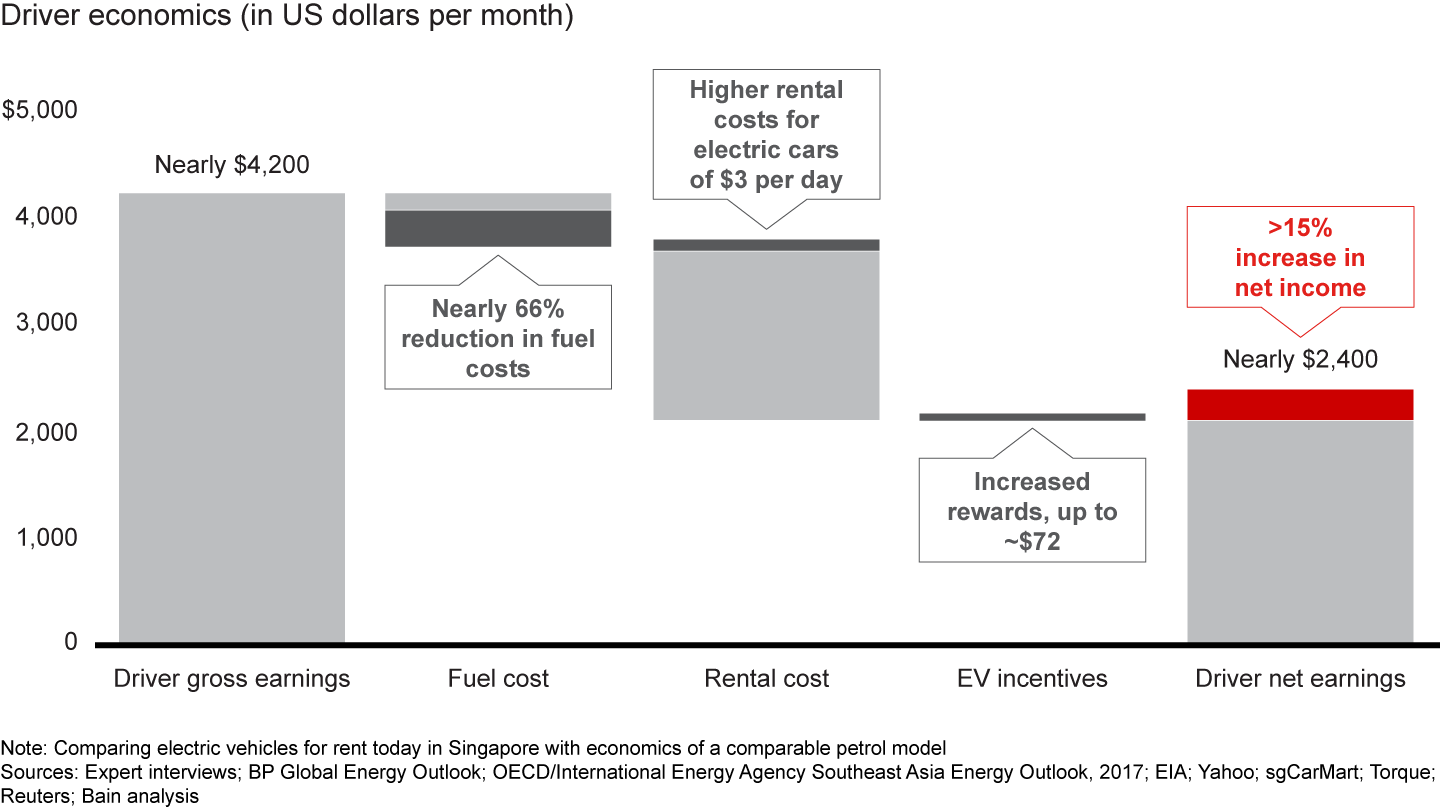

Fleet economics do vary widely across markets given different import costs (assuming all electric vehicles are imported), fuel and maintenance expenses, and electricity tariffs. Still, many commercial users will progressively see the benefits. While TCO parity already has been achieved in select markets today for high-mileage drivers, purchase price parity will arrive around 2025, depending on vehicle type and market.
Two wheelers
Looking beyond passenger cars and fleets, the next-largest segment of the combustion transport sector is two-wheeled vehicles. Motorcycles and scooters are not huge consumers of fuel on a per-kilometer basis, but they do represent a source of considerable air pollution and congestion in most Asean cities. Asean is also the largest motorcycle market in the world, and it is expected to continue to grow at 3% through 2030. Government support for electric two wheelers in several markets is not as crazy as it might seem. Incentives for two-wheeled electric vehicles would not only help the neediest segment of society but it also would make it easier to scale back fuel subsidies and ease the way for local manufacturing.
Already, Indonesia and Vietnam, both major markets for two-wheeled vehicles, are considering options to promote electric scooters and bikes. Indonesian President Joko Widodo has suggested the prospect of homegrown manufacturing and incentives to promote bike and battery production as a first step toward an electric future. Vietnam also is looking at opportunities to develop local production in the two-wheel segment. Local champion Vin Group has invested in the capacity to produce up to 250,000 electric cycles per year. This is a first step toward local production of electric vehicles and buses, and it is backstopped by a recent strategic investment by Korea’s SK Group that will provide access to batteries and other expertise. While both of these countries’ efforts are starting small, these steps represent the near-term developments that will progressively advance the wider transition to electric vehicles and seed consumer interest in a shift.
Potential for a disrupter
A third but more uncertain path forward might be through a disrupter that attempts to solve the electric vehicles problem in a different way. The history of the electric vehicle to date has largely focused on solving the hardest problem first—namely, creating a full replacement for today’s luxury vehicle, with high range, high performance and all the comforts that go with it. The reality is that more than 45% of the Asean states’ population lives in an urban environment, with most drivers only traveling fewer than 15 kilometers per day and rarely far from a service station. Is there an opportunity to provide Asean consumers, particularly millennials, with more fit-for-purpose vehicles—namely, smaller cars at a lower cost that are designed for cities? While consumers do say they want the security and range of today’s internal combustion engines, could this conventional wisdom be challenged?
Such a disrupter could come from China, where small-scale electric vehicles more than doubled the sales of regular electric vehicles in 2017. Many of the small electric vehicles are lower quality and have been manufactured by Chinese companies seeking to take advantage of the boom and incentives offered to the sector. Is there a possibility that these manufacturers would turn their focus from domestic to export markets? While the economics today are still challenging, the door could open as battery costs continue to drop, making a low-cost export model a possible disrupter in this segment for either passenger or fleet customers.
An alternative option would be for a start-up to consider launching such a vehicle with local manufacturing in Southeast Asia. Already many unconventional players considering local production of electric vehicles are emerging, from Dyson in Singapore to Energy Absolute in Thailand to Vin Group’s ambitions in Vietnam to various local players in Indonesia. Whether such OEMs can, in fact, design, manufacture and market a vehicle that consumers want remains to be seen, but there is a clear case for a possible alternative path as leading manufacturers focus their energies elsewhere.
Where to play/how to win
Given the uncertain road ahead, how can incumbents (OEMs, energy companies, fleet owners), new insurgents and investors seek to capitalize on what is certain to be one of the major investing trends of the 2020s?
For all players, success will require simultaneously taking a defensive and offensive approach.
Playing defense means acknowledging that the disruption that will spark this industry may not come from the individual passenger car market but from one of the other sectors—for example, commercial fleets, two-wheeled vehicles or services. Being on defense also means accepting that the disruption may come without government incentives and that battery economics need to improve further. With that as the starting point, the best-prepared incumbents will be those that rigorously watch for the major signposts of imminent disruption—for example, major logistics or taxi companies scaling up a pilot effort or wider adoption of electric public transport. Companies that hedge their bets for the imminent transition and that are prepared to make their moves will be best positioned to play offense when those tipping points come into view.
Playing offense means lining up the best way to participate in the value chain. That could be a matter of partnering with a local fleet operator or investing in fleet management software, charging infrastructure, telematics or passenger services. Alternatively, pursuing partnerships in the two-wheel segment could be a way to ease into markets and learn about consumers for the time when automobiles become more economical. Positioning to seize on opportunities to partner or invest may be the soundest strategy for helping to deliver and profit from Southeast Asia’s electric vehicle future when it eventually arrives.
Dale Hardcastle is a Bain & Company partner based in Singapore, Raymond Tsang is a Bain partner based in Shanghai, and Francesco Cigala is a Bain partner based in Kuala Lumpur. All are members with the firm’s Automotive practice.
First published in июнь 2019