


Brief


|
Резюме
For years, boards have held quantum at a familiar distance: eventually important, potentially transformative, and clearly disruptive but still “far enough away” to leave to research labs. That assumption is now much harder to defend. The technology is moving toward fault-tolerant systems by 2028 to 2029, with IBM’s roadmap targeting 200 logical qubits in 2029. At that threshold, quantum machines will begin to outperform classical systems on some high‑complexity optimization and simulation problems. For hardware players, this will mark a major step toward fault‑tolerant quantum computing; for enterprises, it will be the point at which quantum can start to generate a computational competitive advantage. Industries where differentiation is rooted in rapid simulation models or optimization of scenarios will be the first to realize this advantage, such as designing molecules and treatments (life sciences, healthcare), orchestrating global logistics networks, managing financial risk (banking and insurance), optimizing battery chemistry (chemicals), or modeling dynamic systems in aerospace, energy, manufacturing, and utilities. In these domains, smarter computation directly translates into faster innovation, lower costs, higher resilience, and improved sustainability. But to realize the gains, companies need to be ready to master quantum computing (QC), adding it to other capabilities in their analytics arsenal along with machine learning and artificial intelligence. Move too slowly, and they risk slipping into a widening gap behind competitors that develop this advantage faster. Early movers that embed quantum into their analytics will be able to reset cost bases, speed, and quality in ways that late adopters cannot easily match. Because building quantum capabilities takes three to four years, followers may find themselves structurally behind by the time the technology stabilizes. CEOs and executives shouldn’t still be asking whether quantum will matter, but rather how to prepare an adaptive three‑year roadmap. Once the technology stabilizes, companies need to be ready to turn quantum potential into business advantage. Why this second wave of analytics mattersQuantum computing is one of four major quantum technology domains, alongside sensors, cryptography, and communications. Unlike AI and classical analytics, it is not only about processing more data but also about searching through vast numbers of possible combinations to solve optimization problems and simulating complex systems that conventional tools cannot handle efficiently. Across multiple hardware approaches (superconducting, trapped ion, photonic, neutral atom, topological, quantum dots), progress in error correction and device engineering suggests that systems with around 200 usable logical qubits could be available by 2028 to 2029. Industrialization is likely to accelerate through the 2030s: Quantum processing units (QPUs) will emerge as standard resources, hardware will miniaturize and specialize, and the software and algorithm stack will mature. As systems with thousands of logical qubits become available (mid 2030s) and error correction scales, quantum computing is expected to move from experimental platforms to integration into enterprise architectures. It will sit alongside data platforms, AI models, and high‑performance computing (HPC), and in some cases may displace parts of today’s GPU‑based workflows. The broader technology stack will evolve rapidly, reshaping from algorithms and analytics to data architecture, deployment models, and integrated software ecosystems. This doesn’t mean quantum will replace AI. Instead, it will extend the analytical arsenal, bringing a new capability precisely where classical approaches hit their limits. The most advanced organizations will be the first to treat quantum, AI, and HPC as a continuum of tools that can be activated to cover the full spectrum of business analytics performance. But organizational change occurs more slowly than technology progress. Building the skills and use‑case portfolio, operating model, and infrastructure to exploit quantum at scale can take three to four years. Use cases take six to nine months to develop, from problem framing to mathematical modeling, algorithm tuning, data preparation (including accommodating new formats), computation, and impact assessment. This creates a synchronization problem for executives, in which there are two clocks running:
By the time the technology stabilizes at the end of this decade, the gap between early movers and followers may already be locked in. Quantum isn't another generative AI projectQuantum computing does not follow the same pattern as generative AI. There is no quick proof of concept that can be launched in a few weeks and scaled rapidly across the enterprise. Our work with Le Lab Quantique (a non-profit organization whose goal is to structure and energize the quantum ecosystem in France and abroad) and leading enterprises shows that transforming quantum potential into business value is a multiyear journey. Each use requires deep collaboration among quantum specialists, data and analytics teams, and business owners, and success depends as much on organizational learning as on hardware access. Three implications for CEOs and executives stand out:
For executives, this means quantum should be treated as a strategic technology trend with a long build‑up period. It’s too early for massive capex bets but too late to ignore and wait until it is proven technology. Let use cases lead, not technologyFor most organizations, the right entry point is focused experimentation linked to concrete business problems. The first wave of value will come from use cases where quantum can augment existing analytics in optimization, simulation, and complex modeling. Leading companies share a common approach, blending R&D and operations:
Talent is a central constraint. Companies need a small core of specialized quantum experts and a broader pool of “quantum‑literate” leaders in data, IT, and operations who can identify relevant problems, interpret results, and integrate quantum into decision processes. This capability cannot be built overnight and requires targeted hiring, training, and partnerships. Ultimately, the objective is to make quantum just another layer in the analytics stack—used where it makes a difference but invisible elsewhere. A quantum maturity modelAs with other technology initiatives, organizations can assess their readiness and capability using a maturity model (see Figure 1). This gives senior executives and their teams a common framework for tracking progress and aligning investments.
Figure 1
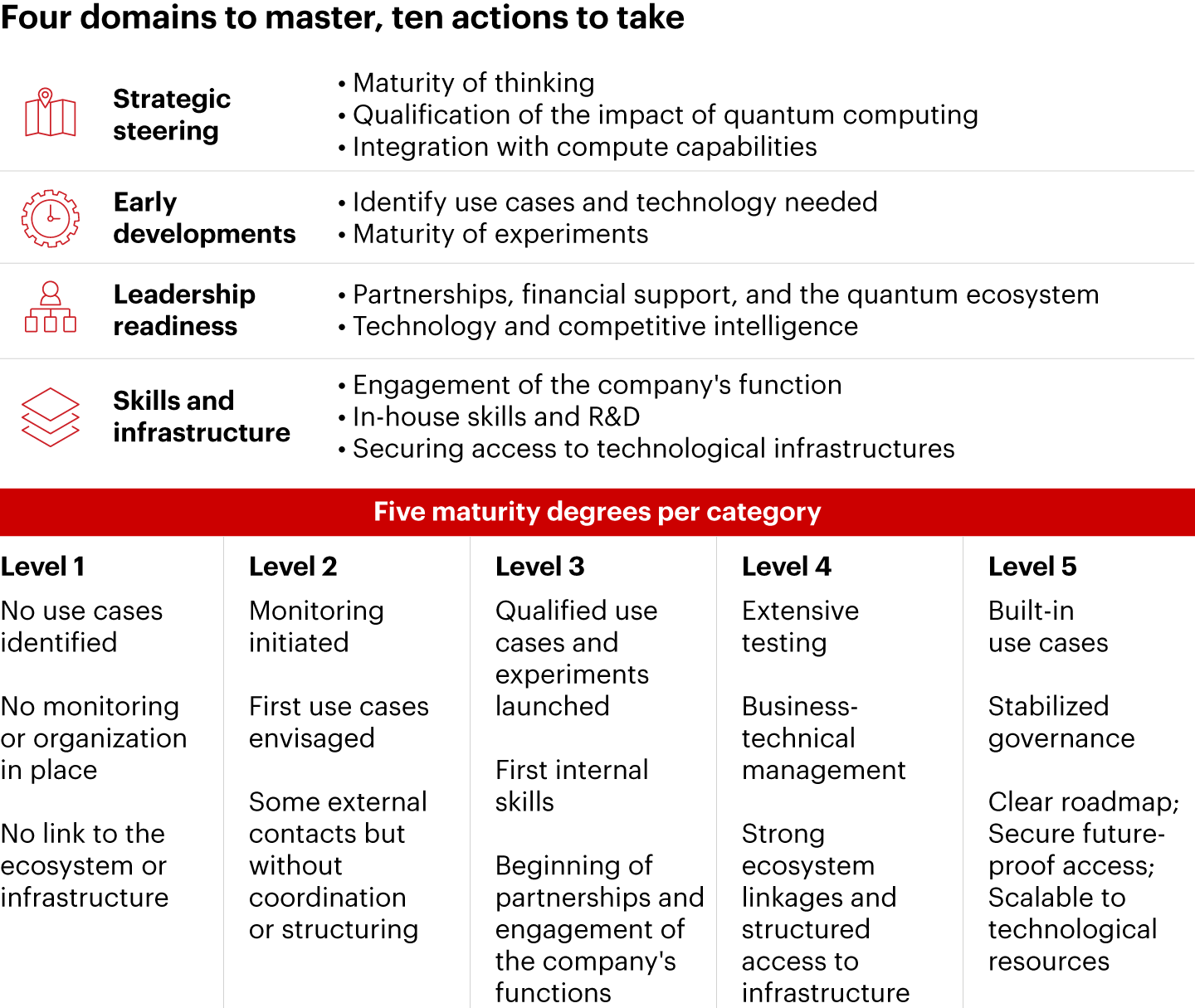

This quantum readiness maturity model considers 10 categories of action across 4 overlapping domains:
For each action category, the model offers specific metrics to gauge progress and development, from a starting point where organizations are not even monitoring an issue, to the goal of having established uses and a clear technology roadmap. A phased roadmap to avoid falling behindThe key challenge for CEOs is pacing. Moving too fast can burn out resources and credibility before the technology is ready, but moving too slowly risks falling far behind once leaders turn quantum into a real advantage. A better way to plan is to follow a phased roadmap that identifies key strategic actions and efforts, showing how they unfold in overlapping waves (see Figure 2). 1. Clarify the vision and posture (first year)
2. Launch targeted experiments and build capabilities (years 1 to 3)
3. Industrialize where quantum proves its value (years 2 to 4 and beyond)
Figure 2
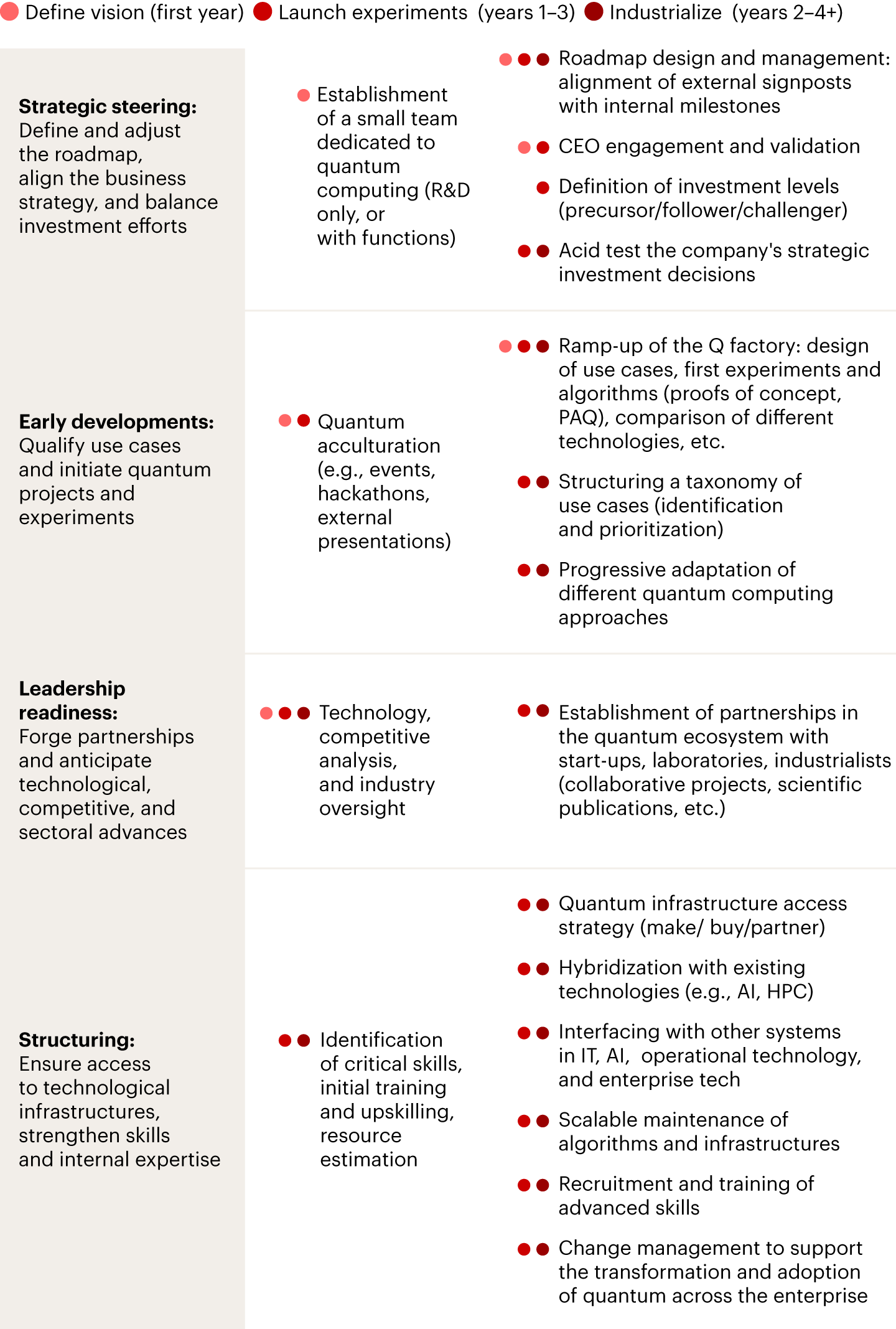

Note: PAQ=Quantum Pack, a funding program of the Ile-de-France region to explore the potential of quantum computing applied to industrial uses Sources: Bain & Company; Le Lab QuantiqueGiven the time required to build capabilities and the uncertainty on exact hardware timing, the priority for CEOs is not to make large bets on specific devices but rather to ensure the organization is ready to move fast when quantum becomes economically attractive. The risk of hesitatingFor sectors where quantum is expected to deliver greatest value earlier—healthcare and pharma, financial services, logistics, aerospace, energy, and defense—quantum is poised to become not just a breakthrough technology but also a new operating capability embedded in how business is run. Experience with previous waves of technology suggests that companies rarely lose because they started preparing too early. They lose because they underestimated how long it would take to build the capabilities and change the organization. Quantum computing may still be approaching its breakthrough moment, but for executives, the preparation phase has clearly begun. The practical question for CEOs is simple: As AI scales across the business over the next 12 to 24 months, will you view quantum as a future research topic, or as the next analytics breakthrough that could redefine the competitive landscape in your industry? The window to prepare is open but may not stay that way for long. |