
Skip to Content
  • Offices

    Offices

    North & Latin America
    • Atlanta
    • Austin
    • Bogota
    • Boston
    • Buenos Aires
    • Chicago
    • Dallas
    • Denver
    • Houston
    • Los Angeles
    • Mexico City
    • Minneapolis
    • Monterrey
    • Montreal
    • New York
    • Rio de Janeiro
    • San Francisco
    • Santiago
    • São Paulo
    • Seattle
    • Silicon Valley
    • Toronto
    • Washington, DC
    Europe & Africa
    • Amsterdam
    • Athens
    • Berlin
    • Brussels
    • Copenhagen
    • Dusseldorf
    • Frankfurt
    • Helsinki
    • Istanbul
    • Johannesburg
    • Kyiv
    • Lisbon
    • London
    • Madrid
    • Milan
    • Munich
    • Oslo
    • Paris
    • Rome
    • Stockholm
    • Vienna
    • Warsaw
    • Zurich
    Middle East
    • Doha
    • Dubai
    • Riyadh
    Asia & Australia
    • Bangkok
    • Beijing
    • Bengaluru
    • Brisbane
    • Ho Chi Minh City
    • Hong Kong
    • Jakarta
    • Kuala Lumpur
    • Manila
    • Melbourne
    • Mumbai
    • New Delhi
    • Perth
    • Seoul
    • Shanghai
    • Singapore
    • Sydney
    • Tokyo
    See all offices
  • Alumni
  • Media Center
  • Subscribe
  • Contact
  • Global

    Select your region and language

    Global
    • Global (English)
    North & Latin America
    • Brazil (Português)
    • Argentina (Español)
    • Canada (Français)
    • Chile (Español)
    • Colombia (Español)
    Europe, Middle East, & Africa
    • France (Français)
    • DACH Region (Deutsch)
    • Italy (Italiano)
    • Spain (Español)
    • Greece (Elliniká)
    Asia & Australia
    • China (中文版)
    • Korea (한국어)
    • Japan (日本語)
  • Saved items (0)
    Saved items (0)

    You have no saved items.

    Bookmark content that interests you and it will be saved here for you to read or share later.

    Explore Bain Insights
  • Industries
    Main menu

    Industries

    • Aeroespacial y Defensa
    • Agroindustria
    • Químicos
    • Construcción e Infraestructura
    • Productos de Consumo
    • Servicios Financieros
    • Salud y Ciencias de la Vida
    • Maquinaria y Equipo Industrial
    • Medios y Entretenimiento
      Industries
      Medios y Entretenimiento
      • Media Lab
    • Metales
    • Minería
    • Petróleo y Gas
    • Papel y Empaque
    • Private Equity
      Industries
      Private Equity
      • Due Diligence
      • Exit Planning
      • Firm Strategy & Operations
      • Portfolio Value Creation
    • Sector Público y Social
    • Retail
    • Tecnología
    • Telecomunicaciones
      Industries
      Telecomunicaciones
      • Capital Expenditure
      • Telco Digital Transformation
    • Transporte
    • Viajes y Turismo
    • Servicios Públicos y Energías Renovables
  • Consulting Services
    Main menu

    Consulting Services

    • Customer Experience
    • Sustainability
    • Innovation
    • M&A
    • Operations
    • People & Organization
    • Private Equity
    • Sales & Marketing
    • Strategy
    • AI, Insights, and Solutions
    • Technology
    • Transformation
  • Digital
  • Insights
    Main menu

    Insights

    • Industry Insights
    • Services Insights
    • Bain Books
    • Webinars
    • Bain Futures
    View all Insights
    Featured topics
    • Tariff Response
    • Artificial Intelligence
    • Thriving in Uncertainty
    • Executive Conversations
    • Macro Trends
    • M&A Report
    • Healthcare Private Equity Report
    • Paper & Packaging Report
    • Technology Report
    • CEO's Guide to Sustainability
    • CEO Insights
    • CFO Insights
    • COO Insights
    • CIO Insights
    • CMO Insights
    View all featured topics
  • About
    Main menu

    About

    • What We Do
    • What We Believe
    • Our People & Leadership
    • Client Results
    • Awards & Recognition
    • Global Affiliations
    Further: Our global responsibility
    • Sustainability
    • Social Impact
    • World Economic Forum
    Learn more about Further
  • Carreras
    Main menu

    Carreras

    • Trabaja con Nosotros
      Carreras
      Trabaja con Nosotros
      • Find Your Place
      • Nuestras Áreas de Trabajo
      • Equipos Integrados
      • Estudiantes
      • Internships & Programs
      • Eventos de Reclutamiento
    • La Vida en Bain
      Carreras
      La Vida en Bain
      • Blog: Inside Bain
      • Historias Profesionales
      • Nuestra Gente
      • Dónde Trabajamos
      • Apoyando tu Crecimiento
      • Grupos de Afinidad
      • Beneficios
    • Impact Stories
    • Nuestro Proceso
      Carreras
      Nuestro Proceso
      • Qué Esperar
      • Entrevistas
    FIND JOBS
  • Offices
    Main menu

    Offices

    • North & Latin America
      Offices
      North & Latin America
      • Atlanta
      • Austin
      • Bogota
      • Boston
      • Buenos Aires
      • Chicago
      • Dallas
      • Denver
      • Houston
      • Los Angeles
      • Mexico City
      • Minneapolis
      • Monterrey
      • Montreal
      • New York
      • Rio de Janeiro
      • San Francisco
      • Santiago
      • São Paulo
      • Seattle
      • Silicon Valley
      • Toronto
      • Washington, DC
    • Europe & Africa
      Offices
      Europe & Africa
      • Amsterdam
      • Athens
      • Berlin
      • Brussels
      • Copenhagen
      • Dusseldorf
      • Frankfurt
      • Helsinki
      • Istanbul
      • Johannesburg
      • Kyiv
      • Lisbon
      • London
      • Madrid
      • Milan
      • Munich
      • Oslo
      • Paris
      • Rome
      • Stockholm
      • Vienna
      • Warsaw
      • Zurich
    • Middle East
      Offices
      Middle East
      • Doha
      • Dubai
      • Riyadh
    • Asia & Australia
      Offices
      Asia & Australia
      • Bangkok
      • Beijing
      • Bengaluru
      • Brisbane
      • Ho Chi Minh City
      • Hong Kong
      • Jakarta
      • Kuala Lumpur
      • Manila
      • Melbourne
      • Mumbai
      • New Delhi
      • Perth
      • Seoul
      • Shanghai
      • Singapore
      • Sydney
      • Tokyo
    See all offices
  • Alumni
  • Media Center
  • Subscribe
  • Contact
  • Global
    Main menu

    Select your region and language

    • Global
      Select your region and language
      Global
      • Global (English)
    • North & Latin America
      Select your region and language
      North & Latin America
      • Brazil (Português)
      • Argentina (Español)
      • Canada (Français)
      • Chile (Español)
      • Colombia (Español)
    • Europe, Middle East, & Africa
      Select your region and language
      Europe, Middle East, & Africa
      • France (Français)
      • DACH Region (Deutsch)
      • Italy (Italiano)
      • Spain (Español)
      • Greece (Elliniká)
    • Asia & Australia
      Select your region and language
      Asia & Australia
      • China (中文版)
      • Korea (한국어)
      • Japan (日本語)
  • Saved items  (0)
    Main menu
    Saved items (0)

    You have no saved items.

    Bookmark content that interests you and it will be saved here for you to read or share later.

    Explore Bain Insights
  • Industries
    • Industries

      • Aeroespacial y Defensa
      • Agroindustria
      • Químicos
      • Construcción e Infraestructura
      • Productos de Consumo
      • Servicios Financieros
      • Salud y Ciencias de la Vida
      • Maquinaria y Equipo Industrial
      • Medios y Entretenimiento
      • Metales
      • Minería
      • Petróleo y Gas
      • Papel y Empaque
      • Private Equity
      • Sector Público y Social
      • Retail
      • Tecnología
      • Telecomunicaciones
      • Transporte
      • Viajes y Turismo
      • Servicios Públicos y Energías Renovables
  • Consulting Services
    • Consulting Services

      • Customer Experience
      • Sustainability
      • Innovation
      • M&A
      • Operations
      • People & Organization
      • Private Equity
      • Sales & Marketing
      • Strategy
      • AI, Insights, and Solutions
      • Technology
      • Transformation
  • Digital
  • Insights
    • Insights

      • Industry Insights
      • Services Insights
      • Bain Books
      • Webinars
      • Bain Futures
      View all Insights
      Featured topics
      • Tariff Response
      • Artificial Intelligence
      • Thriving in Uncertainty
      • Executive Conversations
      • Macro Trends
      • M&A Report
      • Healthcare Private Equity Report
      • Paper & Packaging Report
      • Technology Report
      • CEO's Guide to Sustainability
      • CEO Insights
      • CFO Insights
      • COO Insights
      • CIO Insights
      • CMO Insights
      View all featured topics
  • About
    • About

      • What We Do
      • What We Believe
      • Our People & Leadership
      • Client Results
      • Awards & Recognition
      • Global Affiliations
      Further: Our global responsibility
      • Sustainability
      • Social Impact
      • World Economic Forum
      Learn more about Further
  • Carreras
    Popular Searches
    • Agile
    • Digital
    • Strategy
    Your Previous Searches
      Recently Visited Pages

      Content added to saved items

      Saved items (0)

      Removed from saved items

      Saved items (0)

      Brief

      Reinventing the Consumer Products Supply Chain

      Reinventing the Consumer Products Supply Chain

      Some companies are avoiding the looming margins crunch by taking a new approach to supply chains.

      By Allard Vegter, Thomas Kwasniok, Adam Borchert, and Drew Woodhouse

      • min read
      }

      Brief

      Reinventing the Consumer Products Supply Chain
      en
      Executive Summary
      • Our proprietary research found that consumer goods companies can expect margins to shrink as much as 30% by 2030, as they deal with major industry disruptions.
      • To maintain their margins and prepare for evolving consumer and retailer needs, some companies are upending their traditional view of supply chains.
      • The most successful companies take a future-back and unconstrained view, build segmented supply chains and rigorously assess the digital tools that support them.

      Consumer goods companies face tremendous disorder. Their consumers are evolving fast, seeking greater convenience, demanding sustainable goods, embracing insurgent brands and private labels. Consumers want more from brands: transparency, traceability, and goods that support their well-being and are customized enough that those products seem to have been made just for them. Their retail customers have evolved, too. They’re grappling with tectonic shifts caused by the surging growth of e-commerce and the prevalence of everyday value. As a result, they fiercely negotiate to maintain already razor-thin margins.

      Looking ahead, the traditional value chain in which consumer products companies manufacture goods that retailers sell to consumers could be further turned on its head. Retailers are already moving up and down the value chain, into territory they once actively avoided. Grocers now own manufacturing facilities and have access to world-class comanufacturers to produce sophisticated private labels masquerading as insurgents. They operate farms to grow their own fresh offerings. Also, new channels and intermediaries are emerging at breakneck pace. There’s more competition from direct-to-consumer models and food delivery, for example, and channel fragmentation has enabled consumers to purchase products at their point of need, whether that’s the gym, a hotel or—coming soon—on the street with drone delivery.

      This squeeze from both consumers and retailers can take a huge toll on brands that don’t act quickly. Bain & Company estimates consumer goods companies that fail to take adequate steps could lose as much as 30% of their margins by 2030 (see the Bain Brief “Overcoming the Existential Crisis in Consumer Goods”).

      In many cases, margins are being eroded by rising supply-chain costs. Those costs mount as companies have to serve more channels with distinct requirements, meet retailers’ demands for better service, address consumers’ growing preference for customized products and provide a broader portfolio of channel-specific packaging. In the US, half of those diminishing margins could result from rising supply chain costs. By comparison, only one-sixth of the margin drop will be from the cost pressures of retailer consolidation and one-third from smarter and tougher negotiations (see Figure 1).

      Figure 1
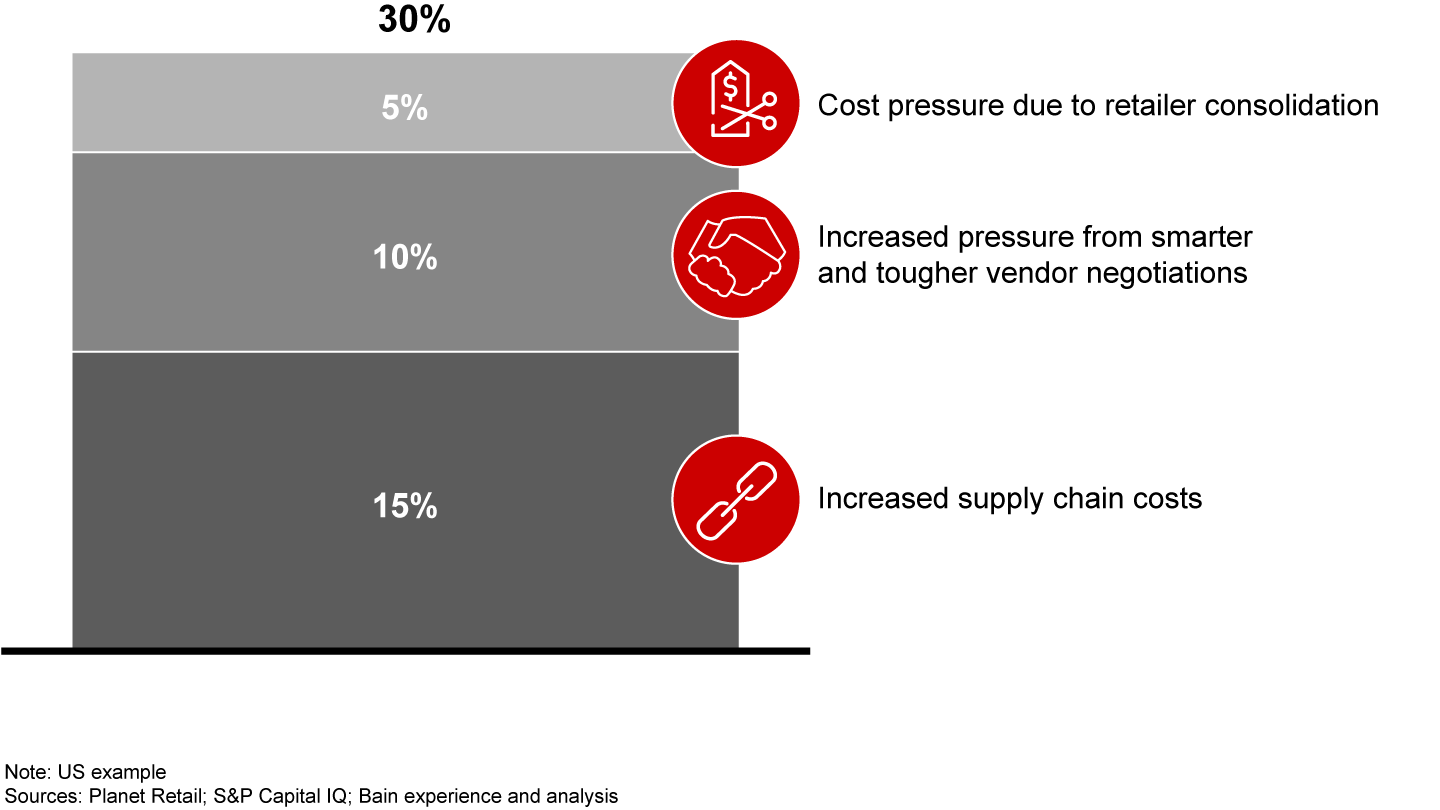
      Consumer goods companies risk losing as much as 30% of their margins
      Consumer goods companies risk losing as much as 30% of their margins
      Consumer goods companies risk losing as much as 30% of their margins

      Trouble is, few consumer goods companies have built supply chains that will give them a competitive edge in an era of rising costs and rapid technological advancement. Yet those that reinvent their supply chains are reaping the rewards: improvements in efficiency, reliability, agility and velocity that boost margins by 5 to 10 percentage points (see Figure 2). Consider the case of a beverage company, a category leader whose cost position wasn’t significantly better than competitors, which were reducing their costs. Rapid growth had caused the company to expand operations without a streamlined strategy for sourcing, manufacturing and logistics. A supply chain transformation decreased the cost per unit by over 20%, positioning the company as the cost leader while maintaining quality and reducing complexity.

      Figure 2
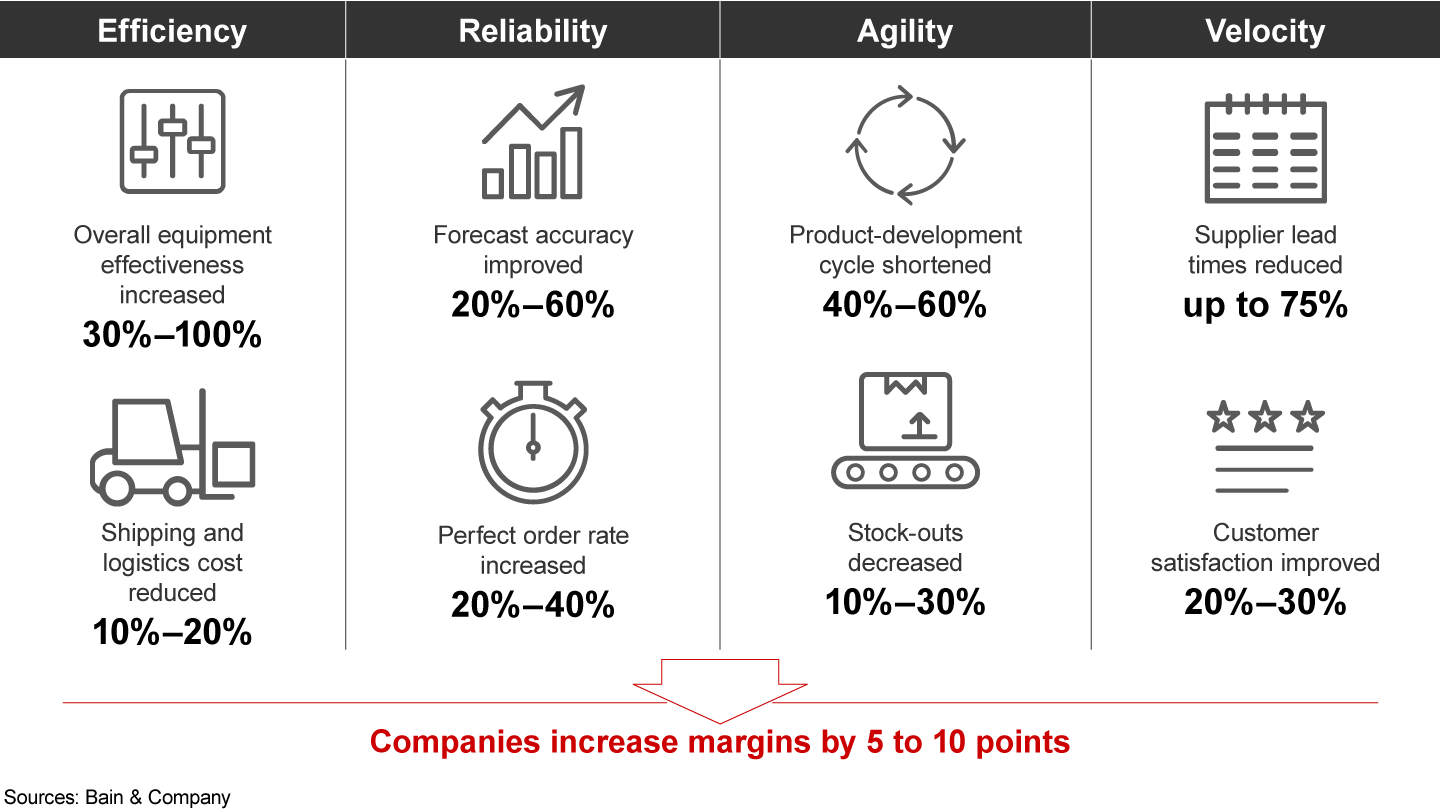
      Supply chain reinvention leads to game-changing results in many areas
      Supply chain reinvention leads to game-changing results in many areas
      Supply chain reinvention leads to game-changing results in many areas

      Indeed, some consumer goods companies are getting ahead by reinventing their end-to-end supply chains for the future, from planning to sourcing, manufacturing, footprint, customer service and logistics. They’re creating segmented, modularized and simplified supply chains; installing automated, no-touch planning; building forecasting systems that use machine learning and such industry 4.0 capabilities as next-gen sensors—all while making the most of Agile innovation.

      In our view, supply chains should always be designed to align with and serve the corporate strategy. The best companies focus on three elements.

      Take a future-back and unconstrained view. To systematically prepare for the future while also creating it, we encourage consumer products executives to follow a future-back approach. Future back requires assessing possible scenarios that will have the greatest impact on industry dynamics, then developing plans around that view of the future. The future scenarios need to account for shifting ecosystems and profit pools, evolving consumer behavior and preferences, disruptive technologies, and new competitors and business models.

      With these priorities in mind, companies start to reinvent their supply chain by taking an unconstrained view of what’s possible. We ask executives to take a clean sheet of paper and design a winning supply chain that supports the business strategy and creates competitive advantage—from scratch. Sometimes, operations decision makers are accustomed—and trained—to focus on continuous improvement. But we ask them to do something counterintuitive: step back and draw a visionary picture of how they would imagine an optimal future. Instead of asking them to make incremental steps and consider constraints, we have them envision a scenario in which the company produces its ideal product portfolio with the most collaborative supplier base, employing a perfect labor model and state-of-the-art production equipment, using digital and industry 4.0 capabilities, and delivering via the optimal route to the customer.

      We then have them go back and insert the constraints, such as capex limits, management bandwidth or regulatory, stakeholder and community concerns. For example, if they can’t spend the $10 billion required for the perfect scenario but have $1 billion, they readjust the schedule. Companies need to be strategic when deciding which constraints to add back. It’s the first move in creating an achievable plan, and it’s often what separates a winning supply chain from a mediocre one. This process typically sheds new light on how to unlock value, for both supply chain costs and commercial capabilities.

      Think segmentation. Every executive knows that all customers, geographies, channels and categories are not equally valuable. The best-positioned consumer goods companies use varying business needs as the starting point for creating separate supply chains. They know where they need to be good enough, where they need to be better than competitors and where they need to be truly differentiated.

      When a global consumer goods company decided to differentiate itself by offering a suite of sustainable products, it carved out a set of supply chains for two dozen sustainable brands that have a lower carbon footprint and create positive social impact. The separate supply chain approach enabled the company to surpass its sustainability targets, reducing its carbon footprint by 15%, while turbocharging growth. Those brands, promoted for their sustainability, are growing 69% faster than the company’s other brands and are generating 75% of its growth. At the same time, the company has reduced costs as much as 20% and surpassed competitors in the ability to innovate quicker and cheaper.

      Another consumer goods company pursued a different type of segmented supply chain. It built one chain for its low-margin businesses, designed for efficiency above all, with standardization in sourcing, manufacturing, customer service and logistics. It built another for its high-margin business, which it saw as an important source of growth. For the latter supply chain, the company shifted the focus from efficiency to service levels, delivery speed and flexibility. It knew that new channel dynamics and business models would keep creating new requirements and that digital technologies would keep creating opportunities to step change agility and flexibility.

      Some companies take a segmented approach based on three archetypes. “Simple and efficient” supply chains drive the core business and are designed to guarantee the lowest total cost for high volumes at consistent quality. “Managed complexity” supply chains can customize or add options, balancing cost with best-in-class reliability. “Agile and adaptive” supply chains spur disruptive growth, rapidly fulfilling new or unexpected customer requests.

      Using this three-archetype approach, a food company laid out a plan to apportion its manufacturing capabilities among three plants. Scale plants will produce large batches and offer flexibility on only a few specific dimensions; flex plants will accommodate short batches and short lead times; and pilot plants will manufacture microbatches of products for market testing prior to launch. Combined with a new emphasis on contract manufacturing for commodity products, late differentiated capabilities in distribution centers and modular logistics solutions such as full pallets to unit picking, the company is positioning itself to leapfrog the competition. It will innovate quicker and cheaper, enabling its growth strategy. The company expects to reduce supply chain costs by 10% to 20% and its carbon footprint by 15%.

      Use digital tools strategically. Some companies move too quickly—or too slowly—to adopt digital tools. The best companies rigorously assess their digital capabilities and how they’ll help the company deliver its unique strategy. They recognize the difference among technologies that are ready to be deployed at scale, those that should be piloted first and those that just need more time to mature before any use. The goal is to use digital capabilities selectively to operate plants more effectively—to squeeze more out of existing assets instead of rebuilding.

      The best digital adopters use advanced analytics to improve logistics and demand planning. They also can rely on control towers to discover supply chain incidents before the issues show up in a KPI report. That means everything from shipped materials that don’t arrive on time, to incomplete production orders, to inventory gaps that result in delayed orders. However, while control towers detect these issues, companies also need a mitigation team that, as part of the workflow system, is ready to take the appropriate action, by releasing inventory earlier than planned, for example.

      The beverage company mentioned earlier identified opportunities to use digital enablers to automate processes in specific plants. Then it directed production for the highest-performing SKUs to those plants, which were the company’s most efficient. The company also maximized scale advantages with key suppliers and began relying on advanced analytics for planning, a move that boosted its ability to forecast consumption. The company could account for a much larger range of variables than before, vastly improving accuracy. In addition to its new status as the cost leader, the beverage company is now much better positioned to quickly serve customer needs—both today and as they evolve in the years ahead.

      As consumer goods companies transform their supply chains to lessen the impact of margin pressures and assess how their supply chains are matched to business strategy in an era of disruption, the most successful will focus on these three elements. They’ll take an unconstrained future-back approach, segment supply chains and be strategic about deploying digital tools—a proven way for consumer goods companies to march more confidently into the future.

      Allard Vegter is a Bain & Company partner based in Amsterdam. Thomas Kwasniok is a partner based in London. Adam Borchert and Drew Woodhouse are partners based in Boston and Sydney, respectively. All are members of Bain’s Consumer Products practice.

      Authors
      • Headshot of Allard Vegter
        Allard Vegter
        Partner, Amsterdam
      • Headshot of Thomas Kwasniok
        Thomas Kwasniok
        Partner, London
      • Headshot of Adam Borchert
        Adam Borchert
        Partner, Boston
      • Headshot of Drew Woodhouse
        Drew Woodhouse
        Partner, Sydney
      Related Industries
      • Consumer Products
      Related Consulting Services
      • AI, Insights, and Solutions
      • Business Strategy
      • Digital
      • Supply Chain
      COO insights
      AI Is Revolutionizing Industrial Operations

      Supply chain planning, procurement enhancements, manufacturing optimization, and engineering augmentation are emerging AI opportunities.

      Read more
      COO insights
      How AI Is Starting to Transform Circular Packaging

      There are 15 AI use cases companies across the value chain can use today to accelerate circularity.

      Read more
      Consumer Products
      Insurgent Q&A: Chomps Cofounder Rashid Ali

      “Our retail expansion story isn’t about taking share—it’s about growing the category.”

      Read more
      Business Strategy
      Transforming Your Business with AI

      Five questions for every CEO.

      Read more
      COO insights
      It’s Time to Rethink Every Link in Your Supply Chain

      A function that once got little attention is now becoming a key differentiator.

      Read more
      First published in enero 2020
      Tags
      • AI, Insights, and Solutions
      • Business Strategy
      • Consumer Products
      • COO insights
      • Digital
      • Supply Chain

      How We've Helped Clients

      A Strategic Separation Enables New Growth for GSK and Haleon

      See more related case studies

      Food Co. jump-starts growth with return to core brands

      See more related case studies

      Focus on core delivers growth for retailer

      See more related case studies

      Want to continue the conversation

      We help global leaders with their organization's most critical issues and opportunities. Together, we create enduring change and results

      Bain Insights. Our perspectives on critical issues global businesses face in today's challenging environment, delivered monthly.

      *I have read and understand Bain’s Privacy Notice.

      Please read and agree to the Privacy Policy.
      Bain & Company
      Contact us Sustainability Accessibility Terms of use Privacy Modern Slavery Act Statement Cookie Policy Sitemap Log In

      © 1996-2026 Bain & Company, Inc.

      Contact Bain

      How can we help you?

      • Business inquiry
      • Career information
      • Press relations
      • Partnership request
      • Speaker request
      See all offices