
Skip to Content
  • Offices

    Offices

    North & Latin America
    • Atlanta
    • Austin
    • Bogota
    • Boston
    • Buenos Aires
    • Chicago
    • Dallas
    • Denver
    • Houston
    • Los Angeles
    • Mexico City
    • Minneapolis
    • Monterrey
    • Montreal
    • New York
    • Rio de Janeiro
    • San Francisco
    • Santiago
    • São Paulo
    • Seattle
    • Silicon Valley
    • Toronto
    • Washington, DC
    Europe & Africa
    • Amsterdam
    • Athens
    • Berlin
    • Brussels
    • Copenhagen
    • Dusseldorf
    • Frankfurt
    • Helsinki
    • Istanbul
    • Johannesburg
    • Kyiv
    • Lisbon
    • London
    • Madrid
    • Milan
    • Munich
    • Oslo
    • Paris
    • Rome
    • Stockholm
    • Vienna
    • Warsaw
    • Zurich
    Middle East
    • Doha
    • Dubai
    • Riyadh
    Asia & Australia
    • Bangkok
    • Beijing
    • Bengaluru
    • Brisbane
    • Ho Chi Minh City
    • Hong Kong
    • Jakarta
    • Kuala Lumpur
    • Manila
    • Melbourne
    • Mumbai
    • New Delhi
    • Perth
    • Seoul
    • Shanghai
    • Singapore
    • Sydney
    • Tokyo
    See all offices
  • Alumni
  • Media Center
  • Subscribe
  • Contact
  • Brazil | Português

    Select your region and language

    Global
    • Global (English)
    North & Latin America
    • Brazil (Português)
    • Argentina (Español)
    • Canada (Français)
    • Chile (Español)
    • Colombia (Español)
    Europe, Middle East, & Africa
    • France (Français)
    • DACH Region (Deutsch)
    • Italy (Italiano)
    • Spain (Español)
    • Greece (Elliniká)
    Asia & Australia
    • China (中文版)
    • Korea (한국어)
    • Japan (日本語)
  • Saved items (0)
    Saved items (0)

    You have no saved items.

    Bookmark content that interests you and it will be saved here for you to read or share later.

    Explore Bain Insights
  • Industries
    Main menu

    Industries

    • Aeroespacial e Defesa
    • Agronegócio
    • Química
    • Construção e Infraestrutura
    • Bens de Consumo
    • Serviços Financeiros
    • Healthcare & Life Sciences
    • Máquinas e Equipamentos Industriais
    • Mídia e Entretenimento
      Industries
      Mídia e Entretenimento
      • Media Lab
    • Metais
    • Mineração
    • Petróleo e Gás
    • Papel e Embalagens
    • Private Equity
      Industries
      Private Equity
      • Due Diligence
      • Exit Planning
      • Firm Strategy & Operations
      • Portfolio Value Creation
    • Setor Público e Social
    • Varejo
    • Tecnologia
    • Telecomunicações
      Industries
      Telecomunicações
      • Capital Expenditure
      • Telco Digital Transformation
    • Transporte
    • Turismo & Lazer
    • Energia & Renováveis
  • Consulting Services
    Main menu

    Consulting Services

    • Customer Experience
    • Sustainability
    • Innovation
    • M&A
    • Operations
    • People & Organization
    • Private Equity
    • Sales & Marketing
    • Strategy
    • AI, Insights, and Solutions
    • Technology
    • Transformation
  • Digital
  • Insights
    Main menu

    Insights

    • Industry Insights
    • Services Insights
    • Bain Books
    • Webinars
    • Bain Futures
    View all Insights
    Featured topics
    • Tariff Response
    • Artificial Intelligence
    • Thriving in Uncertainty
    • Executive Conversations
    • Macro Trends
    • M&A Report
    • Healthcare Private Equity Report
    • Paper & Packaging Report
    • Technology Report
    • CEO's Guide to Sustainability
    • CEO Insights
    • CFO Insights
    • COO Insights
    • CIO Insights
    • CMO Insights
    View all featured topics
  • About
    Main menu

    About

    • What We Do
    • What We Believe
    • Our People & Leadership
    • Client Results
    • Awards & Recognition
    • Global Affiliations
    Further: Our global responsibility
    • Sustainability
    • Social Impact
    • World Economic Forum
    Learn more about Further
  • Carreiras
    Main menu

    Carreiras

    • Trabalhe Conosco
      Carreiras
      Trabalhe Conosco
      • Find Your Place
      • Nossas áreas de trabalho
      • Equipes integradas
      • Estudantes
      • Programas e estágios
      • Eventos de Recrutamento
    • A Vida na Bain
      Carreiras
      A Vida na Bain
      • Blog: Inside Bain
      • Histórias de carreira
      • Nossas pessoas
      • Onde trabalhamos
      • Apoioao seu crescimento
      • Grupos de afinidade
      • Benefícios
    • Impact Stories
    • Nosso Processo Seletivo
      Carreiras
      Nosso Processo Seletivo
      • O Que Esperar
      • Entrevistas
    FIND JOBS
  • Offices
    Main menu

    Offices

    • North & Latin America
      Offices
      North & Latin America
      • Atlanta
      • Austin
      • Bogota
      • Boston
      • Buenos Aires
      • Chicago
      • Dallas
      • Denver
      • Houston
      • Los Angeles
      • Mexico City
      • Minneapolis
      • Monterrey
      • Montreal
      • New York
      • Rio de Janeiro
      • San Francisco
      • Santiago
      • São Paulo
      • Seattle
      • Silicon Valley
      • Toronto
      • Washington, DC
    • Europe & Africa
      Offices
      Europe & Africa
      • Amsterdam
      • Athens
      • Berlin
      • Brussels
      • Copenhagen
      • Dusseldorf
      • Frankfurt
      • Helsinki
      • Istanbul
      • Johannesburg
      • Kyiv
      • Lisbon
      • London
      • Madrid
      • Milan
      • Munich
      • Oslo
      • Paris
      • Rome
      • Stockholm
      • Vienna
      • Warsaw
      • Zurich
    • Middle East
      Offices
      Middle East
      • Doha
      • Dubai
      • Riyadh
    • Asia & Australia
      Offices
      Asia & Australia
      • Bangkok
      • Beijing
      • Bengaluru
      • Brisbane
      • Ho Chi Minh City
      • Hong Kong
      • Jakarta
      • Kuala Lumpur
      • Manila
      • Melbourne
      • Mumbai
      • New Delhi
      • Perth
      • Seoul
      • Shanghai
      • Singapore
      • Sydney
      • Tokyo
    See all offices
  • Alumni
  • Media Center
  • Subscribe
  • Contact
  • Brazil | Português
    Main menu

    Select your region and language

    • Global
      Select your region and language
      Global
      • Global (English)
    • North & Latin America
      Select your region and language
      North & Latin America
      • Brazil (Português)
      • Argentina (Español)
      • Canada (Français)
      • Chile (Español)
      • Colombia (Español)
    • Europe, Middle East, & Africa
      Select your region and language
      Europe, Middle East, & Africa
      • France (Français)
      • DACH Region (Deutsch)
      • Italy (Italiano)
      • Spain (Español)
      • Greece (Elliniká)
    • Asia & Australia
      Select your region and language
      Asia & Australia
      • China (中文版)
      • Korea (한국어)
      • Japan (日本語)
  • Saved items  (0)
    Main menu
    Saved items (0)

    You have no saved items.

    Bookmark content that interests you and it will be saved here for you to read or share later.

    Explore Bain Insights
  • Industries
    • Industries

      • Aeroespacial e Defesa
      • Agronegócio
      • Química
      • Construção e Infraestrutura
      • Bens de Consumo
      • Serviços Financeiros
      • Healthcare & Life Sciences
      • Máquinas e Equipamentos Industriais
      • Mídia e Entretenimento
      • Metais
      • Mineração
      • Petróleo e Gás
      • Papel e Embalagens
      • Private Equity
      • Setor Público e Social
      • Varejo
      • Tecnologia
      • Telecomunicações
      • Transporte
      • Turismo & Lazer
      • Energia & Renováveis
  • Consulting Services
    • Consulting Services

      • Customer Experience
      • Sustainability
      • Innovation
      • M&A
      • Operations
      • People & Organization
      • Private Equity
      • Sales & Marketing
      • Strategy
      • AI, Insights, and Solutions
      • Technology
      • Transformation
  • Digital
  • Insights
    • Insights

      • Industry Insights
      • Services Insights
      • Bain Books
      • Webinars
      • Bain Futures
      View all Insights
      Featured topics
      • Tariff Response
      • Artificial Intelligence
      • Thriving in Uncertainty
      • Executive Conversations
      • Macro Trends
      • M&A Report
      • Healthcare Private Equity Report
      • Paper & Packaging Report
      • Technology Report
      • CEO's Guide to Sustainability
      • CEO Insights
      • CFO Insights
      • COO Insights
      • CIO Insights
      • CMO Insights
      View all featured topics
  • About
    • About

      • What We Do
      • What We Believe
      • Our People & Leadership
      • Client Results
      • Awards & Recognition
      • Global Affiliations
      Further: Our global responsibility
      • Sustainability
      • Social Impact
      • World Economic Forum
      Learn more about Further
  • Carreiras
    Popular Searches
    • Agile
    • Digital
    • Strategy
    Your Previous Searches
      Recently Visited Pages

      Content added to saved items

      Saved items (0)

      Removed from saved items

      Saved items (0)

      Brief

      Focus on key decisions

      Focus on key decisions

      Don't overlook small, frequent decisions that generate a lot of value over time.

      By Marcia W. Blenko, Michael C. Mankins and Paul Rogers

      • min read

      Brief

      Focus on key decisions
      en

      Nike’s famous “swoosh” is a global icon, a brand that’s recognized by consumers and sports fans worldwide. Less well known are the organizational structure and processes Nike has relied on to build global leadership in sports-related footwear, apparel and equipment. The company had long been organized as a matrix, with the three businesses on one dimension and geographic areas on the other. In 2007, however, executives began to see that they were missing a holistic focus on a given sport—soccer, golf, etc.—across the three business areas. So they introduced a sport-focused dimension to the matrix.

      With their “Just Do It” attitude, most people at Nike welcomed the change, realizing it would bring them closer to consumers. But many also wondered if another set of dotted-line accountabilities would bog down the organization. Who would make key decisions? Who would be responsible for implementing them? Unless everyone at Nike understood exactly how the new organization would work, they would never be able to respond quickly enough to changing trends in all the countries, products and sports where the company competes.


      An organization’s decision abilities determine its performance. Companies that make better decisions, make them faster and translate them into action more effectively nearly always outrun their competitors. But managers and employees in any large company make countless decisions every day. How can an individual manager or a leadership team know which decisions to focus on? How can it analyze those individual decisions to see what’s working and what isn’t?

      This article aims to help you answer both questions. It shows how to identify your organization’s critical decisions, the ones that most affect results. And it shows how to use a tool we call a decision X-ray to expose the trouble spots and begin to identify improvements. Taken together, these actions can tune up your organization to deliver peak performance.

      Two categories of critical decisions

      What are your critical decisions? Any organization’s success obviously hinges on big, high-value choices, whether strategic or operational. When Starbucks introduced its instant coffee, or when Applied Materials moved its manufacturing and engineering base to Asia, the decisions involved sizable amounts of resources and significant risk. Each company had to do the best job it possibly could on the decisions.

      Decisions like these aren’t limited to the corporate level—every unit within a company has big strategic decisions of its own. When IT decides to invest in a major systems upgrade, for example, that’s clearly a critical decision for the IT organization.

      But there’s a second category of decisions that can be equally important: those that are made and remade frequently, week in and week out, and that add up to a substantial amount of value over time. These decisions are typically more operational in nature. The people who make and execute them can be anywhere in the organization, and often they are on or near the frontline. For instance, Amazon.com’s continuing success depends partly on a host of savvy merchandising decisions, including decisions about special prices and shipping discounts, suggestions for complementary purchases and targeted email notices about new offerings. Individually, each of these decisions may have a relatively small impact. Taken together, they stimulate many millions of dollars in sales and contribute to a winning customer experience.

      Every part of an enterprise is likely to have this kind of everyday critical decision as well. IT organizations, for example, must make routine but often essential decisions about matters such as software upgrades and help-desk staffing levels.

      Critical decisions are an example of the “80–20” rule—a subset of decisions has a disproportionate impact on an organization’s performance. The key, therefore, is for organizations at whatever level—business units, functions, even teams—to develop their own lists of critical decisions, including decisions from both categories. That way they will always be focusing on what’s most important.

      Bain Book

      Decide & Deliver

      Learn more about the five steps that leading organizations use to make great decisions quickly and execute them effectively.

      Identifying your critical decisions

      Here’s a simple two-step process that will help you identify your own critical decisions.

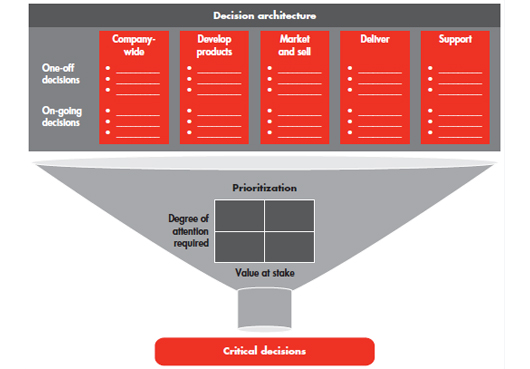
      1. Create a decision architecture

      A decision architecture lays out a list of decisions for every major business process of a given company or unit. It shows the value creation steps that the business or unit is responsible for. It identifies the decisions, both one-off and ongoing, involved in each one. Depending upon the business, a decision architecture may contain scores of decisions. It gives you a holistic view, enabling you to home in on those that are central to success. It ensures that you have thought through all the possibilities and that you don’t miss any important decisions.

      2. Winnow the list

      The next step is to shorten the list of decisions to those you most need to focus on. Companies typically employ two distinct screens as they narrow down their lists. One is the value at stake. High value decisions are generally more important than those with lower value. To make sure you don’t miss the everyday decisions that add up over time, you can keep in mind a handy formula: decision value multiplied by frequency. A European rental-car company, for instance, realized that its growth would come from serving international travelers, which it had failed to serve well in the past. So it put a high priority on everyday operating decisions made in one geographical area but affecting customers originating from elsewhere. These decisions affected pricing, customer service and fleet management, among others. The objective was to do everything necessary to provide the international travelers with a seamless experience.

      The other screen is the degree of management attention required. Some decisions need more management attention than others in order to work well. They may be particularly complex. They may represent an organizational bottleneck that is getting in the way of other decisions. Or they may be new to the organization—decisions resulting from a change in structure, for example.

      The output from these two screens is a list of critical decisions, which must work well if the organization is to improve its performance.

      di-what-are-your-critical-decisions-fig-01.jpg

      In practice, each company tailors this two-step process to its own situation. Some take a comprehensive approach, listing decision areas (such as brand management) and then identifying important decisions within each area (such as the target customer segment for each brand). Once they have a long list of decisions, they use surveys, interviews and workshops to assess the value and degree of attention required and thus pare down the list.

      Other companies take a simpler approach. They create a high-level architecture with decision areas, assign priorities to each area and brainstorm critical decisions only in the areas with the highest priority. Both approaches can work, and both are likely to produce 20 to 30 decisions to focus on. Nike, for example, identified 10 major decision areas, including category selection, budgeting and targeting, and channel and sales strategy. Then the company came up with 33 key decisions under the 10 headings.

      Using a decision X-ray to analyze critical decisions

      Once you have a clear sense of your organization’s critical decisions and have highlighted those that most need improvement, it’s always tempting to jump right in and fix things. That’s understandable. But it’s usually more productive first to take a closer look at many of these decisions. How are they working right now? Where are the failings, exactly—decision quality, decision speed, execution of the decision (yield), the effort involved or some combination of the four? What aspects of the organization are holding the decisions back?

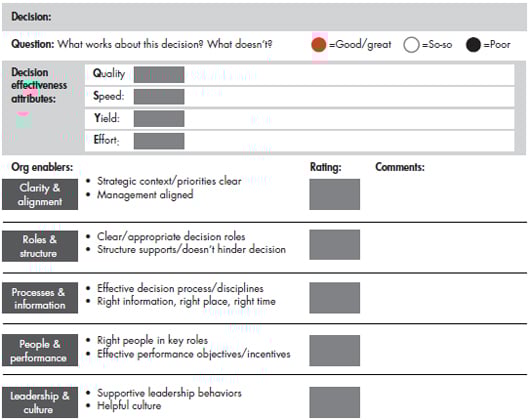
      To reach that level of specificity, we use a tool called a decision X-ray. In a decision X-ray, leaders ask questions of everyone involved in the selected decisions. How do they rate quality, speed, yield and effort? Who plays what roles, and are the roles clear to all? How well does the process work? Where is the organization helping or hurting? What behaviors get in the way? An X-ray often uncovers issues that a broad survey misses. It can reveal the kinds of actions likely to improve problem areas. It also may turn up issues common to many key decisions.

      At Nike, team members used surveys to get broad input on all 33 critical decisions. Then they conducted detailed X-ray-style interviews to get more insight into a few. One set of decisions, for instance, involved how much to invest in new product development. In the previous system, the business unit (such as apparel or footwear) would make the decision. But who should make the decision in the new system? Should it be the business unit, with input from the category organization? Or should the roles be reversed? Survey respondents had a range of views both on how the decisions worked today and on how they should work in the future, with perhaps predictable differences on country versus centre, and category versus sport. Decisions regarding retail strategy for each country showed similar differences.

      Nike, of course, wasn’t just interested in diagnosing the issues. The company used the decision X-rays to help resolve them. In workshops, managers clarified how specific decisions should be made in the new matrix. They also proposed other practical changes, such as co-locating project teams that had previously been dispersed throughout the building. That made it easier for teams to communicate and collaborate, and for Nike to deploy teams quickly to the hottest opportunities, whether it was basketball in Poland or swimwear in Germany. The one-two punch of identifying the critical decisions and then X-raying them to determine specific fixes helped Nike get the new matrix working without missing a beat in performance.

      Many attempts to reshape organizations inevitably have a scattershot quality—a little bit here, a little bit there. The teams leading the charge never really know whether the changes they’re working so hard on will have a real effect. But viewing the organization with critical decisions in mind transforms the process. You’re now focused on what matters—and you know that improving these decisions will generate better performance.

      Marcia W. Blenko is a partner with Bain & Company and leads the firm’s Global Organization practice. Paul Rogers is the managing partner of Bain’s London office. Michael C. Mankins is a partner with Bain’s San Francisco office. He leads Bain’s Organization practice in the Americas and is a key member of the firm’s Strategy practice. 


      How to conduct a decision X-ray

      A decision X-ray assesses the effectiveness of the particular decision and diagnoses what’s holding it back. You can gather people in a room (physical or virtual), conduct a series of interviews or send out a broader online survey. Start with gauging quality, speed, yield and effort. Then assess which organizational elements may be standing in the way of an effective decision. Of course, if an area is particularly strong, you’ll want to note that, too. Decision effectiveness is as much about building on strengths as it is about fixing weaknesses.
       

      di-what-are-your-critical-decisions-fig-02.jpg


      As part of the X-ray, it’s often helpful to sketch out a “day in the life of a decision.” This shows what a decision has to go through—the loops, disconnects and misalignments that slow things down and push people toward lowest-common-denominator solutions. Mapping the actual steps a decision goes through, rather than the ideal steps encapsulated in a process guide, often leads to a “How could we have let that happen?” moment. It also provides concrete ideas on how to fix the problem.

      Authors
      • Headshot of Marcia Blenko
        Marcia Blenko
        Advisory Partner, Boston
      • Headshot of Michael Mankins
        Michael Mankins
        Partner, Austin
      • Paul Rogers
        Former Partner, Middle East
      Related Consulting Services
      • People and Organization
      People and Organization
      Score your organization

      How to measure the quality, speed and effort of your company's decisions.

      Read more
      People and Organization
      Make decisions work

      How companies can reset the What, Who, How, and When of individual decisions so that they work smoothly and effectively.

      Read more
      People and Organization
      When a New Organizational Structure Isn’t Enough: How to Truly Live Your Operating Model

      The goal of any organizational redesign is for people to work differently, but that only happens if leaders invest in changing the work itself.

      Read more
      People and Organization
      Shift to Vertical: David Haines, Group CEO, Flora Food Group

      What does it take to stay connected to your customers when scale and complexity threaten to pull you away? 

      Read more
      People and Organization
      Leading with Dynamism: AI and the Future of Top Teams

      In the age of AI, dynamic leadership—not just digital tools—is a true competitive advantage.

      Read more
      First published in novembro 2010
      Tags
      • People and Organization

      How We've Helped Clients

      A Video Game Company Levels Up With a New Operating Model

      See more related case studies

      Building a winning media salesforce

      See more related case studies

      Powering a mining company's growth through cultural change

      See more related case studies

      Quer saber mais?

      Ajudamos líderes do mundo todo a lidar com desafios e oportunidades cruciais para suas organizações. Juntos, criamos mudanças e resultados duradouros.

      Bain Insights. Our perspectives on critical issues global businesses face in today's challenging environment, delivered monthly.

      *I have read and understand Bain’s Privacy Notice.

      Please read and agree to the Privacy Policy.
      Bain & Company
      Contact us Sustainability Accessibility Terms of use Privacy Cookie Policy Sitemap Log In

      © 1996-2026 Bain & Company, Inc.

      Contact Bain

      How can we help you?

      • Business inquiry
      • Career information
      • Press relations
      • Partnership request
      • Speaker request
      See all offices