

Brief

Executive Summary
- The wealth management business, with its capital efficiency and recurring revenue streams, has the potential to double the market capitalization of any parent company.
- Realizing that potential, though, has become more difficult because of emerging customers with different priorities, which require new delivery models, new offerings, and new economic models.
- Three business models are emerging to capture the new opportunities: integrated platform provider, customer acquisition specialist, and specialist provider.
- Each model entails investment in digital technologies as well as recasting the role of advisors.
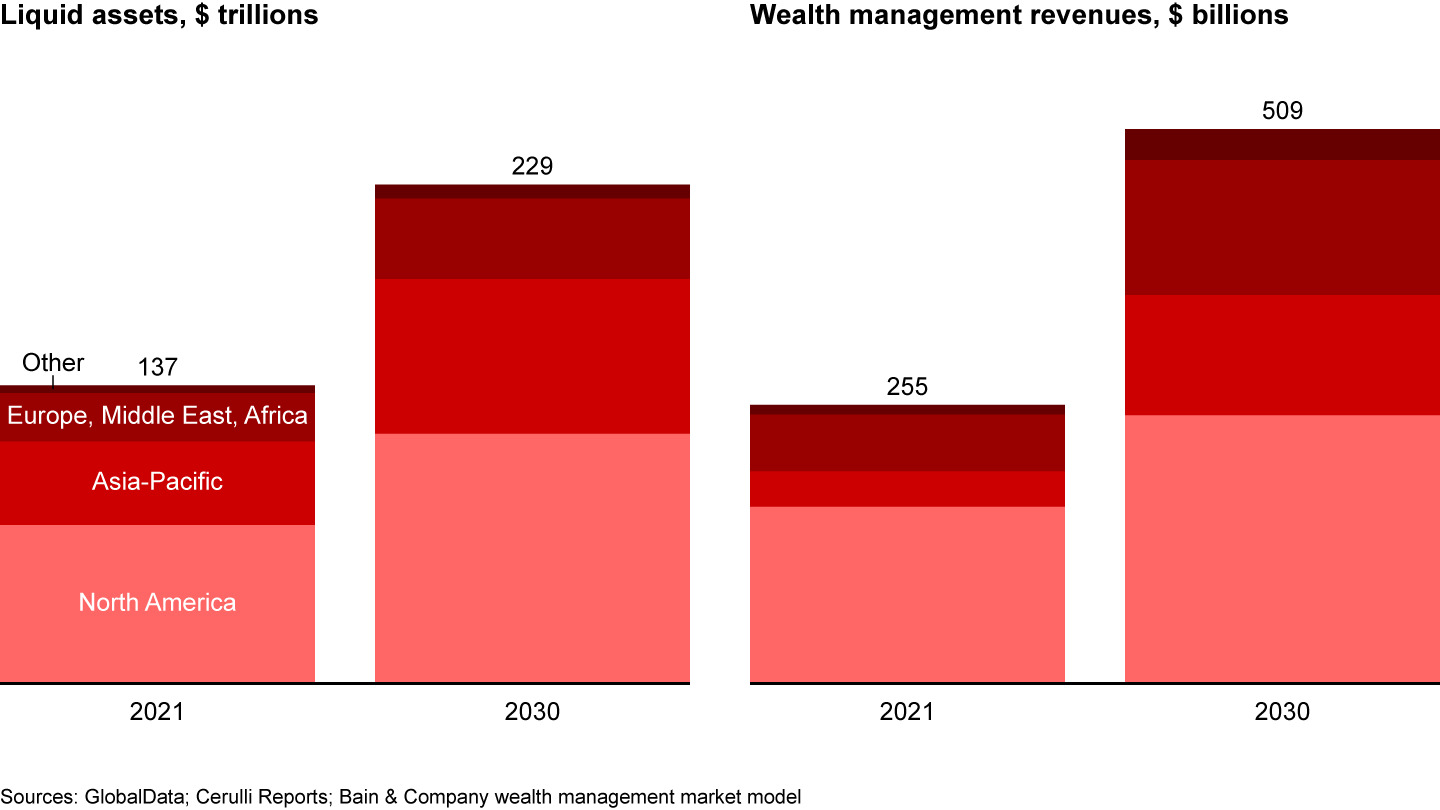
Financial services companies aiming to outperform the market and create value will find that wealth management holds the potential to take their business to the next level. Customer demand for wealth management continues to surge, and by 2030, we expect the industry’s revenues to grow by $254 billion, doubling 2021 revenues (see Figure 1).
Figure 1

Moreover, the business is characterized by capital efficiency and recurring revenue streams. Consider Morgan Stanley’s experience over the past decade. From 2012 through 2021, assets under management (AUM) rose 2.7 times, and AUM per investment advisor by 2.8 times. This has contributed to the growth of the firm’s market capitalization, which has reached five times that of 2012. Its price/earnings ratio of 11 (as of the end of March 2022) leads the wealth management market average of 7.
More broadly, a wealth management business has the potential to double the market cap of its parent firm. While the industry is highly attractive, banks and other wealth management firms face disruptive forces in four areas that are causing a realignment of the market: new customers, new delivery models, new offerings, and new economic models to thrive in the future.
New customers with new traits
Demographic shifts and the expansion of wealth globally are creating new customer segments. An estimated 250 million Generation Y and Generation Z customers (born between 1981 and 2012) will have an annual income of over $100,000 by 2030. The Americas and Asia-Pacific will lead this wealth expansion, with 110 million and 90 million of the total, respectively.
From 2021 to 2030, we project a $90 trillion increase in liquid assets from all investors globally, with $40 trillion coming from individuals who have assets between $100,000 and $1 million. Again, the Americas and Asia-Pacific will lead the charge.
Emerging customers share a couple of key characteristics. They tend to be more self-directed and self-educated. Roughly 70% of households with a net worth of $500,000 and headed by a person under age 45 had an investing style that was strongly or mostly self-directed in 2019, up from 57% in 2010, according to research firm Aite-Novarica.
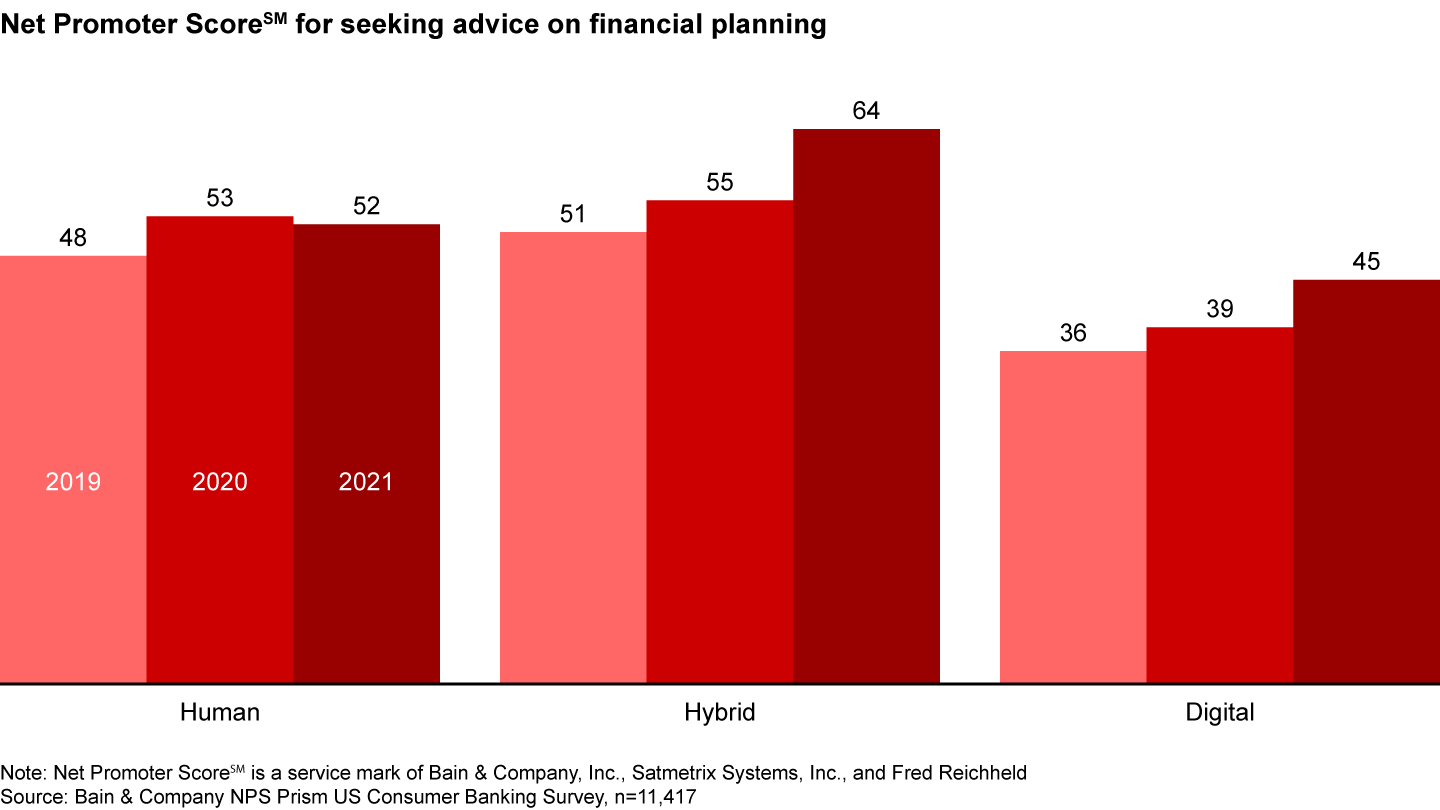
In addition, younger customers have a greater preference for digital channels and interactions, though they want human interactions for difficult decisions. That’s why they prefer hybrid engagement models to human-only or digital-only models (see Figure 2).
Figure 2

New products for customers’ different priorities
As emerging segments grow, so too do their different priorities regarding products, offerings, and ways of interacting with wealth management providers. Among the most salient are the following:
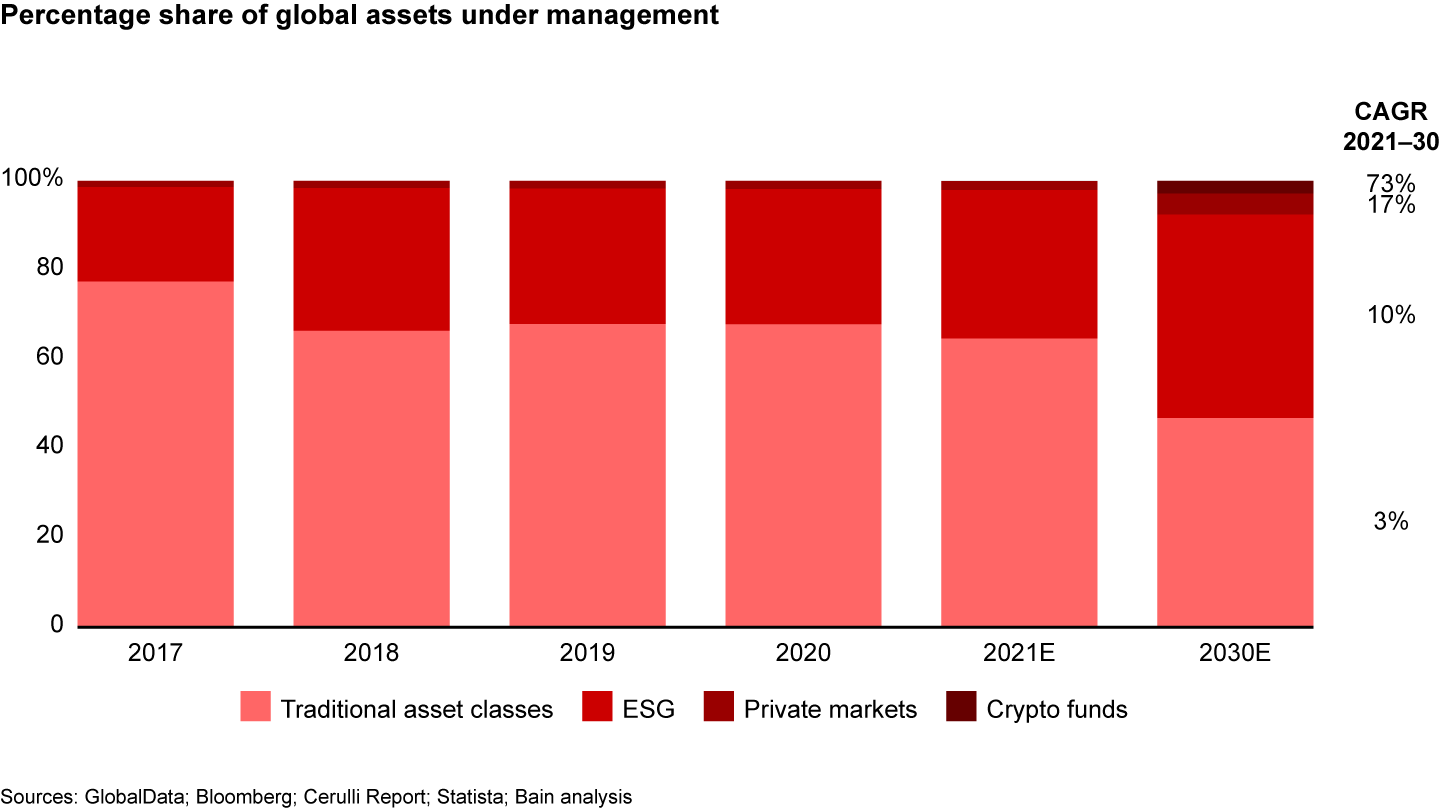
- ESG offerings. Some 75% of wealthy millennials consider environmental, social, and governance (ESG) elements to be an important factor in their investment decisions. We project that ESG-related assets will compose about 46% of all AUM by 2030, up from 33% today. Personalized ESG solutions thus become critical in winning and pleasing these new customers. JPMorgan acquired OpenInvest, a value-based investing company, to meet its goal of facilitating more than $2.5 trillion in ESG investments over the next 10 years.
- Private markets. The rapid growth and outperformance of private markets relative to public markets has whetted investors’ appetites, spurring several wealthtech companies to broaden access to private equity and debit. Yieldstreet, for example, allows private market investments with a minimum threshold of $500 and expects to generate $3 billion in income by 2025.
- Digital assets. The market cap of public companies issuing cryptocurrency fluctuates but reached $2.2 trillion before sliding back to $1.3 trillion as of mid-May. Many advisors expect to invest between 1% and 5% of clients’ portfolios in digital assets over the next five years.
- Retirement solutions. With baby boomers retiring amid the ongoing shift from defined benefit to defined contribution plans, investors are looking for innovative decumulation solutions to maintain a comfortable standard of living. Current decumulation solutions don’t offer enough security for people who risk outliving their retirement savings, nor do they provide spending advice or support.
Among the innovators on this front, BlackRock embeds annuity contracts directly into a target-date retirement strategy, through which participants have the option to purchase fixed individual retirement annuities from the insurers. And RightCapital offers dynamic retirement spending strategies that help advisors design flexible decumulation-phase income plans based on portfolio performance.
Overall, the percentage of global AUM invested in ESG-compliant, crypto, or private markets will increase from 40% to 58% by 2030, we estimate (see Figure 3).
Figure 3

New delivery models: High-tech and high-touch
If wealth managers hope to generate outsized growth in the future, they will need to create a more approachable value proposition for younger investors. This segment has fewer liquid assets than older generations currently do, so wealth management firms will need to reach them at critical moments through a scalable, high-tech, and high-touch model—digitally powered and with advisors who cover a greater number of clients.
A similar trend of broadening brand appeal and reach revived the luxury goods industry. Hybrid channels increased product accessibility and awareness for next-generation customer segments and helped move the industry into the mass market, leading to a forecasted tenfold increase in the customer base between 1985 and 2025. Companies like Gucci, Prada, and Versace built digital brand platforms to reach mass-affluent customers—a business model whose market share is expected to grow by about 21% annually between 2020 and 2025.
Along with this emerging segment, the needs and values of traditional customers are changing, particularly in their embrace of digital tools and channels. Further digital investments thus will be relevant for all customers.
The wealth management industry’s classic model emphasized attracting advisors who brought large client bases with them and helped grow the firm. Now the rise of new technologies and digitally native customer segments opens an opportunity to reorient business models from advisor focused to customer first. Here, advisor recruitment as a driver of growth takes a back seat to customer loyalty and advocacy (see Figure 4).
Figure 4


Serving the new customers effectively requires a delivery model that actively leverages digital tools and channels, with human interactions reserved for critical or complicated episodes (see Figure 5). Tilting digital would allow companies to increase the ratio of clients per advisor to around 300. But not just any form of digital will do; most customers expect simple, convenient tools and user interfaces.
Figure 5


In this new world, the advisor’s role should change from a full-service advisor, holding the entire customer relationship, to the “advisor for tricky decisions,” deploying in sensitive or complicated situations, whether navigating a personal event or market volatility. To do this well, advisors will need a comprehensive view of each customer—including assets, liabilities, and cash flow—and the authority to support the customer. For high-net-worth clients, the advisor will continue to serve as point person, teaming with specialists to provide advice on the client’s entire balance sheet, such as estate planning or optimizing taxes.
Lead generation will be the domain of digital marketing and referrals from other business units, such as commercial banks, retail banks, or retirement platforms. Effective digital customer acquisition will require more advanced analytics of marketing metrics such as brand mentions, organic searches, and regular website audits. Portfolio construction will be handled by home-office teams of investment managers or by a third party that provides asset allocation models.
New economics: Scale will dominate
These currents, which are now coursing through the wealth management market, will tend to drive greater returns to scale. In this industry, we estimate that returns to scale are about 35% higher with a digitally intensive model relative to traditional models, because digital has a higher proportion of fixed technology and operating costs. Scale benefits will become even more apparent with the imperative to invest in technology, data, and analytics that underpin distinctive client experiences (see Figure 6).
Figure 6
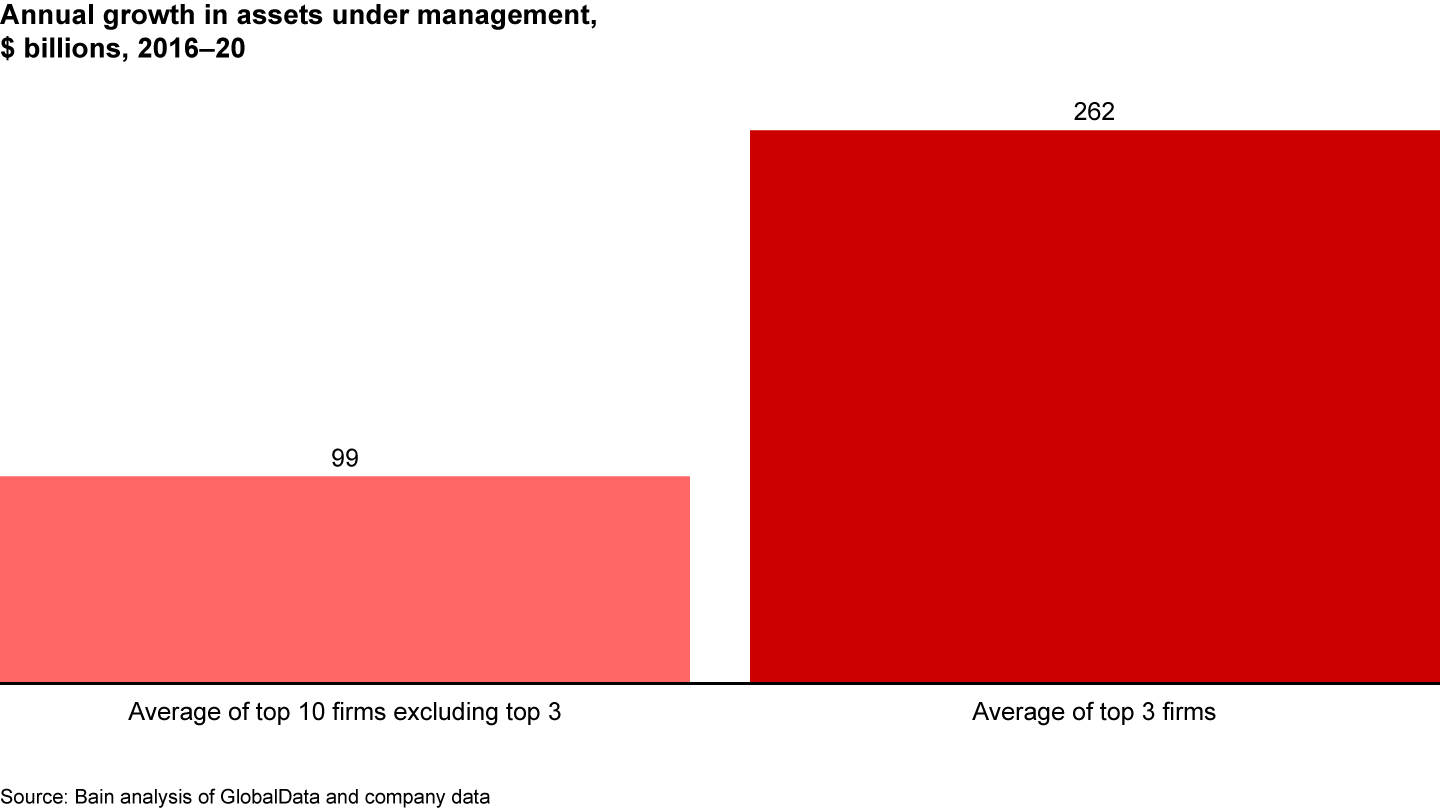

To attain greater scale, many firms will turn to mergers and acquisitions. For example, Raymond James acquired the US private client services unit of Deutsche Asset & Wealth Management, to be operated under the Alex Brown brand. Smaller firms, meanwhile, can consider “renting” scale from wealthtech companies, though they will not be able to set themselves apart through technology.
Because of these returns to scale, required investments in technology, and the increasing role of the firm (not the advisor) in delivering a strong customer experience, wealth management firms will capture a greater share of the industry profit pool, while advisor payouts as a percent of AUM will shrink. Still, advisors will remain highly compensated so long as they increase their productivity.
Three viable business models
To capture the opportunities for profitable revenue growth, wealth management firms will need to adopt one of three business models now emerging.
- Integrated platform provider. Large firms with distinctive capabilities and expertise, the ability to build standout products and insights, and access to high-quality investment opportunities will have an edge. They should seek to expand to mass-affluent and affluent customers by democratizing their offerings through digital tools and channels that offer a better experience.
UBS, which traditionally focused on wealthy customers, has taken this route with its wealth management division. To that end, the bank launched Next, a $200 million fund that targets investments in wealthtech and broader technology ecosystems. In 2022, it acquired Wealthfront, an automated wealth management provider that appeals to affluent Gen Y and Gen Z investors.
Morgan Stanley is another exemplar. Jed Finn, chief operating officer of Morgan Stanley Wealth Management, told a reporter, “We’ve gone from two and a half million high-net-worth relationships to over 15 million relationships with clients across the age and the wealth spectrum, with different service models that can meet their needs.”
- Customer acquisition specialist. This model relies on access to customers through highly productive advisor forces or adjacent business lines. One distinctive feature of this model is holistic advice for customers.
In recent years, Vanguard, one of the world’s largest investment management companies, has deployed technology to serve existing clients with financial advisory services. The company launched Digital Advisor and Personal Advisor Services as two ways to sell wealth management advice and was able to acquire customers rapidly. By February 2022, these services had approximately $207 billion in AUM, vs. $27 billion for Betterment and $21 billion for Wealthfront. - Specialist provider. A third model involves providing a value proposition tailored to a clearly defined customer segment. Despite being smaller scale, a specialist can succeed by applying the right advice and offerings to customers who will not be well served by larger, broad-based competitors.
Case in point: Silicon Valley Bank is the premier financial partner to the innovation economy. Through its 2021 acquisition of Boston Private, the bank has expanded its wealth management capabilities to better serve entrepreneurs and investors with bespoke advice, products, and solutions.
Any firm could scale up by expanding geographically and providing highly customized niche offerings in each new region.
For firms deciding which model to pursue, what to invest in, and at what cadence, it’s useful to start by answering a set of high-gain questions, including these:
- How will we go about acquiring the next generation of wealth management customers before they develop relationships with competitors, especially as intergenerational wealth transfer accelerates?
- What technology investments are essential to deliver the seamless, omnichannel experiences that these customers expect? Where are our biggest gaps in technologies and capabilities?
- Are our advisors and our investment teams well equipped to advise on a client’s entire balance sheet?
- Is our firm positioned to deliver solutions suitable to the needs of emerging clients?
- What distinctive features or expertise do we possess that will allow us to win against competitors? And what do we need to develop?
Material wealth continues to spread around the world. New technologies allow individuals to be more competent investors and control more of their financial destiny. But there’s still an important role for wealth management firms. Those that develop the right blend of digital tools and human advice for the next generation of investors stand to reap substantial value for years to come.
First published in julho 2022