
Skip to Content
  • Offices

    Offices

    North & Latin America
    • Atlanta
    • Austin
    • Bogota
    • Boston
    • Buenos Aires
    • Chicago
    • Dallas
    • Denver
    • Houston
    • Los Angeles
    • Mexico City
    • Minneapolis
    • Monterrey
    • Montreal
    • New York
    • Rio de Janeiro
    • San Francisco
    • Santiago
    • São Paulo
    • Seattle
    • Silicon Valley
    • Toronto
    • Washington, DC
    Europe & Africa
    • Amsterdam
    • Athens
    • Berlin
    • Brussels
    • Copenhagen
    • Dusseldorf
    • Frankfurt
    • Helsinki
    • Istanbul
    • Johannesburg
    • Kyiv
    • Lisbon
    • London
    • Madrid
    • Milan
    • Munich
    • Oslo
    • Paris
    • Rome
    • Stockholm
    • Vienna
    • Warsaw
    • Zurich
    Middle East
    • Doha
    • Dubai
    • Riyadh
    Asia & Australia
    • Bangkok
    • Beijing
    • Bengaluru
    • Brisbane
    • Ho Chi Minh City
    • Hong Kong
    • Jakarta
    • Kuala Lumpur
    • Manila
    • Melbourne
    • Mumbai
    • New Delhi
    • Perth
    • Seoul
    • Shanghai
    • Singapore
    • Sydney
    • Tokyo
    See all offices
  • Alumni
  • Media Center
  • Subscribe
  • Contact
  • Brazil | Português

    Select your region and language

    Global
    • Global (English)
    North & Latin America
    • Brazil (Português)
    • Argentina (Español)
    • Canada (Français)
    • Chile (Español)
    • Colombia (Español)
    Europe, Middle East, & Africa
    • France (Français)
    • DACH Region (Deutsch)
    • Italy (Italiano)
    • Spain (Español)
    • Greece (Elliniká)
    Asia & Australia
    • China (中文版)
    • Korea (한국어)
    • Japan (日本語)
  • Saved items (0)
    Saved items (0)

    You have no saved items.

    Bookmark content that interests you and it will be saved here for you to read or share later.

    Explore Bain Insights
  • Industries
    Main menu

    Industries

    • Aeroespacial e Defesa
    • Agronegócio
    • Química
    • Construção e Infraestrutura
    • Bens de Consumo
    • Serviços Financeiros
    • Healthcare & Life Sciences
    • Máquinas e Equipamentos Industriais
    • Mídia e Entretenimento
      Industries
      Mídia e Entretenimento
      • Media Lab
    • Metais
    • Mineração
    • Petróleo e Gás
    • Papel e Embalagens
    • Private Equity
      Industries
      Private Equity
      • Due Diligence
      • Exit Planning
      • Firm Strategy & Operations
      • Portfolio Value Creation
    • Setor Público e Social
    • Varejo
    • Tecnologia
    • Telecomunicações
      Industries
      Telecomunicações
      • Capital Expenditure
      • Telco Digital Transformation
    • Transporte
    • Turismo & Lazer
    • Energia & Renováveis
  • Consulting Services
    Main menu

    Consulting Services

    • Customer Experience
    • Sustainability
    • Innovation
    • M&A
    • Operations
    • People & Organization
    • Private Equity
    • Sales & Marketing
    • Strategy
    • AI, Insights, and Solutions
    • Technology
    • Transformation
  • Digital
  • Insights
    Main menu

    Insights

    • Industry Insights
    • Services Insights
    • Bain Books
    • Webinars
    • Bain Futures
    View all Insights
    Featured topics
    • Tariff Response
    • Artificial Intelligence
    • Thriving in Uncertainty
    • Executive Conversations
    • Macro Trends
    • M&A Report
    • Healthcare Private Equity Report
    • Paper & Packaging Report
    • Technology Report
    • CEO's Guide to Sustainability
    • CEO Insights
    • CFO Insights
    • COO Insights
    • CIO Insights
    • CMO Insights
    View all featured topics
  • About
    Main menu

    About

    • What We Do
    • What We Believe
    • Our People & Leadership
    • Client Results
    • Awards & Recognition
    • Global Affiliations
    Further: Our global responsibility
    • Sustainability
    • Social Impact
    • World Economic Forum
    Learn more about Further
  • Carreiras
    Main menu

    Carreiras

    • Trabalhe Conosco
      Carreiras
      Trabalhe Conosco
      • Find Your Place
      • Nossas áreas de trabalho
      • Equipes integradas
      • Estudantes
      • Programas e estágios
      • Eventos de Recrutamento
    • A Vida na Bain
      Carreiras
      A Vida na Bain
      • Blog: Inside Bain
      • Histórias de carreira
      • Nossas pessoas
      • Onde trabalhamos
      • Apoioao seu crescimento
      • Grupos de afinidade
      • Benefícios
    • Impact Stories
    • Nosso Processo Seletivo
      Carreiras
      Nosso Processo Seletivo
      • O Que Esperar
      • Entrevistas
    FIND JOBS
  • Offices
    Main menu

    Offices

    • North & Latin America
      Offices
      North & Latin America
      • Atlanta
      • Austin
      • Bogota
      • Boston
      • Buenos Aires
      • Chicago
      • Dallas
      • Denver
      • Houston
      • Los Angeles
      • Mexico City
      • Minneapolis
      • Monterrey
      • Montreal
      • New York
      • Rio de Janeiro
      • San Francisco
      • Santiago
      • São Paulo
      • Seattle
      • Silicon Valley
      • Toronto
      • Washington, DC
    • Europe & Africa
      Offices
      Europe & Africa
      • Amsterdam
      • Athens
      • Berlin
      • Brussels
      • Copenhagen
      • Dusseldorf
      • Frankfurt
      • Helsinki
      • Istanbul
      • Johannesburg
      • Kyiv
      • Lisbon
      • London
      • Madrid
      • Milan
      • Munich
      • Oslo
      • Paris
      • Rome
      • Stockholm
      • Vienna
      • Warsaw
      • Zurich
    • Middle East
      Offices
      Middle East
      • Doha
      • Dubai
      • Riyadh
    • Asia & Australia
      Offices
      Asia & Australia
      • Bangkok
      • Beijing
      • Bengaluru
      • Brisbane
      • Ho Chi Minh City
      • Hong Kong
      • Jakarta
      • Kuala Lumpur
      • Manila
      • Melbourne
      • Mumbai
      • New Delhi
      • Perth
      • Seoul
      • Shanghai
      • Singapore
      • Sydney
      • Tokyo
    See all offices
  • Alumni
  • Media Center
  • Subscribe
  • Contact
  • Brazil | Português
    Main menu

    Select your region and language

    • Global
      Select your region and language
      Global
      • Global (English)
    • North & Latin America
      Select your region and language
      North & Latin America
      • Brazil (Português)
      • Argentina (Español)
      • Canada (Français)
      • Chile (Español)
      • Colombia (Español)
    • Europe, Middle East, & Africa
      Select your region and language
      Europe, Middle East, & Africa
      • France (Français)
      • DACH Region (Deutsch)
      • Italy (Italiano)
      • Spain (Español)
      • Greece (Elliniká)
    • Asia & Australia
      Select your region and language
      Asia & Australia
      • China (中文版)
      • Korea (한국어)
      • Japan (日本語)
  • Saved items  (0)
    Main menu
    Saved items (0)

    You have no saved items.

    Bookmark content that interests you and it will be saved here for you to read or share later.

    Explore Bain Insights
  • Industries
    • Industries

      • Aeroespacial e Defesa
      • Agronegócio
      • Química
      • Construção e Infraestrutura
      • Bens de Consumo
      • Serviços Financeiros
      • Healthcare & Life Sciences
      • Máquinas e Equipamentos Industriais
      • Mídia e Entretenimento
      • Metais
      • Mineração
      • Petróleo e Gás
      • Papel e Embalagens
      • Private Equity
      • Setor Público e Social
      • Varejo
      • Tecnologia
      • Telecomunicações
      • Transporte
      • Turismo & Lazer
      • Energia & Renováveis
  • Consulting Services
    • Consulting Services

      • Customer Experience
      • Sustainability
      • Innovation
      • M&A
      • Operations
      • People & Organization
      • Private Equity
      • Sales & Marketing
      • Strategy
      • AI, Insights, and Solutions
      • Technology
      • Transformation
  • Digital
  • Insights
    • Insights

      • Industry Insights
      • Services Insights
      • Bain Books
      • Webinars
      • Bain Futures
      View all Insights
      Featured topics
      • Tariff Response
      • Artificial Intelligence
      • Thriving in Uncertainty
      • Executive Conversations
      • Macro Trends
      • M&A Report
      • Healthcare Private Equity Report
      • Paper & Packaging Report
      • Technology Report
      • CEO's Guide to Sustainability
      • CEO Insights
      • CFO Insights
      • COO Insights
      • CIO Insights
      • CMO Insights
      View all featured topics
  • About
    • About

      • What We Do
      • What We Believe
      • Our People & Leadership
      • Client Results
      • Awards & Recognition
      • Global Affiliations
      Further: Our global responsibility
      • Sustainability
      • Social Impact
      • World Economic Forum
      Learn more about Further
  • Carreiras
    Popular Searches
    • Agile
    • Digital
    • Strategy
    Your Previous Searches
      Recently Visited Pages

      Content added to saved items

      Saved items (0)

      Removed from saved items

      Saved items (0)

      Brief

      Is R&D complexity crippling innovation at your company?

      Is R&D complexity crippling innovation at your company?

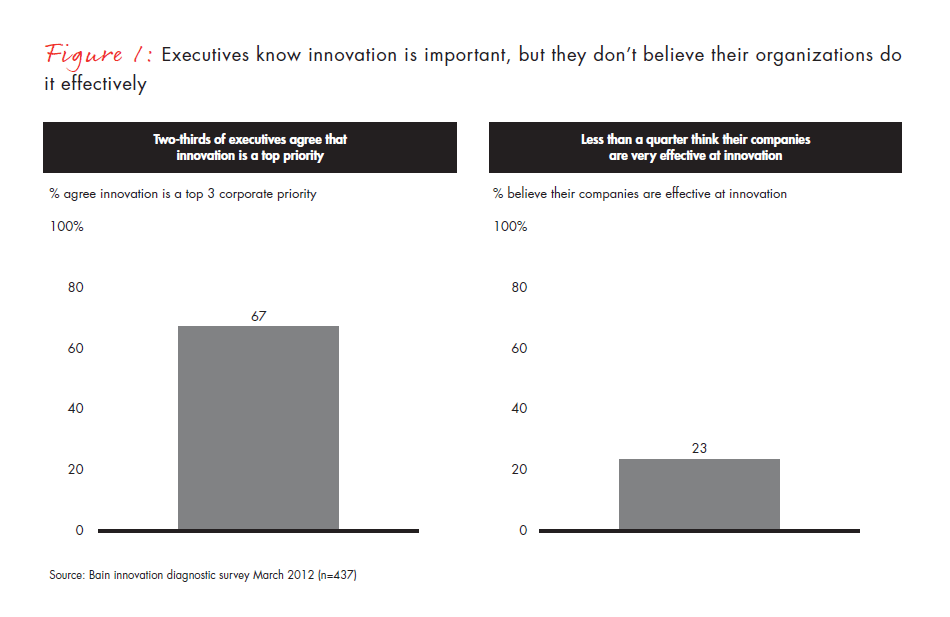
      Executives know that innovation is critical, but less than a quarter of them believe their organizations do it effectively.

      By Kayvan Ardalan, Asit Goel and Chris Brahm

      • min read

      Brief

      Is R&D complexity crippling innovation at your company?
      en

      Innovation is a top priority for most companies. But few leaders believe their companies are effective at innovating (see Figure 1). So, why the disconnect? In our experience, the root cause is most often complexity in the R&D organization itself—in the portfolio of projects it manages, the structure of the organization or the development processes it employs to drive innovation.

      Too much complexity in the R&D organization can cripple a company’s ability to innovate and grow profitably.

      is-r-and-d-complexity-crippling-innovation-fig-01_embed

      Executives who manage R&D don’t intentionally set out to hobble their R&D groups with underperforming product lines, convoluted structures or complicated development processes. Over time, as the organization grows through acquisitions, as pressure mounts to increase revenues or as managers strive for greater autonomy, complexity creeps in.

      Highly innovative organizations manage these pressures very differently. They focus their investment on doing fewer things better and on delivering sustainable results through a repeatable R&D execution model. Some organizations start out with a clear focus and successfully maintain that discipline. Others find ways to simplify their R&D organizations and restore investment discipline. By developing clear, concise and Repeatable Models®, these companies manage their R&D organizations in ways that achieve the best possible returns on every dollar they invest in R&D.

      Manage complexity where you find it

      R&D complexity typically manifests itself in three areas: the project portfolio, the structure of the R&D organization and the development processes employed to manage innovation. When complexity rises in any one of these areas, it more often than not spreads to the other two.

      Portfolio complexity hinders top-line growth. Companies that have too many projects in their R&D portfolio inevitably spread their investment too thin across too many opportunities. Symptoms of this type of problem include: Investing too little in all projects rather than culling the portfolio and investing more significantly in high-potential ones

      • Not having a rigorous screening mechanism to kill bad bets early
      • Failing to consider customer input in new product specifications
      • Too much emphasis on near-term priorities suffocating longer-term investment needs

      Organizational complexity suffocates innovation and drives away critical talent. When an organization has grown too complex, decisions take too long to make, hindering progress on innovation. Indicators of this kind of problem include:

      • Too many R&D sites, with teams fragmented across them
      • An inflated middle-management layer, with too many supervisors and not enough “doers”
      • Incentives that are poorly aligned and so do not drive results
      • Top talent getting frustrated and leaving

      Development-process complexity leads to missed market windows. Companies that spend too much on their process overhead or managing their historical portfolio often miss windows of opportunity in the marketplace. Signs that this is happening are:

      • Too much process overhead
      • Too many different types of tools and methodologies across locations, often a result of acquisitions
      • Processes that are optimized for past products rather than future opportunities

      Transforming the R&D organization

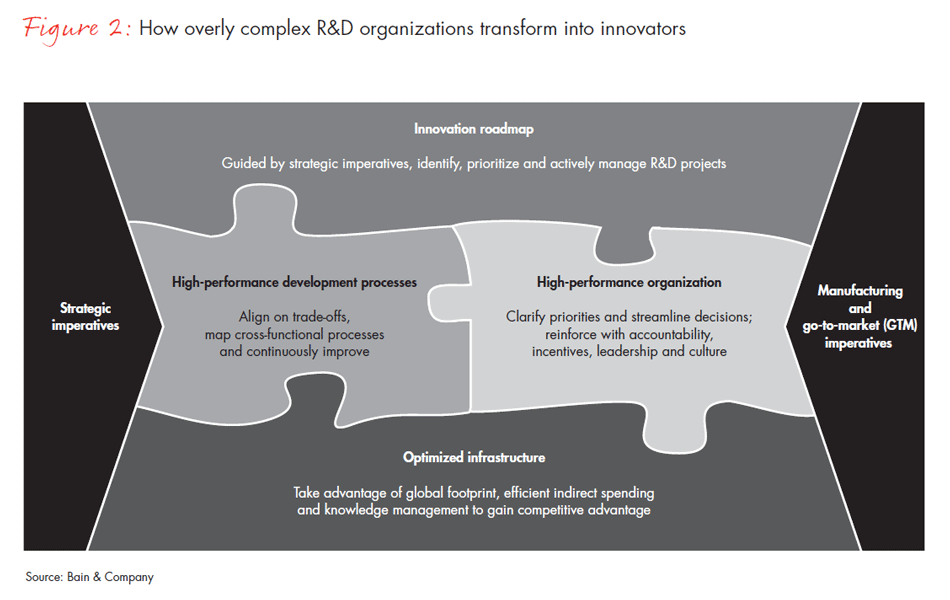
      Companies can reduce R&D complexity by transforming their approach to innovation. This transformation aligns the product roadmap with the company’s strategic objectives, simplifies the R&D organization itself, and restores discipline to development processes and R&D infrastructure (see Figure 2). In our experience, three elements are most critical to success.

      is-r-and-d-complexity-crippling-innovation-fig--02_embed

      Align the innovation roadmap with strategic imperatives to create focus. An R&D organization fighting too many battles at once will struggle to innovate. Simplifying the roadmap restarts a virtuous cycle of focus and successful delivery—building momentum and restoring confidence in the R&D team.

      Take the case of Biogen Idec. While the company has long maintained a disciplined approach to R&D, its efforts over the past four years demonstrate a renewed commitment to focusing on the work that matters most. After George Scangos became CEO in 2010, he streamlined the company’s approach to R&D, cutting programs in oncology and cardiology while focusing on core areas such as neurology. Scangos also brought two of the company’s campuses together in Cambridge, Massachusetts, so that its R&D site was no longer isolated from the rest of the company. The efforts to reduce complexity in R&D were part of a comprehensive effort that has lifted Biogen Idec’s share price from the mid-50s when Scangos came on board to highs above 200 in 2013.

      Build leadership commitment and simplify the organization. For R&D simplification to work, leadership must fully commit to the effort and put the right team in place to make the necessary changes to the project portfolio, organization and processes. This may require new leaders with a new vision for the product line and the organization. It may also require matching the R&D organization structure to the product development focus.

      When Steve Jobs returned to Apple in 1997, the company was crippled with complexity, and sales had fallen 30% in the last quarter of 1996. Jobs cut 70% of the product line and focused the company on four products that represented a clearly defined and differentiated core. That focus enabled a repeatable R&D innovation model that defined Apple’s success in the years since with the iPod, iPhone and iPad.

      Install disciplined development processes and infrastructure. Successful transformations tackle complexity by putting in place more disciplined product roadmap, planning and development processes. They instill greater clarity and accountability, and fewer decision points and decision makers.

      After Alan Mulally took the reins at Ford Motor Company, he implemented a more rigorous business plan review process that accelerated decision making and improved accountability for performance. Ford reduced the number of vehicle platforms globally, from more than 40 to fewer than 15 in just three years. It also put in place a more rigorous product development process with greater accountability and focus on product quality. Simplification in Ford’s R&D program contributed to the company’s rebound in the years 2007–2012.

      Installing decision discipline into development processes also helps reduce turnover of the most talented staff. Elite, entrepreneurial talent tend to have little tolerance for bureaucracy, so it’s important to keep organizational oversight in check, continuously paring red tape in order to stay nimble enough to pursue new opportunities and flexible enough to retain the talent that can make it happen. Leading R&D organizations employ clear decision architecture with end-to-end accountability. Bain’s RAPID® decision-making framework, for example, clearly defines who has responsibility for decisions and who is responsible for informing or advising those decisions, removing ambiguity and the need to get complete consensus before moving to the next mark.

      Highly innovative organizations focus on doing fewer things better and on delivering sustainable results through a repeatable R&D execution model, says Kayvan Ardalan, a partner in Bain's Performance Improvement practice.

      A long journey—but worth it

      Reducing complexity in R&D takes time. It requires patience and persistence. But it can deliver enormous value for a company’s shareholders through improved innovation, shorter time to market and higher product quality. In our experience, less complexity leads to lower operating expenses and higher productivity, as much as 15% to 20% improvement over time. In some cases, the savings generated by early successes can offset the costs of subsequent efforts, allowing the transformation to fund itself.

      Does your R&D engine need a tune-up or a transformation?

      Depending on your R&D organization’s current state and the degree of change in the firm’s external environment, your R&D engine may need a minor tune-up—or a more significant transformation. Take a moment to assess your R&D engine.

      Have you been losing share in specific market segments (or not gaining the desired traction) while increasing your investment in R&D?

      • Is more than 80% of your R&D budget spent on maintenance or incremental gains rather than medium- or longer-term innovation?
      • Do you face delays in key, time-sensitive decisions because they are too difficult to get approved?
      • Are your undesired attrition rates high (more than 5%) and growing?
      • Does your competition have greater breakthrough innovation and velocity than you?
      • Does your R&D organization suffer from “not invented here” syndrome and ignore the potential of external sources of innovation?

      If you answered “yes” to two or more of the questions above, it is likely that your organization needs a sustained effort to reduce R&D complexity and unlock the innovation potential of your firm.

      Kayvan Ardalan is a partner with Bain & Company in Los Angeles, where he is a leader in the firm’s global R&D/Product Development practice. Asit Goel is a Bain partner in Palo Alto and the leader of the firm’s North American R&D/Product Development practice. Chris Brahm is a partner in Bain’s San Francisco office; he leads the firm’s Technology practice in North America.

      The authors would like to acknowledge the contributions of Michael C. Mankins, a partner with Bain & Company in San Francisco, and Patrick O’Hagan, a Bain partner in Boston.


      is-r-and-d-complexity-crippling-innovation-fig-01_full

      is-r-and-d-complexity-crippling-innovation-fig--02_full
      Authors
      • Headshot of Chris Brahm
        Chris Brahm
        Alumni, San Francisco
      Related Industries
      • Technology
      Enterprise Technology
      Big Data: The Organizational Challenge

      If you don't know who (and where) your chief analytics officer is, you may already be behind the curve.

      Read more
      AI, Insights, and Solutions
      The value of Big Data: How analytics differentiates winners

      Only 4% of companies said they have the right resources to draw meaningful insights from data—and to act on them.

      Read more
      Technology
      How to Keep Control of an IT System That's Outsourced to Multiple Suppliers

      To master increasingly complex IT, companies are turning to multiple suppliers. But that strategy creates another risk: loss of control over mission-critical functions.

      Read more
      Technology
      Software M&A

      The good news: Most deal best practices still apply to AI acquisitions.

      Read more
      Technology
      Exploring AI for Packaging Circularity

      AI is already creating value across the packaging lifecycle, from optimising design and reducing material use to improving sorting and traceability.

      Read more
      First published in dezembro 2013
      Tags
      • Technology

      How We've Helped Clients

      Helping a Midsize ERP Player Compete against the Giants

      See more related case studies

      Aggressively growing an IT service provider with a high-performance culture

      See more related case studies

      Electronics manufacturer increases value of CRM investment

      See more related case studies

      Quer saber mais?

      Ajudamos líderes do mundo todo a lidar com desafios e oportunidades cruciais para suas organizações. Juntos, criamos mudanças e resultados duradouros.

      Bain Insights. Our perspectives on critical issues global businesses face in today's challenging environment, delivered monthly.

      *I have read and understand Bain’s Privacy Notice.

      Please read and agree to the Privacy Policy.
      Bain & Company
      Contact us Sustainability Accessibility Terms of use Privacy Cookie Policy Sitemap Log In

      © 1996-2026 Bain & Company, Inc.

      Contact Bain

      How can we help you?

      • Business inquiry
      • Career information
      • Press relations
      • Partnership request
      • Speaker request
      See all offices