

Brief

Many global brands are facing the inescapable fact that it is a particularly tricky time to be in the consumer goods business. Following decades of solid and dependable growth, the future started getting hazy in 2012. That is when, despite steadily rising global demand, a series of events began taking a toll on large consumer products companies’ revenues and profits.
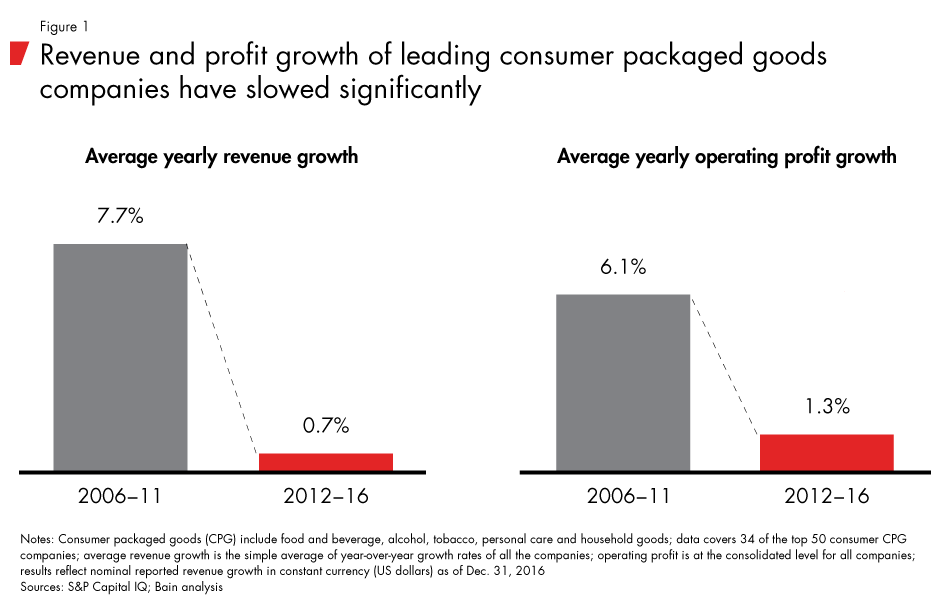
When we analyzed the 2012 to 2016 performance of 34 of the world’s top 50 consumer goods companies, we made the unsettling discovery that 85% of those big companies had seen a decline in either revenues, profits or both (see Figure 1). Only 15% managed to escape unscathed.
There are a number of reasons behind this lackluster performance.
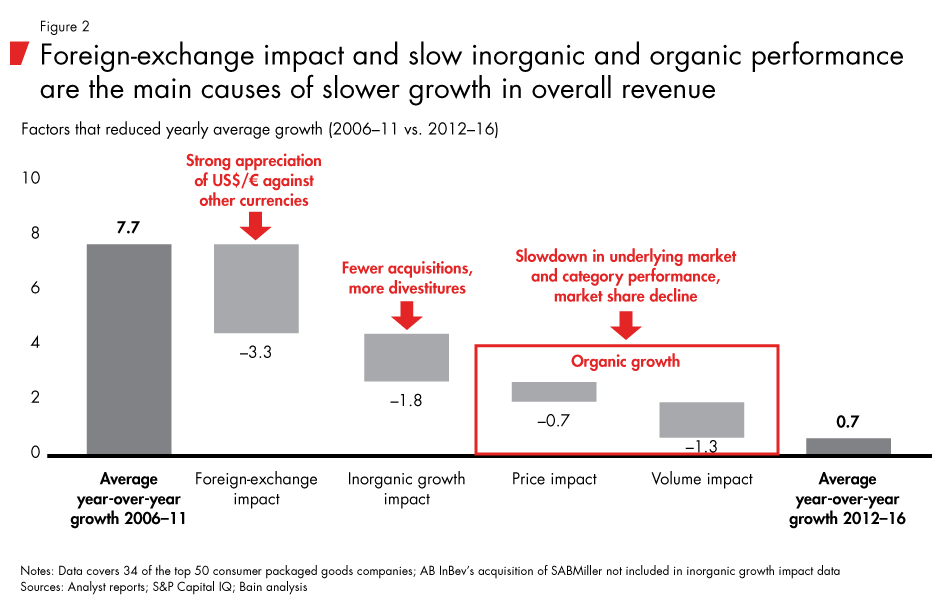
First, consider the impact of lower growth in previously booming developing-market economies. Large countries such as Russia, India, Mexico and Brazil saw their growth rates decline by 20% to 25%, while China has experienced a more brutal deceleration, with a growth rate eroding in excess of 60%. That slowdown, combined with the strong devaluation of their local currencies, explains more than half the problem in top-line growth for many multinational consumer goods companies (see Figure 2).
Second, the industry saw similar levels of M&A activity as in previous years, but for every large acquisition, there was a large consumer goods company selling or carving out a big part of its business. In the past, M&A spurred meaningful growth; now it is having a negative net effect as divestitures were greater than acquisitions among the largest players.
Third, many product categories have gone through unprecedented levels of disruption. Think about the movement from ground coffee to capsules or from standard to craft beer. Because of such disruptions, only 40% of all fast-moving consumer goods (FMCG) categories saw volume growth outpace population growth over the past 10 years.
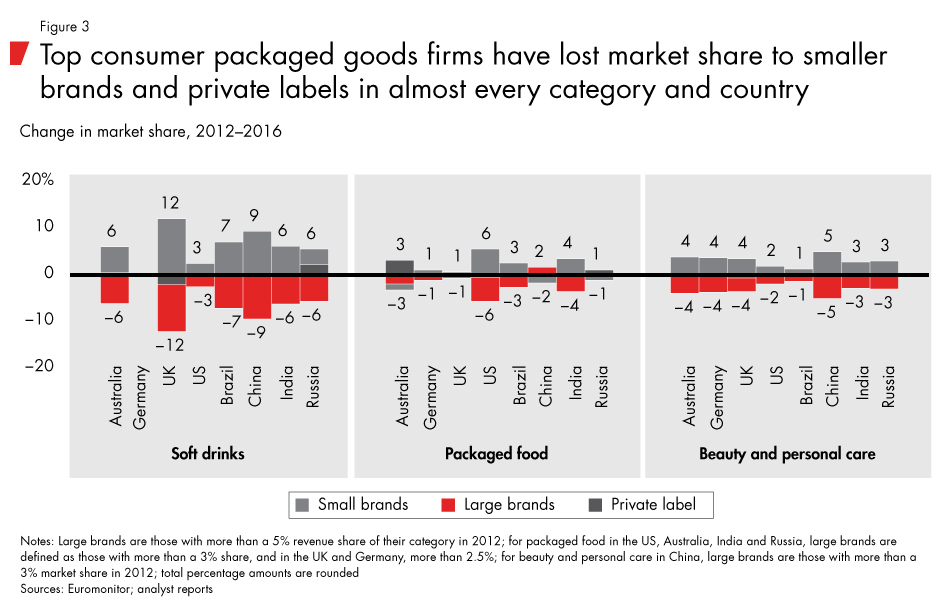
A fourth factor: In most markets, large brands have lost share to local incumbents and small insurgent brands (see Figure 3). In the US, small brands are 65% more likely than large brands to outgrow their category, according to our analysis. In fact, less than 5% of the growth in US consumer goods between 2011 and 2015 came from the 25 biggest companies. Results are surprisingly consistent across many categories throughout the world.
Finally, the pressure and expectations from the market have intensified. Activist investors such as 3G Capital now strongly influence the boardroom agenda, completely redefining the notion of the lean enterprise. The pressure to engage in major cost-cutting programs aimed at short-term profit improvement has hindered growth for some companies.
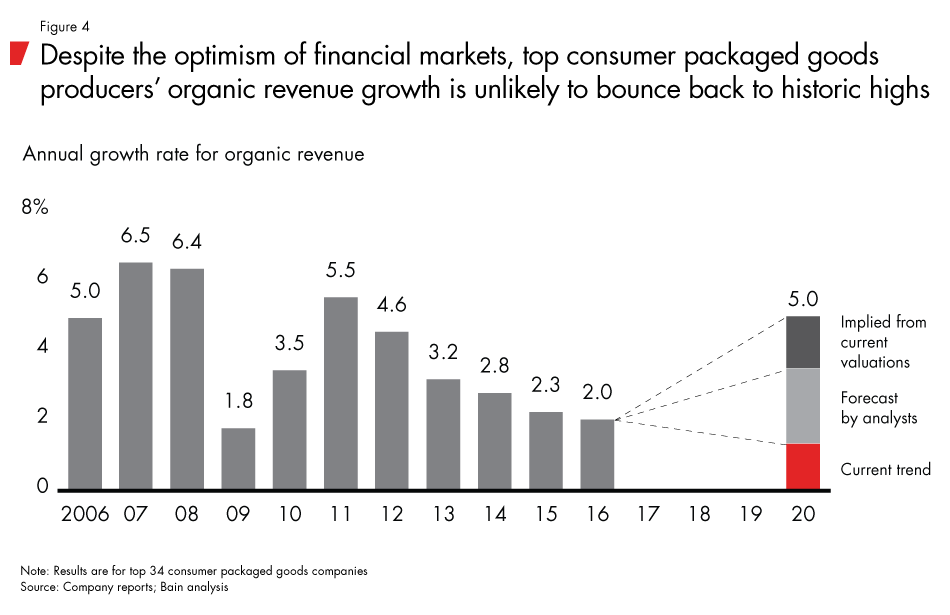
All of these forces have led large consumer goods companies to watch their average annual organic growth descend steadily from a healthy 5.5% rate in 2011 to 2% in 2016.
Finding the opportunities in turbulence
We believe that a number of turbulence factors will shape the future of the consumer goods industry and the performance of its leading players, creating new challenges but also opening doors for new prospects.
The metamorphosis of retail as we know it. Everywhere around the world, digital commerce, everyday value and convenience formats thrive while traditional retail formats stall out (see Bain’s briefs on retail’s tectonic shifts in the US, China and Europe). Consequently, over the next few years, retailers will need to engage in waves of consolidation, simplification and dramatic cost cutting just to stay in the game. Regardless of the exact scenario, we are looking at a decade of harder retailer negotiations without any evident prospects of getting more growth from the investments that large consumer goods companies will need to make. Looking further out, we are moving into a world where everything will be available for purchase anytime, anywhere, using image recognition, voice technology, the Internet of Things and other emerging innovations. Consider the vast and unpredictable impact of voice technology alone—it can single-handedly rewrite the established rules of marketing and selling products to consumers.
The return (but increasing unpredictability) of developing markets’ growth. After an exceptional period of stability, the world economy went back to its old unpredictable self. Emerging markets will grow again—some of them already are—but with lots of ups and downs. The next list of countries with large populations, low GDP and low consumption per capita, including Pakistan, Nigeria, Myanmar and others, will not make it much smoother. It will be more difficult to find sustainable, predictable growth in emerging markets, and the performance of existing investments (on volume growth, exchange rates or external shocks such as import duties) will become more volatile than in recent proglobalization years.
The accelerating shifts and drifts of consumer needs. Consumers have always shopped around, looking for different alternatives to satisfy their needs. Today, that pace of change seems unprecedented. Some categories are deemed unhealthy overnight. Flocks of shoppers crowd the fresh food aisles. Meanwhile, indulgence categories, such as snacks, chocolates and spirits, thrive in a schizophrenic pattern. New niche categories, such as gluten-free products, suddenly fill an unpredictable and seemingly universal need. The future will see more of these changes happening faster as supply and demand rapidly interact to continue expanding offerings.
The leap from genteel sports to mixed martial arts. Twenty years ago, competition in the consumer products industry looked like professional tennis. You faced opponents with business models that were similar to yours. You had been playing against them for years. It was tough but predictable and manageable. Now, the competition resembles mixed martial arts. Players come from every sport. Products and brands expand into adjacent territories in an effort to cater to more consumer needs. Retailers have essentially become competitors through their expanded private label offerings. And small insurgent companies out-innovate and out-hustle large established firms, eroding their share in most premium segments.
The constant redefinition of the benefits of size. Many of the fundamental scale advantages that have helped big consumer goods companies thrive are becoming hindrances. For decades, large companies could install the lowest-cost capacity, afford top research and development (R&D) capabilities, spread advertising broadly and efficiently, deploy large salesforces into a single channel or access the cheapest capital.
Today, evolving technology and an expanding network of specialized third-party solutions are changing all of that. Market conditions now appear to favor asset-light companies that rely on third-party infrastructure or external R&D networks. Digital marketing solutions are now more effective and affordable. Data and data management are becoming the real competitive advantage—and available to all. What will matter most in the years ahead: speed and adaptability instead of established processes and predictability.
And there are a host of other trends making consumer goods companies less steady and less manageable than before, creating both challenges and opportunities. For example, expanded public agendas are increasing regulatory pressure. Sourcing is now a critical asset to control due to climate change; environmental and social concerns raise the bar on sustainability and fundamentally impact supply chains. Meanwhile, companies must contend with geopolitical shifts, sustained market pressure on short-term productivity improvements and, last but not least, the intensifying battle for talent.
Given these trends and tensions, many companies now are dealing with an existential crisis. Current valuations reflect an expectation that consumer goods companies will return to 4% to 5% organic growth (see Figure 4). However, for some of them, the reality will probably be much harsher unless they do something truly different about all of the above. For others, the turbulence will offer great opportunities to reinvent their future.
A new strategic agenda
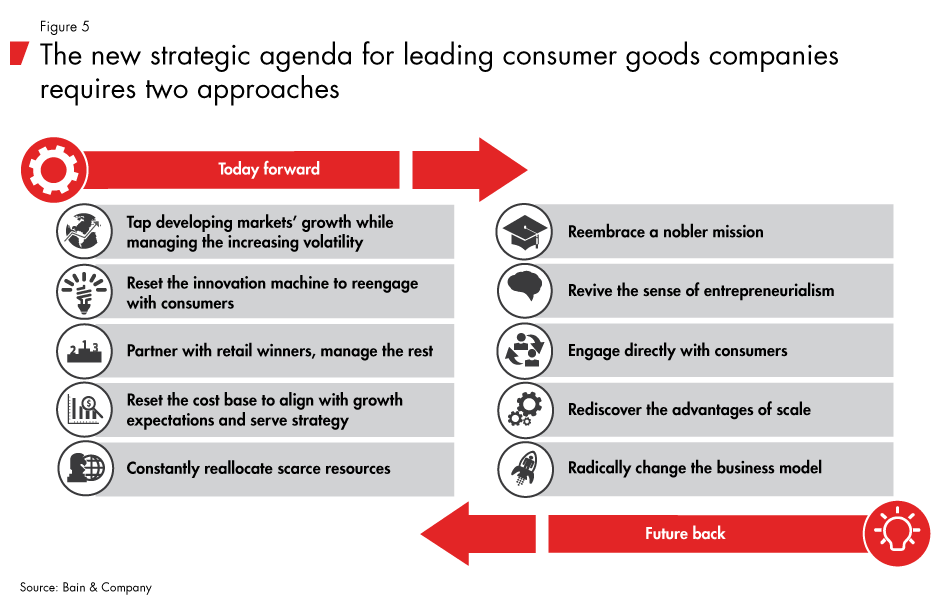
Large consumer goods companies have faced dark clouds and uncertainty before, but the playbooks that they have used to weather previous storms won’t help much this time around. In fact, the rapid pace of change and the growing unpredictability make it more critical, but also harder, to design responses that stand the test of time. Instead, we suggest attacking the mounting challenges from two different angles simultaneously. We call them today forward and future back (see Figure 5).
Today forward
Today forward means focusing on the current challenges that you are facing to reignite profitable top-line growth over the next three to five years. The biggest priorities will be:
- Tapping developing markets’ growth while managing the increasing volatility. Developing markets will continue to be the main tailwind behind brand growth in the years to come. At the current pace, we estimate it would take 30 to 40 more years for developing markets to begin reaching the consumer goods penetration levels of their developed-market counterparts. Leading consumer goods companies with global ambitions will need to continue investing disproportionately in developing markets but will also need to be careful in their country footprint choices to minimize dependence while reducing overall volatility.
- Resetting the innovation machine to reengage with consumers. That means identifying new, underserved needs by opening the aperture and challenging the standard category definitions typically found in panel data. Winning companies will innovate their way out with new products, new systems and new needs that help elevate their categories to premium status while increasing product and assortment penetration. In doing so, large companies should not be afraid of insurgent brands. Start them, buy them or ignore them—but appreciate their ability to increase the elevation of categories to premium status and create opportunities.
- Partnering with retail winners, managing the rest. Brands will find themselves navigating a more challenging retail landscape. They will be required to up their game in managing key accounts, establishing pricing and trade terms, and moving resources more quickly across customers and channels. In Europe, brands will need to do all of this at both country and cross-country levels as the region continues its path toward becoming a truly single market. For that, consumer goods companies must understand how to help retailers make money again. It’s surprising how many companies have a limited understanding of the economics of their customers.
- Resetting the cost base to align with growth expectations and serve strategy. As we mentioned, the short-term market pressure for higher efficiency is far from over. Over the past decade, many consumer products companies started programs with names such as “fuel for growth,” in which the basic idea was to reduce costs to invest back into advertising and promotion (or into higher payouts). That model has run its course. The fact is that cost bases need to be fundamentally reset, not just squeezed. Too many companies still have inflated growth expectations that permit higher-than-acceptable costs. Removing complexity, bureaucracy, and low-value-added processes and activities is a good starting point.
- Constantly reallocating scarce resources. Today, companies typically make their strategic resource allocations based on history or simple inertia, and through lengthy and painfully rigid planning processes. They also design targets that ensure incentive payouts. In turbulence, companies will need to reevaluate their investment choices more quickly and more regularly. Future winners will master the art of getting the money and resources to the parts of the business that really fuel growth.
Matthew Meacham, a partner with Bain's Consumer Products practice, discusses how large brands need to take a two-pronged approach to thrive now and in the future.
Future back
Future back means redefining the vision for your industry and your company, often inspired by a fundamentally underserved consumer need or an emerging and breakthrough technological solution. It means reinventing your own destiny and starting to progress toward it. The biggest priorities will be:
- Reembracing a nobler mission. Rearticulate a meaningful, sustainable consumer-led purpose that will reset the company’s sense of insurgency. Done right, these purposes fundamentally guide innovation and sustainability strategies, and genuinely inspire the front line. Many global brands are stuck in a spiral of increasing complexity caused by penetration-churning innovation. But a strong purpose is a surefire way to generate significant, category-expanding new ideas that are better for the world. Such purposes also inform M&A strategy beyond market consolidation. Your company will assemble assets and capabilities that truly enable your mission.
- Reviving the sense of entrepreneurialism. The underpinnings of Bain’s Founder’s Mentality® methodology include eliminating bureaucracy and resetting a company’s sense of insurgency, frontline obsession and owner mindset to fuel growth (see The Founder’s Mentality: How to Overcome the Predictable Crises of Growth). Among the tools at hand to make this important leap: adopting Agile ways of working. Innovative companies of all sizes are revolutionizing their cultures through Agile. It is substantially better than traditional project management and changes the way you work and innovate—it is fast, meritocratic, flat, fun, self-learning, and delivers what customers and talented employees want, on time.
- Engaging directly with consumers. Traditionally, consumer goods companies have had no relationship with their customers after a purchase. It is hard to imagine that they will be able to retain a share of the profit pool unless this changes. We believe that many companies should start exploring direct paths to consumers and shoppers. This might take the shape of creating a network of stores, launching direct online or mobile commerce operations, setting up subscription-based models, or partnering with a third party to operate a new channel or format. There are many obvious benefits to going direct, but probably the most critical one in the age of information will be the access to consumption and shopping data that can prove invaluable for innovation, cross-selling, upselling and customer service, to list a few.
- Rediscovering the advantages of scale. While many of the classical benefits of scale have drastically changed in recent years, we still believe that being big has essential advantages that need to be rediscovered, reclaimed and redeployed. For example, big companies should be best positioned to secure proprietary access to scarce commodities. They are also well placed to access Big Data to generate better business insights. They have an advantage when it comes to accessing external networks and establishing stronger partnerships with third parties that will always favor scaled relationships. Investing some of the returns from cost cutting into new sources of scale is a smart move.
- Radically changing the business model. That means stretching a brand beyond products into services or using the latest digital technology to move quickly and build a cost and data advantage where it matters.
It has been a tough few years. While there will be some recovery in developing markets over the next few years, the immediate future still will be a challenging time for most major consumer goods companies. However, the long-term future seems more daunting—almost existential. Still, we strongly believe that large brands can continue to play a leadership role in shaping and satisfying consumer tastes and desires, and achieve good profitability while doing it. The winners will be those that do the best job of meeting today’s short-term challenges while reinventing themselves to capture the opportunities that lie further down the road.
Matthew Meacham, a Bain & Company partner in London, leads the firm’s Global Consumer Products practice. François Faelli, a partner based in Brussels, leads the firm’s Consumer Products practice in Europe, the Middle East and Africa. Eduardo Giménez and John Blasberg are partners in Madrid and Boston, respectively; both are leading members of Bain’s Consumer Products practice.
Founder’s Mentality® is a registered trademark of Bain & Company, Inc.
First published in março 2018