

Founder's Mentality Blog

We’ve written previously on how to select your first set of micro-battles. In the first wave of micro-battles, we emphasized that you should select battles that are material, winnable, address big sources of organizational dysfunction and involve the stars of your business. But, of course, you want to launch more than one wave of micro-battles. So that raises the question: After the first wave of micro-battles, how should you begin choosing the full portfolio of micro-battles? This blog focuses on that issue. We’ll review three topics.
- How do you scale the first wave of micro-battles to a full portfolio?
- How do the criteria for choosing the right micro-battles change over time, if at all?
- What are best practices in managing the full portfolio?

Micro-battles
Want to learn more about the journey to scale insurgency? Explore the Bain Micro-battles System℠, step by step.
Topic 1: How do you scale the first wave of micro-battles to a full portfolio?
Before we get started, we want to emphasize one thing. Throughout your micro-battles journey, you’ll constantly be asking yourself, “Should I devote incremental resources to scaling an existing micro-battle or to launching a new one?” We’re assuming you’ve properly resourced existing micro-battles and you’re ready to launch more. But, in our experience, there’s always more you can do to scale an existing micro-battle. So don’t assume that the best use of resources is to increase the quantity of micro-battles.
If your current battles are properly resourced, we believe scaling your first 25 micro-battles is best done through what we call the “four doublings.” You should start with three micro-battles and run them through three to four cycles (a cycle refers to the time between Leadership sessions and lasts roughly three to four weeks). This gives you nine to 16 weeks to get used to running micro-battles and work out the kinks. Then you launch three new battles, doubling the number of micro-battles to six. You double again after four cycles. After you do this twice more, you’ll end up with a portfolio of 24 to 25 micro-battles. Scaling to about 25 micro-battles takes roughly 200 to 300 days, depending on how long your cycles are and how many cycles you run with each wave (see Figure 1).
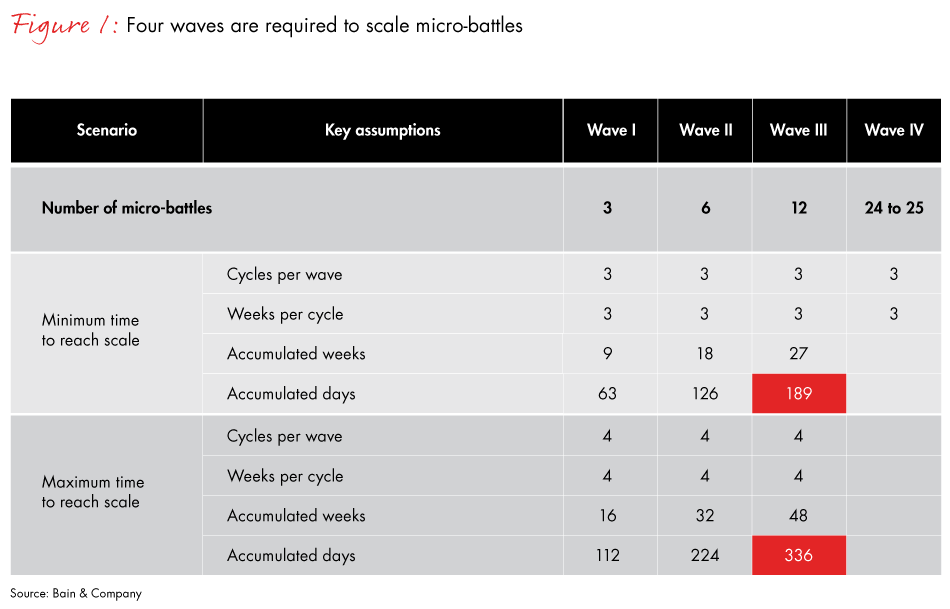
We typically recommend the longer time frame, running four full cycles of four weeks each before you launch the next wave. You need time to properly resource each micro-battle and to train teams.
Topic 2: How do the criteria for choosing the right micro-battles change over time, if at all?
In short, we do believe that the criteria for choosing micro-battles will change over time. You’ll begin to choose much more challenging micro-battles (where it’s increasingly less clear if they are winnable) and focus much more intently on the “secondary benefits” of winning a specific micro-battle (most notably, people development, new capabilities and scaling skills.) This shift over time is represented in Figure 2.
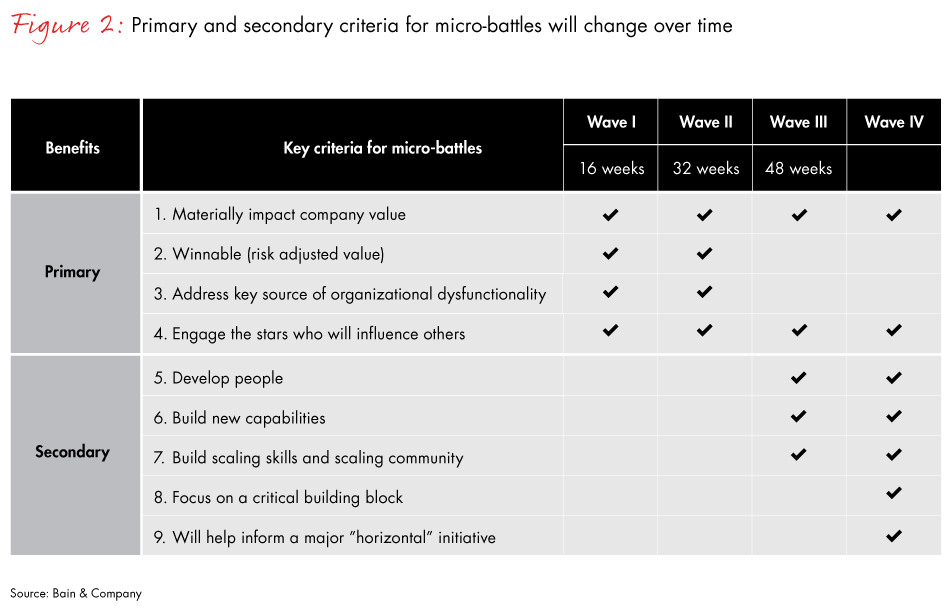
Let’s take a moment to explore the secondary benefits of micro-battles, which will become increasingly important as you launch each new wave.
- Develop people. In wave I, you’re asking the established stars of your business to lead micro-battles and influence others to support the initiatives. But over time, you’ll also want to use micro-battles to help develop your people—in particular, to help them build their skills. There are three great conflicts in business: scale vs. intimacy, routine vs. disruption, and short vs. long term. In early waves, you’ll find established stars with strengths on each side of the conflict to join micro-battle teams. But over time, you might want to bring people onto micro-battle teams to help them hone these skills. As you think through these issues, you might choose one micro-battle over another based on the criterion of developing your key people.
- Build new capabilities. As you run Leadership sessions in the first waves, you’ll begin to see common patterns in micro-battles. One pattern is missing capabilities—the portfolio of micro-battles reveals that you’re missing key skills. This might be direct-to-consumer engagement. This might be the ability to deploy technology with the front line so it can serve customers better. It’s quite common to pick a single capability and select micro-battles that require you to build this capability as you win and scale.
- Build scaling skills and the scaling community. Another common pattern our Leadership teams discover is that the company isn’t very good at scaling innovations (we’ve written separately on 10 lessons for scaling). It’s very common to find teams selecting new micro-battles on the basis of the question: “Will running this micro-battle help us build scaling skills or further develop our scaling community?”
- Focus on critical building blocks. Separately, we’ve distinguished that six building blocks set out the what of becoming a scale insurgent, while micro-battles set out the how. We covered these building blocks in detail elsewhere. As you move to the later waves of choosing micro-battles, you might select those that help you address one of these building blocks.
- Insurgent mission and critical capability spikes that help you deliver that mission to customers.
- Engine 2, a second engine of growth outside your core business (Engine 1).
- Operating model focused on your franchise players.
- Learning systems built on specific feedback.
- Fuel for growth. Freeing up resources can pay for growth programs that might entail massive reductions in cost and complexity.
- A company of insurgents who can drive behavioral change throughout the organization.
- Inform a major “horizontal” initiative. Micro-battles are vertical initiatives, connecting the senior leadership team with the frontline teams and the customers they serve. They’re surgical strikes. But micro-battles will also lead to insights about horizontal initiatives that you’ll need to launch—this might be a re-org, a change in your portfolio, a major complexity-reduction program, and so on. In early waves, you might identify one or two horizontal initiatives that are critically important and use your selected micro-battles to bring more insights to those two initiatives.
At its simplest, as you move through each wave, you’re going to focus ruthlessly on creating momentum behind micro-battles. In doing so, you can use the micro-battle portfolio to help you learn and to develop your people.
Topic 3: What are best practices in managing the full portfolio?
As we’ve worked with management teams picking each wave of micro-battles, we’ve pulled together some common best practices. Here are our top five.
- Recognize that criteria will change over each wave. It’s right to talk about how criteria will change after each wave. We recognize that you post some versions of Figures 1 and 2 on your mindset wall in the learning center. Be prepared to talk about reviewing the criteria themselves before choosing the next wave of micro-battles.
- Be open to consider secondary benefits in waves III and IV. We believe the notion of primary and secondary benefits is a useful one. We also believe that it’s important to consider secondary benefits, especially in waves III and IV. We’ve listed five examples of secondary benefits above, but you’ll discover more on your journey.
- But don’t choose a micro-battle based on secondary benefits alone. Two primary benefits are critical to all micro-battles: a material impact on the value of your company and the engagement of the stars of your business. To us, these are nonnegotiables. But as Figure 2 suggests, in later waves, you can trade off the winnable criteria (likely outcome of success) and address key sources of organizational dysfunction to gain other secondary benefits.
- Understand that momentum matters throughout. We argue that in waves I and II, a major goal is to create momentum for the idea of micro-battles across the company. This explains why the winnable criteria are so important early on. But we don’t want to suggest that momentum doesn’t matter in waves III and IV. In fact, building momentum for micro-battles is critical at every stage. Here’s a rule of thumb: If you can’t identify specific actions that are building momentum this month, you’re losing momentum. But you must also understand that over time, you’ll build momentum in different ways.
- Accept that a twinkle of cynicism isn’t a bad thing. It’s right and proper that you talk quite realistically—and dare we say it, cynically—about how to maintain momentum for the program. If you have an initiative that you know is a slam dunk and is likely to succeed outside the micro-battle process, it isn’t a bad thing to call it a micro-battle and claim an early victory. If you have two good micro-battles, but one can be led by a star that will influence huge numbers of people to get on board, then it’s not a bad thing to favor that micro-battle. You have only so much good will in any broad initiative; use it wisely—and occasionally with a healthy dose of cynicism.
As previously mentioned, this discussion assumes that you’re ready to launch new micro-battles. But we want to end as we started—with a reminder that you’re often better off investing in the scalability of current micro-battles than launching new ones. So, please, as you think about launching new battles, ask yourself:
- Are our current micro-battles on track to scale across the enterprise?
- If not, is this a resource problem?
- If this is a resource issue, should we hold off on launching more micro-battles until we resolve the resource bottlenecks of our current battles?
Sometimes, the new micro-battles draw on different resources, but not always. Best to have the discussion.

Managing the Micro-battles Portfolio
Companies can scale their success with micro-battles to the next level of leadership and beyond.
First published in 4월 2018