

Article
Interview with Bain partner Jorge Leis, who explains how utilities can gain a lead over industry rivals by reducing their exposure to carbon.
Bain: Why does carbon competitiveness especially matter? Aren’t most CEOs already worrying about issues like sustainability and carbon emissions?
Leis: Carbon competitiveness goes beyond issues like sustainability and carbon emissions. It’s about looking at competitors within your industry and asking: “How can I use carbon competitiveness to gain an edge over my rivals?”
Right now, very few CEOs do that. In my experience, most CEOs currently focus on the big picture. They attend industry forums, participate in the development of government policy and sometimes even chair industry lobbying efforts to influence the direction of policy to protect their industry’s best interests. Many CEOs are also conscious of how “green” their company is, especially in terms of compliance with regulations, avoiding negative publicity from activist organizations and branding products and services to appeal to eco-conscious customers.
However, increasingly, CEOs need to ask the carbon-competitiveness question. Across industries, the relative size of the carbon footprint of a company will define its comparative advantage within the industry. As governments around the globe regulate the emission of greenhouse gases with increasing severity in the next two decades, carbon dioxide (CO2) emissions will become a financial liability, not just at the industry level but also at the company level. Carbon regulation will change the competitive landscape of many industries but will also fundamentally change the competitive standing of individual companies within the industry. Those CEOs who are not planning strategically for a carbon-regulated world may inadvertently put their company’s future competitiveness at risk.
Bain: What does carbon competitiveness entail in the context of utilities?
Leis: For many utilities, even a modest regulatory regime for CO2 emissions will result in annual liabilities well in excess of current profits. But even before that, some power companies will feel the pressure from competition due to less efficient operations. One of the largest US utilities, American Electric Power (AEP), for example, produced 5.86 MT CO2 per 1,000 MW of installed capacity in 2009. In contrast, Florida Power & Light Company (FPL) produced 2.14 MT CO2 and Entergy just 1.71 MT CO2. These differences arise because historically, companies acquired productive assets or built product portfolios under an older “carbon-free” environment. Today, within the same industry, each company has a unique carbon footprint—to manufacture the same product or deliver the same service. In such an environment, carbon regulation does not affect each utility within the industry equally; instead, it has the potential fundamentally to change the rules of competition. A utility’s competitiveness within the industry can therefore be severely impacted by legacy assets and products that are more CO2 intensive than its competitors’. Or, as we prefer to think, the utility that has lower CO2 exposure than its competitors has a chance to strengthen its position dramatically within the industry.
Bain: What exactly does a company’s carbon competitiveness depend on?
Leis: In our work across industries, we find managements are very surprised when they get down to reviewing their areas of carbon competitiveness! Sometimes, there is a vast difference between what a company perceives as its areas of vulnerability and the reality. Often, the challenge for most CEOs is to recognize that their vulnerability to carbon exposure can be from either direct emissions—that is, those emitted by the companies during their operations—or indirect emissions, those emitted during the combustion of their product or both. In most industries, CEOs struggle for clarity on what affects their business more—direct or indirect exposure—and, therefore, they find it hard to benchmark their relative position compared with the competition, which might or might not have the same type of exposure due to different legacy assets.
Bain: Are direct emissions more important for utilities?
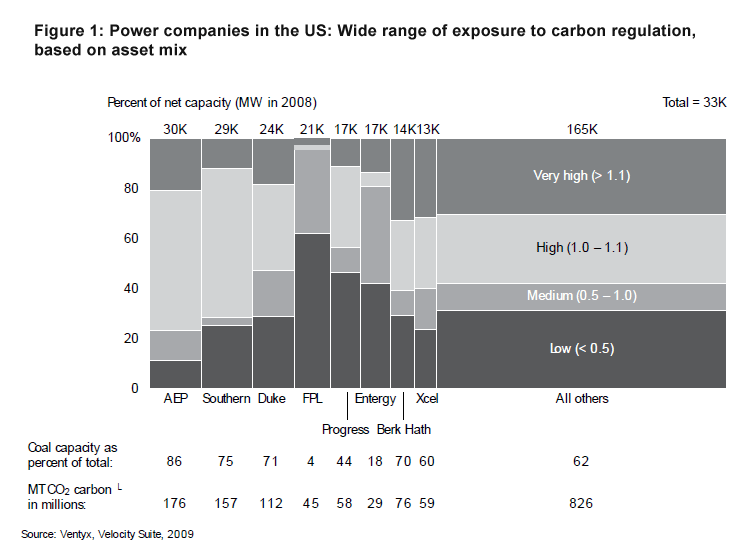
Leis: That’s right. Our research on select utilities in North America shows that in the power generation business, companies can have a spectrum of direct CO2 emission liabilities—based on each company’s asset mix. Each company has a portfolio of power plants of varying fuel types and efficiency. To understand the range better, we divided the power plants into quartiles of CO2 intensity as measured by the tons of CO2 per megawatt-hour of electrical output: very high (greater than 1.1 tCO2/MWHe), high (between 1.0 and 1.1 tCO2/MWHe), medium (between 0.5 and 1.0 tCO2/MWHe) and low (less than 0.5 tCO2/MWHe). Nuclear, renewable and hydropower are all in the low category; the medium category is composed primarily of natural gas combined cycle plants; the high category is predominantly supercritical coal plants; and the very high category is mostly subcritical coal plants.
Our analysis showed that some companies like Florida Power & Light and Entergy are better positioned than others to adjust to CO2 regulations because they produce power through “cleaner” production assets (see Figure 1). For these companies, CO2 regulations are likely to improve their relative cost position, and in certain deregulated markets, that improved cost position can even be translated into expanded market share. On the other hand, companies with a distinctively large mix of coal-fired power plants are fated to see their relative cost position get worse over time.
Let me share a hypothetical example. Suppose in the US the carbon tax rises to more than $60 per ton, then the operating costs of large utilities such as Southern Company and AEP will increase by 70 percent and 90 percent, respectively. Such increases in operating costs represent profound changes to the power business and as such, management’s capital deployment plans must start by considering their direct CO2 exposure.
Bain: It’s interesting that you mentioned nuclear as a carbon-competitive option with low CO2 emissions. In the wake of the Japan earthquake and tsunami crisis will that change?
Leis: Safety is a key issue, of course, and right now, in the light of the catastrophic events in Japan, there is a cloud over nuclear energy. However, the big picture with regard to carbon competitiveness remains unchanged: energy generated from renewable sources will continue to remain important and low carbon emissions will remain an aspiration for utilities. It is difficult to predict what the long-term consequences of the events in Japan will be on the nuclear power industry but in the short term, a greater focus on other renewables and even natural gas is likely. We should remember that renewables could not even be contemplated in the energy mix half a century ago when Japan began building its nuclear power plants.
Bain: How can utilities build carbon competitiveness?
Leis: The key to building carbon competitiveness within an industry lies in taking a cold, hard look at the company’s assets, production processes and products—and benchmarking them against the carbon footprint of the competition. CEOs who play a strong role in industry-level carbon regulation discussions need to be particularly careful: it is not about influencing policy at the macro level or even measuring the potential impact of regulations on the company and competitors. It’s about slowly but surely identifying and mitigating the inefficient processes and legacy assets that weigh down a company’s ability to produce products competitively with lower carbon emissions—and designing and delivering world-class products in a greener, more sustainable world.
Of course, for many utilities, that isn’t easy. CEOs who find themselves in a weak relative position due to their company’s asset mix have limited options, and none is quick or easy: they can either change the asset mix, or retrofit the asset base or do both. These strategies are not mutually exclusive, but they require clear priorities and careful consideration of how much capital is deployed, the return on investments and the operating expense trade-offs.
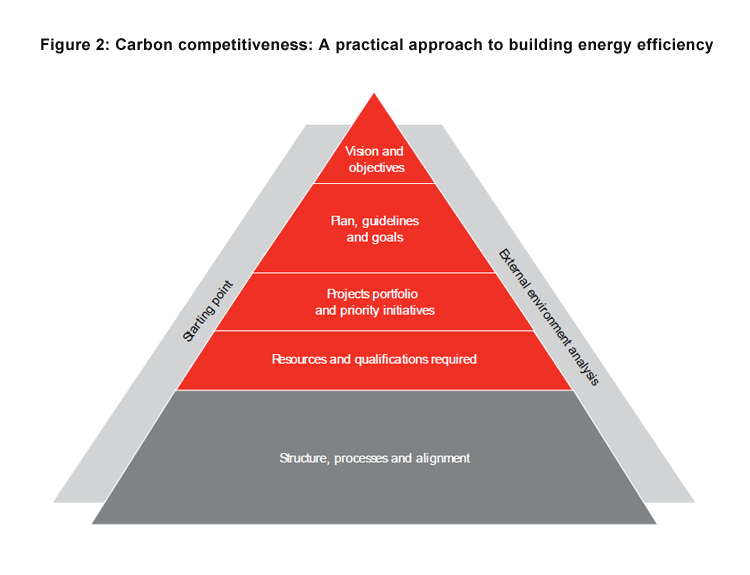
We find that CEOs who embrace this responsibility start with setting the long-term vision and clearly articulate the objectives of their energy efficiency strategy (see Figure 2). The challenge to reposition a company with less competitive legacy assets and products is daunting and can take years to overcome. But utility CEOs have to remember that it is through no fault of their own or their predecessors that a company finds itself in a position of relative weakness. No matter what the historical journey of the company or the legacy baggage it carries, it is the responsibility of the incumbent CEO to plan for the road ahead—and leave behind a smaller carbon footprint.
Jorge Leis is a Bain partner based in Dallas and leads the firm’s North American Oil & Gas practice.
First published in 4월 2011