
Skip to Content
  • 오피스

    오피스

    미주
    • Atlanta
    • Austin
    • Bogota
    • Boston
    • Buenos Aires
    • Chicago
    • Dallas
    • Denver
    • Houston
    • Los Angeles
    • Mexico City
    • Minneapolis
    • Monterrey
    • Montreal
    • New York
    • Rio de Janeiro
    • San Francisco
    • Santiago
    • São Paulo
    • Seattle
    • Silicon Valley
    • Toronto
    • Washington, DC
    유럽, 중동, 아프리카
    • Amsterdam
    • Athens
    • Berlin
    • Brussels
    • Copenhagen
    • Doha
    • Dubai
    • Dusseldorf
    • Frankfurt
    • Helsinki
    • Istanbul
    • Johannesburg
    • Kyiv
    • Lisbon
    • London
    • Madrid
    • Milan
    • Munich
    • Oslo
    • Paris
    • Riyadh
    • Rome
    • Stockholm
    • Vienna
    • Warsaw
    • Zurich
    아시아, 호주
    • Bangkok
    • Beijing
    • Bengaluru
    • Brisbane
    • Ho Chi Minh City
    • Hong Kong
    • Jakarta
    • Kuala Lumpur
    • Manila
    • Melbourne
    • Mumbai
    • New Delhi
    • Perth
    • Seoul
    • Shanghai
    • Singapore
    • Sydney
    • Tokyo
    오피스 전체보기
  • 얼럼나이
  • 미디어 센터
  • 구독
  • 연락처
  • Korea | 한국어

    지역 및 언어 선택

    글로벌
    • Global (English)
    미주
    • Brazil (Português)
    • Argentina (Español)
    • Canada (Français)
    • Chile (Español)
    • Colombia (Español)
    유럽, 중동, 아프리카
    • France (Français)
    • DACH Region (Deutsch)
    • Italy (Italiano)
    • Spain (Español)
    • Greece (Elliniká)
    아시아, 호주
    • China (中文版)
    • Korea (한국어)
    • Japan (日本語)
  • Saved items (0)
    Saved items (0)

    You have no saved items.

    관심 있는 내용을 북마크하여 Red 폴더에 저장할 수 있습니다. Red 폴더 에서 저장된 내용을 읽거나 공유해보세요.

    Explore Bain Insights
  • 산업
    메인 메뉴

    산업

    • 우주항공, 방산 및 정부 서비스
    • 농업 관련 산업
    • 화학
    • 인프라, 건설 및 건축 자재
    • 소비재
    • 금융 서비스
    • 헬스케어
    • 산업용 기계 및 장비
    • 미디어 및 엔터테인먼트
    • 금속
    • 광업
    • 석유 및 가스
    • 제지 및 패키징 산업
    • 사모펀드
    • 사회 및 공공 부문
    • 유통
    • 기술
    • 텔레콤
    • 운송
    • 여행·여가
    • 유틸리티 및 재생가능 에너지
  • 컨설팅 서비스
    메인 메뉴

    컨설팅 서비스

    • Customer Experience
    • ESG
    • Innovation
    • M&A
    • 운영
    • 조직
    • 사모펀드
    • 고객 전략 및 마케팅
    • 전략
    • AI, 인사이트 및 솔루션
    • Technology
    • 변화 혁신
  • Digital
  • 인사이트
  • 베인 소개
    메인 메뉴

    베인 소개

    • 업무 소개
    • 베인의 신념
    • 구성원 및 리더십 소개
    • 고객 성과
    • 주요 수상 경력
    • 글로벌 파트너사
    Further: Our global responsibility
    • 다양성과 포용
    • 사회 공헌 활동
    • Sustainability
    • World Economic Forum
    Learn more about Further
  • Careers
    메인 메뉴

    Careers

    • Work with Us
      Careers
      Work with Us
      • Find Your Place
      • Our Work Areas
      • Integrated Teams
      • Students
      • Internships & Programs
      • Recruiting Events
    • Life at Bain
      Careers
      Life at Bain
      • Blog: Inside Bain
      • Career Stories
      • Our People
      • Where We Work
      • Supporting Your Growth
      • Affinity Groups
      • Benefits
    • Impact Stories
    • Hiring Process
      Careers
      Hiring Process
      • What to Expect
      • Interviewing
    FIND JOBS
  • 오피스
    메인 메뉴

    오피스

    • 미주
      오피스
      미주
      • Atlanta
      • Austin
      • Bogota
      • Boston
      • Buenos Aires
      • Chicago
      • Dallas
      • Denver
      • Houston
      • Los Angeles
      • Mexico City
      • Minneapolis
      • Monterrey
      • Montreal
      • New York
      • Rio de Janeiro
      • San Francisco
      • Santiago
      • São Paulo
      • Seattle
      • Silicon Valley
      • Toronto
      • Washington, DC
    • 유럽, 중동, 아프리카
      오피스
      유럽, 중동, 아프리카
      • Amsterdam
      • Athens
      • Berlin
      • Brussels
      • Copenhagen
      • Doha
      • Dubai
      • Dusseldorf
      • Frankfurt
      • Helsinki
      • Istanbul
      • Johannesburg
      • Kyiv
      • Lisbon
      • London
      • Madrid
      • Milan
      • Munich
      • Oslo
      • Paris
      • Riyadh
      • Rome
      • Stockholm
      • Vienna
      • Warsaw
      • Zurich
    • 아시아, 호주
      오피스
      아시아, 호주
      • Bangkok
      • Beijing
      • Bengaluru
      • Brisbane
      • Ho Chi Minh City
      • Hong Kong
      • Jakarta
      • Kuala Lumpur
      • Manila
      • Melbourne
      • Mumbai
      • New Delhi
      • Perth
      • Seoul
      • Shanghai
      • Singapore
      • Sydney
      • Tokyo
    오피스 전체보기
  • 얼럼나이
  • 미디어 센터
  • 구독
  • 연락처
  • Korea | 한국어
    메인 메뉴

    지역 및 언어 선택

    • 글로벌
      지역 및 언어 선택
      글로벌
      • Global (English)
    • 미주
      지역 및 언어 선택
      미주
      • Brazil (Português)
      • Argentina (Español)
      • Canada (Français)
      • Chile (Español)
      • Colombia (Español)
    • 유럽, 중동, 아프리카
      지역 및 언어 선택
      유럽, 중동, 아프리카
      • France (Français)
      • DACH Region (Deutsch)
      • Italy (Italiano)
      • Spain (Español)
      • Greece (Elliniká)
    • 아시아, 호주
      지역 및 언어 선택
      아시아, 호주
      • China (中文版)
      • Korea (한국어)
      • Japan (日本語)
  • Saved items  (0)
    메인 메뉴
    Saved items (0)

    You have no saved items.

    관심 있는 내용을 북마크하여 Red 폴더에 저장할 수 있습니다. Red 폴더 에서 저장된 내용을 읽거나 공유해보세요.

    Explore Bain Insights
  • 산업
    • 산업

      • 우주항공, 방산 및 정부 서비스
      • 농업 관련 산업
      • 화학
      • 인프라, 건설 및 건축 자재
      • 소비재
      • 금융 서비스
      • 헬스케어
      • 산업용 기계 및 장비
      • 미디어 및 엔터테인먼트
      • 금속
      • 광업
      • 석유 및 가스
      • 제지 및 패키징 산업
      • 사모펀드
      • 사회 및 공공 부문
      • 유통
      • 기술
      • 텔레콤
      • 운송
      • 여행·여가
      • 유틸리티 및 재생가능 에너지
  • 컨설팅 서비스
    • 컨설팅 서비스

      • Customer Experience
      • ESG
      • Innovation
      • M&A
      • 운영
      • 조직
      • 사모펀드
      • 고객 전략 및 마케팅
      • 전략
      • AI, 인사이트 및 솔루션
      • Technology
      • 변화 혁신
  • Digital
  • 인사이트
  • 베인 소개
    • 베인 소개

      • 업무 소개
      • 베인의 신념
      • 구성원 및 리더십 소개
      • 고객 성과
      • 주요 수상 경력
      • 글로벌 파트너사
      Further: Our global responsibility
      • 다양성과 포용
      • 사회 공헌 활동
      • Sustainability
      • World Economic Forum
      Learn more about Further
  • Careers
    최근 검색어
      최근 방문 페이지

      Content added to saved items

      Saved items (0)

      Removed from saved items

      Saved items (0)

      Brief

      With Advanced Analytics, It's People (Not Data) That Stand in the Way of Change

      With Advanced Analytics, It's People (Not Data) That Stand in the Way of Change

      Companies that take a one-team approach to behavior change will see transformational results with advanced analytics.

      글 Chris Brahm, Lori Sherer, Richard Fleming and Briana Bennett

      • 읽기 소요시간
      }

      Brief

      With Advanced Analytics, It's People (Not Data) That Stand in the Way of Change
      en

      Only five years ago, a World Economic Forum report predicted that data would become its own kind of economic asset, able to hold value similar to gold or dollars. Ever since then, companies have been rushing to horde and harness their cut of the more than 23 zettabytes of data available—an amount that’s expected to nearly double by 2020, according to IDC.

      Among the 334 executives that Bain recently surveyed, more than two-thirds said that their companies were investing heavily in data and analytics. Not surprisingly, 40% expect to see “significantly positive” returns on their investments, with another 8% going as far as predicting “transformational” results. Their optimism isn’t unfounded—companies from UPS to USAA are mobilizing advanced analytics to great effect.

      Even so, 30% of these executives said that they lack a clear strategy for embedding data and analytics in their companies. And despite the best intentions of the 70% whose companies have strategies, many will lose their way with their data because of one simple reason: people. A company can have the most sophisticated tools and the most brilliant data scientists, but its efforts will fail without the behavioral changes necessary to support decision making and action.

      Consider the recent experience of a global food manufacturer. With the goal of reducing spoilage and shipping costs, the company invested in an algorithm that aimed to predict demand at thousands of distribution points. Ideally, the algorithm would match deliveries with expected sales to keep stale food from ending up in trash cans. However, the company never created incentives to motivate stores to order based on demand predictions. And worse, the algorithm’s forecasts turned out to be inaccurate, further hobbling the effort.

       Lori Sherer, a partner with Bain's Advanced Analytics practice, shares three strategies for companies looking to productively invest in data and analytics to drive business performance.

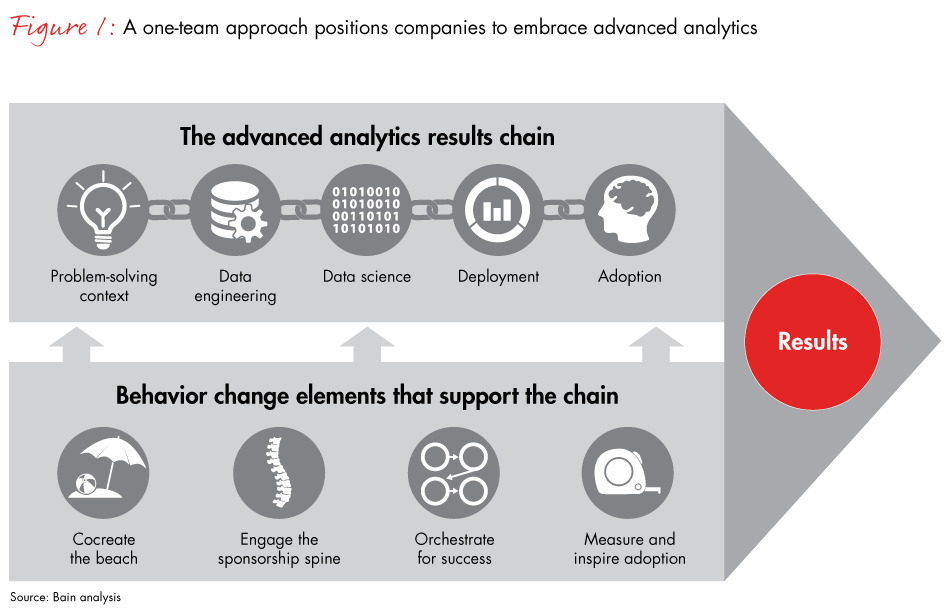
      In our experience, the journey to lasting results with advanced analytics starts with a desire to fix a critical business problem. From there, companies choose their data engineering and data science approaches before moving on to deployment and then adoption.

      However, a company’s advanced analytics efforts will inevitably fall short if a company doesn’t take the necessary steps to change behavior (see Figure 1). This one-team approach brings together stakeholders from all areas of a company to build early support for an advanced analytics initiative. Getting there involves four crucial steps:

      • co-creating “the beach” by bringing employees from different parts of the company together to develop the company’s vision of how it will benefit from advanced analytics;

      • engaging the sponsorship spine by enlisting critical leaders at every level of the company who can help motivate the right behaviors from employees;

      • orchestrating for success so that leaders and employees can anticipate potential challenges; and

      • measuring and inspiring adoption so that companies can change course if necessary.

      The human aspect of advanced analytics can’t be understated—the vast majority of business processes are still governed and carried out by people. In fact, behavior change issues account for the five most common reasons that we see in disappointing advanced analytics initiatives.

      long-mile-fig01_embed

      Reason No. 1: The front line isn’t committed to using data analytics. Perhaps frontline employees weren’t engaged at the start of a company’s forays into advanced analytics, or they don’t see the value of the data. In either case, it’s likely that leaders haven’t communicated the beach—that is, the company’s vision for how frontline employees would get the most from advanced analytics. Swiss Life encountered such doubts when it introduced new analytics tools to help employees increase sales leads. The insurer overcame the naysayers by piloting the effort in an underperforming business unit that used the tool to beat its sales targets. The insurer publicized the victory across the company, which helped recruit support for the effort.

      Reason No. 2: The data science and business teams aren’t communicating. Too often, data science teams dump insights over the transom and let business units make sense of it. That approach rarely works. At leading companies, Agile and cross-functional teams tackle a specific problem, along with input from the employees closest to the issue. Data scientists might report to a central leader who guides companywide analytics efforts, but they immerse themselves in their designated business units, allowing them to stay close to the products and customers they serve. That approach has worked for data leaders Netflix and Airbnb. And when it’s time to share internal analytics developments more broadly, leading companies turn to their best communicators—often their marketing teams—who can convey opportunities with compelling visuals and easy-to-grasp language.

      Reason No. 3: The data solutions aren’t user-friendly. “Black box” or overly academic data solutions—those that rely on opaque, generic back-end technology—seem like an easy way for companies to catch up in the advanced analytics game. But these tools can provide clunky, overly complicated insights that are impossible for employees to deploy at scale. The best systems turn complex data into simple visuals and scores that enable quick action. Think about FICO, which takes a consumer’s complex loan history and calculates a simple measure of creditworthiness that banks have been using to make lending decisions for more than 25 years. The scores are so effective that banks have started to share them with customers, allowing them to take steps to improve their financial health.

      Reason No. 4: The data users are not prepared to change their behavior. Adopting new processes and tools can intimidate even the most seasoned employees. Naturally, companies deploying Big Data solutions need to provide constant training and coaching to not only teach employees how to use new technology but also to understand the decision-making implications at every level of the company. Companies that do it best establish a strong sponsorship spine that can help motivate the right behaviors from employees. Without a sponsorship spine to support deployment and adoption, an insurer’s senior underwriters might feel threatened by tools that calculate predictive scores for lending decisions rather than rely on their expertise. A telecom company that provides detailed customer feedback to call center employees might never reap the benefits of personalized service, a feature that’s quickly becoming a basic service expectation.

      Reason No. 5: A company fails to reinforce and monitor critical behavior changes. Supervisors can provide frontline employees with new tools and data, but real change only takes hold with clear incentives and strong feedback loops that allow users to flag problems to analytics teams early and often. Consider a bank that gives detailed analytics about customer experience trends and cross-selling opportunities to branch managers, who then use that data to improve one measure at the expense of the other. If the bank had made it more appealing for employees to choose new behaviors instead of old and had provided positive reinforcement throughout the process, it might have gained on both fronts.

      Behavior change is often the hardest part of improving a company’s performance on any dimension. It’s the reason why only 12% of change efforts achieve or exceed a company’s expectations and 38% fail by wide margin. Many of the companies making huge investments in advanced analytics will be disappointed to discover that data tools alone aren’t enough to grow a company’s fortunes. However, companies that take a one-team approach to behavior change—by enlisting sponsors, creating their ideal vision, orchestrating for success and measuring progress—set themselves up for transformational results.

      Chris Brahm is a Bain & Company partner who leads the firm’s Global Advanced Analytics practice. Lori Sherer is also a partner with the Advanced Analytics practice. Both are based in San Francisco. Richard Fleming is a partner with Bain & Company in the New York office, and he leads Bain’s Americas Results Delivery® practice. Briana Bennett is a manager on the Advanced Analytics practice in San Francisco.

      Results Delivery® is a registered trademark of Bain & Company, Inc.


      long-mile-fig01_full
      저자
      • Headshot of Chris Brahm
        Chris Brahm
        Alumni, San Francisco
      • Headshot of Lori Sherer
        Lori Sherer
        어드바이저 파트너, San Francisco
      • Headshot of Richard Fleming
        Richard Fleming
        파트너, Sydney
      문의하기
      관련 컨설팅 서비스
      • 어드밴스드 애널리틱스
      • Change Management
      최적의 솔루션 찾기
      • Behavior Change
      어드밴스드 애널리틱스
      Closing the Results Gap in Advanced Analytics: Lessons from the Front Lines

      Six principles can help companies design advanced analytics approaches that lead to action.

      자세히 보기
      성과 개선
      A Smarter Approach to Digital Operations

      Stop tinkering, and focus on the digital trends that really matter.

      자세히 보기
      어드밴스드 애널리틱스
      The Analytics of Sales Time Well Spent

      It's 10 AM. Do you know what your sales reps are doing?

      자세히 보기
      Behavior Change
      Change Management Programs

      Change Management programs are plans that enable companies to implement new processes, systems, and strategies to achieve superior business performance.

      자세히 보기
      Behavior Change
      When a New Organizational Structure Isn’t Enough: How to Truly Live Your Operating Model

      The goal of any organizational redesign is for people to work differently, but that only happens if leaders invest in changing the work itself.

      자세히 보기
      First published in 8월 2017
      태그
      • 어드밴스드 애널리틱스
      • Behavior Change
      • Change Management

      프로젝트 사례

      조직 An Energy Company Maintains Its Cultural Spark amid Multiple Acquisitions

      See more related case studies

      Mobilization Efforts Help a Chemical Company Implement and Sustain 15% Cost Reduction

      See more related case studies

      어드밴스드 애널리틱스 Analytics guide an entertainment company's growth strategy

      See more related case studies

      베인에 궁금하신 점이 있으신가요?

      베인은 주저 없이 변화를 마주할 줄 아는 용감한 리더들과 함께합니다. 그리고, 이들의 담대한 용기는 고객사의 성공으로 이어집니다.

      급변하는 비즈니스 환경에서 살아남기 위한 선도자의 시각. 월간 Bain Insights에서 글로벌 비즈니스의 핵심 이슈를 확인하십시오.

      *개인정보 정책을 읽었으며 그 내용에 동의합니다.

      Privacy Policy를 읽고 동의해주십시오.
      Bain & Company
      문의하기 환경정책 Accessibility 이용약관 개인정보 보호 쿠키 사용 정책 Sitemap Log In

      © 1996-2026 Bain & Company, Inc.

      문의하기

      무엇을 도와드릴까요?

      • 프로젝트 문의
      • 채용 정보
      • 언론
      • 제휴 문의
      • 연사 초청
      오피스 전체보기