

Brief
A consultant friend of ours noticed that his wife was looking annoyed, so he asked her what was wrong. She glared at him. “You’re always on the road,” she said. “You come home tired and jet-lagged. You leave your clothes on the floor and the dishes in the sink. You never walk the dog. And you’re always looking at that stupid little phone. Frankly, I’ve had it up to here.”
The consultant smiled benignly at her. “Thank you for your feedback,” he replied. “I value your opinion very much.”
The story always gets a laugh from corporate audiences. We hope nobody really treats his or her spouse like that. But that’s exactly how many large companies act toward their customers. They ask for feedback, swear how important it is to them and then never do a thing with it. They don’t respond to customer complaints. They don’t take action to change whatever it was the customer didn’t like. Most of the time, they don’t even acknowledge favorable feedback.
There’s a reason for this indifference, of course. Large companies may have millions of customers. They attempt to gather feedback from those masses of buyers in big statistical chunks, usually through long surveys or point-of-sale questionnaires. But they lack the capacity to listen and respond to individual customers, let alone link individual experiences to a specific product, transaction or interaction with the company. Nor are they able to push the feedback to the organization in real time, so that frontline employees can hear it and take actions to correct the problems. All employees see is a statistical summary of what some customers—who knows which ones—were feeling three months ago. The effect creates a huge gap between employees and customers where there should be a personal relationship.
The Net Promoter System® (NPS®) restores that personal relationship. NPS practitioners have created sophisticated systems that enable them to close the loop with customers, bring the comments and criticisms that they get to the front line and use that feedback to continually improve the customer experience. They have learned how to link the feedback to their customer relationship management (CRM) software and their existing operational infrastructure, so that they know what the customers’ experiences actually were. They can also tie it to their financial systems, thus giving executives a crystal-clear picture of the economics of customer loyalty.
At its best, the system creates a large-scale version of the traditional shopkeeper, who knows his customers intimately and intuitively grasps the connection between their experience and his bottom line. Like those shopkeepers, NPS leaders have built listening and responding to customers into their daily business operations.
Let’s consider the systems involved, starting with the simplest.
The survey trigger
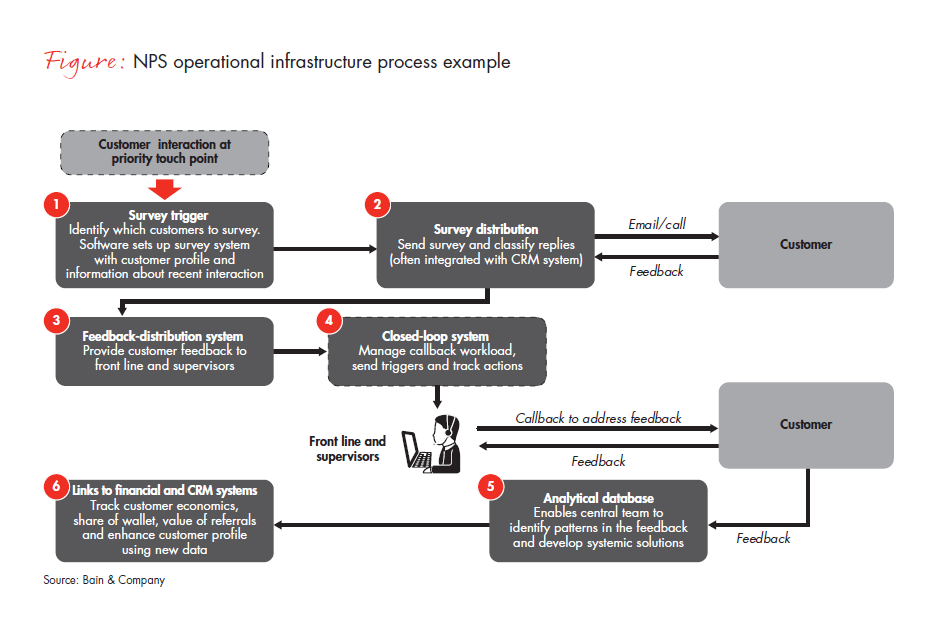
Net Promoter® companies regularly ask a sample of their customers how likely they would be to recommend the company or the product, and what the primary reasons are for their rating. Beforehand, the company must decide which customers, and how many, it wants to survey. Software then identifies customers who fit the criteria and delivers a packet of information to the survey system that includes the customer’s identifying data, along with information about his or her recent interactions with the company.
At The Hartford insurance company, for example, customers who dial in to a contact center are first asked by an interactive voice response system whether they want to participate in a post-call survey. If a customer agrees, an automated survey system calls back after the customer hangs up with the representative and asks a set of five questions that focus on the customer’s likelihood to recommend and the ease of interacting with The Hartford.
The survey system
A second system actually sends out the surveys, typically by email, and then collects and classifies the responses. Most companies try to integrate this system with their CRM software so that customers’ responses are linked directly to their records. For instance, several airlines have CRM systems that know how often you fly each year, how late your last flight was, what type of equipment was used in that flight and so on. The company can correlate all these variables with your and other customers’ feedback and ratings to gain insight into the root causes of delight or dissatisfaction.
In the case of The Hartford, the automated phone survey data is connected to data about the customer, the rep and a recording of the customer’s interaction. Speech analytics of those calls helps managers and frontline employees analyze why a call or set of calls resulted in a particular score.
The information-distribution system
This is the system that provides customer feedback to frontline employees and their supervisors. The “front line” in this context naturally includes salespeople and service reps that spend their days taking actions or making decisions that directly affect customers. It may also include back-office employees such as pricing managers or Web designers, who periodically make decisions that affect customers. Typically, the front line gets three types of data:
- Alert data sent to specific teams or employees. This category includes customer feedback related to interactions with these individuals, along with any requests for action.
- Dashboard data, including Net Promoter Scores and trends. Executives and managers see this information as well. But the closer you get to the front line, the more it focuses on individual groups, short-term results and how a given group affects the trend.
- Intranet data. The company’s intranet might contain customer verbatims, success stories of individual service recovery and information about new policies or procedures designed to address customers’ problems.
At Schwab, for example, each day every branch manager receives the results of client feedback. That information is also rolled up to the regional managers for coaching and pattern recognition across the branches.
The closed-loop system
At the heart of the Net Promoter philosophy is closing the loop, which means following up on feedback from individual customers. If a customer registers a complaint and is willing to accept a callback, a frontline employee or supervisor telephones that person, probes for the nature of the problem, apologizes for the poor experience and offers a solution or recompense when possible. The process requires a separate system to manage that workload. The system distributes the appropriate information to the people responsible for the calls. It triggers a work order, including in that order the information a caller needs for a productive conversation. The system has to accommodate internal feedback as well. If the employee tried to reach the customer and couldn’t, it should trigger another request for contact a day later. If the contact was successful, the system must record whatever the employee learned and allow for follow-up steps.
At The Hartford, both a poor score on an after-call survey and speech analytics of a call that suggest a failed customer interaction trigger an immediate outbound call to that customer. The goal is to learn more about the situation and do something about it.
The closed-loop system also needs the capacity to track everything that happens, so the company can learn from it. The system records what action the company took after talking with the customer, what the impact of the action was and how much the solution cost. It should provide all the information people inside the company need to help them understand exactly what transpired. All this data feeds into the individual and team feedback, and into the information on the dashboard.
The analytic database
The feedback from customers—the ratings and verbatim comments about their experiences—not only goes to the frontline teams that dealt with those customers, it also flows into a database that enables a central team to identify and analyze patterns in the feedback and thus come up with systemic solutions to recurring issues. When Logitech came out with its much-heralded MX 5000 keyboard a few years ago, its Net Promoter surveys came back with many more negative ratings than the company expected. Analysis of the feedback revealed three specific problems: the keyboard’s Bluetooth connectivity wasn’t sufficiently reliable, the LCD screen was hard to read and recharging was difficult. A quick redesign addressed all three problems, and the follow-up keyboard was far more successful than the original model.
Rob Markey, global practice leader of Bain's Customer Strategy & Marketing practice, explains how in this short video.
Links to the financial and CRM systems
The data provided by the customer feedback allows a company to enhance both its financial and its CRM system. For example, it can now link customers’ experiences to differences in their lifetime value, in share of wallet and so on. It can track the differing economics of promoters, passives and detractors, and enable a company to calculate the value of moving a customer from one category to another. If the initial survey includes a question about how the customer first heard of the company or the product, the system allows the company to track the value of referrals over time. The system can also help marry those usually separate functions, sales and service. At the Australian bank Westpac, for example, the CRM system highlights potential offers—everything from a specific product opportunity to activating e-statements or gathering missing contact details—for individual customers. Call-center bankers who act on these offers find that over half of their callers accept them and that on average the NPS for these customer interactions is 10 points higher than interactions in which they do not make an offer.
The connections between these systems will differ from one company to another (see figure). But nearly every company will need to gauge whether its IT systems are up to all these challenges. If a company doesn’t already have the ability to identify and interact with customers in a productive manner, an attempt to implement a Net Promoter System will quickly reveal the gap. It is likely to force the company to rethink the information it keeps about customers and how accessible and useful that information is. Companies that already keep in close touch with customers have an advantage here. Some find that they can add the necessary NPS capabilities by using software-as-a-service vendors (see below). Others upgrade their own IT capabilities. At Rackspace, for example—a provider of cloud-computing and managed hosting—managers saw that the alert system should identify not just survey respondents who jumped a category, say, from passive to promoter, which might represent no more than a one-point improvement. It should also flag respondents who had changed their score by two or more points, up or down. The new alerts enabled teams to catch quick signals from customers about improvements and declines in relationship status, to probe for root causes and to take appropriate action.
Managing the systems
Responsibility for developing and managing all these systems typically falls to a central project team, which some companies call the customer advocacy office. Whatever it may be called, the central team has a wide variety of functions. For instance, it determines which systems to develop inhouse and which to outsource, and it selects vendors for the latter. It works with IT to prioritize and integrate the systems and it helps people in the organization learn to use them. It plays a key role in setting goals for Net Promoter Scores—by geography, by customer segment, by product category and so on—and cascading them throughout the organization. It determines the priorities for initiatives to improve the customer experience, and it allocates resources accordingly. A team may not seem like infrastructure, but it is every bit as essential as any information system.
To shopkeepers who look their customers in the eye every day, the systems and people that make up the operational infrastructure of a Net Promoter System would seem pretty extensive. And they are: Re-creating the same customer intimacy that an individual shopkeeper can provide isn’t a simple task for a large organization with specialized functions and operations and customers all over the world.
But the Net Promoter System makes it possible for employees to know and care about each customer and to see the impact that their behavior has on the customer, much as the shopkeeper does. Achieving this sort of intimacy—this human level of relationship—at such a scale requires a system that is supported by a robust operational infrastructure.
Fred Reichheld and Rob Markey are authors of the best-seller The Ultimate Question 2.0: How Net Promoter Companies Thrive in a Customer-Driven World. Markey is a partner and director in Bain & Company’s New York office and leads the firm’s Global Customer Strategy and Marketing practice. Reichheld is a Fellow at Bain & Company. He is the best-selling author of three other books on loyalty, published by Harvard Business Review Press, including The Loyalty Effect, Loyalty Rules! and The Ultimate Question, as well as numerous articles published in Harvard Business Review.
You don’t have to build it alone
Building a Net Promoter System is a serious commitment. But you don’t have to go it alone. A host of vendors offer the systems and services companies need to build and support their Net Promoter Systems, including:
Customer experience management/Customer relationship management solutions
These integrated business and operational support systems help companies understand and manage the customer experience. The systems fall into two broad categories:
- Software as a service (SaaS)
- CRM systems
Market research firms
These firms collect and report information about the experiences and opinions of a company’s customers.
Specialized service providers
A variety of firms exist to provide services for specific aspects of the data collection, analysis and reporting process, including:
- Phone research agencies
- Statistics and data mining
- Text analytics
For an updated list of vendors and links to their websites, go to: http://www.netpromotersystem.com/resources/vendors.aspx
For more information, please visit www.netpromotersystem.com
Net Promoter® and NPS® are registered trademarks of Bain & Company, Inc., Fred Reichheld and Satmetrix Systems, Inc.
Net Promoter SystemSM is a trademark of Bain & Company, Fred Reichheld and Satmetrix Systems, Inc.
First published in maio 2013