

Brief
Barely a decade after digitized content challenged the reign of physical formats, a third wave of media formats and business models is taking center stage. Until recently, most digital media models tried to replicate the physical forms they replaced: e-books, downloadable music and movies, linear video games. The new wave of native digital content breaks free from those formats. Long-form media downloads and sell-through models, inherited from the constraints of physical distribution, are giving way to unbundled, long- and short-form content, streamed at will and paid for through subscriptions, micro-transactions or advanced advertising solutions.
Bain & Company’s annual survey of more than 7,000 consumers in Europe, the US and the BRICS countries gives a clear picture of the audience for this third wave of media: a new segment of content consumers, mostly under 25 but also some who are older and prefer digital media. Combined, these digital-savvy consumers already outnumber analog diehards, and content formats and business models created for them are quickly gaining momentum. That momentum is generating much interest (and investment) even though the profitability of these new models remains sporadic.
As in other consumer industries, much of the growth and value in this third wave will hinge on the media industry’s ability to capture the next billion audience members, mostly in emerging markets. Media executives will need a global perspective, a local playbook and the ability to develop innovative business models.
To succeed, they need to focus their efforts in three areas:
- Invest in native digital formats. Innovate in third-wave media, tap into high-growth models and gather data to inform content creation and monetization.
- Rethink the monetization playbook. Go beyond the traditional choice between consumer-pay and advertising to develop a more nuanced palette of audience monetization options.
- Strengthen the alliance between content and communications networks. Set the right balance for content publishers, platforms and telcos to invest in and profit from the content experiences consumers will value.
The end of the beginning
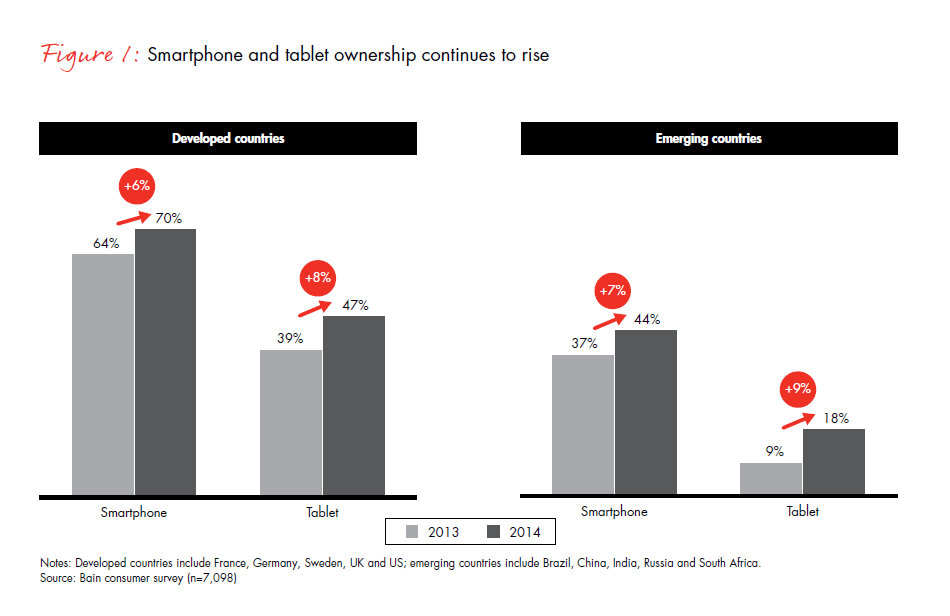
Affordable mobile devices have spurred a revolution in media that shows few signs of abating (see Figure 1). In developed countries, 70% of consumers own smartphones and 47% have tablets. Those numbers are higher for younger consumers: 84% of 15- to 18-year-olds own a smartphone. Meanwhile 58% of those in Brazil and Russia and 36% in China and India said they owned at least one smartphone.
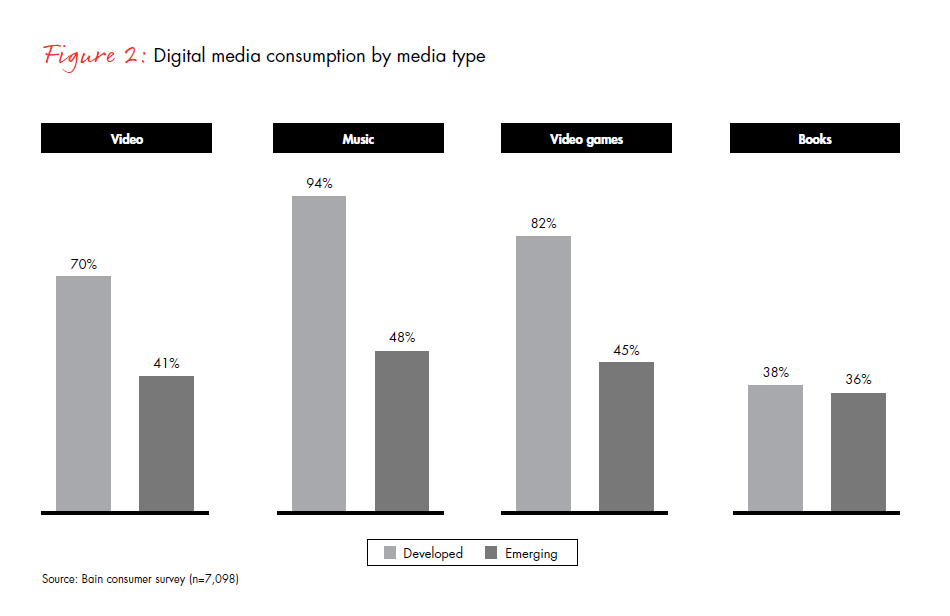
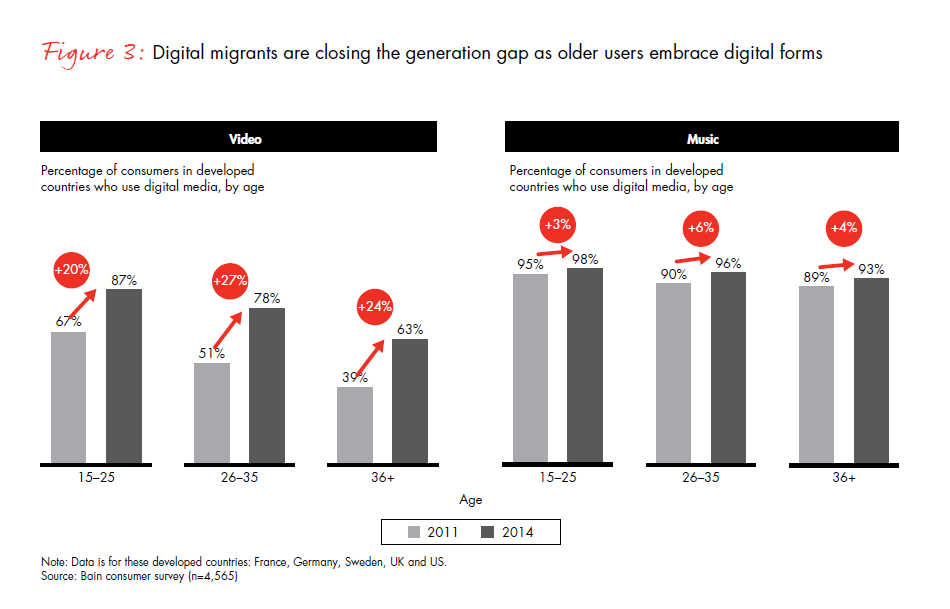
All of these devices, connected on ever-faster communication networks, are changing the way people consume media (see Figure 2). In developed economies, 63% of adults over 35 watch video online, 93% listen to digital music and 34% read e-books. The percentages for younger consumers are higher: 87% of consumers between 15 and 25 watch video online, 98% listen to digital music and 46% read e-books. Digital content consumption is now firmly entrenched across age groups.
Millennials—some of whom have barely experienced physical media—are at the forefront of the digital revolution. In our survey, 20% of people 15 to 18 in western markets said they never use traditional media to watch videos, three times more than for respondents over 35.
Our survey showed other differences between these digital natives and older consumers. Younger consumers rely more on social networks to select media content: more than two-thirds of those aged 15 to 25 in developed countries said they choose video, music and books based on social recommendations, compared with less than half of those over 35. Younger consumers also have a different take on data privacy, being more willing to give up a little data privacy in exchange for better recommendations.
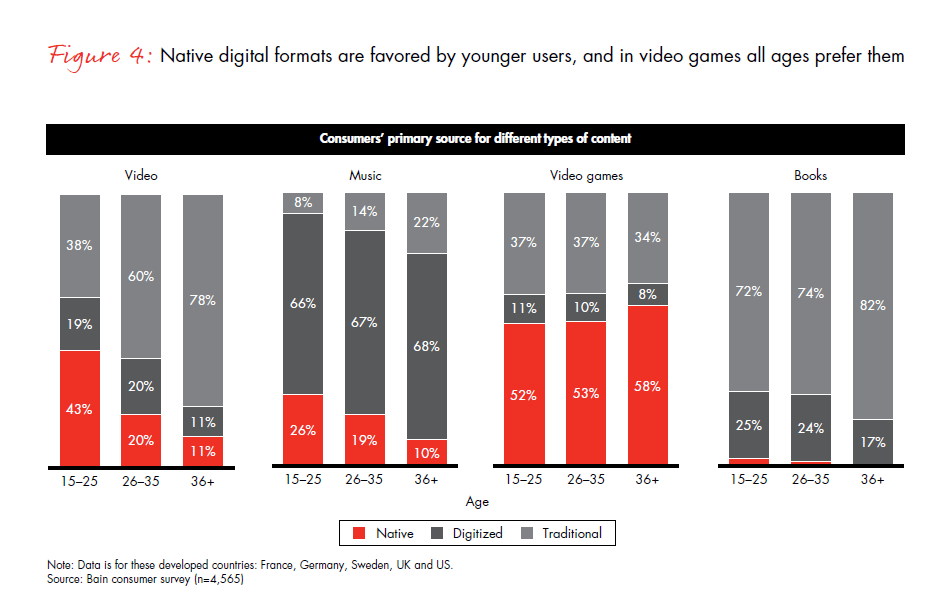
Still, age alone is too narrow a way to segment the next generation of content consumers. People younger than 36 may consume more content digitally, but those aged 36 and older are following quickly, closing the gap on video, music and games (see Figure 3). In our view, this marks the advent of Generation #hashtag—a new generation of content consumers that cuts across ages, combining the digital natives that live and breathe the social media they were born with, and the over-25 migrants that have already embraced digital media as their primary source for content (see Figure 4).
Native digital formats on the rise
As digital became the dominant mode of media delivery, it mostly mimicked the physical forms it displaced. Content creation remained in the hands of powerful companies: movie studios, major music labels, AAA game developers and book publishers. And the business model was based on consumers buying and owning their media—just as they had bought and owned physical forms.
Native digital models reconfigure the media playbook for a fully digital world. Start-ups use always-on networks, social media, user-generated content and crowdsourcing to create content that appeals to Generation #hashtag. Holding no analog legacy, they are changing the rules of content creation, distribution and monetization.
Many of these start-ups have already acquired sizeable user bases and market clout. Spotify signed up more than 40 million users for its unlimited music service in only six years. Twitch, a video-streaming website for gamers launched in 2011 and acquired by Amazon this year, already attracts 45 million unique viewers per month. Supercell, a developer of socially-oriented casual video games, grossed close to a billion dollars in 2013, its third year of existence. King, the maker of smash hit casual game Candy Crush Saga, went from 100 million monthly unique users to 350 million in one year.
These and other players are fast turning music, video and gaming into native digital ecosystems (see Figure 5). Even in books, which have struggled to move from a depressed physical distribution network, some genres such as educational or children’s books are beginning to combine text, video, music and interactivity in interesting ways. Amazon is experimenting with short-form e-books like Kindle Singles, which resemble short stories or lengthy magazine essays but are sold separately for a few dollars each.
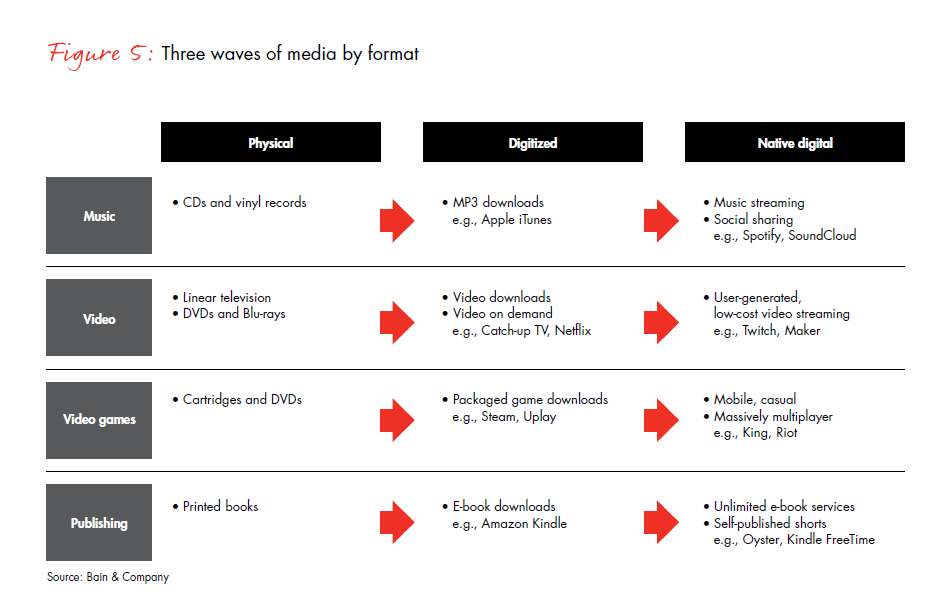
Games may be the furthest along, as shown by the success of short-form games developed for smartphone screens, such as Angry Birds. While the video and music industries still focus mostly on producing traditional content, some design is adapting and evolving to fit the needs of native digital media. SoundCloud, for example, offers a platform for musicians to share sounds or bits of music as a prompt for creativity among its wide user base.
Sporadic profitability
But for all the bang, many digital native disruptors have yet to produce a buck. To date, the value creation from natively digital models has varied widely by category. In music, where the industry is transitioning from digital downloads to streaming services, Spotify is investing to build scale faster than its rivals and encourage listeners to switch from its free, ad-supported service to a paid subscription-based product. As a result, its revenue more than doubled from $253 million in 2011 to $576 million in 2012, but its losses also increased from $60 million to $77 million. In video, Netflix, which pioneered subscription- based video on demand, has aggressively grown its user base, expanded its geographic footprint and invested in original programming as it invests to differentiate itself from the slew of new over-the-top competitors. This has reduced its EBIT margin from double-digits in 2009 to 2011, to 5.2% in 2013. Investors, who appear to be satisfied with its 27% growth rate between 2009 and 2013, lifted the value of its shares tenfold over the same period, in hopes that margin expansion will follow top-line growth.
By contrast, some third-wave video game publishers have already achieved spectacular profitability. Candy Crush Saga maker King saw a more than tenfold revenue increase in 2013, as sales skyrocketed to $1.88 billion from $164 million in 2012. Supercell, the maker of Clash of Clans, achieved an EBITDA margin of 52% in 2013 while increasing sales ninefold in that year.

Generation #hashtag: Native digital content is on the rise
A new wave of content for the Age of Digital Natives.
For game makers, the problem is the opposite of subscription services like Netflix and Spotify: profitability soars on popularity of a new game, but growth is dangerously fickle. Former gaming superstar Zynga saw its revenue drop by 32% in 2013 as interest in Farmville withered and other launches disappointed. Angry Birds maker Rovio Entertainment may suffer the same fate: growth stalled in 2013, forcing it to slash its net margin in half while investing in new content.
Cracking the puzzle of monetization for digital media remains a big challenge. Since many models prioritize share over revenue, consumers get used to paying little or nothing for content. Some of these consumers wind up generating more value through advertising or micro-transactions (such as in-game purchases). But the model leaves some investors understandably nervous.
Growth from emerging markets
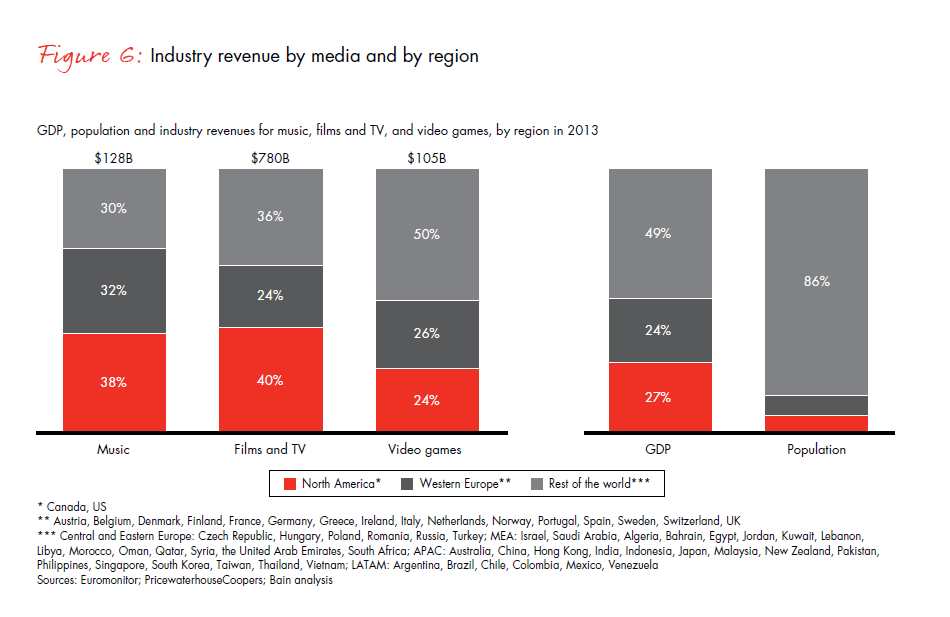
Media markets today are highly concentrated in developed economies: Western Europe, North America and Japan still accounted for 70% of the music and video industry revenues in 2013. But opportunities are growing in the emerging markets. Over the past year, smartphone ownership rose rapidly in China (45% to 50%), India (14% to 21%), Brazil (45% to 54%) and Russia (45% to 63%). One in four respondents in China said they own a tablet, and more than one in five own one in Russia and Brazil. Youthful demographics combined with improving access to connected devices is spurring rapid growth of Generation #hashtag across emerging countries.
This will create some great opportunities for media companies. Many will be able to skip the legacy phases of physical and digital distribution and go straight to native digital content—leaving the economic downside of piracy behind. Freemium models, with their free entry and paid upgrades, could help early movers capture a large user base and then monetize the growing sliver of the population able to afford premium service. And the data collected as they serve these customers will also generate new value for advertisers and others who want to reach the next billion consumers.
Riding the third wave
To make the most of these new opportunities in emerging and developed markets, media companies will need to focus their initiatives in three areas.
Invest in native digital formats. Hit casual games 2048 and Flappy Bird were each created in a few days by single developers, and many YouTube stars reached global fame with little more infrastructure than a webcam and a dorm room. These successes make it look easy, but few large media companies know how to operate in an environment of thin margins, community orientation and trial-and-error productions. They will need to learn to balance investments in big, heavy-hitting franchises with a longer tail of small, innovative projects that take new forms and rely more on crowdsourced ideas.
Acquisitions are one way to enter the fray. Disney bought Maker Studios not only to gain access to its 380 million subscribers but also to pick up expertise in the algorithms that draw native digital audiences. Another way is to play at both ends of the spectrum: Epic Games is both the main middleware vendor supplying the software engines that power AAA games from traditional publishers, while it also crowdsources the next version of Unreal Tournament, one of its marquee franchises.
Rethink the monetization playbook. For media companies used to richer spoils, the revenue model around Generation #hashtag may look unattractive. Freemium models dominate, and even subscriptions, where they exist, are low—such as Netflix’s $8.99 monthly fee for streaming. But as the pool of consumers continues to grow in developed and emerging markets, advertisers’ interests will follow.
Another revenue model taps the inherent data richness of native digital content to build up large data stashes, which have value on the B2B market—a model that players such as Facebook and LinkedIn have already demonstrated successfully. Monetization opportunities based on data could prove essential in countries where consumers have less money to spend on media, further balancing the industry’s delicate equilibrium between consumer-pay models and advertising.
In a global, data-driven market in which consumers from different regions will vary in their willingness and ability to pay for media, the choice between advertising and consumer-pay may become more tactical than strategic. Increasingly, media companies will not just make “either/or” strategic choices about whether to offer paid or freemium services, but will juggle hybrid business models in parallel, making tactical choices about which offer is right for each consumer segment they serve in a market. The agility to navigate this evolution will become a prerequisite for survival in the native digital era.
Strengthen the alliance between content and communications networks. High-quality, third-wave video, games and music will require new investments in networks. Already in the US, streaming video on Netflix makes up about one third of downstream traffic during peak evening hours, straining the capacity of telco pipes in spite of network upgrades, rollouts of fiber and 4G mobile technologies. The introduction of 4K video will place even greater requirements on the network to deliver on high-quality video experiences.
The debate over net neutrality—that is, whether telecommunication carriers can deliver differential access and speed to various providers based on the amount they pay or other criteria—is critical to the future of both industries. Telco and media executives must work together with regulators to strike the balance between excessive regulation that could dampen telcos’ incentives to support the content ecosystem, and too little regulation that results in a system where incumbents with scale may have the ability to crush diversity and consumer-friendliness of new start-ups.
Already, relationships are tense between video streaming services and telcos in the US and in Europe. However, we also see some examples of successful collaborations as mobile telecom operators discover the positive impact of over-the-top app usage, including streaming media, on their revenue and churn. Commercial arrangements between over-the-top content providers and telecom operators are becoming more widespread—either by setting up dedicated apps directly into set-top boxes and handsets or excluding their data consumption from contractual data caps. In France, telecom leader Orange invested in music streaming service Deezer in a deal aimed at boosting Orange’s share of the home market while also differentiating Deezer’s service in a highly competitive market.
Governments also play a key role in these discussions, including but not limited to authority over competition laws. In France, the audiovisual regulation authority (Conseil supérieur de l’audiovisuel, or CSA) recently suggested that digital platforms could receive differentiated access to bandwidth in exchange for a measurable commitment to invest in locally produced content.
Against this heated debate, our survey indicates that more than 46% of respondents in developed economies are open to some form of differentiated network access. We found that 31% were willing to pay more to get guaranteed high speed access and, conversely, 23% were willing to sacrifice the quality of their content experience if they could pay less.
An industry transformation
As in most industries, the growth in media is centered in the developing markets rather than in mature economies of Europe and North America (see Figure 6). Unlike many of those other industries, however, the form of media products is shifting so rapidly that to tap that growth, media companies must learn not only how to play in new markets but how to develop and publish an entirely new wave of formats—the native digital forms favored by consumers too young to remember life before the Internet. The future success of media companies will depend on how well executives and creators learn to understand these consumers and embrace their preferences.
Such a dramatic change will require transformations at every level of the industry, from the way it is regulated to the way companies create and distribute content. Business models are changing, too. As a larger share of the world’s media consumption shifts to developing markets where consumers have less money to spend on music, video and other formats, media companies will need to look beyond their traditional advertising and consumer payment models to new opportunities that make better use of the data captured in digital transactions. They will also need to form new partnerships across the media, telecom and technology industries— sometimes with competitors—to ensure that the playing field remains open enough to allow innovation while regulated enough to ensure that the climate remains attractive to new investment.
Laurent Colombani is a partner at the Paris office of Bain & Company, where he manages the firm’s European Media practice. David Sanderson is a director at Bain’s Los Angeles office, where he leads the firm’s Global Media practice. François Videlaine is a principal at Bain’s Paris office.
First published in novembro 2014