

Bain Classic | Brief

It’s no secret that digital technology has transformed the business landscape in ways few could have anticipated even five short years ago. What’s new is that the technologies and solutions that once seemed far-fetched are rapidly becoming table stakes in most industries.
Data, analytics and connectivity are reshaping every sector of the global economy. Amazon and Alibaba have set the pace in retail, largely without owning stores. Airbnb is one of the highest growth brands in hospitality despite the fact that it neither owns property nor operates hotels. Business and retail customers alike have come to expect a smooth, omnichannel buying experience whether they are purchasing a pair of socks or a million-dollar piece of construction equipment. Even the most traditional companies are finding ways to transform their competitiveness by reinventing back-office processes, speeding up supply chains and reimagining service offerings. The most advanced of these we refer to as digital forerunners—the companies that combine the scale advantages of incumbents with the speed and agility of native digital businesses.
What’s at stake, of course, is industry leadership. The companies that can increase their digital fluency and create value throughout the enterprise are increasingly coming to dominate most markets. And because so many digital offerings and business models also create network effects that amplify the advantages of scale, it is especially critical not to be left behind.
Elizabeth Spaulding, a partner in the Digital practice, talks about the five key characteristics of companies that set the pace in digital transformations.
Most executive teams understand this. They recognize the power of technology to change the rules of engagement in their industry. Yet many are unsure where to begin and become overwhelmed by the seemingly endless set of investment options. In our experience, the relative few companies that are setting the pace in digital transformation push past this moment of indecision and dive in, confident that they will gain a deeper understanding of their customers’ needs and use it to develop innovative, elegant solutions. These digital forerunners are transforming themselves in a wide variety of ways. The best, though, share five key characteristics:
1. The vision to disrupt, not be disrupted
Digital forerunners develop a compelling vision for how to lead the disruption that digital technology creates, not follow it. These companies place the digital imperative at the top of the C-suite agenda and define both a clear point of arrival for the strategy and an equally clear set of steps for getting there. They empower the entire organization to learn what customers want and then digitize to deliver—even if that involves taking substantial risks. They also view the effort holistically, choreographing and coordinating digital solutions across the value chain so they work together to improve products and services.

Interactive: How Will Digital Disruption Affect Your Industry?
Explore how digital technology has changed the way companies run their businesses and operations.
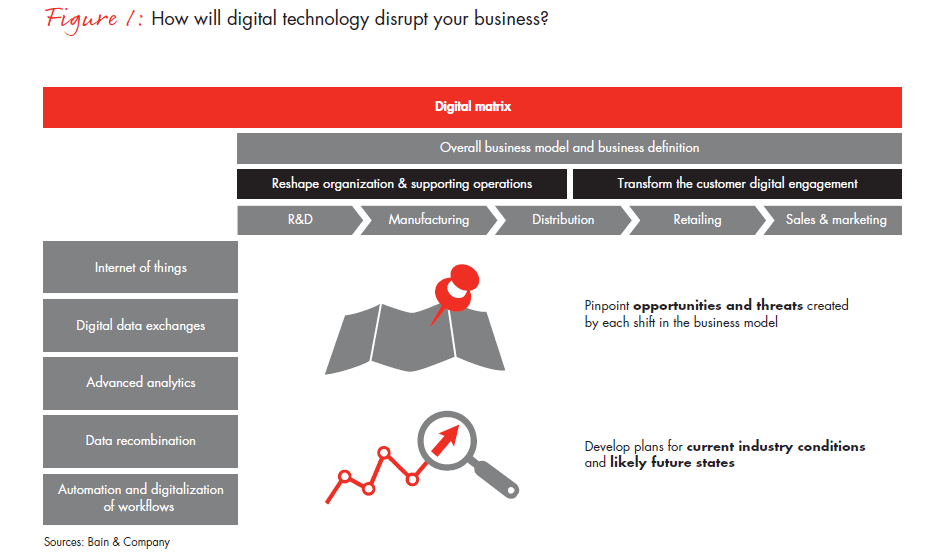
Diagnosing where you are on the digital spectrum involves plotting your company’s position on what we call the digital matrix (see Figure 1). By laying out the most pervasive categories of potential disruption—Internet of Things, Big Data, massive computing power and so on—the matrix helps a company determine where these changes may produce opportunity along specific links in its value chain. Nordstrom, for instance, has made a critical set of investments based on its assessment of what was most likely to disrupt its department store model. HauteLook, Nordstrom’s entry into the off-price, flash-sales arena, allows the company to compete more effectively for millennial customers against rivals like Rue La La. Buying Trunk Club gave Nordstrom the ability to offer men (and more recently, women) a mobile and online experience in which a personal stylist finds them clothing based on their individual size, style and price preferences. Nordstrom has also invested heavily to improve customer touchpoints in its stores and online. And on the back end it has beefed up technology to tie its inventory systems together as it builds its omnichannel offering.
2. A commitment to understand customers and take action
Companies have struggled for decades to understand what their customers really want and how those requirements change over time. But digital forerunners are solving that problem by harnessing Big Data and developing a dynamic “smart view” of their customers. Gathering data is no longer the issue; companies are inundated with it. The challenge is to capture disparate streams of data flowing from various sales channels or customer touchpoints and bring them together to create a single, integrated view of each customer. It is also critical to develop closed-feedback loops that allow the company to monitor and adjust in a continuous cycle as customer preferences evolve.
By deploying advanced analytics, companies are already able to better understand customers’ needs, anticipate what they might want next and provide them with real-time personalized responses. AB InBev, for instance, has created what it calls Bud Lab, an analytics center at the University of Illinois Research Park that uses data to tailor assortments at retail, analyze social media and market trends, and undertake other large-scale data initiatives. The idea is to gain a deeper understanding of what really matters to the company’s target customers.
A key goal of digital customer engagement is to move away from the traditional one-to-many marketing model and create opportunities for a more compelling one-to-one dialogue. That means providing a more individualized, deliberate experience in which each customer becomes an important partner in the value-creation process by providing direct and contextual feedback. Sephora is a good example here. The beauty retailer’s brand-building advertising is ubiquitous across the media spectrum. But increasingly, it interacts directly with customers through a set of proprietary social platforms, such as its online forum, BeautyTalk, and a Pinterest- like photo-sharing service called the Beauty Board, which links back to Sephora.com.
3. An integrated customer experience
Sephora has also worked hard to develop another hallmark characteristic of a digital forerunner: It has used digital technology to create a seamless omnichannel customer experience. Sephora’s mobile apps, for instance, allow customers to scan a tube of lipstick, read reviews about it and perform other prepurchase research in the store or online. The Sephora Beauty Insider loyalty program makes it easy to carry a shopping list across channels and reference past purchases when it’s time for a refill or replacement. In stores, customers can scan a QR code on a holiday poster and send a gift directly to a chosen recipient. When it’s time to check out, the transaction is as easy as a swipe on a sales associate’s iPod touch.
Increasingly, customers want to connect with a company through a fluid ecosystem that reduces friction at every touchpoint. They perceive value in a host of intangibles—Is it making my life easier? Can I get it right now? Will it integrate with a product I already have? Digital forerunners strive to first understand what customers really care about and then create an integrated strategy to use the right mix of physical and digital assets to deliver the most relevant, convenient and differentiated customer experience possible.
4. Speed and innovation
In many ways, digital forerunners look a lot like startups when it comes to innovation. Leadership is committed to encouraging a culture of experimentation that rewards calculated risk-taking. These companies learn to embrace failure; they use rapid prototyping and small-scale trials to learn quickly and iterate toward the right solution. They develop tight feedback loops enabled by advanced analytics to test, learn and test again.
Auto insurer Progressive, for instance, has long used superior actuarial analytics to outprice rivals without taking on more risk. But it also conducts thousands of trials a year across all its customer-facing operations to systematically tweak its products and services, improve delivery channels and hone its creative design. It has a cross-functional “experimental group” composed of more than 200 people with customer-facing, product development and analytic skills, who constantly test variations on standard product offerings. The goal is to use analytics to innovate more quickly and speed up response.
5. Capabilities that cross over traditional boundaries
Dialing up customer responsiveness and speeding innovation through digital technology often requires organizational realignment. Digital forerunners break down silos and increase communication between functions by restructuring roles and reimagining how teams interact. That often requires empowering a senior leader to direct traffic and assemble the resources to guide the digital transformation. If there are clear capability gaps, the company fills them quickly, either by investing in-house or finding the right external partner.
When Australia’s Commonwealth Bank set out to build a world-class customer experience through digital technology and analytics, it recognized early on that its traditional corporate structure was slowing things down. So it formally restructured the organization to elevate the role of IT and put it alongside banking operations under one senior executive, blending many aspects of the two functions and making it easier to work together. One result: Commonwealth customers can now apply for a mortgage online in 15 minutes and get a response in 60 seconds. The same request used to take two or three weeks.
Understanding these five characteristics should help demystify the challenge posed by the onslaught of digital technology. The hurdles for deciding which digital products, services or capabilities to pursue are really no different than the hurdles for any other product, service or capability. Leaders continually ask themselves: Where will digital technology have the greatest impact on our value chain and how can we invest proactively to get ahead of the curve? How can we use technology to better understand our customers and deliver what they want? Is leadership aligned and committed to the vision? Have we engaged the front line to both design and embed our digital strategy?
Digital forerunners are guided by these questions, but they don’t always wait for definitive answers. The key is to get started now, learn along the way and adjust to what an ever-changing market is telling you.
Elizabeth Spaulding is a Bain & Company partner and leads the firm’s Global Digital practice. Sarah Dey Burton is a senior director of Bain’s Global Customer Strategy & Marketing practice. Greg Caimi is a partner and leads Bain’s Digital practice in the Americas. All are based in San Francisco.
First published in 12월 2015